Hiring developers in 2026 is tough, especially if your offers don’t align with developer goals and market trends. Here’s what you need to know:
- AI/ML Engineers are in high demand: Salaries for AI/ML experts are up 9.2% year-over-year, with top-tier professionals earning $280,000–$400,000 annually.
- Generalist roles are declining: Software engineering job postings dropped 49%, but AI/ML listings surged by 59%.
- Pay transparency matters: Listings with salary ranges get 3x more applications and fill 40% faster.
- Regional salary differences: U.S. developers earn a median of $133,080, but salaries in San Francisco and New York can be 1.55x and 1.42x higher.
- Specialized skills pay more: Rust developers average $185,000, while AI/ML engineers lead with $238,000 for senior roles.
- Equity and bonuses matter: For senior roles, equity and signing bonuses often outweigh base salary increases.
To secure top talent, recruiters need to offer competitive, transparent compensation and focus on specialized skills. Delays or outdated benchmarks could cost you the best candidates. Beyond the initial offer, retaining top engineering talent requires a long-term strategy focused on culture and growth.
The 2026 Developer Compensation Landscape
Market Trends and Inflation Adjustments
The developer job market in 2026 is showing some dramatic shifts compared to recent years. Following the salary compression seen in 2024 and 2025, base salaries are starting to bounce back - but not consistently across all roles or locations. Early 2026 offers are trending 6–9% higher than late 2025 levels , though this recovery isn't evenly distributed.
The landscape is further complicated by mixed indicators. On one hand, Q1 2026 recorded 52,050 tech layoffs, marking a 40% increase compared to the previous year. On the other hand, U.S. tech job listings reached 537,000 in March 2026, an 8.9% rise . This highlights a dual trend: companies are reducing generalist roles while fiercely competing for specialized talent.
Entry-level developers are feeling the brunt of these changes. Job postings for junior roles have dropped by about 40% compared to pre-2022 levels , as AI tools increasingly handle routine tasks. Meanwhile, senior-level individual contributors are in short supply, with a 40% greater shortage than in 2025 . These dynamics set the stage for a closer look at how compensation is evolving for specialized roles.
The Pay Premium for AI and Specialized Skills
Specialized skills are now the key to commanding higher salaries, and AI expertise is leading the charge. Fluency in AI tools like Cursor or Claude has become a baseline expectation, and engineers who effectively leverage these tools are earning significantly more.
"AI is not destroying software jobs. It is rewriting the eligibility criteria." - Bhavya Mehta, Co-Founder & CEO, Cadence
AI and machine learning (ML) roles now offer 30–50% higher pay than similar non-AI positions . Senior AI engineers are earning base salaries of $206,000 in 2026 , with total compensation for top-tier AI/ML professionals reaching $400,000 or more .
Other specialized roles are also seeing strong growth. For example, Rust developers are averaging $185,000 annually, an 8% increase from the previous year. Senior cybersecurity engineers are earning around $158,000, reflecting a 23.4% jump over the past two years . Here's a breakdown of salary growth for high-demand roles:
| Role | 2026 Median Salary | 2-Year Growth |
|---|---|---|
| AI / ML Engineer | $215,000 | +30.3% |
| AI Product Manager | $182,000 | +28.2% |
| Data Engineer | $148,000 | +25.4% |
| Cybersecurity Engineer | $158,000 | +23.4% |
| Prompt Engineer | $115,000 | +21.1% |
For recruiters, these updated salary benchmarks are essential for crafting competitive offers. Relying on outdated, generalist salary data could lead to missed opportunities in hiring top talent .
Developer Salary Ranges by Role and Region
Salary Ranges for Core Developer Roles
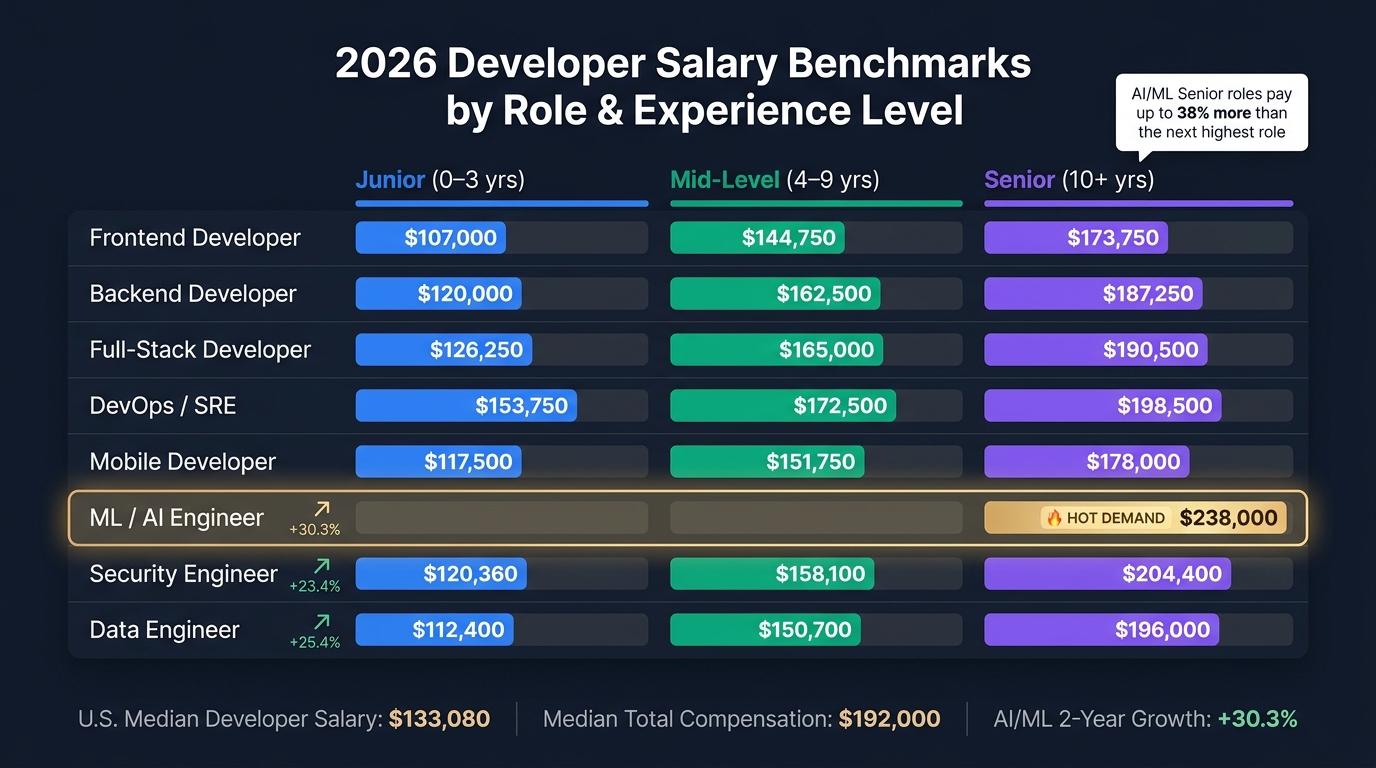
Base salary is just the starting point for evaluating compensation, but it's a critical piece of the puzzle. Here's a breakdown of 2026 U.S. median base salaries for common developer roles, sorted by experience level:
| Developer Role | Junior (0–3 yrs) | Mid-Level (4–9 yrs) | Senior (10+ yrs) |
|---|---|---|---|
| Frontend Developer | $107,000 | $144,750 | $173,750 |
| Backend Developer | $120,000 | $162,500 | $187,250 |
| Full-Stack Developer | $126,250 | $165,000 | $190,500 |
| DevOps / SRE | $153,750 | $172,500 | $198,500 |
| Mobile Developer | $117,500 | $151,750 | $178,000 |
| ML / AI Engineer | $136,620 | $180,900 | $238,000 |
| Security Engineer | $120,360 | $158,100 | $204,400 |
| Data Engineer | $112,400 | $150,700 | $196,000 |
Interestingly, junior DevOps engineers tend to start with higher salaries compared to entry-level roles like frontend or mobile developers. On the senior end, roles in machine learning (ML) and artificial intelligence (AI) lead the pack, reflecting the growing demand for specialized technical expertise.
At top-tier companies like FAANG, senior software engineers can command base salaries of $195,000, with total compensation packages climbing to $355,000 . These figures highlight how competitive the market can be, especially when companies aim to attract talent already working at high-paying firms.
On a national level, the median U.S. salary for developers is $133,080, but tech-focused companies often offer median total compensation of $192,000 to stay competitive . This gap underscores how important it is for recruiters to benchmark offers carefully against industry standards.
How Pay Differs by Region
Geography adds another layer to the salary equation. In markets like San Francisco and New York, developers see significant pay boosts, with multipliers of 1.55x and 1.42x over the national median, respectively. Even secondary markets such as Austin offer competitive rates, with a multiplier of 1.12x .
Meanwhile, Europe is catching up. Developer salaries across the continent rose by 15% in 2026, compared to just 5% growth in the U.S. . Here’s a snapshot of senior base salary ranges by region:
| Region | Senior Base Salary Range | % of U.S. Rate |
|---|---|---|
| United States | $145,000–$180,000 | 100% |
| United Kingdom | ~$105,000 (£70k–£95k) | 60% |
| Germany | ~$95,000 (€70k–€95k) | 54% |
| Eastern Europe | $50,000–$90,000 | 29% |
| Latin America | $40,000–$45,000 | 23% |
| India | ~$30,000 | 17% |
For remote roles, pay has largely stabilized at 70–90% of U.S. office-based rates for equivalent positions . This marks a shift from earlier practices when remote salaries were often tied to local cost of living. Today, many forward-thinking employers are moving away from that model to remain competitive.
"The mistake is comparing your base salary to a levels.fyi total-comp number and concluding you're underpaid - you might just be comparing two different rulers." - Articuler Editorial
It's also worth noting that the total cost of employment - including benefits, payroll taxes, equipment, and administrative overhead - typically runs 1.5x to 1.8x the base salary in the U.S. . For instance, a $160,000 base salary can translate into an annual cost of $240,000 to $288,000 for the employer. This is a crucial consideration when using a tech hiring budget calculator to plan with hiring managers.
What Goes Into a Total Compensation Package
While base salary is often the starting point in negotiations, it’s rarely the factor that seals the deal. For context, the national median base salary for U.S. developers is $133,080, yet the median total compensation climbs to $192,000 . Bridging this gap requires recruiters to build enticing packages that go well beyond just the paycheck. To accurately forecast these expenses, recruiters can use a hiring budget calculator to model total costs.
Equity, RSUs, and Signing Bonuses
For senior, staff, and principal engineers, equity often plays the starring role. As one industry benchmark highlights:
"Base salary barely moves between senior and staff - the raise is almost entirely equity and bonus." - Articuler
At public tech companies, liquid RSUs (Restricted Stock Units) can significantly boost total compensation, often reaching 2–3× the base salary. For instance, staff engineers (L6) frequently earn $400,000–$500,000 in total compensation, while principal engineers (L7) can surpass $600,000 .
In venture-backed startups, equity typically makes up 15–25% of total compensation for senior roles . However, this equity is illiquid, meaning its value depends on a future exit event like an IPO or acquisition.
Signing bonuses, on the other hand, provide an immediate cash boost without adding long-term costs. They’re particularly effective for candidates with unvested equity at their current job. For startups with tighter budgets, creative vesting schedules - such as shortening the cliff period to 6 months or offering a 3-year vesting structure instead of the standard 4-year/1-year setup - can make offers more appealing without increasing cash expenses .
Here’s how compensation components typically vary by employer type:
| Component | Startup (Seed–Series C) | Big Tech / FAANG | Non-Tech Employer |
|---|---|---|---|
| Base Salary | 70–90% of market | Top of market | Median (BLS-aligned) |
| Equity | High % (0.1–2.0%), illiquid | Liquid RSUs, predictable | Little to none |
| Bonuses | Milestone-based | 10–20% of base | Standard annual bonus |
| Perks | Autonomy, title upgrades | Comprehensive benefits | Stability, 401(k) match |
Cash vs. Non-Cash Compensation
The balance between cash and non-cash elements is another critical aspect of total compensation. Generally, cash takes priority when targeting candidates who value stability or immediate liquidity, such as those in non-tech industries. Conversely, equity becomes the focus when pitching roles at high-growth startups, where candidates are often willing to take on risk for the promise of a larger payoff .
When cash budgets are tight, non-cash perks can make a big difference. For example, offering annual professional development budgets ranging from $3,000–$10,000 or monthly tool budgets of $200–$500 for AI software shows a commitment to supporting developers’ growth and productivity . For AI/ML engineers - who typically command a 30–50% market premium - such perks also signal a forward-thinking team culture.
Another option to add value without increasing costs is to allow early exercise of stock options. This reduces future tax burdens for employees and demonstrates a long-term investment in their financial well-being .
Location-Based vs. Role-Based Pay Models
Geographic pay structuring is shaping up to be a critical decision for recruiters heading into 2026. The current market relies on three distinct pay models, each with its own impact on applicant quality, offer acceptance rates, and employee retention. Choosing the right model is key to building competitive offers for developers while addressing evolving candidate expectations.
Pros and Cons of Each Model
Every pay model comes with its own set of trade-offs. Location-based pay is ideal for startups operating on tight budgets, especially in their early stages. However, it can lead to challenges when employees relocate, potentially creating internal pay disparities. On the other hand, role-based (location-agnostic) pay simplifies payroll administration and fosters a sense of fairness by offering consistent rates regardless of geography. The downside? It can increase payroll expenses in regions with lower costs of living. Finally, the hybrid model - a mix of national base salaries with added premiums for high-cost areas - has become a go-to option for many established tech companies. While practical, it may still fall short when competing with full high-cost market pay for top-tier talent.
| Model | Best For | Pros | Cons |
|---|---|---|---|
| Location-Based | Seed-stage, cash-constrained startups | Maximizes budget efficiency | Complex to manage; creates internal pay gaps |
| Role-Based (Agnostic) | High-growth Series A+, AI/ML roles | Simplifies administration; promotes internal equity | Higher payroll costs in lower-cost markets |
| Hybrid | Established tech firms | Balances cost and competitiveness | May still lose top talent to full high-cost market rate offers |
As companies adapt to the growing importance of AI fluency, geographic cost differences are becoming less relevant. Many firms are now leaning toward location-agnostic or hybrid pay models. Bhavya Mehta, Co-Founder & CEO of Cadence, captures this shift perfectly:
"The cost lever is no longer location. The cost lever is the engineer's relationship with their AI stack."
This means that an AI-savvy engineer in Warsaw or Bangalore could outperform a less AI-proficient peer in San Francisco, making steep location-based pay cuts harder to justify for top talent . These dynamics are reshaping how leading companies structure their compensation strategies.
What Leading Companies Are Doing in 2026
In response to these trade-offs, top companies are adopting pay models that strike a balance between controlling costs and attracting talent. Remote developer salaries now typically fall between 70–90% of U.S. base rates, regardless of location . This trend reflects a move away from deep location-based discounts. Most Series A+ companies with solid funding have transitioned to location-agnostic or hybrid models, simplifying payroll management and fostering fairness across distributed teams .
Several companies are setting benchmarks in this area. GitLab has introduced transparent, publicly available regional pay bands. Automattic offers consistent global rates, irrespective of location, and Zapier goes a step further by paying above-market rates for remote roles to secure elite talent .
For businesses unable to match high-cost market rates on a global scale, the hybrid model offers a practical alternative. By anchoring base pay to national market averages and adding premiums for high-cost locations like San Francisco (1.55× the national median) or Seattle (1.38×), companies can manage payroll effectively while staying competitive in key talent hubs . It’s a smart way to balance affordability with the need to attract top talent where it matters most.
How to Benchmark Offers Competitively
Getting compensation benchmarking right boils down to one key factor: choosing the right data source for your specific needs. The three most common sources - BLS, Glassdoor, and Levels.fyi - each provide different insights. Misusing these sources can lead to costly mistakes.
Using Public and Internal Data Sources
For example, the BLS lists the national median base salary for software developers at $133,080, while Levels.fyi reports a national median total compensation of $192,000 . That $60,000 difference highlights the gap between base salary and total compensation, which includes bonuses and equity. Mixing up these figures can result in misaligned offers and unhappy candidates.
Here’s how to use these sources effectively:
- BLS data serves as a baseline, especially for non-tech roles or when budgets are tight.
- Glassdoor's self-reported average of $149,488 works well for mid-market roles.
- Levels.fyi is ideal for competitive negotiations in FAANG-adjacent or equity-heavy positions .
- For startups, tools like Radford or Carta provide employer-contributed data that’s more precise for equity benchmarking .
"The mistake is treating Levels.fyi median total comp as 'the' tech salary. For most tech professionals, the realistic benchmark sits between BLS and Glassdoor figures." - Salario.io
Internal data is just as important. Metrics like offer acceptance rates, time-to-fill statistics, and performance of compensation bands (often tracked through platforms like LinkedIn Recruiter) give you a clearer picture of how your offers stack up against the market. These insights, unique to your organization, help align your offers with both market trends and your strategic goals.
Avoiding Overbidding or Underpricing
Using benchmarking data wisely also means avoiding costly missteps. Two common traps are overbidding on generalist roles by applying AI/ML salary data and underpricing senior talent by relying on outdated or overly conservative numbers. For instance, AI/ML engineers earn an average base salary of $177,316, with 9.2% year-over-year growth, compared to just 1.6% for generalist engineers . Using AI/ML figures for a backend engineer role can waste budget and create internal pay compression if existing team members feel undervalued .
Before adding an AI-related premium to an offer, confirm the candidate’s skills. Proficiency with tools like Cursor or Claude Code can justify higher pay through measurable productivity gains . However, seniority alone isn’t enough to warrant a premium. Pricing specialized skills accurately is key to maintaining balance across your compensation structure.
Handling Salary Negotiations in 2026
Navigating salary negotiations has become more intricate, with developers now arriving armed with crowdsourced data and competing offers. This shift emphasizes the importance of crafting competitive, data-driven offers. Below, we break down strategies to tackle these challenges effectively.
Handling Counter-Offers and Competing Offers
A real competing offer is one of the strongest tools a developer can bring to the table. It can lead to compensation adjustments of 20–40% in one step . To respond effectively, it’s crucial to understand the motivations behind the candidate’s decision.
"The single biggest lever on your pay is not an annual raise - it's a new offer you negotiate." - Articuler
Since base salary often has limited flexibility, consider shifting the conversation toward other components like signing bonuses, stock refreshers, or equity vesting structures. For instance, offering a 3-year vesting schedule instead of the standard 4-year can provide immediate value without increasing long-term payroll commitments. If budget constraints are an issue, a title upgrade can also help close the deal .
When a candidate anchors their expectations to a competing offer, a one-time signing bonus can bridge the gap without creating long-term pay discrepancies that might disrupt internal equity .
| Scenario | Suggested Approach |
|---|---|
| Candidate has multiple offers | Act quickly; highlight equity potential and role autonomy |
| Budget-limited startup | Propose front-loaded vesting or a title promotion |
| Internal pay equity concerns | Keep base salary consistent; use a signing bonus to address gaps |
Managing Tight Decision Timelines
The speed of decision-making plays a critical role in offer acceptance. Companies that extend offers within 24 hours of the final interview experience 18% higher acceptance rates compared to those taking five or more business days . Delays give candidates time to explore other opportunities, reducing your chances of securing top talent.
When a candidate is under pressure to respond to another offer, use this urgency to fast-track internal approvals. Make it clear that delays could result in losing the candidate, and ensure your communication around compensation is prompt and transparent. A timely offer not only improves acceptance rates but also strengthens trust with the candidate.
Pay Transparency and Salary Band Conversations
Pay transparency has become a cornerstone for building trust with top-tier talent, especially when paired with well-structured compensation strategies.
How Pay Transparency Laws Are Changing Recruitment
Across the U.S., many states now require employers to disclose salary ranges in job postings. This trend is pushing recruiters to have well-organized and clearly defined pay bands. When recruiters can't explain these structures, it can damage their credibility.
"Compensation mistakes cost startups in three devastating ways: You overpay and burn through runway unnecessarily, you underpay and lose critical talent to competitors, or you create internal equity issues that destroy morale."
The key to avoiding these pitfalls? A clear, documented pay framework. This framework should outline how salaries are determined - whether they’re location-independent, adjusted by geography, or based on a hybrid model. Without this structure, ad-hoc decisions can lead to pay gaps that quietly erode trust within your team.
These legal requirements and strategic benefits highlight why sharing salary bands early in the hiring process is so impactful.
Why Sharing Pay Bands Early Builds Trust
Beyond compliance, sharing pay bands early signals transparency, which both recruiters and candidates value. This openness has been shown to boost candidate engagement and provides a competitive edge. Companies like GitLab and Buffer have set industry standards by making their pay bands public, earning them recognition for attracting top global engineering talent . By disclosing salary ranges upfront, companies reduce friction, helping candidates self-select and streamlining the hiring process.
Platforms like daily.dev Recruiter incorporate compensation details right from the first interaction. This approach aligns perfectly with what developers want - no guesswork or last-minute surprises. It’s also why the platform sees such high response rates from passive candidates who might otherwise ignore cold outreach.
Pro Tip: When sharing a salary range, include a brief explanation of why the range exists. For instance, the lower end may apply to candidates who are still growing into the role, while the upper end reflects someone already excelling at that level. Providing this context makes the range feel intentional and fair, addressing concerns before they arise.
When Compensation Is Not the Real Issue
Sometimes candidates go silent after receiving what seems like a great offer, and the reason isn’t always about the salary. In fact, around 40% of U.S. engineers leave their roles within the first year due to non-monetary misalignments that weren’t addressed during the hiring process . Spotting these issues early can save everyone time and effort.
Common Non-Monetary Dealbreakers
In 2026, the factors that quietly derail offers often fall into four categories: tech stack, remote flexibility, career trajectory, and equity structure.
Many developers, especially those with seniority, have become particular about the tools they work with. Roles that offer access to AI-native environments like Cursor, Claude, and Copilot are in high demand. These tools can improve productivity on routine tasks by 20–45% . Engineers who are used to these efficiencies are unlikely to accept positions requiring them to work with outdated systems.
Remote work policies are another major consideration. For instance, a developer based in Austin or Raleigh might willingly accept a slightly lower salary for a fully remote role, as their effective income stretches further in lower cost-of-living areas. On top of that, remote and hybrid roles typically offer an average 12% higher hourly rate compared to fully in-office positions .
For senior individual contributors, the nature of the work itself often matters as much as the paycheck. These candidates are drawn to judgment-based roles - positions that involve system architecture, technical ownership, and strategic decision-making. If your job description feels like it’s focused on churning through tickets, you may lose these candidates, no matter how competitive the salary.
How to Identify the Real Objection
When non-monetary concerns arise, it’s crucial to figure out whether the issue lies in the overall value proposition or in how well the role aligns with the candidate’s priorities.
A good place to start is by checking the Compa-Ratio (Employee Salary ÷ Market Median). If the candidate’s offer falls within 90–110% of the market median, the hesitation is unlikely to be about base pay . That’s your signal to dig deeper.
Here’s a simple two-part framework to guide you. First, ask: Is this a Total Value issue - something tied to tangible benefits like equity vesting timelines, signing bonuses, or professional development budgets? Or is it a Value Alignment issue - related to culture, mission, tech stack, or team dynamics?
For Total Value concerns, there are actionable levers you can pull: offering a faster vesting schedule (e.g., 3 years instead of 4), allocating a $3,000–$10,000 annual learning budget, or even providing a title upgrade like "Founding Engineer", which can significantly boost a candidate’s resume .
However, if the concern is about Value Alignment, financial perks won’t bridge the gap. In these cases, an open and honest conversation about fit is the only way forward.
Conclusion: Key Takeaways for 2026 Developer Recruitment
Recruiters in 2026 who prioritize specificity, transparency, and speed will stand out in securing top developer talent. The median base salary for U.S. software developers has climbed to $133,080, with total compensation - including bonuses and equity - averaging around $192,000 for experienced professionals . A common sticking point in negotiations stems from misunderstandings about the gap between base pay and total compensation, making clear communication from the outset absolutely critical.
The job market itself is evolving rapidly. While general software engineering roles have dropped by 49% since their 2022 high, demand for AI/ML engineers has skyrocketed, with listings increasing by 59% . Engineers skilled in AI can command a 30–50% salary premium over their peers who lack these abilities . This sharp divide means that recruitment strategies must adapt to these distinct market dynamics. This shift often requires teams to audit your tech hiring stack to ensure tools are optimized for these specialized roles.
Acting quickly and offering transparent salary details can significantly improve application and acceptance rates. Platforms like daily.dev Recruiter are built around this idea, providing candidates with upfront compensation data right from the start. This approach ensures candidates are informed and more open to engaging.
While competitive pay is essential, it’s not always the deciding factor. If candidates hesitate despite strong offers, the reasons often lie in areas like the tech stack, remote work policies, career growth opportunities, or equity structure. These insights highlight the importance of integrating clear and comprehensive compensation strategies to attract and secure the best developer talent.
FAQs
How do I price AI/ML roles without overpaying?
When hiring for AI/ML roles, it’s important to recognize that these specialists often earn a 30–50% premium compared to generalist engineers. For senior AI/ML engineers, salaries typically fall between $180,000 and $260,000.
To stay competitive, focus on total compensation rather than just base salaries. Offering signing bonuses in the range of $10,000 to $30,000 can help close the gap without significantly increasing fixed costs.
If your needs are short-term, consider project-based contracts instead of full-time hires. This approach allows you to manage costs while still accessing top-tier talent for specific tasks or initiatives.
What should I include beyond base salary to win senior candidates?
To bring senior candidates on board, emphasize the total compensation package. For these roles, equity often plays a key role, as it can make up a large portion of their earnings. Consider offering signing bonuses in the range of $10,000 to $30,000 to balance out fixed base salaries.
Don’t overlook the appeal of non-monetary perks. Highlight benefits like remote work flexibility, which many candidates value at $10,000 to $20,000, annual learning budgets, and allocations of $2,000 to $5,000 for hardware or home office setups. These incentives can make your offer stand out.
Should I use location-based or role-based pay for remote hires?
Deciding between location-based and role-based pay for remote employees boils down to your company's compensation strategy. Some remote-first businesses set salaries based on a national median or use pay bands aligned with second-tier cities to remain competitive. Others adjust salaries according to local cost-of-living, often paying 5%-15% less than major tech hub rates. There’s also the option of adopting a fully location-agnostic pay model.
No matter which approach you settle on, starting with clear and upfront pay ranges helps establish trust and can significantly boost response rates.
.png)