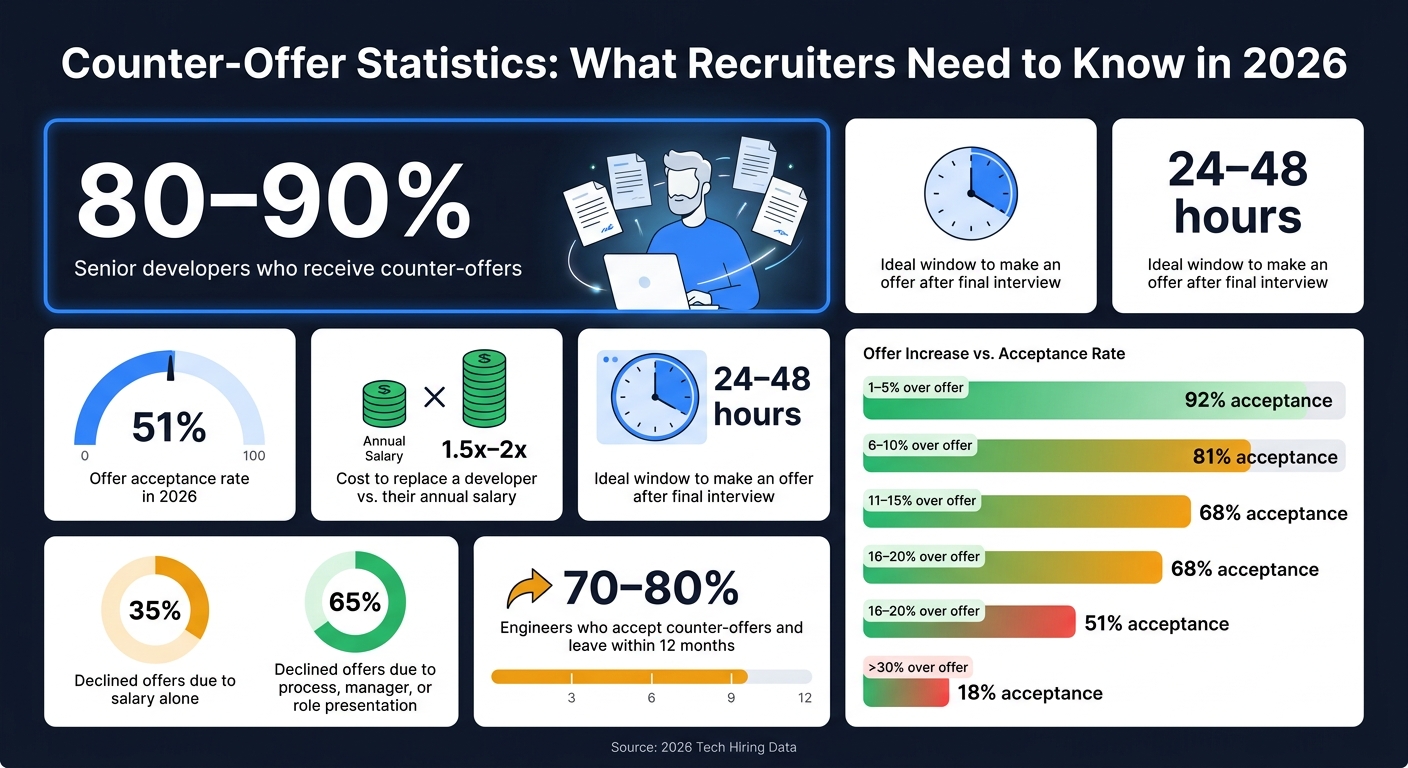
Counter-offers are now a standard challenge in tech hiring. With 80–90% of senior developers receiving counter-offers, recruiters must act fast and personalize offers to close deals. Replacing a developer costs up to 2x their annual salary, so companies often retain talent with quick raises or promotions. Offer acceptance rates have dropped to 51% in 2026, making it critical to understand what developers value most - beyond just salary.
Key Takeaways:
- Why counter-offers happen: Retention is cheaper than hiring, and slow hiring processes give current employers time to react.
- What developers want: Growth opportunities, flexibility, meaningful work, and clarity in offers.
- How to win: Tailor offers based on priorities, move quickly (within 48 hours), and present clear, detailed proposals.
Focus on speed, clarity, and understanding. The goal isn’t just to outbid but to align with what matters most to the developer.
Why Developers Receive and Weigh Counter-Offers
Understanding why counter-offers are so common in tech hiring is key to handling them effectively. The reality is, keeping an employee is often cheaper than replacing them. Recruiting costs can range from 1.5× to 2× an annual salary, making retention a financially smarter move for companies . Knowing this helps you craft offers that align with what developers genuinely care about.
Common Types of Offers and Counter-Offers
Counter-offers come in different forms, and recognizing these can help you respond more effectively. Here are the three most common types:
- Cash retention packages: A quick salary increase or one-time bonus, often the easiest move for a current employer.
- Structural changes: This could mean a title upgrade (like moving from Senior Engineer to Tech Lead), a team transfer, or a clear promotion timeline.
- Competing full-time offers: Offers from other companies, often remote-first, that can arise while you're still in the hiring process.
In 2026, simply offering more money isn’t always enough. Developers now expect more than just a pay bump - they want meaningful changes like promotions or the chance to lead major projects. For instance, a counter-offer that includes both a raise and a title change is much tougher to compete against than one based on cash alone .
By understanding these different counter-offer types, you can better anticipate what might influence a developer’s decision.
What Triggers Counter-Offers in Tech Hiring
Several factors can lead to counter-offers, and recruiters play a crucial role in managing these risks. One major trigger is a slow hiring process. Every day between a final interview and an official offer gives the current employer more time to step in. Research shows that reducing time to hire—ideally by moving within 24–48 hours after a final interview— can significantly reduce the chance of a counter-offer . As one Director of Talent explained:
"You can pay a candidate 10% more or you can call them 4 days sooner. The second one closes more hires, and it doesn't recur in next year's budget." - Director of Talent, JobsByCulture
Another issue is incomplete offer letters. Leaving out details like remote work policies, equity vesting schedules, or career growth opportunities can push candidates to seek clarity - often by entertaining counter-offers . Think of an incomplete offer as leaving the door open for retention bids.
The challenge is even greater for high-demand roles. For senior engineers, AI/ML specialists, or candidates with rare skills, the likelihood of receiving a counter-offer can skyrocket to 80–90% . These individuals often juggle multiple offers - sometimes three to five at once - thanks to transparent market data from platforms like Levels.fyi .
Signs a Developer May Be Weighing Another Offer
Developers rarely come out and say they’re considering another offer, but there are subtle signs to watch for:
| Signal | Implication |
|---|---|
| Slower response times | They might be reviewing a competing offer or retention bid . |
| Last-minute compensation questions | They’re likely comparing your offer to a counter . |
| Reluctance to discuss resignation | Indicates they’re not fully committed to leaving yet . |
| Mentions of "other conversations" | A direct hint that they’re leveraging competing offers . |
Pay attention to how candidates talk about their current roles. If someone says, "I love my team, just not the pay", it’s a red flag - compensation is often the easiest thing for their employer to fix . Similarly, passive technical candidates are more likely to accept counter-offers since they weren’t actively looking to leave in the first place .
"The counter-offer is data, not an obstacle. It tells you what the candidate values, what their current employer is willing to do, and whether the move was about your opportunity or about anywhere-but-here." - Recruiting.by
Catching these signs early allows you to address concerns proactively and reduce the chances of losing a candidate to a counter-offer.
How to Find Out What Developers Actually Want
Figuring out what a developer values most isn’t about guesswork - it’s about having an intentional conversation. The ideal time for this? Right after the final interview but before drafting the offer . This window gives you the flexibility to tailor the offer to the candidate’s priorities. Here’s how to approach this process, from starting the discussion to understanding deal-breakers and even factoring in competing offers.
How to Run a Priority Discovery Conversation
Structured questions are key to uncovering what really matters to a candidate. Open-ended or unstructured chats can lead to missed signals . Instead, ask targeted, clear questions and take notes.
Here are a few examples of questions that can help you get to the heart of their priorities:
- "Outside of compensation, what factors matter most to you - growth, flexibility, title, equity, or team?"
- "What would make you genuinely excited to say yes to this role?"
- "What’s holding you back from saying yes right now?"
These questions go beyond surface-level discussions, helping you understand what truly influences their decision. As Justin Marcus from OfferAlign explains:
"If you've already done alignment and built the offer thoughtfully, the negotiation is smaller. You're starting from 'We built this based on what you told us you needed,' which is stronger."
Even though developers often scrutinize offers in detail, the respect and care shown during the process can often be the deciding factor .
Separating Must-Haves from Nice-to-Haves
Not every request carries the same weight. Once the conversation is underway, focus on identifying what’s non-negotiable versus what’s simply a preference. A direct approach works best: "Are there any deal-breakers or non-negotiables we should discuss now?"
A helpful technique is the "stay" test: ask, "If your current employer offered you a 20% raise and a title change tomorrow, would you stay?" This can reveal whether their hesitation is about compensation - something a counter-offer can address - or deeper issues like lack of growth opportunities, trust in leadership, or alignment with the company’s mission. These deeper concerns often can’t be fixed with a bonus or pay bump .
Here’s a quick breakdown of motivations and how recruiters can respond:
| Motivation Type | Solvable by Counter-Offer? | Recruiter's Response |
|---|---|---|
| Compensation/Title | Yes | Focus on total value, equity details, and signing bonuses. |
| Technical Stagnation | No | Highlight exciting tech stacks, feature ownership, and modern tools. |
| Career Growth | Rarely | Offer a clear 18-month path to Lead/Staff roles in writing. |
| Culture/Management | No | Emphasize team autonomy, transparency, and strong leadership. |
| Remote Flexibility | Sometimes | Treat as a must-have if the candidate identifies it as critical. |
Once you’ve clarified their priorities, you can refine your offer even further by exploring competing proposals.
Gathering Offer Details Without Pressuring Candidates
Asking about competing offers can feel awkward, but it doesn’t have to be. Instead of bluntly asking for numbers, try this: "Can you tell me about what you're weighing against our offer?" This approach shifts the focus to understanding what’s appealing about other offers - whether it’s better equity, a higher role, or a more exciting technical challenge - without making the candidate feel cornered.
It’s also important to ask about unvested equity or deferred compensation. For instance, a candidate leaving unvested restricted stock units (RSUs) is in a very different financial position than one who isn’t. A question like "Are you walking away from any unvested equity or restricted stock we should account for?" allows you to design a signing bonus that addresses this gap, easing their transition.
Ultimately, the goal is collaboration, not competition:
"The best offer experiences feel like collaboration - both parties working toward a mutual yes. The worst feel transactional - company extracting maximum value at minimum cost." – Engineering Offer Acceptance: The Complete Guide
When candidates trust you enough to share these details, they’re more likely to communicate openly if they receive a counter-offer, rather than disappearing. With these insights, you’ll be better equipped to create an offer that aligns with what developers genuinely value.
Building a Counter-Offer That Stands Out
Once you understand what a developer values most, the next step is crafting an offer that aligns with those priorities while staying within budget. The goal is to create an offer that not only meets market expectations but also resonates with what truly matters to the candidate.
Using Market Data to Set Your Offer
Having accurate market data is crucial. Before making any offer, compare it against current U.S. compensation trends. For example, as of 2026, senior developers with 6+ years of experience earn total compensation ranging from $200,000 to $310,000, while Staff/Lead engineers command $270,000 to $450,000+ .
When it comes to counter-offers, the numbers are clear: offering 6–15% above the initial offer is often the sweet spot. Acceptance rates hover around 68% in the 11–15% range, but pushing beyond 25% above the initial offer at non-FAANG companies increases the risk of withdrawal to 26% .
| Offer Increase (%) | Acceptance Rate | Offer Withdrawal Risk |
|---|---|---|
| 1–5% over offer | 92% | 4% |
| 6–10% over offer | 81% | 7% |
| 11–15% over offer | 68% | 8% |
| 16–20% over offer | 51% | 15% |
| >30% over offer | 18% | 26% |
The numbers make a strong case for staying competitive. Replacing a senior developer can cost 1.5x to 2x their annual salary, making a 10–20% salary increase a far more economical choice .
Non-Monetary Benefits Developers Care About
While compensation gets a developer's attention, it's the non-monetary benefits that often seal the deal. For instance, 44% of tech workers rank flexible work arrangements as a top priority, and 49% value work-life balance . These aren't just "nice-to-haves" - they're critical factors in decision-making.
Beyond flexibility, developers are deeply invested in their scope of work: what they’ll own, what they’ll create, and their proximity to end users.
"What engineers actually care about is scope: what will I own, what will I build, and how close am I to the user?" – JobsByCulture
Offering a detailed 18-month roadmap to a Staff or Lead role often holds more weight than vague promises about future growth . Pair this with specifics: highlight the projects they’ll lead, the systems they’ll manage, and the frequency of deployments. These are elements a current employer’s counter-offer might struggle to match. Additional perks, like contributing to open-source projects, speaking at conferences, or writing for the company’s engineering blog, can also appeal to developers who value building their professional reputation .
How to Structure and Time Your Counter-Offer
Timing is everything. Top candidates typically juggle 3–5 offers at once, and delays of more than 5 days often lead to higher rejection rates . Aim to present a verbal offer within 24–48 hours of the final interview to stay competitive.
When structuring the offer, make equity straightforward. Avoid simply listing the number of shares - break it down. Show projections at varying company valuations and explain the vesting schedule clearly (e.g., 4 years with a 1-year cliff) . Transparency about potential upside helps candidates weigh your offer against others.
Finally, include a clear decision window of 3–7 days. This not only encourages timely consideration but also reflects the kind of culture your company represents. A well-structured, timely offer shows thoughtfulness and respect for the candidate’s time and decision-making process.
How to Present a Counter-Offer and Close the Deal
Lead with Empathy and Transparency
When a developer shares that they’ve received a competing offer, it’s important to avoid reacting defensively. Staying calm, curious, and open can make all the difference.
Start by addressing the situation directly. Thank the candidate for being honest and recognize that this is a pivotal moment in their career. Acknowledging their concerns helps reduce tension and keeps the conversation productive . Shift your approach from being a salesperson to acting as a career advisor - someone genuinely invested in helping them make the best decision.
The key here is to bring the discussion back to why they started exploring new opportunities in the first place. A pay raise from their current employer might not solve deeper issues like limited growth opportunities, dissatisfaction with tools or processes, or a strained relationship with their manager. Gently remind them of these original motivations - this is where your offer can stand out.
Once you’ve established trust and empathy, it’s time to present a tailored offer that aligns with their goals.
Walk Candidates Through the Offer with Confidence
Using what you know about the developer’s priorities, explain each part of your offer - base salary, equity, benefits, and career growth - step by step. Make sure every element connects directly to what they’ve expressed as important.
Confidence is crucial during this phase.
"Whoever has more certainty in the counteroffer conversation wins." – RecruitBPM
If they’ve mentioned wanting to work on distributed systems or aiming for a Staff Engineer role, highlight how your offer supports these ambitions. Avoid generic pitches; instead, make it clear that this opportunity is tailored to them. After presenting the offer, pause. That silence often prompts thoughtful reflection .
A practical tactic here is to ask what they’d consider a truly transformative counter-offer - perhaps a salary doubling - if they’re weighing a proposal from their current employer. When they name a figure, it often puts the actual counter-offer they might receive into perspective, making it seem less appealing by comparison .
Set Decision Timelines and Handle Any Outcome
After outlining your offer, establish a clear timeline for their decision and prepare for any outcome.
For engineering roles, a fair decision window is typically 3–7 days . Offer a flexible deadline, such as “Please let us know by [date],” to keep the tone collaborative . Avoid pressuring them with 24-hour deadlines or “exploding” offers, as these can hurt your company’s reputation.
The best counter-offer experiences feel like a partnership - both sides working toward a mutual agreement - rather than a hard negotiation over costs .
If the candidate decides to accept a counter-offer from their current employer, respond with grace. Studies show that 70% to 80% of engineers who accept counter-offers leave their employer within a year . Keep the relationship warm and stay in touch. Many of these candidates reenter the market within 12 months, and they’ll remember how professionally you treated them. This could turn into a future opportunity to bring them on board.
How daily.dev Recruiter Helps Reduce Counter-Offer Risk
Avoiding counter-offers starts with engaging developers who are genuinely ready to make a move, understanding their priorities, and keeping your hiring process efficient.
Reach Developers Who Are Already Open to Opportunities
Counter-offers often arise because of mismatched intentions. When you approach passive candidates without spamming, there's always the risk of retention strategies or competing offers disrupting the process.
daily.dev Recruiter tackles this issue head-on. Instead of relying on outdated resumes or impersonal outreach, it leverages real-time behavioral signals - tracking what developers are reading, following, and working on right now - to identify candidates with active interest. The platform’s double opt-in model ensures that every conversation starts with a developer who has already reviewed the job details and confirmed their interest.
"Recruiting should be built on context, not spam. We help recruiters understand who a developer is now, not just who they were years ago." – Nimrod Kramer, CEO & Co-Founder, daily.dev
This approach not only ensures you're speaking with motivated candidates but also allows you to tailor your outreach based on their current interests.
Use Rich Developer Profiles to Build Better Offers
Counter-offers often win when initial offers fail to address a developer’s specific needs or priorities. With daily.dev Recruiter, you can craft offers that resonate.
The platform provides detailed developer profiles based on real-time activity. You’ll see what frameworks they’re exploring, the topics they’re passionate about, and where their skills are heading. Combine this with access to the Hiring Academy, which offers salary benchmarks and hiring guides for roles in areas like AI, Go, and React, and you’ll have the tools to create offers that align with what developers value most .
Cut Down on Late-Stage Surprises with Smarter Workflows
Late-stage surprises, like undisclosed salary expectations or mismatches on work preferences, often stem from poor communication early in the process. With daily.dev Recruiter, you can avoid these pitfalls.
The platform’s workflow focuses on setting clear expectations upfront. Job briefs include critical details like the full tech stack, salary range, and work model, letting candidates self-select based on accurate information. Custom screening questions help confirm both technical expertise and compatibility with your team. Plus, ATS integration keeps your hiring pipeline organized. By the time you’re ready to make an offer, there’s little room for unexpected issues on either side.
Conclusion: How to Come Out Ahead in Counter-Offer Situations
Counter-offers have become a regular part of tech hiring. According to industry data, nearly 80–90% of senior engineers encounter counter-offers during the hiring process . This trend highlights the importance of being proactive rather than simply reacting by matching compensation dollar-for-dollar.
The recruiters who consistently succeed focus on three key areas: preparation, speed, and personalization. By understanding what a developer truly values early in the process, making offers within 48 hours of the final interview, and emphasizing growth opportunities or technical autonomy over just salary, recruiters can gain a competitive edge. Interestingly, only 35% of declined offers are due to salary concerns. The other 65% stem from factors like the hiring process, manager interactions, or how the role is presented .
Transparency and speed play a critical role here. When developers trust your process, they’re more likely to share details about competing offers, giving you a chance to address their concerns effectively.
These strategies pave the way for leveraging tools that can further reduce the risks associated with counter-offers. For example, daily.dev Recruiter simplifies every stage of the hiring process. By connecting you with developers who have already expressed interest, providing real-time insights into their preferences, and setting clear expectations from the start, it helps prevent the late-stage surprises that often derail negotiations. The goal isn’t just to win a negotiation - it’s to build a hiring process that minimizes the likelihood of counter-offer situations altogether.
FAQs
What should I do the moment a candidate tells me they got a counter-offer?
When faced with a counter-offer, it's important to stay composed and professional. Begin by thanking the candidate for being upfront about the situation. Recognize the counter-offer as a reflection of their worth, but avoid framing it as a compelling reason to remain with their current employer.
Instead of engaging in bidding wars or issuing ultimatums, guide the conversation toward their initial reasons for considering a new opportunity. Encourage them to reflect on whether the counter-offer genuinely addresses the concerns that led them to explore other options in the first place.
Finally, give them the time and space to make a thoughtful decision. Set a clear follow-up timeline - typically within 24 to 48 hours - so both parties can move forward efficiently.
How can I find a developer’s real deal-breakers before I send the offer?
After wrapping up the final interview, set up a structured pre-offer alignment call. This is your chance to uncover any potential deal-breakers before moving forward. Use this time to ask targeted questions about their total compensation expectations, any competing offers, and their professional priorities - whether that’s career advancement, flexibility, or something else.
Make sure to ask directly: "Are there any deal-breakers or non-negotiables we should discuss?" Take detailed notes on their responses. This will help you craft an offer that not only meets their needs but also aligns with what they’re looking for in their next role.
When does increasing comp stop helping and start backfiring?
When companies use higher compensation to gloss over underlying problems like toxic workplace culture, ineffective management, or a lack of career advancement, it often backfires. These are challenges that money alone can't solve. Turning counter-offers into bidding wars can also spiral out of control, leading to inflated salaries, disrupting internal pay equity, and creating unsustainable expectations. And if salary wasn’t the primary reason someone wanted to leave, a raise might only delay the inevitable - many employees still end up departing within 12 to 18 months.
.png)