The demand for AI agent developers is surging in 2026, making it harder than ever to hire the right talent. Companies need developers who can build autonomous systems that go beyond demos and work reliably in production. Here's what you need to know:
Key Takeaways:
- Role Focus: AI agent developers build systems that automate workflows using tools like LangChain, LangGraph, and vector databases. They differ from ML engineers and data scientists by focusing on orchestration and system reliability.
- Essential Skills: Python (async), API integration, memory systems, and reliability-focused design are must-haves. Candidates should also understand Model Context Protocol (MCP) and debugging techniques for non-deterministic systems.
- Compensation Trends: Salaries range from $120K–$160K for junior roles to $350K+ for senior positions, with Bay Area roles exceeding $500K. Equity often plays a big role in attracting top talent.
- Sourcing Tips: Use platforms like GitHub, Hugging Face, and daily.dev Recruiter to find candidates. Tailor job descriptions to include specific challenges and tech stacks to filter for qualified applicants.
- Interview Strategies: Focus on real-world problem-solving, such as debugging flawed agents or optimizing costs. Avoid generic coding tests and instead evaluate candidates on practical, agent-specific challenges.
Why It Matters:
AI agent developers are critical for building autonomous systems that can handle tasks like planning, tool integration, and multi-step workflows. Finding and retaining these experts requires a clear hiring process, competitive pay, and a supportive work environment.
Understanding the AI Agent Developer Role
What AI Agents Are and How They Are Used
An AI agent is more than just a chatbot or a tool for single interactions. It’s a system powered by a Large Language Model (LLM) that continuously operates in a loop of reasoning and action - known as the ReAct pattern (Reason + Act) - to achieve goals without human input . Instead of responding to one prompt at a time, the agent sets its own objectives, uses tools, evaluates results, and iterates until the task is complete.
In real-world applications, this means AI agents can take on tasks like managing customer support tickets from start to finish, investigating order issues, drafting detailed reports, or automating complex workflows. Unlike traditional bots, these agents don’t rely on predefined scripts for every step. For instance, companies like Zendesk have embraced this concept by creating "Agentic Tribes" - teams dedicated to building AI-powered digital teammates that go beyond basic automation .
This operational flow highlights the depth of expertise required to build and maintain these systems.
Core Responsibilities of an AI Agent Developer
AI agent developers are responsible for designing, integrating, and ensuring the reliability of these autonomous systems. Their work involves creating loops that handle planning, action, and observation across multi-step processes, coordinating multiple agents, and managing state to avoid "agentic amnesia" (where agents lose context during tasks) .
Key responsibilities include:
- API Integration: Implementing function calls, defining tool schemas, and linking agents to enterprise data using the Model Context Protocol (MCP).
- Memory Systems: Building memory frameworks with RAG pipelines and vector databases.
- Safety Measures: Setting up guardrails like retry logic, token budgets, and safeguards to prevent issues like runaway loops or prompt injection attacks .
"The real leverage isn't in writing code -- it's in breaking problems down to the point where AI almost never makes mistakes." - Nicholas Carlini, Research Scientist, Anthropic
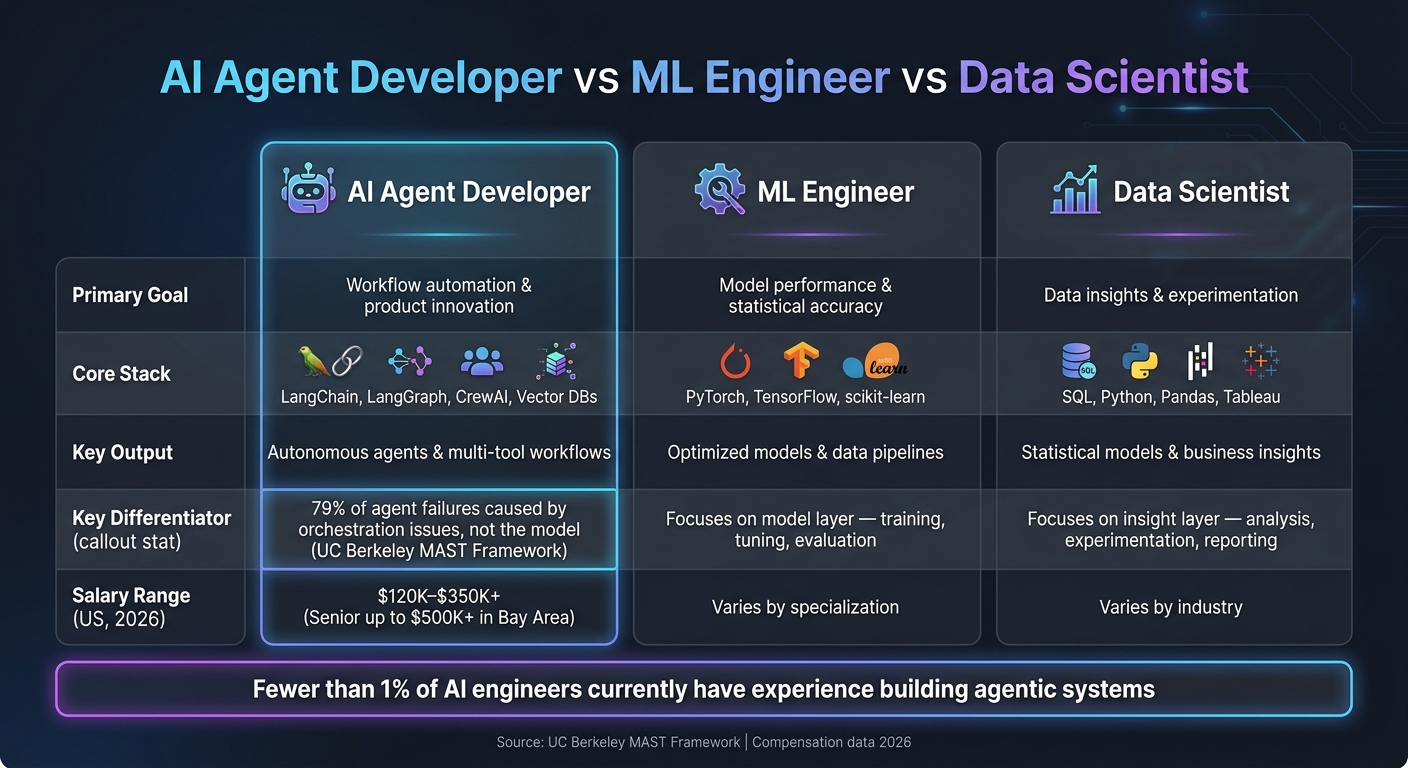
The importance of systems thinking in this role is underscored by data from the UC Berkeley MAST Framework, which shows that 79% of agent failures are caused by orchestration issues, not the quality of the underlying model . This highlights the need for developers who can think holistically about system design and workflow management.
How AI Agent Developers Differ From Other AI Roles
The challenges AI agent developers face set them apart from other AI professionals. While it’s easy to confuse their work with that of ML engineers or data scientists, the focus and tools of each role are distinct.
- ML Engineers: Their priority is building and fine-tuning models, using frameworks like PyTorch and TensorFlow, and delivering trained models and data pipelines.
- Data Scientists: They analyze data to generate insights, often working with tools like SQL, Python, and Tableau.
- AI Agent Developers: They operate at the application layer, orchestrating existing AI capabilities into autonomous systems ready for production .
Here’s a quick comparison:
| Feature | AI Agent Developer | ML Engineer | Data Scientist |
|---|---|---|---|
| Primary Goal | Workflow automation & product innovation | Model performance & statistical accuracy | Data insights & experimentation |
| Core Stack | LangChain, LlamaIndex, CrewAI, Vector DBs | PyTorch, TensorFlow, scikit-learn | SQL, Python, Pandas, Tableau |
| Key Output | Autonomous agents & multi-tool workflows | Optimized models & data pipelines | Statistical models & business insights |
Interestingly, six out of the seven key skills for agent engineering align with traditional software engineering: system design, contracts, reliability, security, observability, and product sense . This overlap explains why fewer than 1% of AI engineers currently have experience building agentic systems .
"A chef doesn't just follow recipes. Anyone can follow a recipe. A chef understands ingredients, techniques, timing, kitchen workflow, food safety, and how to improvise when something goes wrong. The recipe is just the starting point. Prompt engineering is the recipe. Agent engineering is being the chef." - Bri Kopecki, Engineer, IBM
Skills and Qualifications to Look for in AI Agent Developers
Technical Skills for AI Agent Development
A solid AI agent developer needs to be fluent in Python, particularly async Python. This is the backbone of frameworks like LangChain, LangGraph, CrewAI, and OpenAI Agents SDK, all of which prioritize Python . Familiarity with orchestration frameworks is also essential - LangGraph is currently leading in demand, followed by LangChain and CrewAI .
On the data side, look for expertise in vector databases such as Pinecone, Weaviate, or Chroma. Candidates should also be comfortable with Retrieval-Augmented Generation pipelines and persistent state management . Another critical piece is knowledge of the Model Context Protocol (MCP), which is rapidly becoming a standard for linking agents to external tools and data sources .
When reviewing candidates, prioritize GitHub portfolios that showcase complex projects. Look for examples of agents that integrate multiple tools, use real-world data, and include evaluation benchmarks. Bonus points for candidates who document the challenges they encountered and the solutions they implemented .
Finally, evaluate their ability to build systems that are reliable and secure for production use.
Reliability, Security, and Observability Skills
Developing an agent for production environments requires more than just technical know-how - it demands a focus on reliability, security, and observability. Creating a demo is one thing, but ensuring consistent performance in real-world scenarios is a whole different challenge. Skilled developers recognize that language models are inherently non-deterministic and design systems that account for this unpredictability.
"If you're not the model, you're the harness." - Vivek Trivedy, Engineer, LangChain
Candidates should be proficient in implementing retry logic with exponential backoff, circuit breakers, and fallback strategies. They should also understand prompt injection (OWASP LLM01:2025) and know how to use sandboxed environments like Docker or E2B to limit agent actions . A real-world reminder of the stakes: in 2025, Replit's AI agent mistakenly deleted a production database during a code freeze, all because of insufficient permission boundaries .
For observability, the best developers use tools like LangSmith, Langfuse, or Arize Phoenix to gain detailed insights into agent behavior. Debugging non-deterministic systems without trace-level visibility is nearly impossible . A great example: In April 2026, LangChain improved their agent's performance on the TerminalBench 2.0 leaderboard by 13.7 points - achieving this solely by optimizing the surrounding infrastructure, without altering the model itself .
Education, Experience, and Salary Benchmarks
Most senior AI agent developers have 2–3 years of production experience, reflecting the relatively recent adoption of frameworks like LangChain in late 2023 . While academic credentials are less critical, strong candidates often come from senior backend engineering roles, with expertise in distributed systems, asynchronous programming, and API design - rather than pure machine learning research .
The demand for AI agent developers is skyrocketing, with job postings for these roles increasing by 340% year-over-year as of early 2026. Filling senior positions now takes over 90 days on average . Below is a breakdown of compensation in the US market:
| Level | Total Compensation (US) |
|---|---|
| Junior | $120,000 – $160,000 |
| Mid-Level | $160,000 – $220,000 |
| Senior | $220,000 – $350,000+ |
| Principal/Staff | $320,000 – $450,000+ |
Geography significantly impacts compensation. For instance, roles in the San Francisco Bay Area can exceed $500,000 in total compensation, while positions in cities like Seattle and Austin typically max out around $310,000 . A real-world example: In February 2026, a fintech company initially posted a "Senior Agentic AI Engineer" role with a $160,000 base salary. After reassessing the requirements, they redefined the role as a Tier-3 Platform Engineer with a $245,000 base salary. Once the compensation and stack requirements (including LangGraph and Temporal) were clarified, the position was filled in just seven weeks .
"The hire fails when a company screens them like a regular LLM developer and never asks how their last agent behaved at 2 a.m. under load." - Robert Ardell, Co-Founder, KORE1
How to Source AI Agent Developer Candidates
Finding skilled AI agent developers requires a thoughtful and proactive approach. By crafting a precise job description and leveraging effective outreach strategies, you can connect with candidates who have the expertise needed to excel in the role.
Writing a Clear and Detailed Job Description
A common mistake in AI agent job postings is using vague language that could apply to any tech role. To attract the right talent, focus on specific challenges and expectations from the start.
For example, instead of saying, "build and maintain AI systems", try something like: "Reduce our agent's hallucination rate from 12% to under 5% while maintaining P95 latency below 800ms." This level of detail shows candidates you understand the complexities of the work and helps filter out those who may not be the best fit .
Here are some tips to refine your job description:
- Highlight software engineering fundamentals first. Emphasize that you're looking for a strong engineer with proven experience in production-grade Python or TypeScript before diving into AI-specific skills .
- Be explicit about your tech stack. Mention the models you use (e.g., GPT-4, Claude 3.5), vector databases like Pinecone or Weaviate, and orchestration frameworks such as LangGraph or CrewAI. This helps candidates self-assess their compatibility with your tools .
- Share performance metrics and goals. Include details like monthly token spend, response accuracy, and the specific improvements you expect the new hire to achieve .
- Provide transparent compensation details. Include information about base salary, equity (e.g., 0.05%–0.15% for senior roles at early-to-mid-stage startups), and overall compensation expectations .
A strong job description should clearly outline your company’s context, the specific problem to solve, role expectations, required skills, tech stack, performance targets, compensation, and the interview process .
Using daily.dev Recruiter to Find AI Agent Talent
Engaging candidates who are already open to new opportunities can be tricky, especially when traditional job boards and cold outreach yield low response rates. This is where daily.dev Recruiter shines.
This platform, built around a professional network of software engineers, identifies candidates based on their interactions with AI and ML-related content. Each introduction is warm and double opt-in, meaning developers have already expressed interest in exploring opportunities before you contact them. This approach leads to impressive response rates of 85–90% .
Other Sourcing Channels Worth Using
In addition to daily.dev Recruiter, several other platforms and methods can help you find specialized talent:
- GitHub: Use advanced search operators like
language:python,topic:machine-learning, orpushed:>2025-01-01to find developers actively working with relevant tools. Instead of focusing solely on star counts, evaluate their contribution quality, pull requests, and documentation. - Hugging Face: Ideal for finding developers with expertise in large language models. Look for contributors who publish model cards, create demos, or fine-tune open-source models.
- Discord communities: Servers like LangChain and the MLOps Community are great for connecting with candidates. When reaching out, reference specific projects or discussions they’ve been part of - personalized outreach is far more effective than generic messages .
For senior or principal-level roles, academic conferences like NeurIPS, ICML, and ICLR are excellent places to discover researchers tackling complex AI challenges. Platforms like arXiv and Papers With Code can also help you identify emerging talent before they enter the job market.
How to Interview and Evaluate AI Agent Developers
Once you've identified promising candidates, the interview process should go far beyond simple coding exercises. AI agent development involves making unpredictable systems work consistently, so your interview approach must reflect this complexity.
Key Topics to Cover in Technical Interviews
The technical interview needs to gauge not just a candidate's ability to build agents but also their understanding of how and why agents can fail. For example, ask them to explain key design patterns like ReAct, Plan-and-Execute, and Orchestrator-Workers, focusing on how these frameworks address common issues such as state loss or excessive costs.
Here are additional areas to explore:
- State and Memory Management: Can the candidate differentiate between short-term memory (context window), long-term memory (vector databases), and episodic memory (structured logs of past runs)? This distinction is crucial for effective agent design.
- Model Context Protocol (MCP): Familiarity with MCP is now a baseline skill, especially after its adoption by leading companies like Anthropic, OpenAI, and Google. Make sure candidates are up to speed.
- Cost Engineering: Ask how they would reduce the cost of an agent running at $200 per task to $5. Strong candidates should discuss strategies like model tiering, prompt caching, and routing models based on task complexity.
A quick screening question could be: "What's the current version of a leading AI agent?" If they mention a version that doesn’t exist, it’s a sign they may not be keeping up with the field.
For production troubleshooting, pose a scenario like: "It’s 3 a.m., and your agent fails. What’s your first step?" Look for answers involving trace tooling rather than vague responses like "checking the logs."
These technical discussions naturally set the stage for practical challenges that reveal how candidates tackle real-world problems.
Practical Assessments and Take-Home Tasks
Skip generic coding tests like LeetCode. Instead, design challenges that mirror real-world issues. For example, provide a flawed script where the agent gets stuck in a loop, overflows its context window, or misinterprets malformed tool outputs. Ask candidates to debug it.
Real-life case studies can also be eye-opening. Take this example: In November 2025, a LangChain deployment with four agents and no hard step cap entered a "clarification ping-pong" loop that lasted 11 days, costing $47,000 before human intervention. Ask, "What would you have done differently?" to see if candidates suggest solutions like step caps, duplicate-input hash checks, or budget gates for each conversation.
When evaluating take-home tasks, look for clean, maintainable code but also check for features like observability tools, step limits, and human-in-the-loop controls for high-risk actions.
As Ilya Isaev, Software Engineer, aptly put it:
"If you don't have evals, you don't have a product; you have a demo."
Technical evaluations are just one piece of the puzzle. Behavioral questions can reveal how well a candidate navigates production challenges and aligns with user needs.
Behavioral and Product-Focused Interview Questions
Beyond technical skills, it’s essential to assess how candidates approach real-world problem-solving. Behavioral questions can help you uncover their practical experience and decision-making process. For example:
- "Tell me about the last time an agent you built produced complete nonsense." This question helps distinguish candidates who’ve shipped reliable systems from those with limited hands-on experience.
- "When have you decided not to build an agent?" This reveals whether the candidate knows when deterministic code is a better, more cost-effective choice than a probabilistic agent.
Here’s a summary of key behavioral areas and questions to consider:
| Behavioral Category | Question to Ask | What to Look For |
|---|---|---|
| Accountability | "Walk me through a production LLM incident you triaged in the last 6 months." | A clear timeline, root cause analysis, and lessons learned from the postmortem. |
| Critical Thinking | "When did you last say no to the AI? What did it propose that you rejected?" | Evidence of turning a rejection into actionable guidelines or documentation. |
| Pragmatism | "Your agent is spending $200 per task. How do you bring it under $5?" | Concrete strategies like model tiering and caching. |
| User Empathy | "How do you build trust so people actually use the agent for real work?" | Approaches that emphasize confidence signaling and graceful handling of uncertainty. |
The best candidates are those who can refine and improve their systems rather than abandoning them at the first sign of trouble. As Airtable CEO Howie Liu puts it:
"The agents are powerful enough to do almost anything you want. The issue is whether you are able to invest the time and coaching and curation to get it there."
Making Offers and Keeping AI Agent Developers Long-Term
Setting Competitive Compensation for the US Market
Hiring AI agent developers isn't cheap. Mid-level engineers typically earn between $170,000 and $260,000 in total compensation, while senior engineers often command $220,000 to $350,000 or more. For staff and principal-level roles, salaries start at $350,000 and can easily surpass $600,000. At cutting-edge labs like OpenAI and Anthropic, senior engineers see median compensation ranging from $600,000 to $795,000, with top-tier professionals earning over $1.15 million .
"Hiring an agentic AI engineer in 2026 costs $155K to $265K base for mid-to-senior roles, with top performers clearing $400K total comp." - Robert Ardell, AI/ML Staffing Lead, KORE1
Specialized skills can push compensation even higher. Proficiency in tools like LangGraph or MCP often commands a premium. On the other hand, if your job description only mentions LangChain, you might attract less specialized candidates. Equity packages also play a crucial role in this competitive market. With AI-skilled workers earning a 56% wage premium over their peers , offering meaningful equity can tip the scales when candidates are juggling multiple offers.
But securing top talent isn't just about the paycheck - it’s also about creating an environment where developers want to stay.
Building a Work Environment Developers Want to Stay In
While competitive pay gets developers through the door, a strong work environment is what keeps them around. For AI agent developers, this means providing access to state-of-the-art tools like Claude Code, Cursor, and GitHub Codespaces. Covering the costs of frontier-model APIs and tool subscriptions is a small price to pay compared to the expense of losing a senior engineer .
The role of developers is evolving, as noted by Augment Code:
"The human role is shifting from author to architect and editor." - Augment Code
Developers working on multi-agent systems want to focus on high-level architectural decisions, not get bogged down in setup tasks or red tape. Offering a clear path for career growth is equally important. For instance, a production engineer should see a visible trajectory toward platform or principal-level roles. Without this, even your most talented hires may start looking for their next opportunity.
Combining competitive compensation with a supportive, forward-thinking work environment is key to retaining the exceptional talent identified through your hiring efforts.
Tracking Performance and Refining Your Hiring Profile
Once you've built your team, performance management becomes critical. Traditional metrics like sprint velocity aren't enough. Instead, use AI-specific metrics to measure impact. For example, track eval scores on golden datasets, retrieval accuracy in RAG systems, or per-task inference costs. A developer who reduces cost-per-task from $0.40 to $0.15 while maintaining a 95% success rate delivers clear value to the business .
"Eval literacy - knowing how to design, run, and reason about model evaluations - is the single biggest signal of 'this person actually built with LLMs' vs watching YouTube videos." - The AI Career Lab
Use production data to continuously refine your hiring approach. When agents fail - due to issues like hallucinated API calls, runaway loops, or context overflow - document the root causes. These insights can inform your next job descriptions. For example, if postmortems consistently highlight gaps in failure-mode debugging or context engineering, emphasize those skills in future postings. The field of AI agent development moves fast, and your hiring strategies should keep pace.
Conclusion: Key Takeaways for Hiring AI Agent Developers
Hiring AI agent developers in 2026 requires a distinct approach compared to traditional engineering roles. The key is understanding whether you need systems integrators or model builders - a crucial distinction that can streamline your hiring process and save valuable time. Here's a recap of the most important insights.
The best candidates are those who have proven their ability to make an impact in real-world scenarios. Look for developers who have successfully shipped autonomous systems, thoroughly evaluated performance, and resolved production failures. This quick screening method can significantly reduce the time spent during recruitment.
"The job is no longer just writing correct code; it is about constraining unreliable systems into behaving reliably." - Ilya Isaev, AI Strategist
When sourcing talent, prioritize platforms where developers are actively engaged, such as GitHub, Hugging Face, and other technical communities. These spaces are far more effective than relying solely on inbound applications. Once you've identified strong candidates, put them to the test with a concise, 4–6-hour paid take-home assignment that mirrors real-world challenges.
Retention is just as critical as recruitment. To keep top-tier talent, focus on two key factors: competitive compensation and an environment that reduces administrative hurdles while encouraging innovative thinking. Nail these, and not only will you attract exceptional AI agent developers - you’ll ensure they stay.
FAQs
When should we hire an AI agent developer vs an ML engineer?
When you need autonomous, multi-step systems capable of planning, using tools, maintaining memory across steps, and managing failures with observability and cost controls, it's time to hire an AI agent developer. On the other hand, if your priority is training and deploying traditional machine learning (ML) models, focusing on tasks like model training, serving, and monitoring - rather than workflows driven by large language models (LLMs) - you should look for an ML engineer.
What signals prove an agent can run reliably in production?
When evaluating candidates, one of the most telling indicators is their ability to articulate past failures and the technical strategies they used to overcome them. Pay attention to their experience in tackling challenges like infinite loops, tool timeouts, or hallucinations.
Key technical skills to watch for include crafting guardrails, implementing retry logic, and designing fallback behaviors. Additionally, strong candidates should detail how they applied rigorous evaluation methods - such as using golden datasets or conducting shadow testing - to ensure robust performance across a variety of inputs before deployment.
What’s the best paid take-home test for agent developers?
There isn’t a one-size-fits-all "best" test - it all comes down to what you’re looking for: a ready-made solution or something tailored specifically to your requirements.
If you’re leaning toward pre-built options, standardized tests like Agent Framework or LangChain are excellent for evaluating technical skills. They provide a structured way to measure foundational knowledge.
However, for senior-level roles, custom assignments tend to be a better fit. These focus on practical, hands-on tasks such as:
- Building functional agents
- Debugging complex scenarios
- Managing challenges like non-deterministic loops, tool registries, and sandboxing setups
The key is aligning the test with the role’s demands to get the most accurate assessment.
.png)