Reducing the time-to-hire for developer roles without sacrificing quality requires rethinking your hiring process. Here's the key takeaway: Top-performing teams fill developer roles in under 21 days, compared to the industry average of 35–45 days. To achieve this, focus on:
- Pre-qualified talent pipelines: Build a network of engaged candidates to cut sourcing time.
- Efficient scheduling: Use async tools and batch interviews to minimize delays.
- Structured interviews: Standardize questions and scorecards to identify qualified technical candidates in minutes.
- Pre-approved compensation bands: Avoid offer-stage delays by finalizing salary ranges upfront.
- Clear communication: Keep candidates informed at every step to maintain interest.
Developer Time-to-Hire Benchmarks in 2026
What the Numbers Look Like for Developer Roles
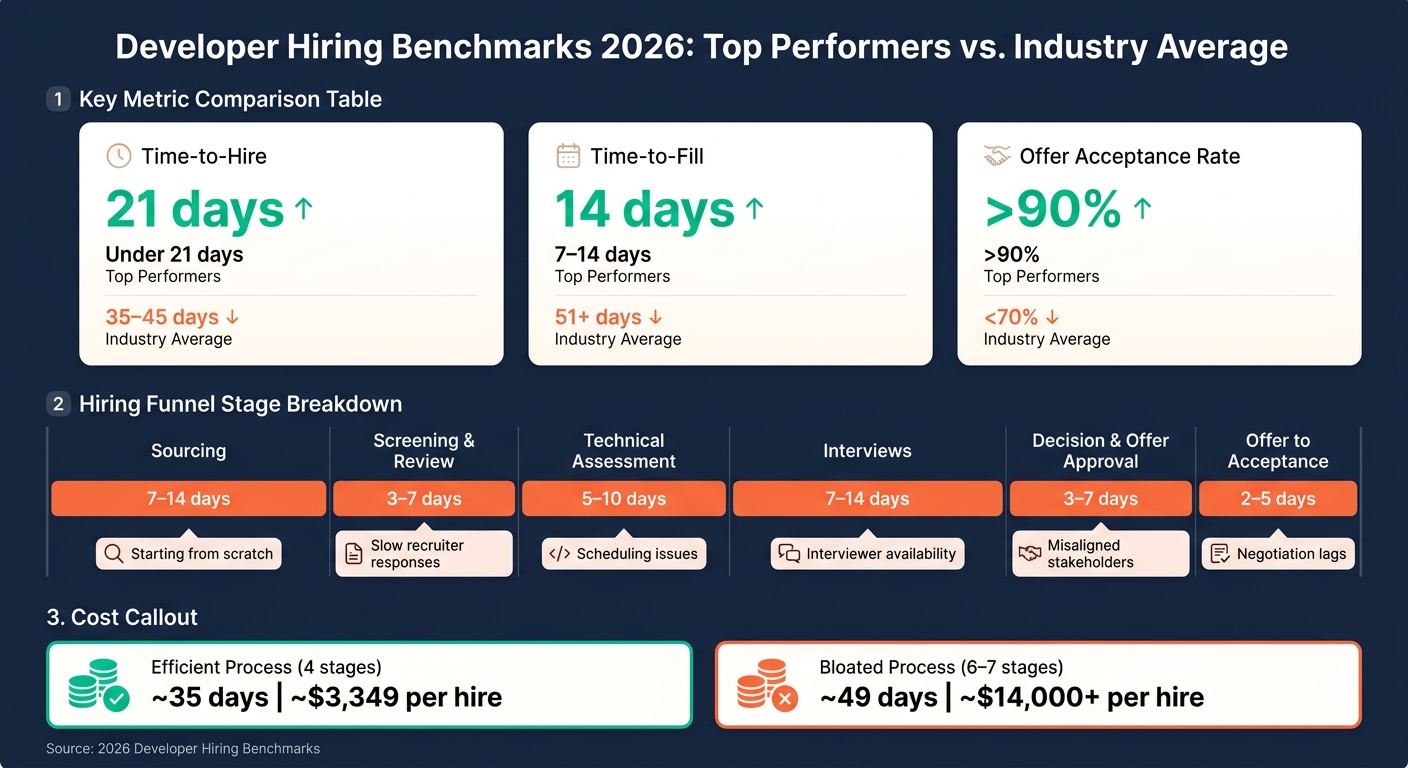
In 2026, the average hiring timeline for developers ranges from 35 to 45 days. However, top-performing teams manage to close these roles in under 21 days. That difference of 14–24 days highlights the impact of streamlined processes, quick decision-making, and a candidate-friendly experience.
It's important to understand the distinction between time-to-hire and time-to-fill. Time-to-hire measures the days from when a candidate enters the pipeline to when they accept an offer. Time-to-fill, on the other hand, starts from the moment a job requisition is approved. Without separating these metrics, teams might mistakenly think they’re improving hiring speed when they’re just reducing delays in the approval stage. Both metrics are critical for pinpointing where inefficiencies occur.
| Metric | Top-Performing Teams | Industry Average |
|---|---|---|
| Time-to-Hire | Under 21 days | 35–45 days |
| Time-to-Fill | 7–14 days | 51+ days |
| Offer Acceptance Rate | >90% | <70% |
These benchmarks do more than measure internal efficiency. They shape how developers perceive your company’s ability to move with purpose and agility.
Larger enterprises often face hiring delays of 45–60+ days due to lengthy approval chains and overly complex interview processes . Such delays often force these companies to offer higher salaries or additional perks to keep candidates interested. Interestingly, even trimming 10 days off the time-to-fill metric can significantly improve offer acceptance rates and reduce hiring costs. Fewer candidates drop out during the process, as they’re less likely to accept competing offers .
Why Developers Pay Attention to How Fast You Move
Developers are frequently juggling multiple opportunities, so a company that acts quickly and decisively naturally stands out. But it’s not just about speed - it’s about what speed represents. It signals strong leadership, clear priorities, and a team that operates without unnecessary roadblocks.
That said, rushing without structure can backfire. If your process skips key steps like thorough technical assessment tools or lacks clear communication, it won’t come across as efficient - it’ll look chaotic. The sweet spot is visible momentum. Candidates should always know their status, what the next steps are, and how long things will take. This kind of predictability demonstrates professionalism and keeps experienced developers engaged all the way to the offer stage.
Where Delays Hide in the Developer Hiring Process
Breaking Down the Hiring Funnel by Stage
Most teams know their hiring process drags, but pinpointing where delays happen is tricky. Time gets wasted at nearly every stage, often costing you top candidates before you even realize it.
Here’s a breakdown of the typical developer hiring funnel and the common culprits behind those time sinks:
| Hiring Phase | Typical Duration | Common Bottleneck |
|---|---|---|
| Sourcing | 7–14 days | Starting each search from scratch |
| Screening & review | 3–7 days | Slow recruiter responses or unclear criteria |
| Technical assessment | 5–10 days | Scheduling issues and lack of async tools |
| Interviews | 7–14 days | Interviewer availability and multi-round delays |
| Decision & offer approval | 3–7 days | Misaligned stakeholders or undefined comp bands |
| Offer to acceptance | 2–5 days | Delays in written offers or negotiation lags |
Here’s the kicker: an efficient process with four streamlined stages takes about 35 days and costs around $3,349 per hire. But a bloated process with six or seven stages? That balloons to 49 days and over $14,000 per hire. This isn’t just a small inefficiency - it’s a completely different ballgame. Let’s dive into the primary bottlenecks and how to fix them.
The Most Common Bottlenecks and How to Address Them
If you want to cut down on time-to-hire without compromising your hiring standards, you need to tackle these bottlenecks head-on.
Sourcing delays can eat up 1–2 weeks when you’re starting every search from scratch. The solution? Build a warm pipeline before you actually need it. Keep a network of engaged, pre-qualified developers ready to go. Tools like daily.dev Recruiter can help by maintaining an active pool of candidates, so you’re not stuck cold-starting every search.
Scheduling is another major time sink. Scheduling delays often add 5–7 unnecessary days while trying to coordinate calendars between hiring managers, engineers, and candidates. Switching first-round screenings to async formats - like recorded video responses or written technical tasks - can slash that time to just 1–2 days.
Decision paralysis is another common hurdle after interviews. Without a shared scorecard or pre-set evaluation criteria, teams can get stuck debating instead of deciding. Agreeing on evaluation metrics before the search even starts can help you move from final interview to decision in under 48 hours.
Lastly, offer approval delays can sneak up on you. Requiring executive sign-off for compensation packages can add 3–5 days to the process. Pre-defining salary bands by role and level eliminates this bottleneck entirely. And considering unfilled senior engineering roles cost over $35,000 per month , those extra days come with a hefty price tag.
How to Speed Up Sourcing Without Starting from Zero
Building a Pre-Qualified Talent Pipeline
The key to speeding up developer hiring is to streamline the sourcing process, setting a strong foundation for the rest of the hiring journey. One effective way to do this is by creating a pre-qualified talent pipeline, so you’re not starting from scratch every time a role opens.
A continuous sourcing strategy keeps your pipeline active and ready to go. Start by focusing on two valuable groups: silver medalists (candidates who reached the final stages but weren’t selected) and boomerang hires (former employees who left on good terms). These individuals already have insight into your company culture and have passed part of the evaluation process. Re-engaging them when a role becomes available can cut sourcing time dramatically - from about 14 days to just 2–3 days.
For example, in May 2023, ClearCo's talent acquisition team reduced their time-to-hire to just 21 days, far below the 45-day market average. How? By integrating their CRM with their ATS to keep candidate data active and ready for action between searches . This kind of efficiency doesn’t come from rushing but from being prepared - avoiding the need to start fresh every time. It’s a proactive approach that ensures you can hire developers faster while maintaining quality.
Reaching Passive Candidates Without Wasting Their Time
Once your talent pipeline is up and running, the next hurdle is engaging passive candidates effectively. This requires a thoughtful approach, as most developers ignore generic outreach.
Generic messages like, "I came across your profile and thought you'd be a great fit", often fall flat because they lack specifics and show little effort. Instead, personalized outreach that highlights their technical work can make all the difference. For instance, referencing a specific project - “I noticed your README for [Project Name] detailed your Docker and Kubernetes setup. We’re working on a similar architecture and tackling comparable scaling challenges” - shows you’ve done your homework and opens the door to a meaningful conversation.
Additionally, developers appreciate when outreach includes key details upfront, such as the tech stack, salary range, and work model. Leaving out this information forces candidates to ask basic questions before they can even decide if the role is worth their time. Platforms like daily.dev Recruiter are designed with this in mind, allowing developers to review full job briefs and opt in before any introductions. This ensures that every conversation starts with mutual interest, not cold outreach.
This approach doesn’t just improve response rates - it also shortens your sourcing timeline. Considering that every unfilled senior developer role can cost a company between $16,500 and $33,000 per month in lost productivity , connecting with genuinely interested candidates quickly can significantly impact your bottom line.
Building a Faster Interview Process That Still Gets It Right
Using Structured Interviews and Scorecards
Dragging out decisions after interviews wastes valuable time, and uncoordinated questions often lead to drawn-out, unproductive discussions. Structured interviews tackle these issues head-on by streamlining evaluations and keeping them focused.
Here’s how it works: every interviewer asks the same core questions and completes a standardized scorecard before a brief group debrief. A good scorecard includes 5–8 competencies, uses a 1–4 rating scale, and provides clear behavioral examples. For instance, a "4" in system design might mean the candidate independently identified failure risks and proposed mitigation strategies, while a "2" might indicate they needed significant guidance to structure their approach.
Each interviewer focuses only on 2–3 key competencies relevant to their part of the interview. This targeted approach ensures high-quality feedback and keeps debriefs short - typically 20–30 minutes. Instead of debating vague notes, the team resolves specific scoring differences.
To make the process even more efficient, consider adding a red-flag checklist for deal breakers like security lapses or plagiarism during live coding. If a red flag is triggered, the debrief is skipped entirely, saving everyone's time.
By cutting down decision delays with structured interviews, you can also speed up the overall interview timeline.
Fitting the Full Interview Process into 10–14 Days
Once interviews are standardized, the next step is eliminating idle time between stages - not the stages themselves. The table below outlines how a streamlined process can fit into a 10–14 day window:
| Stage | Timing | Key Action |
|---|---|---|
| Recruiter screen | Day 0–1 | Conducted same-day or next-business-day, 30 minutes |
| Technical screen | Day 1–3 | Scheduled within 24–48 hours of recruiter screen |
| Onsite / panel block | Day 4–7 | Combine 2–3 interviews into a single half-day |
| Debrief and decision | Day 7–8 | Submit scorecards within 2–4 hours; debrief within 1 business day |
| References + verbal offer | Day 8–10 | Conduct reference checks alongside offer preparation |
Pre-booking interview slots is a game changer. For example, set aside Tuesday and Thursday mornings from 9 a.m. to 12 p.m. every week for key interviewers. Once a candidate passes the technical screen, they’re immediately scheduled into the next available block - no more wasting 3–4 days coordinating calendars.
Batching interviews into a single half-day also minimizes disruptions for candidates, compared to spreading them out over weeks. Companies like Vercel stick to a 14–18 day hiring timeline by favoring live pair-programming sessions over take-home assignments. This approach speeds up feedback and evaluates collaboration in real time, avoiding the need for separate follow-up rounds.
Finally, don’t let any stage sit idle for more than 24–48 hours. The next step should be scheduled as soon as the previous one wraps up, keeping the process on track.
Moving Fast at the Offer Stage Without Losing Candidate Trust
The offer stage is a critical moment in the hiring process - it's where momentum is either maintained or lost. According to LinkedIn Talent Solutions, top candidates are often off the market within 10 days. A slow offer process not only risks losing great talent to faster competitors but also creates a poor impression of your organization.
Setting Up Pre-Approved Compensation Bands
Delays in the offer stage often stem from internal bottlenecks, not candidate indecision. A common culprit? Compensation approvals that haven’t been sorted out in advance. The fix is simple: establish clear compensation bands before you even begin interviewing.
For each developer level (Mid, Senior, Staff), outline the minimum, midpoint, and maximum base salary in USD. Include details like annual bonus targets and equity ranges (such as RSUs or options). Get these numbers approved by finance, HR/compensation, and the hiring manager’s leadership before opening the position. This preparation transforms what could be a multi-day back-and-forth into a quick confirmation process.
Here’s how you can keep things smooth: if the candidate’s package fits within the pre-approved band and meets agreed-upon criteria, the hiring manager should be empowered to extend the offer without further approvals. For packages exceeding the band, set up a clear process for finance reviews - ideally completed within four business hours. For exceptions like relocation packages, signing bonuses, or band overrides, define the escalation path and deadlines ahead of time. This clarity ensures there’s no scrambling when decisions need to be made.
Once compensation bands are locked in, the next step is to deliver the offer swiftly and effectively.
Delivering Verbal and Written Offers Without Delay
With pre-approved compensation, the focus shifts to delivering the offer quickly. Aim to present a verbal offer within 24 hours of the final interview and follow up with a written offer within one business day of verbal acceptance.
Plan ahead by scheduling an offer call for the same day as the final interview or the following morning at the latest. Use this call to confirm the candidate's level, location, and target compensation within the band. Be thorough - clearly outline the base salary, bonus target, equity details, and start date. If there are non-cash terms, such as a signing bonus or remote work arrangements, make sure to include those too. Don’t shy away from asking if the candidate is considering other offers - this allows you to align your timelines with theirs.
If you can’t make the offer call within 24 hours, let the candidate know exactly when they’ll hear from you - and stick to that timeline. A vague promise can erode trust faster than a short, honest delay.
Once the candidate verbally accepts, follow up immediately with a written summary. Include all financial details - base salary, bonus target, equity grant, signing bonus (if applicable), and the offer expiration date (typically 5–7 calendar days). Send the formal written offer for e-signature within one business day.
Speed matters. A fast, well-organized offer backed by clear details and next steps - like background check timelines, start date flexibility, and a point of contact for questions - signals confidence and professionalism. On the other hand, a rushed offer with missing details or shifting terms can make your organization seem disorganized, potentially costing you the candidate.
What to Keep: The Checks You Should Never Skip
Hiring quickly is important, but it only pays off if the person you bring on board can excel in their role and integrate well with the team. Skipping critical steps like thorough technical evaluations or assessing team compatibility can lead to costly mistakes. No matter how tight your timeline, these two steps should always remain part of your process.
Keeping Technical Depth in the Process
Cutting corners on technical assessments to save time can backfire in a big way. While you might save a few days during hiring, the long-term consequences - like poor-quality code or slowed team progress - can be far more costly. Engineers who interview well but lack deep technical skills often introduce more bugs, create architectural problems that require expensive fixes, and hinder team momentum within just a few months.
A focused technical exercise lasting 90–120 minutes is a much better way to gauge a candidate's skills. Think of tasks like debugging, extending an API, or reviewing pull requests. These types of evaluations provide clear insights when paired with a detailed scoring rubric, helping you make confident decisions without wasting time. For senior or staff-level roles, a 60-minute system design session can be equally effective. Use a standardized rubric to evaluate key factors like clarity, scalability, tradeoffs, and reliability.
Worried about candidates feeling burdened by time-consuming tests? Offer a small stipend - $150 to $250 USD - for take-home exercises. This not only respects their time but also attracts more serious applicants.
Beyond technical skills, it’s just as important to ensure the candidate fits well with your team and work culture.
Making Room for Culture and Team Fit
When schedules are packed, it’s tempting to skip the culture-fit conversation. But failing to evaluate this can lead to expensive turnover. Misaligned expectations around things like communication style or ownership often cause engineers in the U.S. to leave within 6–12 months. And when that happens, you’re not just losing a hire - you’re also creating more work for your recruiting team.
To avoid this, dedicate 45–60 minutes to a behavioral interview focused on real-life scenarios. Ask questions like, “Tell me about a time you strongly disagreed with a technical decision - what did you do?” or “Describe a mistake you made in production and what you learned from it.” These questions provide a window into how the candidate operates. Use a structured scorecard to ensure the evaluation is consistent and not based on gut feelings alone.
The financial impact of a bad hire is no small matter. For a developer earning $150,000 per year, replacing them can cost between $45,000 and $75,000 when you factor in lost productivity, recruitment expenses, and the time it takes to onboard a replacement. By keeping these checks in place, you can move quickly without sacrificing quality in your hiring process.
Tracking Results and Fixing What Is Still Slow
Once you've streamlined your hiring process, it's crucial to ensure every stage is hitting its targets. This approach supports the faster developer hiring strategy we've already covered. The best way to pinpoint issues is by measuring time-to-hire at each specific stage instead of relying solely on an overall metric.
Measuring Time-to-Hire at Each Stage
Looking at the total time-to-hire can tell you something is off, but it won't reveal where the problem lies. Stage-level metrics, on the other hand, can show you exactly where delays are happening. Break the hiring funnel into clear stages - sourcing, screening, technical interviews, decision-making, and the offer phase - and assign a time limit to each. Here's an example framework:
| Hiring Stage | Target Maximum Time |
|---|---|
| Sourcing to first response | 3 days |
| Screen to technical interview scheduled | 4 days |
| Technical interview to debrief decision | 2 days |
| Decision to verbal offer | 1 day |
| Verbal to written offer accepted | 3 days |
If one stage consistently takes longer than its target, that’s where your attention should go. Fixing delays at any specific stage can lead to substantial cost and time savings.
For example, you can speed up the sourcing stage by keeping your talent pipeline active. Tools like daily.dev Recruiter allow continuous engagement with developers, ensuring you're reaching candidates who are already familiar with your company and open to opportunities when roles become available.
Once you've gathered stage-level metrics, the next step is to analyze any searches that go beyond the expected timeframe.
Running Post-Hire Reviews on Slow Searches
When a search drags significantly past its target - say, over 45 days - schedule a quick retrospective within two weeks of the hire's start date. Use the stage-level data to identify where the slowdown happened. At each step, ask: What caused the delay?
One of the most effective ways to uncover issues is by reviewing rejection tags. Vague labels like "not a fit" don’t provide much insight. Instead, use specific tags such as "lacks distributed systems experience" or "compensation expectations above band." Patterns in these tags can highlight areas for improvement, whether it's adjusting sourcing criteria, refining job descriptions, or aligning compensation bands with market expectations.
The purpose of these reviews isn’t to assign blame but to make targeted improvements. For example, you might tighten a service-level agreement (SLA), clarify a scorecard metric, or schedule earlier alignment meetings with hiring managers. Each small adjustment helps prevent future delays, reinforces the agile hiring process discussed earlier, and ensures a smoother candidate experience, especially during the offer stage.
Conclusion: Hiring Developers Faster by Getting the Process Right
Streamlining the hiring process is all about making smart adjustments without compromising on quality. Shaving down the typical 35–45 day hiring timeline to 21 days or less means removing unnecessary delays while keeping standards high.
The approach is straightforward: source efficiently, interview effectively, make offers quickly, and track your progress consistently. Maintain an active pipeline of pre-qualified candidates, limit the interview process to 10–14 days with structured scorecards, and have pre-approved compensation bands in USD so you can extend a verbal offer the same day a decision is made. Tools like daily.dev Recruiter can help on the sourcing front, keeping developers engaged even between job openings. This ensures your team is ready with a credible shortlist just days after a new role is posted. Keep an eye on timelines at every stage, and conduct retrospectives for searches that exceed 45 days.
However, speed shouldn’t come at the cost of thoroughness. Assessing technical and soft skills and cultural alignment must remain a priority. The trick lies in delivering these evaluations more efficiently - fewer interview rounds, clearer evaluation criteria, and smarter scheduling - not cutting corners. Skipping these steps to save time often backfires, leading to costly mis-hires. According to the U.S. Department of Labor, a bad hire can cost up to 30% of the employee’s first-year salary - a mistake that far outweighs the time saved by rushing.
Developers notice how a company handles its hiring process. A fast, well-organized approach reflects clear decision-making and respect for candidates’ time, signaling a well-run engineering team. On the other hand, rushing through the process recklessly can erode trust. These targeted improvements create a hiring system that’s both quick and effective.
Take a moment to review your last five hires. Map out where delays occurred, set clear SLAs, and refresh your talent pipeline. These small, consistent tweaks will transform your hiring process into a reliable, sub-21-day system that delivers results quarter after quarter.
FAQs
What’s the fastest hiring timeline that still ensures quality?
Top-performing companies manage to hire in just 15–20 days, while the global average for engineering roles lags at 44 days. To consistently hit a faster timeline of 21–28 days, prioritize building warm candidate pipelines, enforce strict service-level agreements, and swap out lengthy take-home assignments for 45–60 minute live pair-programming sessions. Structured interviews combined with prompt, decisive feedback not only maintain hiring quality but also reflect a well-organized and efficient company culture - something top-tier candidates notice and appreciate.
Which hiring stage usually causes the biggest delays for dev roles?
The most significant delays in hiring developers usually stem from scheduling and decision-making, which make up about 60–70% of the total hiring lag. While sourcing and screening processes can sometimes slow things down, the real bottleneck often lies in coordinating interview schedules through endless email exchanges or navigating multiple layers of approval for feedback and offers. These delays can be costly - candidates might accept other opportunities while your team is still sorting out the next steps.
How do I keep a warm pipeline so sourcing doesn’t restart from zero?
To keep your hiring pipeline active and avoid the hassle of starting over each time, switch to a proactive, always-on sourcing strategy. With daily.dev Recruiter, you can engage developers through intent-based introductions - meaning they’ve already reviewed your job posting and shown interest. This method ensures steady and qualified connections without resorting to scraped profiles or cold outreach. The result? You’re always prepared to fill roles as soon as they become available.
.png)