Most technical hiring processes fail because they waste developers' time and don't reflect actual job skills. Here's what developers want: quick, relevant, and fair evaluations that mirror their daily work. Outdated methods like algorithm puzzles and unpaid take-home tests frustrate candidates and lead to missed opportunities. Worse, these methods don't predict job performance effectively.
Instead, focus on approaches developers respect:
- Async Code Reviews: Fix and improve real code modules in 90 minutes.
- Pair Programming: Collaborate live for an hour to assess problem-solving and communication.
- Paid Work-Sample Tests: Short, compensated tasks (2–4 hours) completed within 7 days.
- System Design Interviews: Solve realistic problems with clear constraints.
- Portfolio Reviews: Evaluate GitHub contributions and technical blogs.
Key takeaway: Respect candidates' time, simplify the process, and prioritize practical assessments. This not only attracts top talent but also improves hiring accuracy.
What's Wrong With Standard Screening Methods
Specific Problems Developers Face in Screening
The main issue with most technical screening processes is the disconnect between the tests and the actual demands of the job. Tasks like memorizing data structures or solving abstract brain teasers don't reflect the real challenges developers face, such as debugging, reviewing code, or weighing trade-offs. Despite this, these outdated methods are still widely used.
Algorithm-focused puzzles often put experienced engineers at a disadvantage. They tend to favor recent graduates who are fresh out of computer science programs, rather than seasoned professionals who operate at a higher level of abstraction. Similarly, lengthy unpaid assignments can deter experienced developers who are balancing full-time jobs and family responsibilities. These candidates, especially if they have other offers, are unlikely to dedicate hours to such tasks.
Another major concern is the growing gap in credibility. Andrew Wegner, VP at Strategic Software, highlights this issue:
"If a freely available tool could pass our technical assessment, we weren't evaluating engineering skill. We were evaluating test-taking ability."
With AI now capable of acing many standard LeetCode-style assessments, the reliability of these tests has plummeted. In 2025, a 48% cheating rate was reported in technical roles . Simply banning AI tools doesn't fix the problem; it just shifts the focus to skills that don't align with the realities of engineering work. This disconnect frustrates candidates and undermines the hiring process.
How Bad Screening Hurts Your Hiring Results
Ineffective screening doesn't just irritate candidates - it actively harms hiring outcomes. LeetCode-style assessments account for less than 12% of the variance in job performance, whereas work-sample tests explain nearly 29% . In other words, one of the most common screening methods is also one of the least effective predictors of success on the job.
Selection bias makes the problem worse. By prioritizing algorithmic recall and availability, traditional methods often filter out the experienced engineers companies want most. On the other hand, teams that replaced algorithmic tests with job-specific work samples saw an 18–24% increase in offer-acceptance rates . Meanwhile, companies sticking to outdated methods face grim statistics: 52% of candidates have turned down a job offer due to a poor interview experience . And the cost of a single bad hire at the senior level? Over $150,000, factoring in recruitment fees, onboarding, and lost productivity .
Lukman Nuriakhmetov, an experienced engineering and product leader, sums it up well:
"Many companies confuse friction with rigor. That is not a fairness problem first. It is a systems problem."
The result? A hiring pipeline that loses top talent at every stage. Not because the candidates lack qualifications, but because the process itself fails to meet their needs and expectations.
Screening Methods Developers Actually Respect
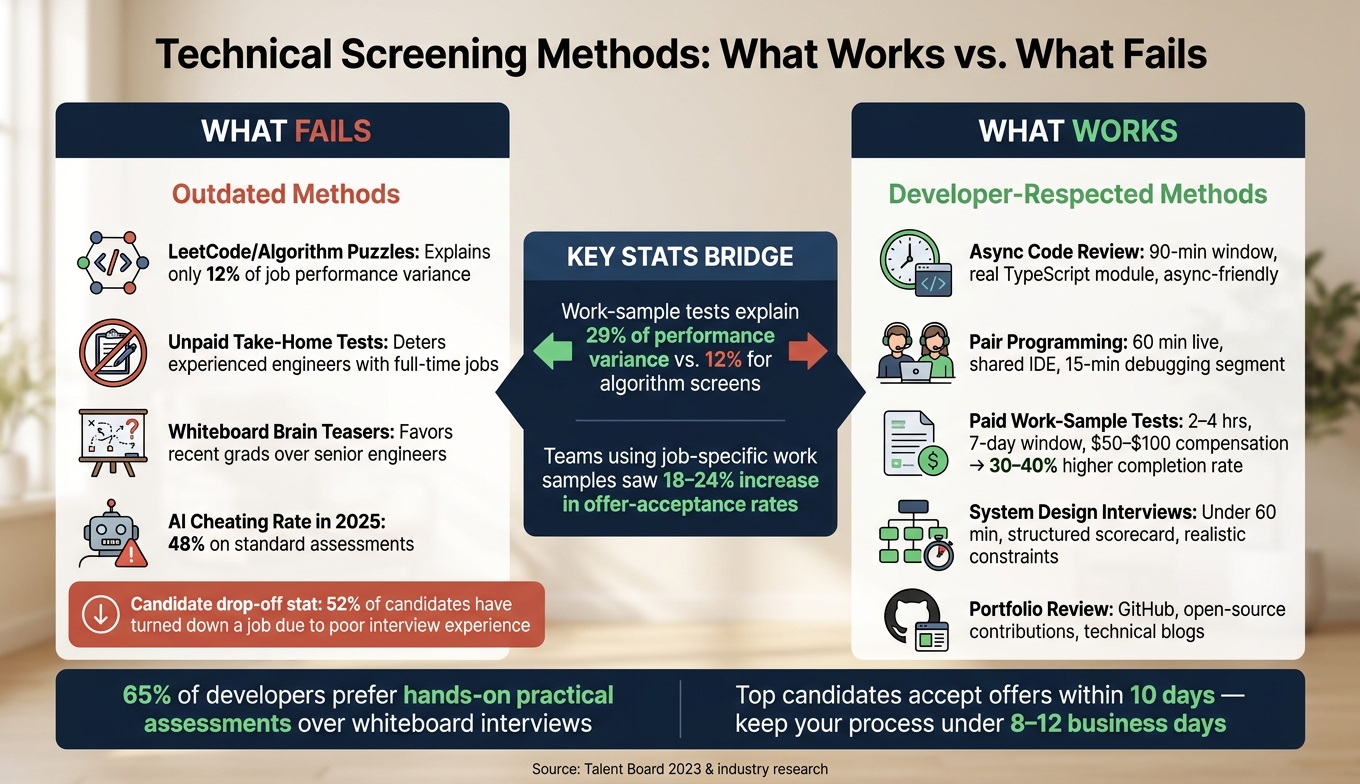
65% of developers prefer hands-on practical assessments over traditional whiteboard interviews . To address this preference, here are screening methods that reflect the actual work developers do daily.
Async Code Reviews
This method involves giving candidates a real TypeScript module with a bug, a missing feature, and messy code. Their task? Fix, implement, and refactor the module within a 90-minute window . This approach mirrors real-world tasks and evaluates practical technical skills.
The asynchronous format is especially helpful for senior engineers managing full-time jobs. It also works well for remote teams, focusing on a critical skill: communicating technical decisions in writing. For a more interactive evaluation, pair programming offers another solid option.
Pair Programming Sessions
Pair programming is one of the few formats that benefits both sides. Candidates get a feel for your team’s collaboration style, while you observe how they approach challenges in real time.
Keep the session to 60 minutes using a shared IDE. Watch for how candidates handle ambiguity, ask clarifying questions, and weigh trade-offs. As Chris Van Pelt, CTO of CrowdFlower, explains:
"When I'm doing phone screens, people are amazed that they're actually coding real problems instead of answering trivia questions. It's a much better way to see how someone really works."
Add a 15-minute debugging segment to the session. Debugging often reveals more about a candidate’s skills than writing new code from scratch .
Paid Work-Sample Tests
Work-sample tests are one of the strongest predictors of job performance, explaining 29% of performance variance, compared to just 12% for algorithm-focused screens . However, fairness is key to making these tests effective.
- Limit the task to 2–4 hours.
- Give candidates a 7-day window to complete it.
- Include a
setup.shscript to minimize time spent on environment setup . - Offer $50–$100 compensation, which can boost completion rates by 30%–40% .
Be clear about what the test doesn’t evaluate (e.g., visual design or framework choice) so candidates can focus on the right areas.
System Design Interviews Done Right
System design interviews often get a bad rap for favoring memorized patterns over actual problem-solving. To fix this, focus on specific, realistic scenarios like: "Design a notification system for 100,000 users on a $5,000/month infrastructure budget" . These constraints encourage thoughtful trade-offs, which is the insight you’re looking for.
Use a structured scorecard to evaluate areas like problem decomposition, scalability, and communication on a 1–4 scale. Keep the session under 60 minutes to respect the candidate’s time and reduce bias in technical hiring by about 40% .
Portfolio and Contribution Review
Experienced developers often showcase their work through GitHub profiles, open-source contributions, or technical blogs. Reviewing these materials offers a glimpse into their craftsmanship.
Look at commit histories, pull request descriptions, and blog posts to assess technical communication and collaboration. Open-source work, in particular, highlights skills like responding to issues, reviewing others’ code, and maintaining documentation - qualities that coding puzzles can’t measure. Portfolio reviews work best as a lightweight first step, complementing deeper evaluations later in the process.
How to Build a Multi-Stage Screening Process That Respects Developer Time
Matching Each Stage to Signal and Time Cost
Creating a developer-friendly screening process involves structuring it as a progression, where each stage justifies asking for more of the candidate's time. The goal? Start with light, efficient steps and only dig deeper when earlier stages provide strong signals.
| Stage | Format | Duration | Primary Signal |
|---|---|---|---|
| 1. Async Screen | Short video + code sample | 30–45 min | Communication & baseline fluency |
| 2. Technical Screen | Live paired coding | 60 min | Problem-solving process & collaboration |
| 3. System Design | Virtual canvas/whiteboard | 60–90 min | Architecture thinking & trade-offs |
| 4. Domain Deep Dive | Structured interview | 60 min | Stack depth & debugging instincts |
| 5. Values Review | Behavioral conversation | 45 min | Ownership mindset & team fit |
The async screen at Stage 1 is a smart starting point. In just 30–45 minutes, candidates can complete a short task - like a video walk-through or a code sample - that evaluates communication and baseline technical skills. This avoids the hassle of scheduling calls and respects everyone's time. By keeping the early stages simple, you can focus your team's energy on candidates who show real promise.
It's also important to limit the involvement of key team members to later stages. Expand participation only when earlier signals indicate a strong match.
Timing is critical. Research shows top candidates often accept offers within 10 days of initial contact . If your process stretches beyond 8–12 business days, you risk reducing time to hire efficiency and losing these candidates to faster-moving companies.
Making the Process Worth the Developer's Time
A screening process that feels one-sided - where candidates only give and get nothing in return - will push talented developers away. To keep the best candidates engaged, ensure every interaction provides value to them as well.
Start by sharing your evaluation criteria before each stage. When candidates understand what you're looking for and how success is defined, they can focus on showcasing their skills rather than second-guessing your expectations . This transparency doesn’t mean handing over answers - it’s about creating clarity and reducing unnecessary friction.
For any paid work-sample tests or take-home assignments, follow up with clear, written feedback. Highlight strengths and suggest areas for improvement. This small gesture can leave a lasting positive impression and demonstrates a commitment to respectful hiring practices.
Another tip: require independent scorecard submissions from evaluators before group debriefs . This prevents dominant opinions from overshadowing others and ensures a more balanced assessment. Using structured rubrics for interviews also makes evaluations approximately twice as predictive of job performance compared to unstructured conversations . Plus, it creates a fairer process for candidates, which benefits everyone involved.
How daily.dev Recruiter Reduces Screening Friction
Why Candidate Intent Matters at the Top of the Funnel
Understanding candidate intent early on can make or break the hiring process. Why? Because the quality of your candidate pool at the start directly impacts how much effort you'll need to put into screening later. When candidates apply with low intent - like responding to a random LinkedIn message or a generic job board post - you often end up sifting through more applicants to find just a few worth pursuing. This is where many hiring teams burn through time and resources.
On the other hand, high-intent candidates completely shift the dynamic. When a developer shows clear interest in a role, you can skip the initial "are they even interested?" stage and dive straight into meaningful evaluation. That’s exactly what daily.dev Recruiter aims to achieve. Every connection is double opt-in, meaning both the candidate and the hiring team have agreed to engage before any conversation begins. This approach creates a more focused and efficient hiring funnel, reducing wasted effort right from the start. Let’s take a closer look at the features that make this possible.
Features That Support a Developer-Respectful Hiring Process
daily.dev Recruiter operates within an active developer community, ensuring that the candidates you connect with are engaged professionals - not just names pulled from a database. Developers encounter your job postings in a trusted environment, aligning naturally with the practical, respectful screening methods mentioned earlier.
"Recruiting should be built on context, not spam. Developers shouldn't have to sift through irrelevant offers from strangers who don't understand their work." - Nimrod Kramer, CEO, daily.dev
Here’s how daily.dev Recruiter simplifies the hiring process for teams:
- AI-driven CV screening: An AI agent reviews resumes upfront to confirm foundational skills . By the time candidates reach your screening questions, their basic technical qualifications are already validated.
- Focused screening questions: You can limit custom questions to three, targeting essential deal-breakers like work authorization, time zone compatibility, relocation preferences, or niche expertise not evident on a resume . Keeping these questions concise - answerable in two to three sentences - respects developers’ time and reduces drop-off rates .
The impact is clear. This streamlined system allows hiring teams to cut the number of screens required per hire in half . That means less time spent interviewing and more time for your engineers to focus on their core work. By providing full job details upfront, daily.dev Recruiter ensures developers enter the process with clear expectations, minimizing frustration and interview fatigue. It’s a win-win for both sides of the hiring equation.
Conclusion: Rethink How You Screen Developers
The key takeaway here is straightforward: if your screening process wastes developer time, you'll lose top talent before you even get to evaluate them. Senior engineers, who often have multiple opportunities, will quietly bow out of any process that feels overly burdensome.
To turn things around, you need to streamline and clarify your approach. Start by designing initial screening tasks that take just 30–45 minutes and reflect practical, real-world scenarios - like async code reviews or pair programming. If a task requires more than a few hours, make sure to compensate candidates for their time. Be upfront about the entire process: outline all stages, how long each will take, and your expected response times. A small gesture like committing to respond within "2 business days after each step" shows candidates you value their time. These adjustments, based on proven practices, tackle many of the issues discussed earlier.
Here’s a simple litmus test for your current system: Would a senior engineer on your own team agree to go through this process today? If the answer is "no" or even "probably not", it’s time to rethink your approach.
Respecting candidates' time isn’t just about being polite - it’s smart business. According to the Talent Board's 2023 Candidate Experience Benchmark Report, candidates who feel respected are over twice as likely to recommend your company, even if they don’t get the job. Plus, realistic assessments are better predictors of on-the-job performance than outdated whiteboard challenges, reducing the risk of costly hiring mistakes. A streamlined, transparent process also minimizes candidate drop-off, saving you from repeatedly sourcing for the same role.
FAQs
What’s the fastest developer-friendly technical screen?
The quickest and most developer-friendly way to screen candidates is by using up to three focused, open-ended custom questions. These questions help confirm essential skills, such as system architecture expertise, right from the start. For a more thorough evaluation, a 45-minute paired programming session can be used. This involves working on a simplified task from your actual codebase, offering a practical alternative to theoretical tests. This approach saves time by skipping lengthy resume reviews and initial calls.
How can I prevent AI-assisted cheating in assessments?
Skip the typical LeetCode-style puzzles - they tend to rely on memorization and are no match for AI tools. Instead, focus on tasks that test deeper skills like judgment and problem-solving.
For example, assign candidates to review, debug, or improve AI-generated code. This approach not only evaluates their technical ability but also their capacity to spot flaws and make thoughtful decisions. You can also ask them to explain the consequences of specific implementation choices, which reveals their understanding of broader software design principles.
Allow candidates to use AI tools during these tasks, but pay close attention to how they work. Are they verifying the tool's output? Are they using AI effectively to enhance their own reasoning? This method gives you a clearer picture of their critical thinking and workflow, rather than just their ability to churn out solutions.
When should a work-sample test be paid?
When a work-sample test demands significant time or involves actual production work, it should come with compensation. Short assignments, like 90-minute take-home tasks, are typically unpaid. However, for more extensive trials - spanning hours, days, or even weeks - payment is essential. Compensation can vary, often starting around $1,000 for a one-week task and reaching up to $6,000 for senior-level projects. This approach ensures fairness while giving both the candidate and employer a chance to evaluate collaboration, communication, and skills before making a long-term commitment.
.png)