If I had to cut this list down fast, I’d say this: pick the certification that fixes your biggest hiring problem. In this guide, the main standouts are AIRS CTR for tech role fluency, AIRS CIR and AIRS CASR for sourcing, SHRM Talent Acquisition Specialty for hiring process control, LinkedIn Certified Professional–Recruiter for LinkedIn-heavy workflows, and AIRS CDR / AIHR AI for HR for bias and AI use in hiring.
Here’s the short version:
- Need better technical conversations? Go with AIRS CTR. This helps you speak the developers' language during technical interviews.
- Need more passive candidates? Look at AIRS CIR or AIRS CASR.
- Need tighter hiring process and interview structure? Choose SHRM TA Specialty.
- Live inside LinkedIn Recruiter all day? The LinkedIn certification is the low-cost pick at $199.
- Need better hiring consistency and less bias in early screening? Consider AIRS CDR, CASR, or AIHR AI for HR.
A few numbers stand out right away:
- $199: LinkedIn certification exam fee
- $895–$995: most AIRS options
- 40 hours: SHRM’s rough time commitment
- 2 years: common renewal cycle for many of these credentials
- 15% faster fills: one stat cited in the article for certified tech recruiters
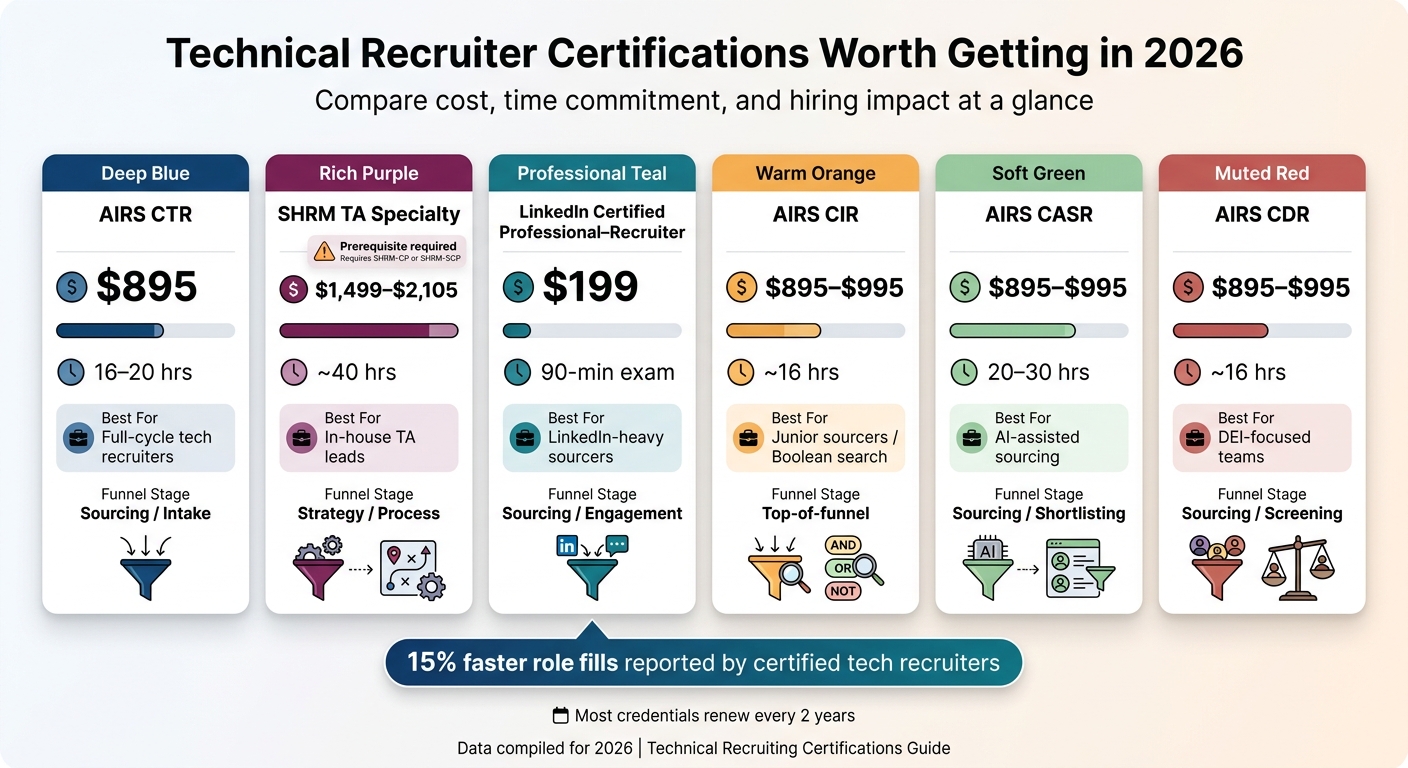
Quick Comparison
| Certification | Best for | Cost | Time | Main tradeoff |
|---|---|---|---|---|
| AIRS CTR | Recruiters hiring engineers, DevOps, cloud, IT | $895 | 16–20 hours | Helps with role language, not deep coding skill |
| SHRM TA Specialty | In-house TA leads and recruiting managers | $1,499–$2,105 | ~40 hours | Needs SHRM-CP or SHRM-SCP first |
| LinkedIn Certified Professional–Recruiter | LinkedIn-heavy sourcing | $199 | 90-minute exam | Mostly tied to one platform |
| AIRS CIR | Sourcers who need Boolean and X-Ray search | $895–$995 | ~16 hours | Stays focused on top-of-funnel work |
| AIRS CASR | Recruiters using AI in sourcing and shortlisting | $895–$995 | 20–30 hours | More sourcing-focused than late-stage assessment |
| AIRS CDR | Teams with DEI hiring goals | $895–$995 | ~16 hours | Payoff depends on company hiring goals |
| AIHR AI for HR | TA leads shaping AI use in hiring | ~$975 | 30–35 hours | More useful for process owners than solo sourcers |
Bottom line: I wouldn’t treat certifications like resume badges. I’d treat them like tools. If a credential helps you source better, screen with more control, or work better with hiring managers, it may be worth the money. If not, skip it.
The rest of the article breaks down each option by hiring impact, cost, time, and who should get it.
1. AIRS Certified Technical Recruiter (CTR)
The AIRS CTR is the certification that lines up most closely with recruiter roles focused on software engineering and infrastructure hiring. If most of your desk is made up of developer, DevOps, cloud, or IT roles, this is the one that fits best. It’s built for recruiters who spend most of their time hiring software engineers and infrastructure talent.
Developer hiring impact
For developer hiring, the main upside is technical fluency. CTR helps recruiters speak more confidently with engineering hiring managers and assess candidates with more precision . That often leads to faster progress on hard-to-fill searches and better trust with engineering managers.
Put simply: when you understand the language of the role, screening gets sharper and intake calls go a lot smoother.
That value comes from the technical fluency the curriculum builds.
Skill coverage
The curriculum covers technical terminology, core technical skill sets, basic IT governance, and emerging tech trends . It also covers sourcing approaches for finding niche and passive candidates in tech communities and channels, along with ways to qualify technical talent more accurately for software engineering and infrastructure roles .
This matters because tech recruiting isn’t just about finding people on LinkedIn. A lot of strong candidates sit in harder-to-reach places, and recruiters need to know both where to look and how to judge fit once they start the conversation.
Cost and time
CTR costs $895 and includes 12 months of OnDemand and instructor-led training, practice exams, digital badging, and the exam . Most people finish it in 16–20 hours over 2–3 weeks. The certification expires after two years and includes free recertification through MyAIRS, plus HRCI and SHRM credits .
The ROI comes down to one thing: does it help you screen better and fill roles faster? If it does, the spend is a lot easier to justify.
The real test is whether that investment pays off in stronger screening and faster hiring.
Best-fit recruiter profile
CTR makes the most sense if you hire technical or infrastructure roles on a steady basis and need more credibility with engineering managers . It’s also a strong pick for agency recruiters who want a recognized credential when pitching tech clients .
Use CTR when technical hiring is your core workload.
2. SHRM Talent Acquisition Specialty Credential
The SHRM Talent Acquisition Specialty Credential is centered on workforce planning, hiring process design, and close alignment with HR leadership. If CTR is more about technical fluency, SHRM is more about putting structure and discipline around how hiring gets done.
Developer hiring impact
This credential won't make you stronger at technical sourcing or Boolean search. That's not its lane.
What it can do is help you tighten intake alignment and make screening more consistent. The program leans into structured interviews, competency-based evaluation, and evidence-based hiring practices tied to job performance .
The weak spot is AI-assisted recruiting. It does little to help you build modern AI-driven sourcing or screening workflows .
Skill coverage
The program covers:
- Workforce planning
- Sourcing strategy
- Employer branding
- Diversity recruiting
- TA technology
- Recruitment analytics
It also includes global hiring and virtual TA modules, which can help support more consistent pipelines. On top of that, it earns 22 Professional Development Credits (PDCs) toward SHRM-CP/SCP recertification .
Optional cybersecurity talent resources are available, but they sit on the side rather than at the center of the curriculum .
Cost and time
Expect to pay about $1,499 to $2,105. The program takes about 40 hours and usually spans 2 to 4 months. You also need an active SHRM-CP or SHRM-SCP to enroll .
Best-fit recruiter profile
This credential fits best for in-house TA leads, senior recruiters, and recruiting managers who work closely with HR Business Partners or report into a VP of HR . In SHRM-led organizations, that name recognition can matter.
Agency recruiters will usually get more out of hands-on sourcing credentials. If you still want the SHRM credential, it makes sense to pair it with a technical sourcing certification so you cover the Boolean search and AI gaps that the SHRM curriculum doesn't address .
If your day-to-day work is more tactical and sourcing-heavy, the next option is a better fit.
3. LinkedIn Certified Professional–Recruiter
For recruiters who do most of their sourcing on LinkedIn, this is the most practical, hands-on upgrade. At $199, it’s the lowest-cost exam-based option on this list, and it makes the most sense if LinkedIn Recruiter is already your main sourcing tool .
Developer hiring impact
This credential won’t help you judge code quality or technical problem-solving. That’s not what it’s for.
What it does help with is finding and contacting passive technical talent faster. The program covers advanced Boolean search inside LinkedIn and InMail optimization. In plain English, that means better searches, better outreach, and a cleaner developer pipeline over time .
There’s also a visibility angle. Certification can improve profile visibility in filtered recruiter searches .
Skill coverage
The exam is about LinkedIn Recruiter workflows, not big-picture recruiting strategy. You can expect questions on:
- Boolean search inside the platform
- Outreach workflows
- Talent analytics
It includes 60–70 questions in 90 minutes and is delivered online through Webassessor .
Cost and time
| Feature | Details |
|---|---|
| Exam Fee | $199 |
| Exam Duration | 90 minutes |
| Question Count | 60–70 questions |
| Validity Period | 2 years |
| Renewal | Full retake at $199 |
Use it when LinkedIn Recruiter is a core sourcing channel, not just a backup tool.
Best-fit recruiter profile
This credential tends to pay off most for early-career recruiters, career switchers, and recruiters who use LinkedIn every day .
It’s also a strong match for recruiters at startups or those handling cross-border tech hiring, where LinkedIn is often the main sourcing channel .
Senior TA leaders usually get less from it. At that level, a proven track record or broader credentials often matters more than skill with one tool . And if LinkedIn isn’t one of your main sourcing channels, the ROI drops fast.
4. AIRS Internet Recruiter Certification
The AIRS Certified Internet Recruiter (CIR) is a sourcing-first credential built for recruiters who need to find engineers outside the usual applicant pools. That matters when generic outreach stops working and passive developers just aren't replying.
Developer hiring impact
CIR is a recognized baseline credential for outbound sourcing . It teaches Boolean and X-Ray search methods that help recruiters find passive candidates across GitHub, Slack communities, and niche forums . When your searches get tighter, your shortlist usually gets better too. And that means less time wasted on people who aren't a fit.
Certified tech recruiters fill roles 15% faster than uncertified peers . That's a clear edge when you're hiring for hard-to-fill DevOps and cloud roles.
Skill coverage
The curriculum is tactical and stays close to day-to-day sourcing work. It covers:
- Advanced Boolean strings and search operators
- X-Ray searching across Google and Bing
- Social media sourcing techniques
- Candidate research and structured sourcing workflows
This certification stays focused on the top of the funnel: finding people. It doesn't spend much time on broader HR planning or compliance.
Cost and time
| Feature | Details |
|---|---|
| Exam Fee | $895–$995 |
| Time to Complete | ~16 hours of instruction; 2–6 weeks total |
| Exam Format | Online, ~100 multiple-choice questions |
| Validity Period | 2 years |
| Recertification | Often free for alumni via the MyAIRS portal |
Best-fit recruiter profile
This certification makes the most sense for dedicated sourcers, agency recruiters, and full-cycle technical recruiters who depend on outbound search more than inbound applicants . It's also a strong match for teams hiring at volume for DevOps and cloud roles .
If you still need to sharpen your sourcing basics, CIR can help. If your Boolean and X-Ray search skills are already strong, it may not add much.
For recruiters who want a narrower search-skill upgrade, the next section looks at Boolean-specific certifications.
5. Boolean Search and Sourcing Certifications
Once you’ve got the basics down, the next move is pretty clear: search faster, target better, and use AI more wisely.
That’s where Boolean and sourcing certifications come in. They can help recruiters identify qualified technical candidates in minutes, which matters even more when developer pipelines are thin. In 2026, the top options stand apart based on how they use AI, how deep they go on technical hiring, and how strong they are for investigative search.
Developer hiring impact
- CASR: AI-assisted sourcing and shortlist automation.
- TechRecruit Pro: role-specific technical language and stack-aware screening.
- ACIR: advanced investigative sourcing for hard-to-fill roles.
Skill coverage
CASR focuses on prompt engineering, AI-driven keyword optimization, and automation for candidate matching. It’s a step up from CIR for recruiters who already know Boolean search and now need AI-assisted sourcing skills .
If you hire for niche technical roles, AI automation may not be the main thing you need. TechRecruit Pro is built for stack-aware screening across AI, ML, and DevOps roles. That helps recruiters write sharper job briefs and better scorecards .
ACIR goes deeper into investigative sourcing for hard-to-fill searches. So it works best as a specialization, not as a replacement for CIR .
Cost and time
| Certification | Cost | Time to Complete | Best Fit |
|---|---|---|---|
| AIRS CASR | $895–$995 | 20–30 hours | AI-assisted sourcing and shortlist automation |
| AIRS ACIR | $895–$1,800 | 60–80 hours | Investigative sourcing for experienced recruiters |
| TechRecruit Pro | ~$870–$1,300 | 3–5 weeks | Stack-aware screening for niche technical roles |
The best pick comes down to what’s slowing you down most. If speed is the issue, CASR makes sense. If technical screening is the weak spot, TechRecruit Pro may fit better. If the challenge is deeper candidate research, ACIR is the stronger option.
Best-fit recruiter profile
CASR is a strong fit for recruiters who spend a big part of the week sourcing or screening . TechRecruit Pro fits independent and agency recruiters in high-growth tech niches who need to back up higher retained-search or agency pricing . ACIR makes more sense for experienced sourcers who need deeper investigative research for executive-level technical roles .
For junior recruiters, a smart path is to start with AIRS CIR and then add CASR. That combo gives you core search logic first, then AI-assisted sourcing on top.
6. DEI and Skills-First Recruiting Credentials
After sourcing, the next challenge is how you assess developers fairly and fast. That’s where DEI and skills-first credentials come in. They help with two hiring issues at once: bringing more people into the pipeline and judging candidates based on proof, not pedigree.
Developer hiring impact
The AIRS Certified Diversity Recruiter (CDR) centers on inclusive hiring, bias reduction, and sourcing underrepresented populations. In developer hiring, that can lead to a broader qualified pipeline .
One credential helps more people enter the funnel. The other helps you sort them more consistently. CASR supports that by standardizing search terms and cutting bias in the first-pass funnel.
Skill coverage
The CDR covers legal frameworks, inclusive sourcing methods, and bias awareness in selection. CASR focuses on prompt engineering, custom GPTs, AI ethics, and automation. AIHR AI for HR covers AI policy, ethics, and vendor review for hiring systems that shape developer sourcing and screening decisions .
Cost and time
| Credential | Cost | Time to Complete | Best Fit |
|---|---|---|---|
| AIRS CDR | $895–$995 | ~16 hours | Enterprise/mid-market with active DEI mandates |
| AIRS CASR | $895–$995 | 20–30 hours | Recruiters whose week includes heavy sourcing or screening |
| AIHR AI for HR | ~$975 | 30–35 hours | TA leads who own process design and AI tooling decisions |
Best-fit recruiter profile
The CDR fits best if your company has clear diversity hiring goals, or if you’re aiming for a TA leadership role where diversity metrics are part of the job . It matters most when hiring goals include measurable diversity targets.
The AIHR AI for HR fits TA leads who make buy-vs-build calls on AI tools or set up hiring workflows from scratch . If you’re an individual contributor who spends most of the week sourcing or screening, CASR will usually improve sourcing output faster .
Use the comparison below to match each credential to your hiring priority.
Side-by-Side Comparison by Recruiter Need
No single certification solves every developer hiring issue. The best pick depends on where your funnel is breaking down. Maybe your pipeline is thin. Maybe candidate quality is off. Maybe conversations with engineering managers feel clunky. Or maybe your process gives you one result this month and a totally different one next month.
This grid helps match each credential to the recruiter problem it can address fastest.
| Certification | Primary Focus | Best For | Typical Cost (USD) | Time Commitment | Strongest Funnel Stage | Main Limitation |
|---|---|---|---|---|---|---|
| AIRS CTR | Tech literacy & niche sourcing | Full-cycle tech recruiters | $895 | 16–20 hours | Sourcing / Intake | Doesn't teach coding or deep engineering |
| SHRM TA Specialty | TA strategy & structured hiring | In-house TA leads | $1,499+ | 40 hours | Strategy / Process alignment | Requires SHRM-CP/SCP first |
| LinkedIn Certified Professional–Recruiter | Platform mastery | Recruiters who source primarily on LinkedIn | $199 | 4–6 hours | Sourcing / Engagement | Limited to LinkedIn workflows |
| AIRS CIR | Boolean & deep-web search | Junior sourcers | $895 | 16–20 hours | Top-of-funnel sourcing | No GenAI coverage |
| AIRS CASR | AI-assisted sourcing & screening | Modern sourcers | $995 | 20–30 hours | Sourcing / Shortlisting | Leans heavily on sourcing vs. screening |
| AIRS CDR | Inclusive hiring & bias reduction | Enterprise / DEI-focused teams | $895 | ~16 hours | Sourcing / Screening | Value depends on the company's DEI mandate |
If cost and time are your main filters, the picture gets clearer fast. The AIRS certifications, priced from $895 to $995, tend to offer the fastest practical payoff for full-time technical recruiters. That makes them easier to defend when you're trying to tie learning time to day-to-day hiring output.
The next table connects common developer-hiring bottlenecks to the certifications that fit best.
| Recruiter Challenge | Most Relevant Certification(s) | Why It Helps |
|---|---|---|
| Low response rates from senior engineers | AIRS CTR, AIRS CIR | Improves outreach through stronger technical understanding and passive-candidate research. |
| Too many irrelevant applicants | AIRS CASR, SHRM TA Specialty | Adds AI-assisted matching and structured intake criteria. |
| Weak technical conversations | AIRS CTR | Builds foundational knowledge of IT frameworks, stack terminology, and engineering roles. |
| Inconsistent hiring processes | SHRM TA Specialty | Supports structured interviews, workforce planning, and evidence-based selection. |
| High manual sourcing time | AIRS CASR, LinkedIn Certified Professional–Recruiter | CASR adds automated candidate sourcing and shortlist automation; LinkedIn improves platform shortcuts and talent pool analytics. |
| Bias in candidate selection | AIRS CDR | Provides bias-reduction strategies and inclusive sourcing methods. |
If you're not sure where to begin, start with the biggest bottleneck in front of you.
- If technical conversations feel weak, AIRS CTR is the clearest fit.
- If your pipeline is thin or full of low-fit candidates, look at AIRS CIR or AIRS CASR.
- If hiring quality changes from one manager to the next, SHRM TA Specialty makes the most sense, though you'll need to account for the prerequisite and the longer 40-hour time commitment.
From there, the next step is to look at the tradeoffs each credential brings in day-to-day use.
Pros and Cons
Now that the certifications are mapped by use case, the next step is figuring out the tradeoff. Every certification helps in one area and gives up something in another. That's the part that matters.
| Certification | Pros | Cons | Best Use Case |
|---|---|---|---|
| AIRS CTR | Strong signal for technical recruiting credibility | Improves literacy, not deep engineering knowledge | Recruiters consistently hiring for software or infrastructure roles |
| AIRS CASR | Strongest AI-assisted sourcing credential | Leans heavily toward sourcing; less coverage of final screening stages | Recruiters spending 15%+ of their week on sourcing or high-volume screening |
| SHRM Talent Acquisition Specialty | Best for TA leadership credibility | Expensive; requires SHRM-CP/SCP first; light on AI or sourcing tactics | Mid-career TA leads in large corporate environments moving toward director roles |
| LinkedIn Recruiter Certification | Low barrier to entry ($199); useful for LinkedIn-heavy sourcing workflows | Platform-specific; narrow beyond LinkedIn | Beginners or recruiters whose workflow is almost entirely LinkedIn-based |
| AIRS Internet Recruiter Certification (CIR) | Essential for recruiters dealing with passive-candidate droughts in niche technical stacks | Covers skills that are narrower than broader sourcing strategy | Recruiters who need to find talent beyond LinkedIn |
| AIRS CDR | Useful for inclusive hiring goals | Credential matters less than actual execution and outcomes | Startups and scale-ups building more inclusive engineering pipelines |
The main choice comes down to three paths:
- Tactical sourcing depth if your day-to-day work is finding hard-to-reach talent
- Platform mastery if most of your workflow lives inside one tool
- Broader TA strategy if you're moving into leadership or shaping hiring systems
Put simply, a certification only pays off when it changes how you source, screen, or run intake. If it doesn't make those parts better, it's just a badge.
The conclusion below turns these tradeoffs into a simple recommendation by recruiter need.
Conclusion
The right certification comes down to the hiring problem you need to fix.
If you need more technical depth, AIRS CTR is the clearest specialty pick. If sourcing is the main bottleneck, CIR or CASR is a better fit. If you need a broader TA lens, SHRM Talent Acquisition Specialty is the strongest match.
Pick based on what matters most right now:
- Technical fluency
- Sourcing speed
- Process discipline
The best recruiters don’t stop at the credential. They pair certification with sharper role calibration, stronger outreach, and vetting technical skills. The credential may help open the door, but the process behind it is what drives results. Using a developer hiring checklist can help ensure that process remains consistent.
FAQs
Which certification should I get first?
Start with the certification that best fits your role and experience level.
- New to recruiting or moving into the field: AIRS Professional Recruiter Certification (PRC)
- Focused on sourcing passive candidates and search logic: AIRS Certified Internet Recruiter (CIR)
- Starting an HR-focused career: HRCI aPHR for hiring basics and compliance
Are these certifications worth the cost?
It depends on where you are in your career and what you want next.
For in-house recruiters, the PHR often gives the best return for the price. It costs $495, which makes it a solid pick if you want HR knowledge that carries weight without spending a huge amount.
If you're aiming for leadership roles, the SHRM Talent Acquisition Specialty can help with credibility and salary upside. The tradeoff is cost. It runs more than $1,800, and you also need a SHRM-CP or SHRM-SCP first.
For sourcers and agency recruiters, AIRS certifications can be worth it if they help you work faster and make more placements. And if you're early in your career, lower-cost options like the $199 LinkedIn Recruiter Certification may give you more bang for your buck.
Do I need a certification to recruit technical talent well?
No. You can recruit technical talent well without a certification. In most hiring teams, results matter more than credentials.
That said, certifications can help in a few cases. They tend to make the most sense when you're early in your career, moving into a new vertical, or trying to step into leadership roles.
The best payoff comes when a certification fills a clear skill gap, like sourcing logic or employment law, and when hiring managers or clients actually recognize it.
.png)