Most DevEx hiring misses happen for one reason: the role is too vague. If you want the right hire, I’d keep the brief tied to one idea: DevEx helps internal engineers build, test, and ship with less friction.
Here’s the short version:
- I’d define DevEx by its user: internal developers
- I’d separate it from nearby roles by ownership
- DevEx: workflows, onboarding, docs, CLIs, CI friction
- Platform engineering: infra, runtime, reliability, cloud systems
- DevRel: external developers, content, community
- Product engineering: customer-facing features
- I’d screen for measured impact, not title alone
- I’d look for proof like:
- reduced onboarding time
- lower build times
- better tool adoption
- stronger self-service
- I’d avoid puzzle-heavy interviews and use tasks closer to the job
- I’d write the brief around scope, user, and success metrics
A few data points help set the bar. Strong teams often aim for local setup in 30–60 minutes. Teams using one-command, container-based setup have cut onboarding time by up to 60%. In many mid-sized orgs, DevEx work sits with 3–5 dedicated engineers.
Quick comparison
| Role | Main user | Main work | What success looks like |
|---|---|---|---|
| DevEx | Internal engineers | Tooling, onboarding, docs, CI flow | Adoption, less toil, better developer satisfaction |
| Platform Engineering | Internal engineers | Infra, runtime, reliability | Uptime, scale, platform use |
| DevRel | External developers | Community, education, advocacy | Reach, signups, community growth |
| Product Engineering | End users | Features and product logic | Revenue, retention, user growth |
If I were hiring for DevEx, I’d keep the whole process centered on one question: has this person made life better for other engineers in ways they can show with numbers, usage, or behavior change?
What Developer Experience roles actually own
DevEx as internal developer enablement
DevEx teams support internal engineers. Their job is to remove day-to-day friction: slow builds, weak onboarding, brittle pipelines, and tools that somehow still need a support ticket just to get used. For recruiters, the main thing to check is simple: is this role meant to improve how engineers work inside the company?
Day to day, that usually means owning the full local development experience. How fast can a new hire clone a repo and run the app? How steady is the CI pipeline? How easy is it to deploy? Strong DevEx teams push for fast local bootstrap times, often under 30–60 minutes . Teams that put containerized, one-command setup tools in place have cut developer onboarding time by up to 60% .
The role is defined by who it serves and what it changes: less friction, faster feedback, and more time shipping.
Common responsibilities in DevEx job descriptions
These responsibilities usually show up in a few repeatable workstreams:
| Responsibility Area | What It Looks Like Day to Day |
|---|---|
| Self-service tooling | Internal portals, templates, and automation that reduce manual tickets |
| CI/CD & build systems | Reducing build times, fixing flaky tests, improving pipeline reliability |
| Dev environments | Docker setups, Dev Containers, and cloud development environments like GitHub Codespaces |
| Documentation | Technical guides, API references, Architecture Decision Records (ADRs), and documentation that stays current |
| Onboarding | Runbooks, automated setup scripts, and "time-to-first-commit" design |
| Measurement | Developer satisfaction surveys, DORA metrics, build duration tracking, and friction analysis |
Measurement is part of the role. Strong DevEx candidates don’t just ship tools and move on. They baseline build time, onboarding time, and CI failure rates before changing anything. That tells you the person thinks like an operator, not just someone who likes building stuff.
Where DevEx teams typically sit in an engineering org
Titles and reporting lines vary a lot, which is one reason sourcing can get messy. The same work may be labeled Developer Productivity, Engineering Effectiveness, Developer Platform, or DevEx, depending on the company.
Org size shapes the setup in a big way. In smaller engineering orgs (fewer than 50 engineers), DevEx work is often handled by one or two generalists, sometimes as a part-time job. Mid-sized companies (50–200 engineers) usually have 3–5 dedicated engineers working on internal tools, build optimization, documentation, and metrics. In larger orgs (200+ engineers), you’ll usually see separate teams with clear sub-functions .
For recruiters, the best signal is the simplest one: is the internal developer the main user? That’s what separates a DevEx role from a platform role that just happens to touch developer tooling.
Use this internal-user lens to separate DevEx from DevRel, platform engineering, and product engineering.
How DevEx differs from DevRel, platform engineering, and product engineering
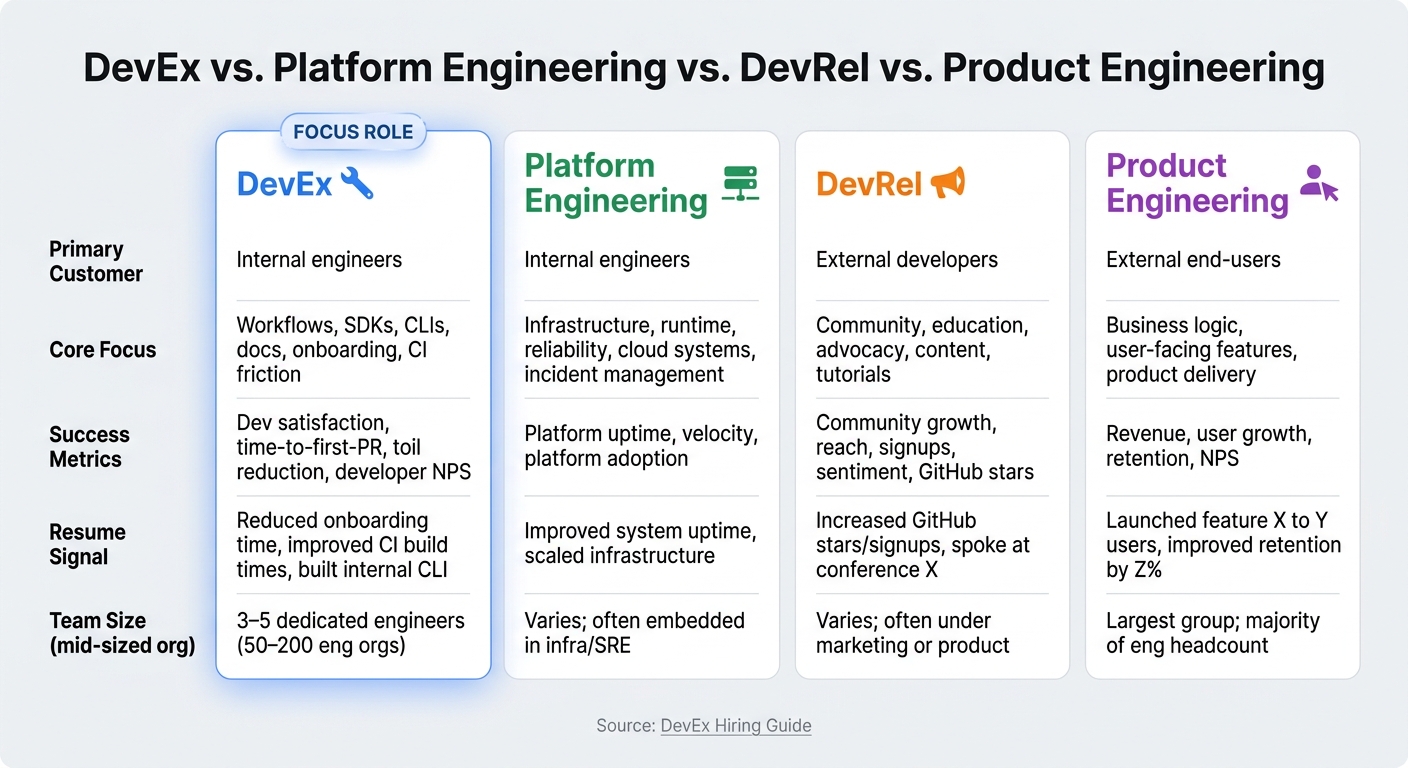
Use the internal-user lens to tell DevEx apart from nearby roles. That makes hiring a lot cleaner and helps you avoid screening the wrong people. The most common mix-ups usually happen in this order: DevRel, then platform engineering, then product engineering.
DevEx vs. Developer Relations
DevEx and DevRel sound close, but they serve different people.
DevEx supports internal engineering teams. DevRel supports external developers and the public-facing developer community.
That difference shows up fast on a resume. DevRel candidates often highlight talks, tutorials, community work, and audience reach. DevEx candidates are more likely to mention SDKs, CLIs, documentation, CI/CD optimization, and onboarding improvements.
If you screen a DevEx role the same way you'd screen a community or advocacy role, you'll pull in the wrong pool from the start.
The next split is a bit trickier: platform engineering. It serves the same internal customer, but it owns a different part of the stack.
DevEx vs. platform engineering
Both DevEx and platform engineering serve internal engineers. That's why people often lump them together. In some companies, they even sit on the same team.
The day-to-day line usually comes down to ownership.
Platform engineering focuses on the infrastructure layer: compute runtime, cloud environments, networking, and incident management. DevEx focuses on the usability layer: self-service workflows, documentation, and reducing cognitive load for developers using those systems. DevEx teams are also more likely to own developer training and education .
A simple way to think about it:
- Platform engineering builds the infrastructure
- DevEx makes that infrastructure easier to use
So if a candidate has a heavy infrastructure background, they may be a better fit for platform engineering, even if they've had some DevEx exposure.
DevEx vs. product engineering
The last split is between internal enablement and customer-facing feature work.
Product engineers build features for external end-users. DevEx engineers build tools and systems for internal developers. That's the anchor point.
A product engineer might ship a feature and track revenue, retention, and NPS. A DevEx engineer might ship an internal CLI tool and track adoption, time to first pull request, and developer satisfaction.
Here’s the side-by-side view:
| DevEx | Platform Engineering | DevRel | Product Engineering | |
|---|---|---|---|---|
| Primary customer | Internal engineers | Internal engineers | External developers | External end-users |
| Core focus | Workflows, SDKs, CLIs, docs | Infrastructure, reliability, scale | Advocacy, community, content | Business logic, user features |
| Success metrics | Dev satisfaction, time to first pull request, toil reduction | Platform uptime, velocity, adoption | Community growth, reach, sentiment | Revenue, user growth, retention |
| Resume signal | "Reduced onboarding time" | "Improved system uptime" | "Increased GitHub stars/signups" | "Launched feature X to Y users" |
Resume signals tell you what the candidate was measured on. And in practice, that's often the fastest way to check role fit.
How to source and screen DevEx candidates
DevEx candidates rarely have DevEx in their title. So when you screen, look for proof that they helped other engineers work better on the inside of the company, not just a job label. The key lens is simple: did this person make it easier for engineers to build, test, and ship?
Technical backgrounds and skills that map to DevEx
Strong DevEx candidates often come from backend or systems engineering, DevOps/SRE, technical writing with coding skills, or QA work centered on testing infrastructure . Different paths, same thread: they improved how engineers build, test, and ship software.
On resumes, put extra weight on hands-on work with CI/CD pipeline ownership, including GitHub Actions, GitLab CI, and Jenkins. Scripting skills in Python, Go, and Bash also map well. So do container and platform tools like Docker and Kubernetes, plus internal tooling work such as CLIs, developer portals like Backstage, and service scaffolding templates .
One of the best signs? They built a golden path that developers used because it was easier than the default option . That tells you this person didn’t just ship tooling. They made something people wanted to use.
Technical fit gets them in the door. But the better signal is whether they remove friction for other engineers.
Behavioral signals and past work that show DevEx fit
The clearest DevEx signal is empathy for engineers because adoption lives or dies on it. A tool can be well built, but if developers don’t use it, it missed the mark. DevEx works only when engineers adopt the tool or workflow.
Look for a product mindset applied to internal tools. That means gathering feedback, tracking adoption, and improving the experience over time. If a candidate can’t show adoption, treat that as a red flag. When you ask, “How did you measure success?” strong answers should point to metrics like time-to-first-commit, CI build time reduction, or developer NPS . In DevEx, unused tools fail.
It also helps to test for influence without authority. DevEx teams often drive change across engineering groups through alignment, trust, and steady relationship-building, not top-down orders . So push past delivery stories. Ask whether they can show adoption.
Those signs help narrow the field. After that, it’s about matching the right people to the titles and resume language they’re most likely to use.
Useful titles, resume signals, and sourcing angles
Search by impact, not title alone. Plenty of strong candidates won’t have “Developer Experience” anywhere in their title. Good titles to search include:
- Developer Productivity Engineer
- Internal Tools Engineer
- Build Engineer
- Engineering Enablement
- Developer Velocity Engineer
Platform Engineers can also fit, but only if their resume shows workflow, usability, or onboarding work, not just infrastructure.
On resumes, look for phrases tied to outcomes: “reduced onboarding time,” “improved CI build times,” “built internal CLI,” “increased tool adoption,” or “created self-service templates” . Those lines point to onboarding, build speed, and self-service gains. Keywords like DORA metrics, inner-loop optimization, scaffolding, and developer NPS are also strong clues.
For sourcing, it helps to target engineers from API-first companies or people who have contributed to open-source developer tooling projects like Babel, ESLint, or Homebrew . In outreach, lead with impact: faster onboarding, smoother releases, and less day-to-day friction.
How to evaluate DevEx candidates and write better role briefs
Once you've found people with the right background, the next step is simple: figure out whether they can improve how developers work day to day.
Interview signals that indicate real DevEx experience
Use interviews to check for impact, not just technical overlap. Ask candidates to walk through one point of friction they fixed: what was going wrong, how they figured it out, what they changed, and how they tracked adoption. You're trying to answer one core question: Can this person help internal developers move faster, with less stress, and with more independence?
Here’s what that tends to look like in practice:
| Signal Area | Strong DevEx Candidate | Weak or Generic Engineering Candidate |
|---|---|---|
| Problem Solving | Starts by understanding developer pain points before proposing a solution | Jumps straight to a technical fix without user context |
| Documentation | Sees docs as part of the deliverable | Treats docs as optional |
| Tradeoffs | Can explain tradeoffs without prompting | Knows one way to solve a problem and can't discuss alternatives |
| Metrics | Uses adoption and developer workflow metrics | Defaults to infrastructure or support metrics |
| Learning | Explains what failed, what changed, and what they'd do differently | Avoids discussing misses or lessons |
A good litmus test is asking candidates to review an API’s onboarding flow or documentation. Strong DevEx people usually spot friction fast, then explain how they'd fix it in a way that helps users get moving sooner.
Those signals should shape your interview loop. The point is to test work they'd actually do, not how well they perform in abstract problem-solving exercises.
How to structure a DevEx-friendly interview process
Skip puzzle-heavy interviews. They don't match the job.
Instead, build the process around scenarios that feel like the work itself. A solid setup might include a recruiter screen, a technical screen, a take-home based on a realistic task, and an onsite that focuses on code review, documentation, and how the candidate thinks about developer needs.
At each stage, push on tradeoffs and judgment. Ask how they'd deal with flaky tests in a CI pipeline, reduce build friction, or make setup self-service for engineers. Those questions surface the product mindset that separates DevEx engineers from infrastructure engineers who also happen to build internal tools.
That same idea should carry into the role brief too. Describe the work, the user, and the success metrics in plain English.
Writing DevEx role briefs and outreach that attract the right candidates
If your role brief reads like a platform engineering post, rewrite it around developer friction and measurable outcomes.
A useful starting point is the 50/30/20 ownership split: about 50% building work such as SDKs, CLIs, and internal tools; 30% documentation, including guides, tutorials, and onboarding flows; and 20% research and advocacy, like developer feedback loops and adoption tracking. Spelling that out tells candidates that documentation counts as real work here, not something people squeeze in after the “main” tasks are done.
| Role Brief Component | DevEx-Specific Angle |
|---|---|
| Mission | Frame it around "reduce developer friction and speed up delivery" rather than infrastructure ownership |
| Responsibilities | Explicitly include "identifying friction points" and "advocating for developer needs" |
| Success Metrics | Use "time-to-first-PR" and "developer NPS" instead of just uptime |
| Requirements | List technical writing and a user research mindset alongside coding skills |
| Tech Stack | Include documentation platforms like Docusaurus and ReadMe alongside CI/CD tools |
| Interview Process | Mention practical exercises like "identifying friction in a sample workflow" instead of puzzles |
Outreach matters too. Lead with the problem the role solves, not the tools it uses. Specific language tends to land better with developers. For example, "You'd own reducing onboarding time for engineers" is stronger than "You'll work on reducing onboarding time." It feels clearer, more direct, and tied to ownership.
It also helps to include 30/90-day goals, such as "reduce time-to-first-API-call by 50% within 90 days." That shows the company has a clear picture of what success looks like, instead of posting a vague job and hoping the right person fills in the blanks.
Conclusion: Hire for DevEx with a clearer brief and better signals
DevEx is not a catch-all developer tools job. It’s a specific role focused on helping internal developers work better. That internal-user lens is what separates DevEx from nearby roles and a lot of hiring noise. When teams blur it with DevRel, platform engineering, or product engineering, they often end up with the wrong hire.
Once you’ve defined the scope, the next screen is simple: has this person improved developer workflows in ways you can measure? Strong DevEx hiring leans toward adoption, usability, and cross-team influence, not tooling for tooling’s sake. The people who do well in these roles tend to treat documentation as real engineering output, judge success by adoption instead of just deployment, and move teams forward even when they don’t have direct authority.
Those signals only mean something if the brief is clear about the user, the ownership, and how success will be measured. A platform-style brief tends to attract infrastructure-heavy candidates and miss the DevEx fit. Be plain about the ownership split, name the success metrics, and say who the user is: internal developers. That kind of detail screens out weak-fit candidates before the first call.
The clearer your DevEx scope, the faster you can move from sourcing to offer with fewer mismatches.
FAQs
When should a company hire DevEx instead of platform engineering?
Hire DevEx when the goal is to improve the developer experience: onboarding, training, documentation, and day-to-day workflow efficiency.
Hire platform engineering when the focus is internal infrastructure, like cloud platforms, networking, and security.
Put DevEx first if developers are complaining about their tools, onboarding takes too long, productivity is slipping, or teams keep building the same internal tools more than once. DevEx helps remove friction and lowers cognitive load for engineers.
What metrics best prove DevEx impact?
Use a mix of delivery, efficiency, and satisfaction metrics. DORA metrics - deployment frequency, lead time for changes, and change failure rate - give you a solid baseline for delivery performance.
It also helps to track onboarding time, time-to-first-commit, pipeline stability, build queue times, test reliability, tool adoption, and developer feedback. The clearest proof of impact shows up in day-to-day work: lower cognitive load, less toil, and faster time-to-market.
What interview tasks work best for DevEx hiring?
The best DevEx interview tasks focus on actual problem-solving and empathy for developers, not abstract technical puzzles.
Ask candidates to walk you through a time they spotted a developer pain point, got internal buy-in, and measured whether the fix worked. That tells you a lot more than a brainteaser ever will.
Practical exercises help too. For example, you can ask them to review a fictional developer platform and point out friction areas, or explain how they'd design an internal portal.
It’s also smart to test communication. Have them explain a technical concept in plain English or talk through how they’d handle resistance from a team. In DevEx work, that kind of people skill matters just as much as technical judgment.
.png)