If you wait until a roadmap slips, you’re already late. I’d make the hiring call by comparing usable team capacity with roadmap demand, then working backward from the ship date because hiring often takes 3 to 6 months, and full ramp can take 6 to 9 months.
Here’s the short version:
- I wouldn’t plan from headcount alone. Teams often have only 40% to 60% of gross hours available for project output.
- I’d subtract meetings, PTO, on-call work, reviews, support, and incident time before I estimate delivery capacity.
- I’d split demand into product work, support work, tech debt/security work, and buffer.
- I’d keep 10% to 20% unassigned for surprise work and avoid planning at 100% utilization.
- If the team stays above 85% utilization for more than a sprint, I’d either cut scope or start hiring.
- I’d choose between full-time hires, contractors, or internal team shifts based on timing, skill gaps, and how long the gap will last.
- I’d treat new hires as partial output at first, not full output on day one.
A simple way to think about it is this: capacity planning turns “we need more engineers” into a number tied to delivery dates. That makes hiring easier to explain to finance, easier to time, and less likely to miss the roadmap.
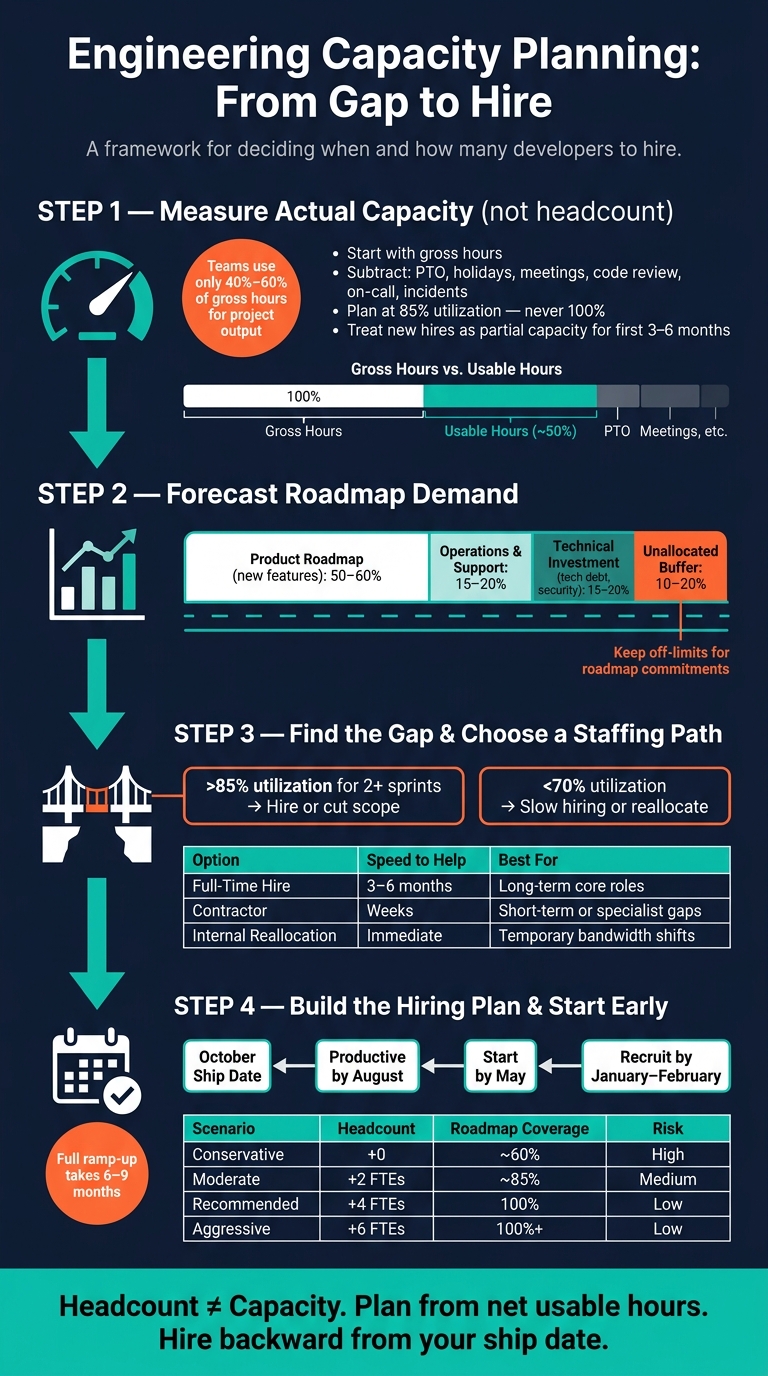
Quick comparison
| Option | Time to help | Best use | Main tradeoff |
|---|---|---|---|
| Full-time hire | 3 to 6 months to hire | Long-term team needs | Slow to fill; salary + benefits |
| Contractor | Weeks | Short-term gaps or niche skills | Higher hourly cost; handoff risk |
| Internal reallocation | Immediate | Temporary team pressure | Can slow other work |
I’d use this framework to answer three plain questions: Can my current team ship the plan? When does demand pass capacity? and What staffing move closes the gap in time?
1. Measure actual engineering capacity, not just headcount
Headcount tells you how many seats are filled. Capacity tells you what those people can actually ship after meetings, support work, and day-to-day ops are taken out.
That gap is where a fuzzy staffing problem turns into a concrete hiring number. It's also where delivery plans tend to go off track.
Many engineering teams operate at only 40% to 60% usable capacity compared with gross hours . So a team of eight developers usually won't produce eight developers' worth of project output. Time gets eaten up by meetings, reviews, on-call work, and unplanned incidents.
Calculate usable sprint or monthly capacity
Start with gross hours. Then subtract PTO, holidays, meetings, code review, on-call time, and expected incident work. Use the last 3 to 6 sprints as your baseline, and plan for 85% utilization, not 100% .
That matters more than it sounds. On paper, a sprint may look full. In practice, part of that time is already gone before project work even starts.
Also, treat new hires as partial capacity during their first few months. Their ramp-up time counts, and so does the onboarding time your current team spends helping them get up to speed .
This gives you the capacity baseline you'll compare against roadmap demand in the next step.
Map skill coverage across the current team
Engineering capacity isn't interchangeable. A backend gap doesn't disappear because you have extra frontend time. The same goes for DevOps, infrastructure, data, QA, or security bottlenecks.
A simple skill map can make those weak spots easy to see. Tag engineers by specialty, such as:
- backend
- frontend
- mobile
- infrastructure
- data
- QA
- security
Then compare that coverage with the roadmap. This helps you spot specialists on the critical path: people with specialized skills who support more than two critical paths .
Most teams have only 60% to 70% of their time left for project work after meetings, on-call duties, and PTO are removed, so skill gaps often matter more than raw headcount. That makes the staffing choice clearer: you may need a new hire, a specialist contractor, or a shift in how work is assigned.
With usable capacity mapped, the next step is to translate roadmap work into delivery demand.
2. Forecast workload from the roadmap and convert it into forecast demand
Once you know your usable capacity, the next step is to turn the roadmap into demand. That gives you a simple side-by-side view: how much work is coming, how much team time you have, and when hiring starts to make sense.
A lot of forecasts go off the rails for one reason: they count roadmap items and forget the work that eats time every week anyway. Ops, maintenance, support, and incident load all matter. If part of the roadmap is still fuzzy, weight it by probability so maybe-work doesn't skew the plan .
Break roadmap work into demand buckets
A simple way to do this is to split work into four buckets: new features, operational work, technical investment, and unplanned buffer.
| Demand Bucket | Typical Capacity Share | Examples |
|---|---|---|
| Product roadmap (new features) | 50–60% | New user-facing functionality, product launches |
| Operations and support | 15–20% | Bug fixes, on-call response, incident triage |
| Technical investment | 15–20% | Tech debt, security patches, dependency upgrades |
| Unallocated buffer | 10–20% | Unexpected work, urgent requests, P1 incidents |
That 10–20% buffer matters more than it may seem. Treat it as off-limits for roadmap commitments. If the quarter stays calm and you don't need it, great - you ship ahead of plan. If a production issue lands out of nowhere, you have room to absorb it without wrecking delivery.
This bucket split also helps you see what's actually going on. Is the team under pressure because of a short-term spike in work? Or is there a steady gap that points to a hiring need?
It also helps to review the backlog for inactive projects - low-priority work that still burns engineering time just because tickets are sitting open . Clearing those out before you forecast can shift available capacity more than most teams expect.
Use a simple headcount model for delivery timelines
After demand is grouped, convert everything into one planning unit. Engineer-weeks or person-months both work. The point is to measure demand and capacity the same way, then compare net roadmap demand with net usable capacity.
For example, a weighted forecast of 37.3 engineer-weeks shows how much team capacity is needed before the roadmap is fully covered . That becomes your planning benchmark.
One more thing: don't plan at 100% capacity. Teams that do that almost always overcommit. Hold a risk buffer so the model matches how delivery works in practice, not how it looks on a spreadsheet.
That total demand number is what you'll compare with current capacity to decide if you need to hire.
3. Find the gap and decide whether to hire, rebalance, or use temporary support
Start by comparing demand with net usable capacity.
If demand still sits above capacity after you hold back a 15%–20% buffer for unplanned work, you have a capacity gap. And that usually means delivery risk. If capacity is well above demand, it’s a sign to slow hiring or move work to other teams.
There’s also a simple pressure check. If utilization stays above 85% for more than one sprint, rebalance scope or begin hiring . If it stays below 70%, that points the other way .
Translate the capacity gap into number of developers needed
The point isn’t to hire until a dashboard shows the “right” percentage. The point is to add enough capacity to protect committed delivery dates.
That means planning for ramp-up time. A new hire usually contributes only part of their full capacity for the first 3–6 months . So if you need help by a fixed date, you can’t treat a new engineer like instant coverage.
The same logic applies when someone leaves. One departure usually means losing about one steady-state developer’s capacity. Start the backfill at once, and account for onboarding lag. In practice, it helps to work backward from the delivery date and ask: when does this person need to be productive, not just hired?
That headcount estimate then feeds the next set of choices: role mix, timing, and hiring scenarios.
Choose full-time hires, contractors, or internal reallocation
The right move depends on three things:
- How long the gap will last
- How specialized the skill set is
- How fast you need coverage
| Staffing Option | Speed to Impact | Cost Structure | Long-term Fit | Best For |
|---|---|---|---|---|
| Full-Time Hire | Slow (3–6 months) | High (salary + benefits) (calculate costs with a hiring budget calculator) | High - builds IP and culture | Core, long-term roles |
| Contractors | Fast (weeks) | Higher hourly rate | Low - can create knowledge silos | Short-term gaps or specialist work |
| Internal Reallocation | Immediate | Neutral | High - retains talent | Temporary bandwidth shifts |
"We need more engineers' is not a business case. Neither is 'we're behind on the roadmap.' CFOs hear these requests constantly and have learned to be skeptical." - Ashley Russell, CodePulse
This is where the gap analysis earns its keep. It turns team strain into a hiring number tied to delivery dates, instead of a vague request for “more help.”
Next, turn the option you chose into a role mix and hiring timeline.
4. Build the hiring plan by role mix, timing, and scenarios
Once you know the capacity gap, the next step is simple in theory and messy in practice: turn that gap into the hires that remove delivery blockers first.
The goal isn't to add headcount for the sake of it. The goal is to hire the people who let the rest of the team move.
Prioritize roles based on roadmap work that is already blocked
Start with your main roadmap initiatives and ask a blunt question: which missing skills are already slowing work down? That's where your hiring plan should begin.
Put the roles that unblock other people at the top. If one missing hire keeps a whole team from shipping, that role goes first. A missing DevOps engineer is a good example. One gap there can hold up deployment across the team.
| Roadmap Initiative | Required Capabilities | Delivery Risk if Missing | Priority |
|---|---|---|---|
| API Performance Scaling | Backend (Go/Node), Database Tuning | System instability; high latency | Critical |
| Security Compliance Audit | Security Eng, Infrastructure | Legal/compliance failure; data breach | Critical |
| Mobile App Refresh | Swift/Kotlin, Mobile UI/UX | Launch delay; poor user ratings | High |
| CI/CD Pipeline Automation | DevOps, Platform Engineering | Deployment bottlenecks; manual error risk | High |
It also helps to watch for bottleneck engineers. These are specialists who sit on two or more critical paths at the same time. If one person is double-booked across key projects, moving tasks around usually won't fix the issue. In that case, the role itself belongs in the hiring plan.
Create conservative, expected, and aggressive hiring scenarios
Hiring plans rarely stay fixed. Scope shifts. Attrition happens. Recruiting takes longer than hoped. That's why it's smart to build a few scenarios upfront instead of rewriting the plan every time something changes.
Model each scenario against the same usable-capacity baseline so the tradeoffs stay clear.
| Scenario Type | Headcount Change | Roadmap Coverage | Delivery Risk |
|---|---|---|---|
| Conservative | +0 | ~60% | High - missed targets, burnout risk |
| Moderate | +2 FTEs | ~85% | Medium - tight, no buffer |
| Recommended | +4 FTEs | 100% | Low - healthy buffer |
| Aggressive | +6 FTEs | 100% + new R&D | Low - expansion-ready |
From there, choose the option that lines up with budget, hiring speed, and delivery commitments.
Start recruiting early enough to match delivery dates
This is where a lot of hiring plans fall apart.
A team says it needs someone by Q3, then opens the role in May. On paper, that sounds fine. In practice, by the time interviews are done, the offer is signed, onboarding happens, and the new hire ramps up, Q3 is gone.
It typically takes 6 to 9 months for a new developer hire to reach full contribution . So work backward from the delivery date, not from the date the role gets approved.
If a feature needs to ship in October, the engineer behind it should be productive by August. That means they likely need to start by May. Which means recruiting should begin in January or February at the latest.
Start recruiting early enough to finish interviews, offers, and onboarding before the milestone.
That's the part teams often miss. If the timing is off, even the right hire won't help soon enough.
Conclusion: A simple framework for confident developer hiring decisions
After you measure capacity, forecast demand, and spot the gap, you can make the hiring call with a lot more confidence. At its core, the process is simple: measure what your team can actually deliver, forecast what the roadmap asks for, find the gap between those two numbers, and then match that gap to the right hiring path and timeline.
The step many teams miss is the first one. Headcount is not capacity. Plan from net capacity, not org chart size. That's why you need to measure usable capacity before you make any hiring move.
Once the gap is clear, the next call is straightforward: which staffing mix closes it fastest? That’s when you decide whether the answer is a full-time hire, a contractor, or an internal shift in team allocation. Capacity planning should limit commitments, not serve as a way to justify them.
Timing matters just as much. Developer hiring usually takes 3 to 6 months . So work backward from the delivery date and open the role early enough to absorb that hiring lag. This often requires reducing time to hire to keep projects on track. Otherwise, blocked work can stay blocked past the deadline.
This framework makes hiring decisions easier to defend because each one ties back to delivery needs, skill gaps, and lead time.
FAQs
How do I calculate usable engineering capacity?
Calculate usable engineering capacity by starting with the total team hours you have on paper, then subtract the time that never makes it into the roadmap anyway: meetings, code reviews, admin, and context switching.
That’s the part many teams miss.
A team might look fully staffed, but its actual output is much lower. In practice, many teams operate at 40% to 60% efficiency once that non-roadmap work is taken into account.
Next, add a 20% to 30% buffer for unplanned work. Bugs pop up. Stakeholder requests land out of nowhere. Systems misbehave at the worst time. That extra cushion keeps your plan from falling apart the moment real life shows up.
From there, compare your net capacity against roadmap demand, whether you measure that demand in engineer-weeks or story points.
This gives you a clear view of the gap:
- If demand is higher than capacity, you likely need to hire, cut scope, or move timelines.
- If capacity and demand are close, your plan is probably tight and leaves little room for error.
- If capacity is higher than demand, you may have room to pull work forward.
It’s a simple exercise, but it turns a fuzzy roadmap conversation into a numbers-based planning discussion.
When should I hire instead of cutting scope?
Hire when capacity planning shows a persistent, long-term gap between the work that needs to get done and the people available to do it. If process fixes still don’t close that gap, adding headcount starts to make sense.
A few signals tend to stand out:
- Utilization stays above 85%
- Velocity drops even though the team is putting in high effort
- The backlog grows faster than the team can finish the work
On the other hand, cut scope or fix the workflow first if utilization is below 70% or if you’re seeing clear signs of waste, rework, or bottlenecks. In that case, hiring won’t solve the root problem.
Use hiring to deal with long-term skill shortages, not short bursts of demand like a six-week spike.
How many developers do I need for a launch?
Base the plan on the capacity gap, not just headcount.
Start by estimating the work on the roadmap. Then compare that workload with your team’s effective capacity, using past velocity and a focus factor of 0.60 to 0.70 to account for meetings, code reviews, tech debt, and support work.
If demand is higher than capacity, look at the missing skills and decide what gives:
- hire
- cut scope
- extend deadlines
Also, factor in a three- to six-month ramp-up for new hires. And don’t plan as if the team can run at 100% utilization. That sounds neat on paper, but it usually falls apart once day-to-day work hits.
.png)