Recruiting developers through online communities like Discord, Reddit, and Slack is more effective than traditional job boards. Why? Developers prefer spaces where they can network, share knowledge, and demonstrate skills in real-time. These platforms allow recruiters to connect with both active and passive talent by engaging in meaningful conversations and observing technical expertise firsthand.
Key Takeaways:
- Discord: Join relevant servers, respect community rules, and engage before posting job opportunities. Look for active servers with dedicated job channels.
- Reddit: Build karma by contributing to discussions in subreddits like r/Programming or r/webdev. Use hiring threads or job-specific subreddits like r/forhire for direct recruitment.
- Slack: Focus on invite-only communities where members often use real identities. Participate in technical discussions and use #jobs channels for posting roles.
By being active, respectful, and transparent, you can build trust and connect with talented developers across these platforms.
How to Recruit Developers on Discord
Finding developer Discord servers worth joining
To recruit developers on Discord, start by identifying servers that align with your hiring goals. For example, if you're looking for game developers, Unreal Source (124,000 members) focuses on C++ and Unreal Engine, while Game Dev League (120,000 members) covers general game development topics . For frontend developers, Reactiflux boasts over 172,000 members specializing in React and TypeScript . If you're searching for talent across various technical fields, The Coding Den hosts more than 93,000 developers skilled in JavaScript, Python, machine learning, and UX .
You can use Top.gg to search for developer communities by typing in keywords like "developer", "hiring", or specific programming languages . Look for servers that feature dedicated job-related channels such as #jobs or #hiring, as these are geared toward recruitment. For instance, the Developer Recruiting Hub has a perfect 5/5 rating on Top.gg, with users praising its efficient hiring process that avoids bots and approval delays . Also, check the "active now" count to ensure the server is lively. For example, Game Dev Network often has over 10,000 active users during U.S. daytime hours, which indicates strong engagement .
Once you've found the right servers, it's crucial to respect the community norms to make a positive impression.
How to participate without getting banned
Every server has its own set of rules, usually found in pinned messages or the #rules channel. Ignoring these guidelines - like posting job ads in general discussion channels - can lead to an instant ban . A better approach is to introduce yourself in the #introductions channel, showing interest in the community's tech focus instead of jumping straight into hiring.
To build credibility, contribute to the community by answering technical questions, sharing helpful resources, or providing feedback in #show-off-your-work channels. When you're ready to mention job opportunities, use the server's designated channels, such as #jobs or #marketplace. Keep in mind that some servers, like Game Dev Network, may require a subscription to post in career-related channels . Additionally, keep an eye on "Looking for Work" channels, where developers often share their bios - this can help you connect with candidates actively seeking roles.
By engaging respectfully and adding value to the community, you'll set the stage for effective recruiting while avoiding common pitfalls.
Discord recruiting challenges and how to handle them
Discord's anonymity can make verifying candidates tricky, as many users rely on pseudonyms and avatars . To overcome this, focus on building relationships through technical discussions and tailor your outreach. Avoid sending generic or automated messages, as these can come across as impersonal. Also, be mindful of Discord's strict spam detection - sending identical direct messages to multiple users in a short period can trigger filters and result in account suspension .
To manage your efforts effectively, limit yourself to three to five servers initially. This allows you to focus on communities where your target developers are most active. Once you’ve established a presence, you can gradually expand to other servers. Always be upfront about who you are and the company you represent. By investing time in meaningful interactions, you can build trust and navigate Discord's recruiting challenges more effectively.
How to Recruit Developers on Reddit
Which subreddits have the best developer talent
Reddit is home to a massive developer community, with r/Programming alone boasting 5.1 million members . Much like platforms like Discord or Slack, Reddit's specialized communities require a thoughtful, community-focused approach to recruitment. A great starting point is r/webdev (1.5 million members) or r/cscareerquestions (966,000 members) . For senior-level professionals, r/ExperiencedDevs is worth exploring, as it requires members to have at least three years of professional experience .
If you're looking for developers with expertise in specific programming languages, language-focused subreddits are invaluable. For example:
- r/cpp: 238,000 members
- r/csharp: 216,000 members
- r/dotnet: 124,000 members
Frontend developers often frequent r/javascript and r/reactjs, while the "related subreddits" section in larger communities can lead you to niche groups like r/UnrealEngine, r/Unity3D, or r/godot .
For collaborative opportunities, check out r/INAT (I Need A Team), where developers actively seek projects and partnerships .
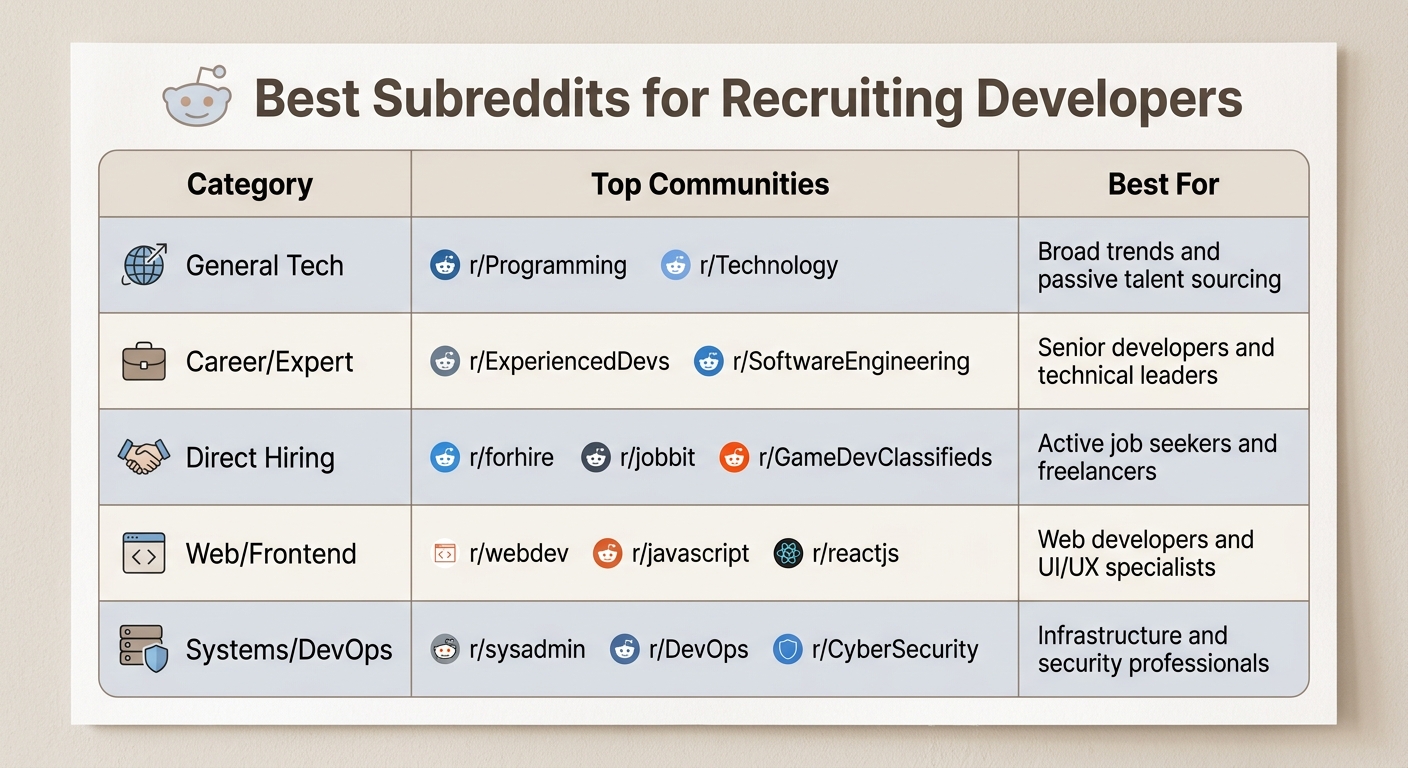
| Category | Top Communities | Best For |
|---|---|---|
| General Tech | r/Programming, r/Technology | Broad trends and passive talent sourcing |
| Career/Expert | r/ExperiencedDevs, r/SoftwareEngineering | Senior developers and technical leaders |
| Direct Hiring | r/forhire, r/jobbit, r/GameDevClassifieds | Active job seekers and freelancers |
| Web/Frontend | r/webdev, r/javascript, r/reactjs | Web developers and UI/UX specialists |
| Systems/DevOps | r/sysadmin, r/DevOps, r/CyberSecurity | Infrastructure and security professionals |
How to earn trust in Reddit communities
Building trust on Reddit starts with karma points, which you earn by contributing helpful and meaningful content . Engage with communities like r/learnprogramming, r/Cpp_questions, or r/javahelp by answering technical questions. Over time, higher karma boosts your credibility and visibility within the platform .
"When you reach someone in a place they actually care about and use daily, you're not competing with a wall of noise." - Dafna Ran, daily.dev
Every subreddit has its own set of rules, typically outlined in the sidebar. For instance, r/talesfromtechsupport prohibits mentioning personal or business names, while r/ReverseEngineering rejects posts with "marketing fluff" or non-technical content . Breaking these rules can result in a permanent ban from the subreddit - or even Reddit itself . Timing is also key; subreddits like r/webdev only allow project sharing on specific days, such as "Showoff Saturday" .
When discussing job opportunities, transparency is crucial. Be upfront about your tech stack and include the relevant programming language in your post titles. This ensures you're targeting candidates who are already a good match, saving time for both you and the community .
Using hiring threads versus regular posts
Once you've established credibility, you can start using hiring threads strategically. Many large subreddits prohibit standalone job posts, instead directing recruiters to specific threads . For example, r/webdev uses pinned monthly threads for career-related discussions, while r/ExperiencedDevs limits recruiters to its weekly "Ask" thread .
If you're ready to post directly, hiring-focused subreddits like r/forhire, r/jobbit, or r/SysadminJobs are your best bet. These communities are specifically designed for job postings, but make sure to follow the rules - use tags like [HIRING] to make your post searchable and compliant . In some cases, like with r/GameDev, hiring posts are not allowed at all. Instead, you’ll need to use r/GameDevClassifieds .
For long-term relationship building, regular posts in technical subreddits are more effective. Unlike traditional job boards, Reddit allows you to review a developer's post and comment history, offering insight into their expertise and communication style. By focusing on adding value to the community first, you'll naturally create opportunities to connect with talented developers.
How to Recruit Developers on Slack
Finding and Joining Developer Slack Communities
Slack hosts a range of invite-only, professional developer communities where members typically use their real names and list their current employers . This setup simplifies credential verification, but gaining access to these exclusive spaces requires a thoughtful strategy.
Start by exploring Slack communities tailored to specific technologies or regions. For example, Rands Leadership Slack is popular among engineering leaders and senior developers, while the dbt Community Slack focuses on data professionals. You'll also find niche groups dedicated to particular frameworks, programming languages, or methodologies - think Kubernetes enthusiasts or mobile app developers. Because these groups are private, gaining access often depends on referrals or connections with existing members.
To get started, look to industry conferences, meetups, or online forums where these communities are often discussed. Pay attention to where developers in your target area of expertise spend their time online. If you already know engineers in these circles, ask them for introductions. Once you're in, focus on contributing meaningfully before attempting to recruit.
How to Contribute Value in Slack Communities
Slack communities thrive on collaboration and mutual respect, much like platforms such as Discord or Reddit. Jumping in with job postings right away is a quick way to alienate members. Instead, focus on building relationships and following the community's rules.
These groups are built around horizontal collaboration, where developers use Slack to integrate tools for tasks like code reviews, testing, and documentation . Members aren't there to job hunt - they're solving problems and exchanging ideas.
"Today's developers fundamentally work more horizontally than vertically and Slack helps to enable this way of working." - Slack
To establish credibility, use your real name and professional title. Participate in technical discussions, share useful resources, and offer insights on industry trends. Once you've built trust, share job opportunities in designated #jobs channels rather than sending unsolicited direct messages. These channels are often where members share and refer opportunities to one another.
If you're aiming to build a long-term talent pipeline, stay engaged in the community over time. Answer questions, celebrate milestones, and participate authentically in discussions about technical topics.
Navigating Slack Recruiting Challenges
One of the biggest hurdles of recruiting on Slack is its fast-paced nature. Conversations and job posts can be buried within hours . Additionally, Slack provides limited analytics - there are no read receipts, engagement metrics, or insights into how many users saw your message.
"Slack is ineffective for hosting content and extending the conversation around it over the long term. Slack's limited search function also makes it hard to search for anything unless you can remember exactly how it was worded to begin with." - Jon Beer, COO, Zapnito
When transitioning from Slack discussions to a formal hiring process, clarity is key. Be upfront about the role, your team culture, and the challenges your company is tackling. Developers value transparency, so avoid vague job descriptions. Include specifics about your tech stack, compensation range, and what sets your opportunity apart. In these tight-knit, invite-only communities, a recruiter’s reputation can spread quickly - don’t risk it by wasting developers' time with unclear or generic posts.
Rules for Recruiting in Developer Communities
Why Cold Pitches Fail in Developer Communities
Cold pitches often come across as opportunistic rather than collaborative, which can immediately damage your reputation. Developer communities exist for members to solve problems, explore frameworks, and work together - not to fend off unsolicited job offers. In tightly-knit, invite-only Slack groups, for instance, breaking these norms can quickly lead to being ignored, blocked, or even banned.
Here’s a telling statistic: about 78% of job candidates perceive the recruitment experience as a reflection of how a company values its employees . If your first interaction with a developer is an unsolicited pitch, you’ve already lost a chance to build trust. Interrupting meaningful discussions with a message like, "Hey, I’ve got a great job for you", is one of the quickest ways to alienate potential candidates.
How to Add Value Before Recruiting
To succeed in these communities, you need to embrace a "Contribute, Don’t Lurk" mentality. This means actively participating: answer questions, share helpful resources, and provide thoughtful feedback. Asking well-informed, relevant questions is another way to engage meaningfully - just avoid generic or shallow contributions, which can detract from the conversation. Over time, this consistent involvement lays the foundation for more productive interactions.
Before reaching out, take the time to review their GitHub projects or technical blog. This extra effort shows you’ve done your homework and understand their expertise. Personalizing your outreach in this way turns what might feel like spam into a conversation that feels relevant and respectful. When the time comes to discuss job opportunities, your established rapport will make the conversation feel natural rather than forced.
When to Mention Job Opportunities
The timing of introducing job opportunities is critical. Only bring them up after you’ve built credibility through active, meaningful participation. Use top communities for sourcing developers and spaces specifically designed for such discussions, like #jobs channels on Slack or hiring threads on Reddit, where job-related posts are welcomed and expected . Respecting these boundaries demonstrates your awareness of community norms.
Take, for example, Chipotle’s virtual career fair on Discord. By leveraging an authentic, community-focused approach, they attracted nearly 24,000 applications in just one week . This highlights the effectiveness of engaging with communities in the right way.
"The key is to genuinely contribute to discussions before mentioning a job opportunity." – Brenton Matuszczak, Latitude IT
When you do reach out, be upfront about your intentions and ask if the person is open to discussing opportunities . Research shows that companies that prioritize a positive candidate experience can improve the quality of their hires by up to 70% . This respectful, transparent approach turns what could be seen as an interruption into a welcome conversation. By timing your outreach carefully, you demonstrate respect for the community and set the stage for ongoing, positive interactions.
Platforms like daily.dev Recruiter make this process easier by connecting with developers who are already open to opportunities. With daily.dev Recruiter, every interaction starts on the right foot - mutual respect, context, and a warm, double opt-in approach ensure that conversations are meaningful from the very beginning.
Building Your Long-Term Presence in Developer Communities
How to Establish Yourself as a Trusted Recruiter
Gaining trust in developer communities starts with presenting yourself as a peer rather than a salesperson. Your profile should reflect both your technical knowledge and a genuine interest in the community you’re engaging with - whether that’s React, DevOps, game development, or another niche. Developers are quick to spot insincerity, so your participation needs to come across as authentic, not just a recruitment tactic.
Speak directly and informally, as one developer might to another, rather than from a corporate standpoint. This means joining technical conversations, sharing valuable resources, and asking meaningful questions about frameworks or code reviews. By contributing in ways that add value, you can shift from being seen as "just a recruiter" to someone who belongs in the space.
Forget outdated recruiting methods. Instead, focus on clear, honest communication about job opportunities and team culture. Developers are more likely to respond positively to introductions made within the community than to cold pitches or job board ads.
Establishing this trust is the foundation for building long-term relationships, which are crucial for sustainable recruiting success.
Staying Active in Communities Over Time
Once you've built credibility, staying consistently active is the key to reinforcing your position as a valuable community member. Don’t just show up when you’re hiring - participate regularly to match the community’s activity. For example, if members are posting daily, aim to engage at a similar pace.
"A company should never join if they have no intention of engaging on a regular basis. Developer audiences can always spot imposters and will likely ignore or disengage with brands that seem to only participate out of self-interest." – Darren Yuen
To maintain relevance, focus on sharing resources that developers can immediately use, like troubleshooting guides, technical tutorials, or links to documentation. Avoid half-hearted responses; instead, keep the conversation going to encourage deeper interactions. Over time, this steady engagement builds a reputation where developers see you as a helpful contributor rather than a disruption. When trust is established, even job-related mentions feel natural and welcome.
Platforms like daily.dev Recruiter can help you connect with active developers through a mutual opt-in process, ensuring interactions are respectful and relationship-driven.
Measuring Community Recruiting Results
Metrics That Matter for Community Recruiting
When it comes to community recruiting, the metrics that truly matter are different from traditional hiring benchmarks. Instead of focusing on surface-level numbers like total server members or message activity, the focus should shift to meaningful engagement. For instance, tracking the engagement rate - how often direct messages or posts receive substantial replies - is key. A strong engagement rate for community sourcers is around 30% or more. To put it into perspective, response rates in community recruiting are typically 25–30% higher compared to generic LinkedIn outreach .
Conversion metrics also play a critical role. For job postings, a conversion rate of 3% or higher is excellent, while anything below 1% could indicate a need to refine your approach . Understanding where candidates drop off in the hiring funnel is essential. For example, if you’re getting a lot of initial responses but few candidates make it to the interview stage, it might signal that your application process is overly complicated.
A real-world example brings these metrics to life. Back in February 2026, Sten Mikkelsen, a former DevOps Discord moderator, began recruiting independently on SkillSeek. Using his reputation in a community of 30,000 members, he identified 18 high-potential candidates in just 45 days. By day 60, he successfully placed a Senior Site Reliability Engineer at a Berlin fintech startup, earning a €4,200 commission. His community-driven outreach achieved a response rate three times higher than his previous cold outreach efforts on LinkedIn .
These metrics not only measure immediate success but also help shape a strategy for ongoing, sustainable engagement.
Balancing Quick Hires With Relationship Building
Community recruiting isn’t just about quick wins; it’s about building trust through personalized outreach. While it’s important to track placements, it’s equally valuable to measure how many genuine connections you’ve formed. These relationships can lead to future job opportunities or valuable referrals. One way to evaluate this is by calculating your sourcing ROI - compare the time spent engaging in communities with the placement fees you’ve earned.
The 90-Day Active Contributor Test is a helpful framework for assessing relationship-building efforts. It tracks how many developers return to interact with you within a 90-day period . Additionally, monitoring DevRel Qualified Leads (DRQLs) can show how effective you are at becoming a trusted connector within the community .
Platforms like daily.dev Recruiter make it easier to strike this balance. They connect recruiters and developers through a mutual opt-in process, ensuring you’re engaging with active, interested candidates. This approach not only speeds up placements but also preserves the relationship-building aspect that makes community recruiting so impactful in the long run.
Conclusion
Recruiting developers effectively means showing up consistently, offering meaningful contributions, and building trust - not just posting job links and hoping for the best. Developers can easily spot corporate spam and gravitate toward authentic engagement over generic job board tactics.
This approach lies at the heart of our platform-specific strategies. On Reddit, dedicated hiring threads and AMAs thrive when transparency leads the way. Discord shines through real-time voice chats and connecting with niche developer networks. Slack, on the other hand, works best in invite-only, professionally curated spaces. Each platform demands a tailored approach, with a focus on quality interactions.
As Derick Ruiz, Technical Content Specialist at Abundant.dev, advises:
"I'm not encouraging anyone to join these carefully cultivated communities and start immediately asking that they're looking for a job. They took time to build. Please be respectful" .
This shift toward community-driven recruiting aligns with the need for authentic engagement. With AI-generated applications overwhelming traditional job boards, developers are turning to spaces where expertise and meaningful discussions stand out. Respecting established community norms is essential. Platforms like daily.dev Recruiter help bridge the gap by connecting recruiters and developers through a double opt-in process, fostering mutual respect and genuine interest.
The key to finding passive talent lies in investing time to build relationships. The most successful hires often come from long-term, respectful interactions - not cold outreach.
FAQs
How do I verify a developer’s skills and identity when they use a pseudonym on Discord or Reddit?
When working with pseudonymous developers, building trust and assessing their expertise are essential steps. Here’s how you can approach it effectively:
Look at their community contributions: Pay attention to their participation in technical discussions, forums, or any shared insights. These interactions often showcase their knowledge and problem-solving abilities.
Request tangible proof of work: Ask for links to their portfolio, GitHub profile, or other work samples. These can provide a clear picture of their skills and experience.
Use references or public repositories: If identity verification is needed, references or contributions to open-source projects can serve as reliable indicators of their credibility.
The key to working successfully with pseudonymous developers lies in building relationships through consistent communication and engagement. Over time, trust becomes more important than simply relying on the anonymity of their profiles.
What should my first message look like to avoid being flagged as spam or banned in these communities?
Your initial outreach should focus on creating a connection, not making a pitch. Keep it brief, personal, and respectful. Here's an example of how to approach it:
"Hi {name}, I really admire your work on {specific project}. I’m reaching out to connect with developers regarding {brief mention of purpose} and would love to exchange resources or hear your insights. No pressure - just wanted to introduce myself."
The goal is to establish rapport by showing genuine interest and offering value, without diving straight into recruitment or sales.
What metrics show if community recruiting is effective for my roles?
When assessing the success of your community recruiting efforts, it’s crucial to keep an eye on specific metrics. Start with pipeline data, including source of hire, engagement-to-application conversion rates, and quality of hire. These provide insight into how effectively your recruiting strategies are working.
Additionally, focus on community-specific indicators like:
- Participation levels: How actively are members engaging with your community initiatives?
- Inbound traffic: Are your efforts driving more people to your platforms or job postings?
- Share of voice: How much presence and influence does your brand have within the community compared to competitors?
Together, these metrics offer a clear picture of the effectiveness of your approach and the caliber of candidates you're attracting through community recruiting.
.png)