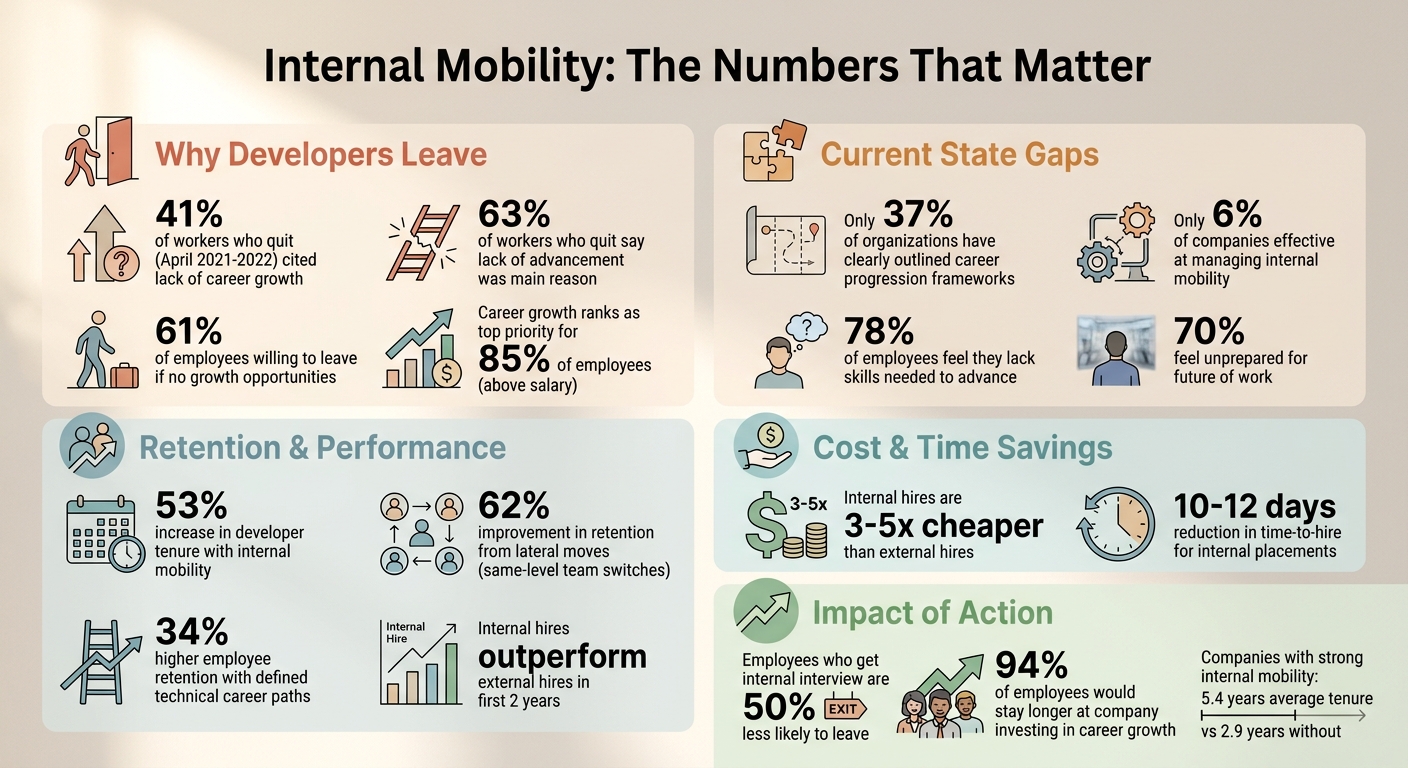
Top developers leave when they feel stuck. Between April 2021 and 2022, 41% of workers who quit cited a lack of career growth as the main reason. Internal mobility can solve this by offering developers new challenges, leadership roles, or team transitions - all within your organization. This approach not only reduces turnover but also cuts hiring costs, shortens onboarding times, and boosts team productivity.
Key Takeaways:
- Retention Boost: Internal mobility increases developer tenure by 53%.
- Cost Savings: Internal hires are 3–5 times cheaper than external ones.
- Faster Hiring: Internal placements reduce time-to-hire by 10–12 days.
- Better Performance: Internal hires outperform external ones in the first two years.
- Lateral Moves: Switching teams at the same level improves retention by 62%.
The solution? Build skills inventories, define clear career paths, and train managers to guide developers toward growth opportunities. Transparent job postings, personalized upskilling programs, and structured feedback loops can help you keep your best talent engaged and growing. If you don’t provide internal opportunities, your competitors will.
Build a Skills-Based Talent Inventory
To effectively match developers to new opportunities, understanding their skills is key. Unfortunately, many engineering leaders rely on outdated job descriptions or vague assumptions about who has the expertise needed for current projects. This disconnect is significant, as 27% of developers report their teams lack the technical knowledge required to implement ongoing projects . A skills-based talent inventory addresses this by creating a transparent, up-to-date database of both current skills and future potential.
The benefits are clear. Take CircleCI, for example. In 2018, CircleCI revamped its competency matrix, condensing nearly 50 initial values into 27 competencies within six levels over eight months. Under the leadership of Director of Engineering Lena Reinhard, the framework introduced "Economic Thinking" as a defining skill for senior roles, while junior roles focused more on execution. This structured approach clarified promotion readiness and identified skill gaps that hindered growth . A skills inventory like this sets the stage for targeted skill gap analysis and intentional developer development.
Conducting a Skills Gap Analysis
Start by grouping similar roles into job families and identifying 8–12 core competencies for each family. Use precise language tailored to your engineering environment. For instance, merging all software engineering roles - from junior to principal - into a single family helps pinpoint shared competencies .
To get the most accurate picture, use a dual assessment process. Both developers and managers should evaluate the same competencies. Multi-rater assessments are 31% more accurate than single-source evaluations, uncovering blind spots where individuals might overestimate or underestimate their abilities . Use a standardized 0–5 proficiency scale, where 0 means no experience, 3 indicates competence, and 5 reflects expertise with the ability to teach others.
Dive into HRIS and LMS data from the past 12–18 months to identify which roles are successfully transitioning and where skill shortages are creating bottlenecks . Combine this data with business forecasts to align your skills inventory with upcoming technical shifts, such as a migration to microservices or the launch of a new AI product. This proactive approach ensures you're addressing gaps before they become roadblocks . It's worth noting that the skills required for the average job change by 25% every three years , so staying ahead of these shifts is critical.
Using Skills Mapping Tools for Developer Growth
Once you've identified skill gaps, dedicated tools can help maintain and update your skills inventory. While spreadsheets may suffice for smaller teams, larger organizations - those with over 50 engineers - should consider specialized platforms . Tools like Skills Base, iMocha, and TalentGuard enable you to record skill levels, spot gaps, and plan development activities . For instance, HackerRank SkillUp allows for skills verification in real-world coding environments. Interestingly, 33% of technical assessments on the HackerRank platform are now used to evaluate internal talent rather than external candidates . In one case, a company uncovered over 100,000 previously unknown skills across its workforce using these assessments .
To keep your inventory accurate, schedule quarterly updates and prompt immediate profile revisions after key milestones like project completions, certifications, or training. Real-time updates ensure your data stays relevant. Most importantly, tie every identified gap to a concrete action - whether it's mentorship, short-term projects for upskilling, or targeted certifications . As Josh Friedman aptly puts it:
A matrix that identifies gaps but doesn't connect to development plans is an audit, not a tool .
Create Clear Career Progression Paths for Engineers
Lay out your team’s skills and define clear career growth trajectories. Right now, only 37% of organizations have clearly outlined career progression frameworks . This leaves engineers guessing about their future, which can be costly - companies with defined technical career paths experience 34% higher employee retention rates . A solid internal mobility structure combines skill mapping with transparent growth plans, helping retain top talent. One effective approach is a dual-track system that supports both technical expertise and leadership ambitions, aligning developer goals with achievable growth opportunities.
Technical Growth vs. Leadership Roles
For many engineering teams, the Senior Engineer level is a pivotal point where developers must choose between deepening technical skills or transitioning into people management. A dual-lane model ensures Individual Contributors (ICs) can achieve the same level of compensation, influence, and recognition as Engineering Managers (EMs), without being forced into leadership roles .
In December 2022, Secret Escapes introduced a two-track career ladder after identifying that a lack of perceived growth opportunities was contributing to turnover. Head of Engineering Nikos Galifianakis and HRBP Laura Pearce developed separate competency matrices for ICs and EMs. The IC track emphasized skills like coding, system design, and architecture, while the EM track focused on organizational planning, hiring, and coaching. They used a frequency-based rating system (never, sometimes, often, always) to evaluate how consistently engineers demonstrated each competency . Pearce and Galifianakis explained:
"It's often assumed that the only level up from a senior software engineer role is lead engineer, followed by engineering manager. But this path might not be appealing to those who don't aspire to become people managers."
PagerDuty takes this concept further with a six-level Software Development Engineer (SDE) scale, where all six levels are IC roles. Engineers can progress to SDE 5 (Staff) and SDE 6 (Principal) based on their business impact and problem-solving abilities, ensuring technical excellence is as valued as leadership .
To avoid prematurely pushing engineers into management, consider using interim roles. For example, GitLab has a 3-month "Interim Manager" trial. During this period, candidates must successfully hire someone and evaluate that hire’s performance after 30 days before earning a permanent promotion .
Once these paths are established, it’s crucial to communicate them clearly so every engineer knows how to advance.
Communicating Career Paths Effectively
Building a career framework is just the first step - developers need to understand it. Clearly document expectations for each level across areas like technical expertise, autonomy, mentorship, and project scope. This shifts the focus from simply requesting a promotion to demonstrating the impact required for the next level . A practical guideline is the 75% rule: engineers should consistently meet about 75% of the criteria for the next level before being considered for promotion . For example, Poll Everywhere introduced a four-level IC ladder (Junior, Mid, Senior, Principal) in April 2022, specifying that Senior Engineers must demonstrate readiness by managing end-to-end projects, including scoping and release management .
Replace annual performance reviews with more frequent quarterly career coaching sessions . GitLab’s "Mobility Principle" ensures transparency by requiring all new roles to be posted internally for at least five days, giving everyone equal access to opportunities . In August 2025, 7Factor Software adopted a "self-declared" promotion model. Engineers review the competency matrix and declare their readiness for advancement, with managers acting as supporters rather than gatekeepers .
Career growth opportunities rank as the top priority for 85% of employees, even above salary . Whether the goal is becoming a Distinguished Engineer or a VP, clear career paths play a key role in boosting retention.
Enable Managers to Support Developer Growth
Once clear career paths are established, managers become crucial in using these frameworks to help developers grow and stay engaged. Managers are often the bridge to internal mobility - they spot talent, guide career discussions, and help developers transition into new roles. However, 75% of industries report higher turnover among high-potential employees. A common cause? Managers focusing too much on current performance rather than future potential . The distinction is vital: performance reflects what a developer excels at today, while potential shows what they could achieve in more complex roles . Developers with high potential are quick learners, adaptable, and skilled at both technical and interpersonal challenges .
The 9-Box Grid is a tool that helps managers evaluate developers by balancing current performance with future potential. This approach identifies those in the "high potential" quadrant . To make one-on-one meetings more impactful, shift the focus from routine updates to career growth by asking questions like, "Where am I already meeting expectations?" and "What work demonstrates readiness for the next level?" . GitHub engineer Dalia Abuadas emphasizes the importance of open communication:
"Your manager can't debug what they don't see."
Gathering 360-degree feedback provides a fuller picture of a developer's interpersonal and professional contributions, aligning well with a skills-based talent inventory . Assigning stretch assignments, such as leading cross-functional projects, can also uncover leadership and problem-solving abilities in real-world situations .
Training Managers to Support Career Development
Managers need tools and frameworks to make career development actionable. The Three Circles of Impact evaluates a developer's contributions across three areas: Individual Contributions (direct work), Collaboration (team support), and Enabling Others (mentorship and system-wide improvements) . This framework provides clarity during growth discussions. Managers can also act as "decision-making APIs", connecting business objectives with career opportunities and clearing up uncertainties in career paths .
Using SMART goals (Specific, Measurable, Achievable, Relevant, Time-bound) is another way to create clear development plans . For developers exploring a transition from Individual Contributor to Engineering Manager, offering interim roles can be effective. GitLab, for instance, uses a 3-month interim manager program where candidates can test new responsibilities with measurable outcomes . This trial period allows developers to explore new paths without fear of long-term failure.
It’s also critical to train managers to recognize and address unconscious biases, such as affinity bias, which can skew decisions during internal mobility reviews . Lack of career growth opportunities drives 42% of voluntary turnover - far more than the 36% linked to dissatisfaction with pay .
Maintaining Team Morale During Transitions
When a developer transitions to a new role, managers must balance celebrating the move with maintaining team productivity. Frame these transitions as organizational wins - you’re not losing a team member, but gaining a collaborator in another part of the company . LinkedIn’s Chief People Officer Teuila Hanson advocates for this mindset, encouraging employees to "switch careers, not companies" .
Transitions can briefly reduce output due to onboarding and coordination demands . To manage this, plan ahead and aim for a manageable team size - managers with more than nine direct reports often struggle to provide adequate support during these periods .
A Competency and Skills Matrix is a useful tool for redistributing tasks based on actual abilities, ensuring equity and avoiding overloading specific team members . Before any transition, solidify workflows and document knowledge thoroughly. Poorly defined processes can become major pain points during role changes . Create a formal transition plan that includes strategies for backfilling roles and completing active projects to maintain team morale .
Don’t overlook mid-level engineers, who are often the backbone of teams. While managers tend to focus on junior staff development or senior-level retention, mid-level developers can feel stagnant during transitions. This can lead to disengagement and higher turnover . Employees who feel underutilized are 10 times more likely to seek new opportunities .
Promote Internal Opportunities Transparently
Once you've established strong career frameworks and proactive management practices, the next step is to make internal opportunities clear and accessible. This is essential for tapping into hidden talent within your organization.
A lack of internal mobility is the second most common reason employees leave their jobs - only compensation ranks higher. Yet, only 6% of companies are effective at managing internal mobility . The disconnect often boils down to one thing: visibility. If your top engineers don’t know about available opportunities, they can’t pursue them.
Internal mobility isn’t just about promotions. It includes lateral moves and role transitions that align with changing career goals . The challenge lies in making these opportunities both visible and easy to access. To address this, organizations need structured systems that fit naturally into the way their teams already work.
Creating Dedicated Channels for Internal Job Postings
A static job board isn’t enough. You need to actively integrate internal opportunities into the tools and platforms your team uses daily. Think Slack channels, company newsletters, or even team-wide meetings. As 180 Engineering puts it:
"Instead of relying on employees to check job postings, those postings could be shared via regular company communications or through platforms like Slack."
The application process for internal candidates should also be simplified. If you already have access to performance data and skills inventories, there’s no need to ask for a traditional resume. Instead, consider project-based assessments tailored to the role. For instance, a backend developer transitioning to DevOps might complete a relevant infrastructure project rather than going through endless interview rounds.
Another effective tool is a skills database that tracks talents beyond formal job descriptions. For example, a manufacturing engineer who codes in Python as a hobby or a frontend developer with UX design skills could be great fits for unexpected roles. When positions open up, you can proactively match candidates rather than waiting for applications. Temporary cross-team collaborations also allow employees to explore new roles while giving managers a chance to identify internal talent.
Making job postings more accessible is just one part of the equation. You also need to encourage open, ongoing conversations about career aspirations.
Encouraging Open Discussions About Career Goals
Transparency isn’t a one-way street. Developers need to feel comfortable sharing their career goals without worrying about negative repercussions. LinkedIn’s Chief People Officer Teuila Hanson captures this idea perfectly:
"Switch careers, not companies."
Managers play a crucial role here. Train them to act as career coaches who regularly check in on their team members' long-term goals. When 94% of employees say they’d stay longer at a company that invests in their career growth , these conversations become a key strategy for retention. Leadership can reinforce this culture through personal messaging - such as video updates from executives sharing their own development goals.
Another idea is to introduce a structured “transfer window,” a set period when internal moves are actively encouraged, and barriers are minimized . This creates predictability and shows employees that career exploration is a priority. Frame these moves as a win-win: managers gain allies in other departments who bring fresh perspectives , and the organization benefits by aligning employee ambitions with internal opportunities.
Develop Targeted Upskilling and Cross-Functional Training Programs
Skill development plays a critical role in career growth. In fact, recent data reveals that 78% of employees feel they lack the skills needed to advance their careers, while 70% feel unprepared for the future of work . These numbers highlight the growing need for tailored upskilling initiatives.
Personalizing Learning Paths
The best results come from a personalized approach. Work closely with developers to design learning paths that align specific training and coursework with their individual career aspirations . Guild's Career Mobility Guide puts it perfectly:
"Career mobility connects what employers need – new skills to support company growth – with what employees want and need as well – growth into careers that pay more, provide more stability, offer more flexibility, or are simply a better fit for their interests."
This personalized strategy delivers real results. For example, Walmart saw promotion rates double and attrition decrease through employer-sponsored education programs. Similarly, Chipotle found that employees enrolled in their programs were six times more likely to become managers .
Offering Certifications and Specialized Training
Start with a skills gap analysis by blending market trends and internal evaluations to identify the technical skills your team needs . Use this data to map out training programs tied directly to roles, detailing required courses and pathways in job postings .
Mentorship is another powerful tool. Pair developers with mentors who can provide career guidance and coaching as they navigate technical training . You can also leverage AI tools to pinpoint skill gaps. For instance, Sourcegraph’s engineering career framework, introduced in 2021, uses three objective axes - Proficiency, Execution, and Teamwork - across levels L1 to IC5. This framework helped them scale their engineering team from 20 to over 100 members .
To keep learning engaging, gamification works wonders. Challenges, rewards, and leaderboards can drive participation. The Royal Bank of Canada used Axonify to create personalized learning paths that included points and leaderboards. This approach led to a 26% increase in knowledge levels and participation rates as high as 97% in some regions .
Using Cross-Team Collaboration Opportunities
Formal training is essential, but hands-on experiences can take skill-building to the next level. Job rotations and cross-functional projects allow developers to gain real-world experience in new areas . Temporary roles, such as interim or acting positions, are another way to test out new responsibilities. For example, GitLab’s Interim Manager program lets Senior or Staff Engineers try out management roles for three months. Success is measured by specific goals, like making a successful hire, before the role becomes permanent .
For even more flexibility, project-based mobility enables developers to explore diverse tech stacks and workflows without requiring a permanent role change . To keep career growth on track, schedule quarterly career development discussions separate from performance reviews. These conversations can help align opportunities with long-term goals .
Measure and Improve Your Internal Mobility Program
Creating an internal mobility program is just the beginning. The real challenge lies in evaluating its performance and making adjustments. Without clear data, it’s tough to know if your efforts are keeping developers engaged and committed.
Key Metrics to Track Program Success
Start with the basics: retention rates and internal promotion rates. Companies with strong internal mobility programs boast an average employee tenure of 5.4 years, compared to just 2.9 years at companies without one . That’s nearly double the retention. Another critical metric is the internal fill rate, which measures how many open roles are filled by current employees instead of external hires. A strong internal fill rate signals that your program is working as intended.
Also, keep an eye on internal interview rates. Employees who get an internal interview are 50% less likely to leave your company . On the other hand, those rejected before the interview stage are twice as likely to quit . Interestingly, if a rejected candidate sees the role filled by another internal hire instead of an external one, their likelihood of leaving decreases by 50% .
Don’t stop at these metrics. Look at leading indicators that predict future success. For example, track how many developers are participating in training programs or earning certifications. Monitor engagement with internal job postings through email clicks or site visits. These early signs show whether your team is interested in advancing their careers internally before they even apply . Together, these metrics provide a comprehensive view of your program’s performance and help identify areas for improvement.
Using Feedback to Refine Mobility Strategies
While numbers reveal trends, feedback from developers and managers fills in the missing details. Regular surveys, focus groups, and Net Promoter Scores (NPS) can help you understand how the program is perceived and whether the application process is working smoothly .
Encourage open communication by hosting manager town halls or weekly talent calls. These meetings allow leaders to discuss immediate needs and identify employees ready for new opportunities . This approach ensures managers actively participate in career development rather than just overseeing it. Additionally, track each manager’s history of supporting internal mobility. If certain managers consistently block mobility, hold them accountable .
When developers don’t land a role they applied for, provide clear and constructive feedback. Outline the specific skills they need to work on and suggest alternative roles that align with their career goals . Turning rejection into a learning moment can keep employees motivated instead of pushing them to look elsewhere. After all, 63% of workers who quit say the lack of advancement opportunities was their main reason for leaving . A strong feedback loop can make all the difference between retaining talent and losing it.
Conclusion: Building a Culture of Growth and Retention
Internal mobility is reshaping how companies approach talent management. A striking 61% of employees are willing to leave if they don’t see opportunities to grow within their organization, while those promoted within their first three years are 60% more likely to stay put. The takeaway? If you don’t create pathways for growth, you risk losing your best developers.
Once you’ve measured the success of your internal mobility efforts, it’s time to shift focus. Move away from relying heavily on external hiring and start tapping into the talent you already have. By mapping out clear career paths and offering opportunities for skill-building, you empower employees to adapt to changing market needs. The result? A workforce that’s more engaged and ready to tackle new challenges.
Practical steps include setting up a centralized talent marketplace, using AI to map career paths, encouraging gig-style assignments, and formalizing mentoring programs. These initiatives align perfectly with the career progression frameworks discussed earlier.
Here’s another key insight: 73% of workers actively seek information about new roles within their current companies. By centralizing career development tools, you eliminate confusion and make internal opportunities more accessible. This transparency not only aligns personal ambitions with company goals but also boosts productivity by 21%. It’s the final piece of the internal mobility puzzle.
With 96% of employees reportedly exploring new job opportunities in 2023, the urgency to prioritize internal mobility couldn’t be clearer. Start today - build a culture where growth is the norm, not the exception.
FAQs
How do we start internal mobility without disrupting delivery?
To kick off internal mobility without interrupting your team's workflow, start with solid planning and open communication. Build change management strategies that tackle potential resistance and make transitions smoother for everyone involved. Leverage tools designed for mobility to ensure role changes happen with minimal disruption to operations.
Bring managers into the conversation early, offer resources to support transitions, and make sure mobility efforts align with your overall talent strategies. This approach helps maintain productivity while working toward your organization's goals.
What data should we track to prove internal mobility is working?
To understand how well internal mobility is working, focus on tracking key metrics such as employee transition rates, promotion rates, the frequency of lateral moves, outcomes of role changes, and the retention rates of employees who’ve moved internally. These numbers give you a clear picture of how effectively your strategies are supporting career growth and keeping talent within the organization.
How can managers support transfers without hurting team morale?
Managers can ease the process of transfers while keeping team morale intact by focusing on clear and open communication. Start by acknowledging the contributions of the team member who is transferring and explain how their move fits into the bigger picture of the organization's goals. This not only shows appreciation but also helps the team understand the reasoning behind the change.
To maintain confidence within the team, provide opportunities for growth, such as skill-building sessions or involvement in fresh projects. By addressing concerns with empathy and aligning individual goals with team objectives, managers can build trust and ensure ongoing engagement.
.png)