Hiring developers from Latin America and Eastern Europe can help you build skilled, cost-efficient remote teams. Latin America offers time zone alignment with the U.S., making it ideal for real-time collaboration, especially for frontend and mobile development. Eastern Europe, known for its strong backend, AI, and cybersecurity expertise, works well for asynchronous workflows. Both regions provide access to large talent pools at competitive rates, but hiring dynamics and cultural preferences vary.
Key Insights:
- Latin America: Time zone overlap (6–8 hours with U.S.), frontend/mobile strengths, and faster hiring (under 14 days).
- Eastern Europe: Backend/AI expertise, lower hourly rates, and structured hiring processes (14–28 days).
- Costs: Senior developers in Latin America earn $75,000–$110,000 annually, while in Eastern Europe, it's $72,000–$108,000.
- Retention: Attrition rates are 15–20% in Latin America and 25–35% in Eastern Europe.
Quick Comparison:
| Factor | Latin America | Eastern Europe |
|---|---|---|
| Time Zone Overlap | 6–8 hours (U.S. ET) | 2–3 hours (U.S. ET) |
| Primary Strengths | Frontend, Mobile, UI/UX | Backend, AI, Cybersecurity |
| Hiring Speed | Under 14 days | 14–28 days |
| Senior Salaries | $75,000–$110,000/year | $72,000–$108,000/year |
| Attrition Rate | 15–20% | 25–35% |
To succeed, tailor your hiring strategy to each region's strengths, consider legal compliance, and focus on clear communication and onboarding processes.
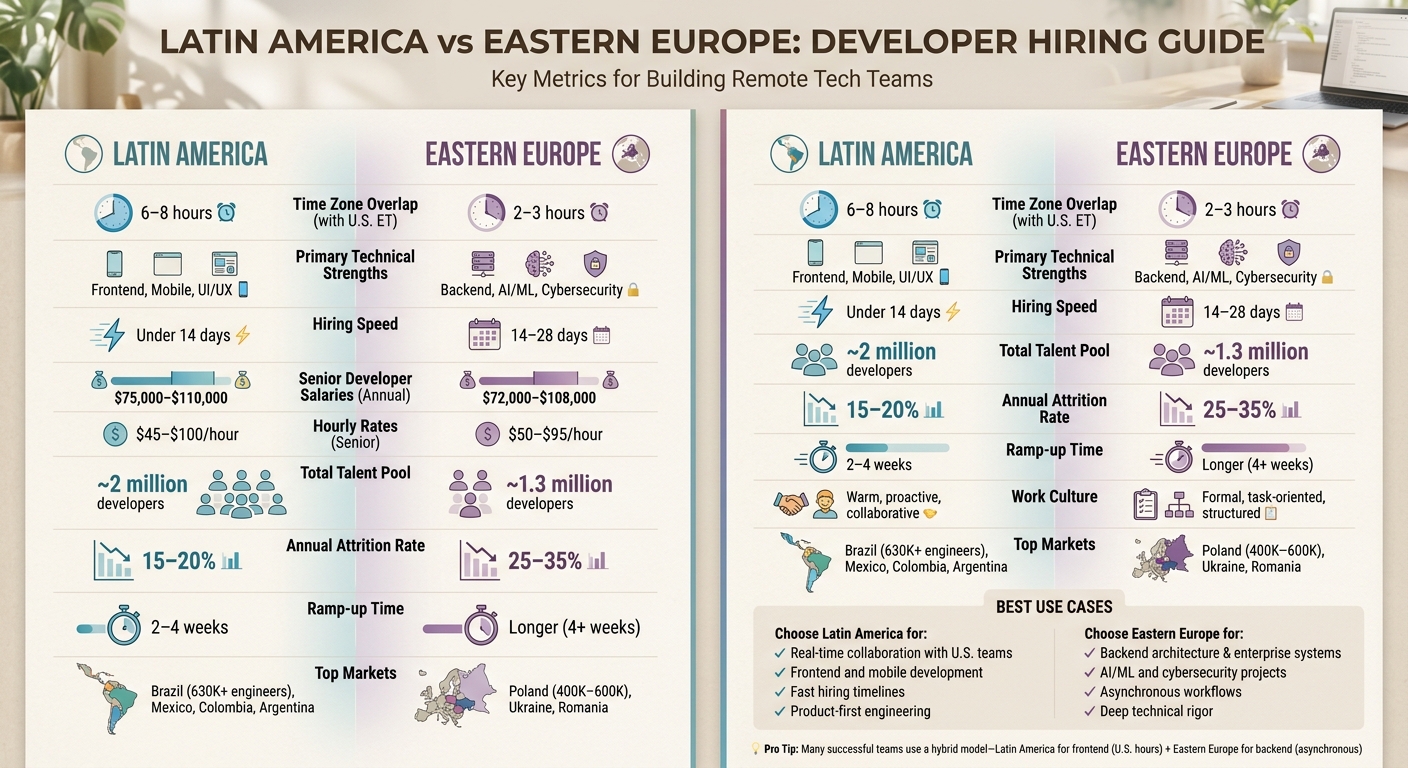
Regional Talent Markets: What to Expect
Technical Skills by Region
Latin American developers are particularly skilled in JavaScript, Python, React, Node.js, and mobile development frameworks like Swift, Kotlin, Flutter, and React Native. This region has a strong emphasis on product-first engineering, especially for consumer-facing applications, UI/UX design, and cloud-native architectures on platforms like AWS and GCP .
In Eastern Europe, developers boast a solid foundation in computer science, excelling in Java, .NET, C/C++, and Rust. There's also growing expertise in AI/ML, with tools like Python, PyTorch, and TensorFlow being widely used . Eastern Europe is particularly known for its strengths in backend architecture, cybersecurity, and creating enterprise-level systems for industries like fintech and telecommunications . According to HireTalent.lat, "Eastern Europe talent often brings a kind of technical rigor that goes deep... excellent at backend architecture, algorithms, AI systems, and blockchain" .
"LATAM developers are more likely to have hands-on experience with Agile SaaS delivery models, API-first development, and mobile-first UX." - Scio
While technical skills are a key factor, time zones and communication styles also play an important role in how these developers integrate with US teams.
Time Zones and Work Culture
Time zone compatibility is crucial for collaboration with US teams. Latin America stands out with 6–8 hours of daily overlap with US time zones (GMT-3 to GMT-6). This allows for real-time standups, same-day code reviews, and smooth synchronous collaboration . Eastern Europe, on the other hand, offers only 2–3 hours of overlap with the US East Coast, making it more suitable for asynchronous workflows. These "relay race" setups allow tasks to be handed off at the end of one team's workday to be picked up by another .
Work culture also varies significantly. Latin American developers tend to favor warm, proactive communication, thriving in Agile environments . In contrast, Eastern European teams often lean toward a formal, task-oriented approach, with a focus on detailed documentation and clear technical specifications . Studies indicate that every hour of time difference can reduce productivity overlap by about 11%, making Latin America's time zone alignment particularly advantageous for fast-paced product development .
How to Source Developers in Latin America
Using Local Job Boards and Networks
Latin America offers a wealth of tech talent, making it an attractive region for hiring developers. To tap into this pool effectively, recruiters should look beyond traditional job boards and focus on specialized platforms tailored for tech roles. Platforms like LATAMhire (with over 800,000 members), Workling (600,000+ vetted candidates), and CloudDevs (500,000+ developers) are excellent starting points. These marketplaces pre-screen candidates and use AI to match them to your specific requirements, often providing shortlists within 24 to 72 hours .
For companies targeting Brazil, Geekhunter is a standout platform, featuring a database of over 372,000 tech professionals. Notably, 76% of developers on Geekhunter respond to interview invitations within 48 hours . If you're after elite talent, platforms like LatinDevs and Tecla specialize in top-tier candidates, accepting only 2–3% of applicants after rigorous technical and English language evaluations .
Countries like Brazil, Mexico, Argentina, and Colombia are particularly strong hubs for tech talent, boasting established ecosystems and deep talent pools . For time zone alignment, consider Mexico for West Coast teams and Brazil or Argentina for East Coast operations . To simplify the process, partnering with agencies that focus on nearshore recruitment can save time and effort.
Working with Nearshore Recruitment Agencies
Engaging with nearshore recruitment agencies can streamline the hiring process while ensuring quality and compliance. These agencies handle tasks like initial screenings, technical assessments, and language proficiency checks. Revelo, for instance, offers access to a pool of over 400,000 developers and reports an average hiring timeline of just 14 days . Similarly, CloudDevs can match you with candidates in as little as 24 hours and even provides a 7-day risk-free trial period .
"The fact that TECLA put us in front of really high-quality and fitting candidates almost immediately was outstanding." - Co-Founder & CEO, Ours Wellness
Agencies also handle legal and payroll complexities through Employer of Record (EOR) services, which is particularly helpful in navigating Brazil's strict labor laws. For example, LATAMhire operates on a "no deposit" model, where you only pay if you decide to hire, while Revelo offers flexible month-to-month payment options with no long-term contracts .
Attracting Talent with Your Employer Brand
Securing top talent goes beyond sourcing - it requires a strong employer brand. In Latin America, developers often prioritize professional growth over high salaries. A survey found that 65% of students in the region value opportunities for development more than compensation . In Mexico, 77% of IT professionals cited professional development as the most critical factor in accepting a job offer .
To attract applicants, emphasize career growth, learning opportunities, and meaningful projects in your job descriptions. Including salary ranges upfront can also make a big difference - listings with compensation details attract up to 70% more candidates in the region . Offering payment in USD is another major draw, especially in countries like Argentina, where inflation is high . Senior software engineers in Latin America typically earn $60,000 to $80,000 annually, representing significant cost savings compared to U.S. hires .
To build genuine connections with Latin American developers, treat them as integral members of your team. Involve them in product discussions, invite them to demos, and give them a voice in decision-making . Instead of generic coding tests, consider assessing technical skills without coding tests by offering short, paid trial projects that mimic real work scenarios. This approach not only respects their expertise but also provides a clear sense of how collaboration might look . Lastly, use WhatsApp for recruitment outreach and follow-ups - it’s the go-to communication platform for over 90% of internet users in key markets like Brazil .
How to Source Developers in Eastern Europe
Finding Candidates Through Professional Communities
Eastern Europe is home to a thriving community of over 1.5 million software developers, many of whom are active on platforms like GitHub, Stack Overflow, and Dev.to . These platforms are excellent places to discover talent by analyzing code commits, technical discussions, and community interactions. You can also explore LinkedIn groups and Meetup events in major tech hubs like Warsaw or Kyiv for additional opportunities . To narrow your search, try using Google "X-ray" searches, such as site:github.com "location:Poland" "python", which can help you find candidates directly . When reaching out, referencing specific projects or articles they've worked on can make your message stand out and improve your chances of a response.
Using Specialized Recruitment Platforms
Once you've identified potential candidates, platforms like daily.dev Recruiter can simplify the screening process. This tool connects you with developers by analyzing their technical engagement rather than relying solely on keyword matches. Notably, 40% of its network consists of senior developers, making it a valuable resource for finding experienced talent . daily.dev Recruiter also offers a straightforward pricing plan - $350 per role each month without placement fees . Keep in mind that hiring in Eastern Europe often involves a more deliberate approach, so patience and preparation are key.
Planning for Longer Hiring Cycles
Hiring developers in Eastern Europe requires an understanding of the region’s recruitment dynamics. Developers here often prefer structured, detail-oriented processes before committing to a role . To align with this preference, consider offering short paid trials to evaluate how candidates approach tasks and collaborate. Additionally, establish a clear 30-60-90 day plan outlining responsibilities, tasks, and evaluation metrics . While the process may take more time, the effort is well worth it - developers from countries like Poland, Hungary, and Ukraine consistently rank among the top 15 globally for their problem-solving and algorithmic skills .
Evaluating and Interviewing Candidates
Running Technical Assessments
Skip theory-heavy interviews and instead assign short, paid trials based on real product tasks . These trials, lasting one to two weeks, involve actual tasks from your product backlog - like fixing a bug or building a small feature. This approach lets you observe how candidates collaborate, respond to challenges, and deliver code in a realistic work setting. As Justin Gluska, CEO & Founder of HireTalent.lat, explains:
"You'll learn more in one week of real collaboration than in ten interviews" .
For senior roles, include a system design interview to evaluate architectural thinking and past project experience . Ask candidates to walk you through their previous projects or explain their thought process during a take-home assignment. Reviewing their GitHub commit history and pull request interactions can provide insight into their consistency and teamwork . Real-world assignments are the most effective way to gauge coding skills and collaboration. Afterward, shift focus to how well they align with your team’s working dynamics.
Assessing Team Fit and Communication
Regional communication styles can offer clues about how candidates will mesh with your team. Developers from Latin America often take a proactive and collaborative approach, while those from Eastern Europe tend to favor a more formal, task-oriented style. Keep in mind that Eastern European professionals may interpret feedback as criticism rather than constructive input .
To evaluate asynchronous communication skills, ask candidates to draft a concise update explaining a technical concept or summarizing a recent project . Behavioral questions can also be valuable - for example, ask how they’ve handled pull requests or communicated during a major outage. These questions can reveal genuine communication habits. Finally, verify English proficiency to ensure smooth collaboration across the team.
Managing Language Differences
Assess English skills through live code walkthroughs and short video introductions via Loom . Live walkthroughs allow candidates to explain their reasoning while showcasing both technical depth and verbal clarity. Early in the process, request a short video introduction to evaluate communication skills before committing to formal interviews. Strong verbal and written skills are critical for successful remote work.
Pay attention to whether candidates ask for clarification on unclear requirements - this demonstrates effective communication in a remote setting . Developers in Argentina, Mexico, and Costa Rica often have high English proficiency, while those in Brazil may vary more in skill level . Eastern European professionals from countries like Poland, Romania, and the Czech Republic generally have strong English skills and a direct communication style .
Managing Remote Hiring Operations
After finding top talent, the next step is fine-tuning processes to ensure a smooth transition into remote work.
Handling Legal Compliance and Payroll
One of the trickiest challenges in hiring remote developers is navigating worker classification. Authorities in regions like Latin America and Eastern Europe now use "substance over form" tests. This means they look beyond the contract's label to examine the actual working relationship. For instance, if a developer joins daily standups, uses company tools, and works solely on your product, they’re likely to be seen as an employee .
For core team members, using an Employer of Record (EOR) can simplify compliance. An EOR handles local payroll, taxes, and statutory benefits, ensuring everything is above board . Costs for EOR services range from $199 to over $1,000 per employee per month. For example, Remofirst starts at $199/month, while enterprise-level providers like Globalization Partners charge $700–$1,000+ . Though this might seem like a steep expense, it protects against risks like misclassification penalties or being taxed as a local branch if developers are granted legal authority to represent your company .
When budgeting, don’t overlook mandatory benefits, which can significantly increase costs. In Brazil, employer contributions like FGTS and INSS can add 40–70% to salaries, while in Mexico, these costs are typically 25–35% higher . Many countries in Latin America also require a 13th-month salary (e.g., Aguinaldo in Mexico, Prima in Colombia). Meanwhile, in Eastern Europe, notice periods can stretch up to three months . Always calculate the total cost, including these statutory obligations, rather than just focusing on hourly rates .
It’s also critical to include clear intellectual property (IP) assignment clauses in contracts, reviewed by local legal experts. As Teamed Legal points out:
"A contract clause that's enforceable in Mexico may be insufficient in Argentina" .
Without explicit language, code ownership doesn’t automatically belong to the employer. Ensure contracts include present and future IP assignment along with waivers of moral rights to safeguard your company's assets .
Once legal and payroll concerns are sorted, the focus shifts to keeping developers engaged and ensuring smooth collaboration across time zones.
Improving Retention Through Onboarding
A well-structured 30-day onboarding process can make a huge difference. Provide essential tools, clear documentation, and assign a dedicated buddy to guide new hires . This initial period often determines whether a hire transitions from good to great. Pairing new team members with a senior colleague or local contact helps bridge cultural gaps and provides a go-to resource for questions.
Management styles should also reflect regional preferences. Developers in Latin America often value personal connections, so regular one-on-one meetings and team-building efforts go a long way . In contrast, Eastern European developers may respond better to structured workflows and direct feedback . Understanding these differences ensures feedback is delivered effectively and avoids potential misunderstandings .
Retention also benefits from investments in professional growth. Offer online courses, certifications, or mentorship programs to keep developers engaged . Attrition rates in tech can be high - 15–20% annually in Latin America and 25–35% in Eastern Europe. Often, developers leave for roles offering more challenging work or better pay . Regularly benchmarking salaries against local market rates is crucial, as developers in these regions are often pursued by both local and international companies .
A strong onboarding process sets the stage for effective global collaboration.
Coordinating Across Time Zones
Time zone alignment is one of the advantages of hiring from certain regions. Latin America works well for U.S.-based teams, as most countries operate on Eastern or Central Standard Time . Eastern Europe is ideal for UK and EU-based companies, with only a two- to five-hour time difference in most cases .
Consistent one-on-one check-ins and tools like Slack or Microsoft Teams are essential for maintaining daily communication . Establish clear expectations for response times and escalation processes. Latin American developers often prefer a collaborative, relationship-driven approach, while Eastern European developers tend to favor direct, task-oriented communication . Setting these norms early helps avoid miscommunication.
For developers in high-inflation economies like Argentina, offering partial compensation in stablecoins (e.g., USDC or USDT) can help offset currency instability . Adding a 10–15% currency buffer to your budget can further protect compensation value and enhance satisfaction .
Cost, Timeline, and Talent Comparison
These metrics highlight why having a focused approach is essential when sourcing tech talent from these regions. Here's a comparison of cost, hiring speed, and talent availability between Latin America and Eastern Europe.
Latin America vs. Eastern Europe: Side-by-Side Comparison
The table below breaks down the key differences:
| Factor | Latin America | Eastern Europe |
|---|---|---|
| Total Talent Pool | ~2 million developers | ~1.3 million developers |
| Largest Markets | Brazil (630,000+ engineers) ; Mexico, Colombia, Argentina | Poland (400,000–600,000) ; Ukraine, Romania |
| Junior Developer Rates | $10–$40/hour | $18–$60/hour |
| Mid-Level Developer Rates | $35–$70/hour | $35–$70/hour |
| Senior Developer Rates | $45–$100/hour | $50–$95/hour |
| Annual Senior Salaries | $75,000–$110,000 | $72,000–$108,000 |
| Time-to-Hire (Managed) | Under 14 days | 14–28 days |
| Ramp-up Time | 2–4 weeks | Longer due to communication styles |
| Time Zone Overlap (US ET) | 6–8 hours (high overlap) | 2–3 hours (limited overlap) |
| Primary Technical Strengths | Frontend, Mobile, UI/UX, Product Development | Backend, AI/ML, Cybersecurity, Enterprise Systems |
| Annual Attrition Rate | 15–20% | 25–35% |
| Hidden Costs | 10–15% currency buffer (Argentina) | 10–20% agency fees |
While hourly rates are a critical factor, they don't tell the whole story. For instance, hiring in Latin America can save 30–50% compared to US-based developers . However, Argentina's peso volatility may require a 10–15% currency buffer . On the other hand, Eastern Europe often involves agency fees, and senior developer rates in cities like Warsaw are nearing Western European levels, ranging from $55–$95/hour .
Hiring speed is another area where Latin America shines. Managed platforms in the region can provide a shortlist within 72 hours and fill senior roles in under two weeks . In contrast, Eastern Europe generally takes 14–28 days for self-managed hiring . Time zone overlap also plays a big role: Latin America's 6–8-hour overlap with US Eastern Time allows for quicker code reviews and real-time collaboration .
Some companies take advantage of both regions by combining Latin American teams for frontend development during US hours and Eastern European teams for backend work, creating an almost 24-hour development cycle .
Specialized skills like AI/ML and fintech come with added costs. In Latin America, these skills can command a 15% premium, while in Eastern Europe, the premium can climb to 20% . Understanding these details helps you plan your budget and focus on the right talent pools for your specific needs.
Conclusion
Main Takeaways
When it comes to hiring developers from Latin America and Eastern Europe, the choice isn't about picking one region over the other. It's about understanding and leveraging the unique strengths each offers. Latin America stands out for its time zone compatibility with U.S. teams, making it perfect for real-time collaboration, frontend development, and accelerating product timelines. On the other hand, Eastern Europe shines in areas like backend architecture, AI/ML, and cybersecurity, thriving in asynchronous workflows.
The most successful teams often adopt a hybrid model: Latin American developers handle frontend and mobile tasks during U.S. working hours, while Eastern European teams focus on backend and data infrastructure asynchronously. This setup maximizes productivity nearly around the clock, balancing cost, expertise, and collaboration while respecting each region's strengths .
"Geography isn't destiny. Your hiring and management processes are." – Mark, HireTalent.lat
Retention is just as important as hiring efficiently. Latin America typically experiences 15–20% annual attrition, while Eastern Europe sees 25–35% . To keep top talent, consider paying above local market rates, creating a structured onboarding process with a buddy system, and thoroughly assessing English proficiency and cultural fit .
These strategies provide a strong foundation for effective hiring. Next, let’s explore how daily.dev Recruiter can help you put these principles into practice.
Getting Started with daily.dev Recruiter
daily.dev Recruiter simplifies cross-border hiring by tapping into the strengths of both regions. The platform connects you with pre-vetted developers who are active in the daily.dev community, regularly engaging with technical content. This approach eliminates the need for cold outreach or outdated profiles, offering warm, double opt-in introductions to developers who are genuinely interested in new opportunities.
With AI-driven matching across 50+ skill dimensions, daily.dev Recruiter ensures candidates align with your technical stack and team needs . Whether you're looking for React developers in Brazil or backend engineers in Poland, the platform helps you find the right talent quickly, cutting hiring timelines to just 2–6 weeks .
FAQs
Which region is better for my tech stack and product stage?
Choosing between Latin America and Eastern Europe comes down to your product's stage and your specific technical requirements.
Latin America stands out for its time zone alignment with the U.S., strong English proficiency, and affordable talent pool. This makes it a great choice for growth-stage teams that rely on real-time collaboration to scale quickly.
On the other hand, Eastern Europe is known for its advanced technical skills and ability to handle complex engineering challenges. This region is often better suited for mature products requiring specialized expertise. However, it’s worth noting that geopolitical factors could affect long-term stability.
Ultimately, your decision should hinge on what matters most to your business: seamless collaboration and scaling, or tackling advanced technical challenges.
Should I hire contractors or use an Employer of Record (EOR)?
When deciding between hiring contractors or using an Employer of Record (EOR), it's important to weigh factors like compliance, flexibility, and control. Contractors are ideal for short-term projects and provide a high level of independence. However, they can come with legal challenges, particularly in areas with intricate labor laws, such as Latin America and Eastern Europe. On the other hand, an EOR streamlines international hiring by handling compliance, payroll, taxes, and benefits. This reduces legal risks and offers a safer solution for managing remote and global teams.
How do I reduce attrition when hiring in these regions?
To keep developers in Latin America and Eastern Europe engaged and reduce turnover, it's crucial to prioritize retention strategies. Start with offering competitive compensation that matches or exceeds local market standards. Pair this with a supportive work environment and opportunities for professional growth, such as training programs or mentorship.
Equally important are strong communication practices and ensuring cultural alignment within teams. Developers value clarity in their career paths, so providing defined development opportunities can boost loyalty. Regular check-ins and tailoring incentives to local preferences can also improve job satisfaction, especially in remote work settings.
.png)