Recruiting frontend engineers in 2026 has shifted dramatically. Here’s what you need to know:
- Automated candidate sourcing is the norm: Recruiters use AI to scan platforms like GitHub and Stack Overflow, analyzing code contributions and technical activity to identify top candidates quickly.
- Skill depth matters: Framework expertise is no longer enough. Companies prioritize skills in performance optimization, accessibility, and advanced state management.
- Passive candidates dominate: Most qualified engineers aren’t actively job hunting. Personalized outreach and warm introductions through developer platforms are key to engagement.
- Real-world testing: Practical, production-focused assessments have replaced abstract algorithm puzzles to better gauge candidates’ abilities.
- Global competition is fierce: With remote work expanding, recruiters face intense competition for top-tier talent worldwide.
The hiring process now revolves around discovering talent, verifying technical depth through hands-on tests, and building trust with personalized communication. AI tools and developer platforms are central to these efforts, cutting time-to-hire and improving candidate quality.
1. Using AI and Developer Platforms to Find Candidates
AI has changed the game for how recruiters discover frontend talent. Instead of relying on traditional methods, new candidate sourcing tactics use AI algorithms to analyze developer activity - like GitHub contributions, blog posts, and community engagement - to identify candidates actively working on production-grade applications. As Aditya Sheth from Juicebox.ai puts it:
Sourcing has shifted from a high-volume activity to a strategic exercise. It is no longer about who can search the fastest, but who can attract the best with a clear, well-drawn map.
With AI-powered sourcing tools, companies have seen a 70% reduction in the time it takes to discover candidates. Tasks that used to require 8 to 10 hours of manual work can now be done in under 2 minutes . AI also helps bridge skill gaps, identifying mid-level developers who, with AI support, can perform at a senior level .
1.1 How AI Helps Discover Candidates
AI doesn't just look at resumes - it evaluates real-time technical output, such as component architecture, code quality, and contributions to frameworks like React, Next.js, and TypeScript. It also consolidates profiles from over 60 platforms into a unified talent map, verifying key details like email addresses . By analyzing performance metrics such as Largest Contentful Paint (LCP) and Cumulative Layout Shift (CLS), recruiters can zero in on engineers with proven technical expertise.
Instead of relying on complex Boolean search strings, recruiters can now use natural language prompts to find niche talent. For example, they can locate engineers transitioning from specific industries into startups with ease . Once candidates are identified, developer platforms step in to help recruiters secure warm introductions.
1.2 Getting Warm Introductions Through Developer Platforms
Developer platforms have embraced double opt-in models to ensure candidate interest. For instance, daily.dev Recruiter uses this approach to confirm that passive candidates are genuinely open to opportunities before recruiters reach out. This strategy dramatically improves response rates by engaging developers in spaces where they already spend time - reading, learning, and contributing to technical content.
Unlike traditional job boards that rely on keyword searches and cold outreach, these platforms analyze real-time activity, such as code contributions, to match candidates with opportunities. By focusing on developers who have signaled openness to new roles, these platforms replace impersonal cold emails with trust-based, context-rich communication. This shift transforms recruitment from a numbers game into a more meaningful, relationship-driven process.
2. Finding Candidates with Specific Frontend Skills
Once you've identified potential candidates, the next step is making sure they actually have the skills your role requires. By 2026, this process involves much more than scanning resumes for keywords like "React." Modern AI screening tools now use semantic skill matching to connect related technologies. For instance, if a candidate lists "Zustand" or "Jotai" on their profile, AI tools can infer their proficiency in state management - even if your job description specifically mentions "Redux."
This shift is crucial because about 60% of candidates claiming 5+ years of React experience test at a mid-level or below when it comes to architectural depth . With global competition intensifying, verifying technical expertise is more important than ever. The focus has moved from simply matching keywords to truly assessing technical depth. AI-powered screening tools can save up to 73% of manual screening time by parsing specific React-related skills like hooks and component architecture . The real game-changer? Evaluating how candidates perform in real-world scenarios. This requires robust skill assessments and an understanding of emerging technologies, as outlined below.
2.1 Using Skill Assessments to Verify Abilities
The best recruiters in 2026 have moved away from abstract algorithm puzzles and now prioritize production-focused testing. Instead of solving theoretical problems, candidates are tasked with challenges like building a responsive component from a Figma mockup or debugging a slow production dashboard using profiling tools.
For senior roles, many companies now offer $100–$200 for a 2–4 hour paid task. These tasks, such as creating a data-fetching component with error handling and caching , respect candidates' time while ensuring high-quality submissions. These assessments also require candidates to explain their technical decisions, providing insight into their understanding of trade-offs and architectural impacts.
Platforms like HackerRank, Codility, and CodeSignal have adapted to this trend, offering project-based assessments that mimic real-world scenarios - like server-side rendering, state management, or complex component design. However, one of the most revealing methods is asking candidates to walk through their own portfolio work. As one recruiter put it:
"Most React developers can build a todo app. Senior React developers can explain why your 200-component dashboard is slow and fix it in a day." - Full Scale
A simple but effective test is to ask candidates how they would improve a slow application. Senior developers will typically start by discussing profiling techniques (using tools like React Profiler or Chrome DevTools) before suggesting optimizations like useMemo. This approach highlights whether they truly understand performance fundamentals or are just repeating memorized fixes.
2.2 Finding Candidates Who Know New Frontend Technologies
Staying competitive means hiring developers who not only master traditional frameworks but also keep up with cutting-edge tools and technologies. Platforms like LeadCognition, for example, track contributions to repositories like vercel/next.js to identify experts in emerging frontend trends .
By 2026, proficiency with AI tools has become a must-have skill. Over 84% of developers worldwide are expected to adopt AI-assisted development by early 2026 . But the key question isn't just whether candidates use tools like GitHub Copilot or Cursor - it’s how they integrate these tools into their workflow. Damian Wasserman, Founder of BEON.tech, explains:
"The right question isn't 'do you use AI tools?' - it's 'show me how you use them and where you don't trust them.'" - Damian Wasserman, Founder of BEON.tech
Top recruiters dig deeper by asking candidates to demonstrate how they validate AI-generated output, handle technical debt when using AI assistance, or leverage AI for tasks like architectural risk analysis. For roles requiring advanced technical expertise - such as React 18's concurrent features, Next.js App Router, or strict TypeScript null checks - recruiters also look for "battle scars." These are real-world incidents where the candidate can explain the problem, their solution, and the long-term architectural changes they implemented.
Platforms like daily.dev Recruiter simplify this process by analyzing developers' real-time activity. They track the articles developers read, the technologies they engage with, and what they’re actively learning. This dynamic approach goes beyond static resume keywords, helping recruiters find developers who are truly staying ahead in the fast-evolving world of frontend development.
3. Reaching Passive Frontend Developers
Finding candidates is only half the battle. To engage top frontend developers, you need to shift from generic outreach to personalized, meaningful conversations. Many of the best engineers are thriving in their current roles, so they’re not actively job hunting. In fact, 89% of software engineering placements at specialized firms in 2024 came from passive candidates . This means you’re not just advertising job openings - you’re sparking interest in people who aren’t looking but might be intrigued by the right opportunity.
Here’s the reality: 70% of the global workforce consists of passive talent . Combine that with traditional outreach methods that have dropped response rates to just 8%, and it’s clear why personalized messaging is essential . The secret? Show developers you’ve taken the time to understand their work.
3.1 Writing Messages That Developers Actually Read
Generic messages don’t work. Developers can spot them a mile away and will ignore them just as quickly. Recruiters who succeed focus on "talent signals" instead of simple keyword matches. This means referencing specific achievements or contributions that show you’ve done your research.
For instance, instead of saying, "I see you have React experience", you could write something like:
"I came across your Stack Overflow post about Django ORM optimization - your solution for reducing N+1 queries was exactly what we needed for a similar challenge" .
This kind of message stands out because it’s clear you’re not just copying and pasting the same pitch to dozens of people.
Where you source candidates also matters. Platforms like GitHub and Behance yield much better response rates - 30–40% compared to 10–15% on traditional professional networks . Even better, communities like Slack and Discord can push response rates above 40% because developers trust these peer-validated spaces over recruiter-heavy platforms.
When crafting your message, lead with value. Instead of asking, "Are you interested in a Senior Frontend Developer role?" focus on the challenges they’d tackle. For example:
"You’d be building a high-scale component library from scratch and modernizing our legacy dashboard."
This approach resonates because developers care more about solving interesting problems than vague job titles.
Timing also plays a key role. Developers who’ve been at their current job for 18–24 months are statistically more likely to consider new opportunities . Tools powered by AI can help identify these patterns and even suggest ways to tailor your outreach, like weaving in shared connections, highlighting recent promotions, or referencing portfolio work.
Transparency is non-negotiable. Developers want to know the exact tech stack (down to specifics like Next.js 14 or React 18), the company’s mission, and clear compensation details. If you’re hiring for a startup, be ready to explain equity - covering dilution, strike prices, and the differences between preferred and common stock .
This kind of tailored messaging doesn’t just get a response - it builds trust, which is crucial for engaging passive talent.
3.2 Building Trust with Context-Rich Introductions
Even with AI and advanced sourcing platforms, trust is built over time. The best recruiters don’t just wait for job openings - they create "always-on" pipelines by engaging with developers in their natural spaces. Whether it’s GitHub, Stack Overflow, or Reddit, participating in these communities and offering value first is key. Share industry insights, career tips, or even technical resources to position yourself as a helpful partner, not just another recruiter.
"A keyword search finds people who have done a job; a talent signal search finds people who can do the job." - Vicky Liu
This proactive approach flips the script. Instead of scrambling to find candidates when a role opens, you’ve already built relationships. When the right opportunity comes along, you’re not some random stranger - they already know and trust you.
Platforms like daily.dev Recruiter are designed for this kind of engagement. Rather than relying on outdated profiles or cold InMails, they connect you with developers in spaces where they’re already active - reading, learning, and interacting with technical content. The platform tracks what articles developers engage with, the technologies they’re exploring, and their learning interests. This allows for introductions that feel natural and relevant, not intrusive.
Every introduction on daily.dev Recruiter is warm and double opt-in, meaning developers have already expressed interest in connecting. This shifts recruiting from a noisy, impersonal process to a genuine, trust-based conversation.
Referrals remain the ultimate trust-builder, with response rates exceeding 50% . Building ambassador programs that incentivize employees and industry partners to refer candidates can open doors to passive developers who wouldn’t respond to traditional outreach. By clearly communicating the role’s value and details, these programs amplify trust and significantly boost results.
4. Screening Candidates with Practical Frontend Tests
Building on advanced outreach strategies, the next step in hiring is to implement tests that mirror the real challenges of frontend development. Traditional interviews and algorithm-heavy tests often fall short in predicting how candidates will perform on the job. In fact, around 70% of candidates fail to meet the requirements during the initial technical screen .
To address this, companies are shifting to practical tests that simulate real-world tasks. Instead of asking candidates to solve abstract puzzles, you can assign them tasks like building a responsive component from a Figma mockup or debugging a slow production dashboard - tasks they’re likely to encounter on their first day.
"Inverting binary trees doesn't predict job performance. Debugging broken APIs, fixing security vulnerabilities, and optimizing slow queries do." - Code Assess AI Team
This approach helps identify developers who can deliver production-ready interfaces. While over 40% of developers worldwide use React, fewer than 15% can design scalable, production-level applications . Practical tests close the gap between theoretical knowledge and actual skills.
To respect candidates’ time and effort, many top recruiters now offer $100–$200 for a 2–4 hour technical test . This not only motivates candidates but also shows appreciation for their expertise.
4.1 Designing Tests That Match Real Job Tasks
Generic coding challenges are becoming obsolete. Candidates recognize them quickly, and these tests rarely reflect the demands of a real work environment. Instead, create tests that simulate actual production scenarios.
- For mid-level roles: Provide a Figma mockup and ask candidates to build a responsive, interactive component from scratch . This evaluates their ability to translate design into code, manage edge cases, and write clean, maintainable CSS.
- For senior roles: Assign tasks like building a data-fetching component that manages loading states, handles errors, and includes caching strategies .
Debugging is another critical skill. For example, you could give candidates a slow dashboard and ask them to identify performance bottlenecks using tools like React Profiler or Chrome DevTools .
"Most React developers can build a todo app. Senior React developers can explain why your 200-component dashboard is slow and fix it in a day." - Full Scale
Clear communication is equally important. After completing the test, candidates should walk through their solutions, explaining their technical trade-offs and architectural decisions . This discussion reveals whether they truly understand the reasoning behind their choices. Considering that many senior candidates struggle with core React and JavaScript fundamentals, these hands-on tests are invaluable .
| Feature | Traditional Algorithm Test | Practical Production Test |
|---|---|---|
| Focus | Computer science theory, puzzles | Debugging, API integration, UI building |
| Predictor | Tests if they studied recently | Predicts actual job performance |
| Candidate Experience | High anxiety, often resented | Respects real-world skills |
| Tools Used | Whiteboard, basic IDE | Figma, DevTools, Profilers, Real APIs |
4.2 Automating Technical Tests to Save Time
Even with well-designed tests, manual screening can be a time sink. On average, tech teams spend five weeks hiring for permanent roles, much of it reviewing unqualified candidates . Automating the process can save significant time.
Start with "QuickScreen" assessments - short, 10–15 minute tests embedded in job postings to filter out up to 70% of unqualified applicants before they even reach your Applicant Tracking System (ATS) .
Modern platforms use AI to evaluate submissions across various criteria, including code quality, component architecture, performance optimization (e.g., proper use of useMemo), and accessibility standards . These tools can reduce time-to-hire by 67%, cut manual screening time by 73%, and improve candidate quality scores by 38%. Some predictive models even forecast on-the-job performance with 81% accuracy .
To prevent fraud, these platforms employ techniques like code fingerprinting, behavioral analysis, and monitoring for excessive use of AI-generated solutions . Integration with tools like Greenhouse or Workday ensures that high-scoring candidates automatically advance to the next stage .
Keep the tests concise and engaging. Long assessments (45–90 minutes) often lead to a 60% drop-off rate . Instead, use formats like "coding-in-the-blanks" to test syntax and logic without requiring a full project build . Short, focused tests not only save time but also improve the candidate experience.
5. Scaling Recruitment with ATS and Targeted Outreach
When hiring for multiple frontend roles, manual tracking quickly becomes impractical. Once you've streamlined how you identify and evaluate candidates, the next hurdle is scaling the recruitment process. The key? Integrating your sourcing tools with an Applicant Tracking System (ATS) and using outreach methods that feel personal - even when automated.
Here’s a striking stat: 78% of recruiters using an ATS report greater efficiency in their hiring process . The magic happens when your developer platform and ATS work hand-in-hand, eliminating redundant data entry and ensuring candidates don’t slip through the cracks. This approach builds on the AI-driven candidate discovery methods mentioned earlier, creating a smooth process from initial identification to outreach.
5.1 Connecting Developer Platforms to Your ATS
ATS integrations rely on real-time pass-through systems to transfer candidate data directly from your sourcing tools. For example, when a frontend developer shows interest on a platform like daily.dev Recruiter, their profile and engagement data sync instantly with your ATS. This eliminates the need for manual data entry and maintains the personal touch developers expect - an essential element of effective relationship-building.
Using unified APIs like Merge, Knit, or Unified.to, you can connect to multiple ATS platforms (like Greenhouse, Lever, Workday, or Ashby) through a single integration point . Instead of spending 4+ weeks building custom integrations for each ATS, you can be up and running in days. Plus, adding new connectors later requires minimal effort . This approach significantly reduces costs; while custom integrations can cost $10,000+ per platform plus ongoing maintenance, unified APIs consolidate these expenses under a single subscription .
The best integrations go a step further by mapping specific frontend skills directly into your ATS. For instance, if a candidate on daily.dev Recruiter lists React, Next.js, and TypeScript as their expertise, these skills should automatically populate as searchable tags in systems like Greenhouse or Lever . This allows recruiters to easily run targeted reports, such as "candidates with Next.js experience who engaged in the last week", without manually tagging profiles.
Real-time webhooks also play a big role, triggering instant status updates in your ATS. This enables your team to respond while candidates are still engaged, improving response rates dramatically . For security and compliance, ensure your integration uses a zero-storage architecture, passing sensitive candidate data directly between systems without storing it .
5.2 Targeting Candidates by Skills and Experience
Generic outreach often falls flat. For example, LinkedIn InMail response rates drop from 30% to 8% when using non-personalized templates . That’s why targeted, personalized engagement is essential when reaching out to candidates.
Instead of broad searches like "Frontend Engineer", refine your approach with Boolean strings such as "software engineer" AND (React OR Next.js) AND "remote" NOT "contractor" to find candidates with specific skills . On platforms like GitHub or Stack Overflow, reference a repository they’ve contributed to or a technical question they’ve answered. This shows your outreach isn’t just automated spam .
More than 70% of professionals are passive candidates - they’re not actively job hunting but are open to the right opportunity . Timing is everything. Developers are most receptive to new opportunities 18–24 months into their current role, so tailoring your outreach during this "flight risk" window can yield better results .
Using multi-channel strategies across LinkedIn and email, and platforms like GitHub or Twitter can increase your touchpoints without extra manual effort . For instance, a small recruiting agency in Austin cut their average time-to-fill from 18 days to 11 by automating follow-up sequences. This allowed them to source 40% more candidates weekly without adding staff .
For niche frontend roles, consider engaging in developer communities like Reactiflux on Slack or Discord before pitching. Spending time in these spaces builds credibility and makes your outreach feel less transactional .
Advanced teams are also leveraging AI tools to streamline sourcing and craft outreach messages that feel personal but scale effectively . These tools can enrich candidate profiles with data like GitHub commit frequency or Stack Overflow reputation, then generate messages referencing specific contributions . Make sure your sourcing tools have "writeback" capabilities so all candidate interactions are logged in your ATS, keeping everything organized in one place .
| Feature | In-House ATS Integration | Unified API Integration |
|---|---|---|
| Development | 4+ weeks per ATS | Go live in days for multiple platforms |
| Maintenance | High; frequent updates needed for API changes | Low; managed by the unified provider |
| Scalability | Slow; each new ATS requires custom code | Rapid; easily add new connectors |
| Cost | ~$10K+ per integration plus ongoing costs | Lower total cost through subscription |
6. Most In-Demand Frontend Skills in 2026
::: @figure 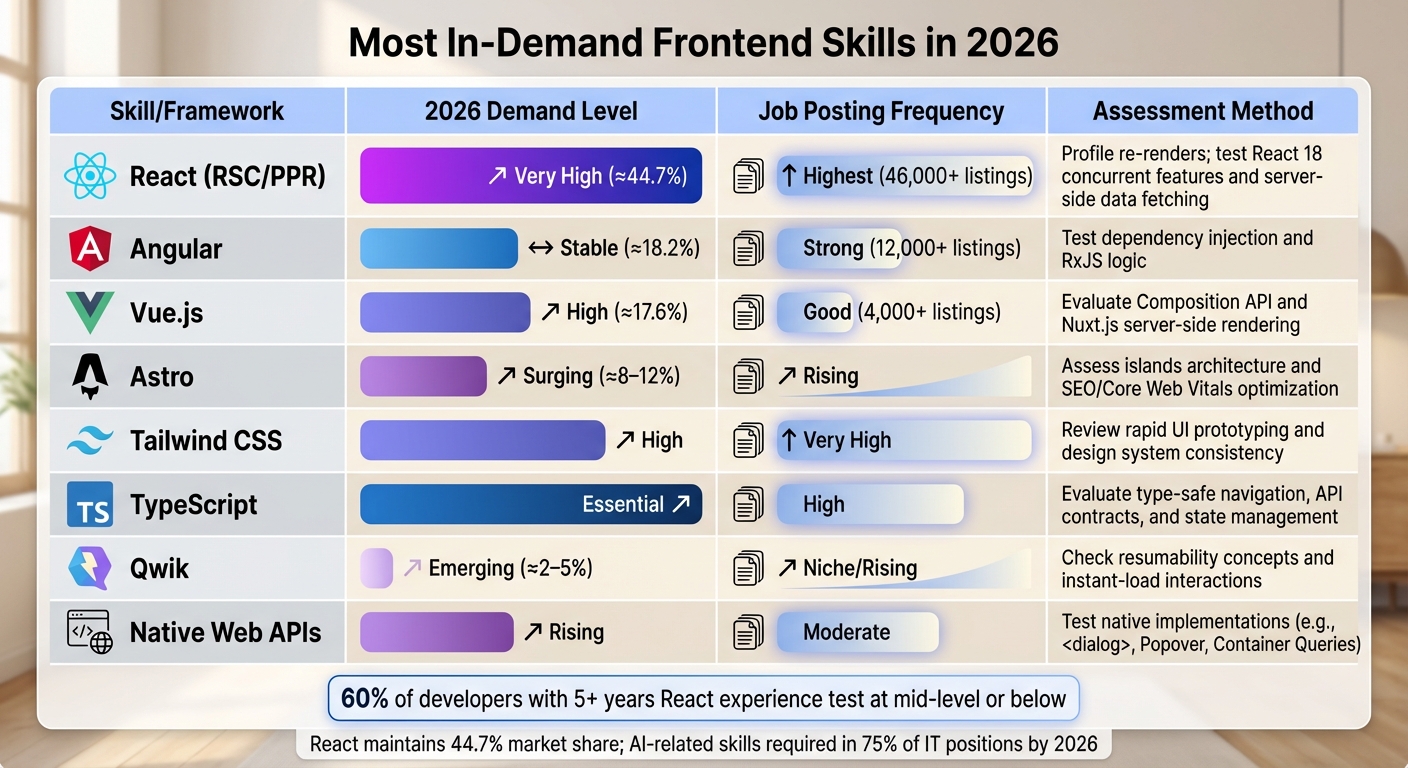 {Frontend Skills in Demand 2026: Framework Comparison and Assessment Methods}
As the tech landscape evolves, recruiters need to focus on frontend skills that meet the demands of modern production environments. React continues to lead with a 44.7% market share, but expertise in React Server Components (RSC) is now essential. RSC enables the creation of server-first applications, reducing browser workloads and improving performance.
Performance-focused frameworks are gaining traction. Astro, used by 8–12% of content-heavy sites, and Qwik, favored in e-commerce for its resumability, are becoming go-to choices for SEO-driven projects. These tools allow browsers to seamlessly continue execution from where the server left off, making them particularly effective for optimizing user experiences.
Artificial intelligence is also reshaping frontend roles. By 2026, 75% of IT positions will require AI-related skills, with job postings for generative AI roles increasing by 170% over the past year. Frontend engineers are expected to design "Generative UI" component schemas, allowing AI to deliver personalized user interfaces. Additionally, familiarity with native browser APIs - like the <dialog> element, Popover API, and View Transitions - has become critical. These APIs help developers reduce reliance on heavy third-party libraries, aligning with the practical coding tests mentioned earlier.
To effectively assess candidates, recruiters should focus on real-world scenarios. For example, ask candidates to profile a slow dashboard with React DevTools or explain when to use useMemo versus useCallback. Tasks like implementing a modal with the native <dialog> element instead of an external library can reveal their ability to optimize for production needs. Interestingly, even among those with 5+ years of experience, 60% fail to exceed mid-level performance in realistic vetting scenarios.
The table below highlights the most sought-after frontend skills for 2026, along with suggested methods to evaluate candidates.
6.1 Frontend Skills Comparison Table
| Skill/Framework | 2026 Demand Level | Job Posting Frequency | Recommended Assessment Method |
|---|---|---|---|
| React (RSC/PPR) | Very High (≈44.7%) | Highest (46,000+ listings) | Profile re-renders; test React 18 concurrent features and server-side data fetching |
| Angular | Stable (≈18.2%) | Strong (12,000+ listings) | Test dependency injection and RxJS logic |
| Vue.js | High (≈17.6%) | Good (4,000+ listings) | Evaluate the Composition API and Nuxt.js server-side rendering |
| Astro | Surging (≈8–12%) | Rising | Assess islands architecture and SEO/Core Web Vitals optimization |
| Tailwind CSS | High | Very High | Review rapid UI prototyping and design system consistency |
| TypeScript | Essential | High | Evaluate type-safe navigation, API contracts, and state management |
| Qwik | Emerging (≈2–5%) | Niche/Rising | Check resumability concepts and instant-load interactions |
| Native Web APIs | Rising | Moderate | Test native implementations (e.g., <dialog>, Popover, Container Queries) |
Conclusion: Improving Frontend Hiring in 2026
Frontend hiring is undergoing a transformation, leaning heavily on AI-powered sourcing and skill-focused assessments. Recruiters who pivot to using developer-centric platforms and practical testing methods will create stronger talent pipelines. On the other hand, sticking to outdated job boards and traditional metrics like "years of experience" will leave many struggling to keep up. By 2026, 75% of engineering-led organizations are expected to prioritize hiring based on what candidates can actually do, rather than how long they've been in the industry .
This shift isn't just theoretical - it’s supported by data that’s reshaping hiring standards. For example, daily.dev Recruiter connects recruiters directly with highly engaged developers through warm, double opt-in introductions. This cuts through the noise of conventional outreach methods. Building trust is critical, and developers now expect transparency on key details like compensation, equity, and the challenges of the role . Speed also plays a huge role - responding to candidates within 48 hours signals respect and keeps the hiring process moving smoothly . Practical assessments that mimic real-world tasks are becoming essential for verifying skills beyond what’s listed on a resume.
The stakes are high: the U.S. is projected to face a developer shortage exceeding 1.2 million by the end of 2026 , while nearly 40% of core tech skills will evolve by 2030 . In this competitive landscape, leveraging AI-driven sourcing tools and realistic skill assessments is no longer optional. Platforms like daily.dev Recruiter help recruiters stay ahead by mapping talent signals, engaging passive candidates, and focusing on critical abilities like AI orchestration and performance optimization. Those who adapt will secure the frontend engineers needed to maintain product velocity and stay competitive in the long run.
FAQs
What should I look for in GitHub activity to spot real frontend skill?
When assessing frontend engineering expertise, keep an eye out for repositories with high star counts (e.g., 500+ stars), active contributions (e.g., 50+ pull requests in the last year), and a solid follower base (e.g., 1,000+ followers). Also, look for involvement in well-regarded projects and polished, professional README profiles. These factors often signal genuine skill and commitment to the craft.
How do I create a paid, 2–4 hour practical test that’s fair and job-relevant?
To create a fair and relevant paid practical test for frontend engineers, design a concise coding task that mirrors the actual responsibilities of the role. The test should focus on evaluating practical skills alongside theoretical understanding. Using tailored online skills assessments can simplify the process, helping you efficiently identify candidates with the right expertise. This not only saves time but also minimizes hiring risks, enhancing the overall recruitment process.
How can I personalize outreach to passive frontend engineers without sounding creepy?
To make outreach feel personal without crossing boundaries, aim to create authentic connections. Mention their recent work, achievements, or projects to demonstrate that you genuinely appreciate their expertise. Keep your message short, warm, and specific to their skills or passions. Steer clear of aggressive or overly salesy language. Instead, highlight how your opportunity aligns with their professional aspirations. This thoughtful approach builds trust and makes a positive response more likely.
.png)