Reducing the number of technical evaluations (or "screens") per hire can save time, money, and resources while improving the candidate experience. Here’s how you can optimize your hiring process:
- Pre-Screen with Tools Like daily.dev Recruiter: Automate early filtering by connecting with pre-qualified candidates who meet your job requirements. This eliminates unqualified applicants before they reach your engineering team.
- Use Skills-Based Tests Early: Implement automated coding assessments to evaluate technical abilities upfront. This helps identify qualified candidates without requiring live interviews for everyone.
- Structure Your Interviews: Standardize questions, scoring rubrics, and evaluation criteria to reduce unnecessary follow-ups and ensure consistency.
- Combine Technical and Teamwork Assessments: Use collaborative methods like pair programming to evaluate multiple skills in one session, cutting down interview stages.
- Targeted Sourcing: Define precise technical requirements and focus on candidates who match these criteria, reducing wasted time on unsuitable applicants.
Key Benefits:
- Save up to $18,000 per hire by automating early-stage filtering.
- Reduce engineering hours spent on hiring by 60%.
- Improve candidate satisfaction with structured and efficient processes.
Streamlining your process doesn’t mean sacrificing quality - it’s about working smarter, not harder.
Use daily.dev Recruiter for Better Pre-Screening
The key to reducing the number of interviews per hire is to filter out unqualified candidates before they even reach your engineering team. daily.dev Recruiter connects you with developers who are already engaged, pre-qualified, and genuinely interested in your role. Instead of sifting through hundreds of cold applications, you can start with candidates who are already invested in the opportunity.
This method doesn’t just save time - it saves money. Nitish Kasturia, Founder of EvoHire, explains:
"By automating the top-of-funnel, you reclaim over $18,000 per engineer/year and eliminate the risk of hiring 'paper-tigers' - candidates who look great on AI-written profiles but cannot design systems."
By filtering out mismatched candidates early, your engineering team can focus its time and energy on those who are truly qualified and have passed the initial technical stages. Here’s how daily.dev Recruiter streamlines the pre-screening process:
Double Opt-In Introductions
With daily.dev Recruiter, you’re only introduced to candidates who have already shown interest in your specific role. This double opt-in approach ensures mutual interest before any conversation begins. As a result, you’ll experience higher response rates and fewer wasted screens, as every candidate has already expressed curiosity about the position.
Custom Screening Criteria
You can define precise technical requirements - like programming languages, frameworks, or experience levels - that candidates must meet before being introduced. Think of it as an automated filter, similar to "knockout questions" in traditional applicant tracking systems, but seamlessly integrated into the matching process. Instead of manually combing through resumes, the platform does the heavy lifting, saving hours of effort.
Connect with Passive Candidates
Not every great engineer is actively job hunting, but many are open to the right opportunity. daily.dev Recruiter focuses on engaging passive candidates who are active on the platform. Unlike standard AI tools scanning external databases - used by 87% of employers globally in at least one part of their hiring process - daily.dev Recruiter connects you with developers who are already interacting with the platform. This ensures you’re reaching professionals who are current, engaged, and ready to explore new opportunities.
Add Skills-Based Tests Early in the Process
When using daily.dev Recruiter to connect with potential hires, it’s crucial to evaluate their skills early on with tests designed to measure real abilities. Why? Because this step can save both time and money. On average, teams spend 40 hours per candidate and $400 per technical screen. Skills-based tests help you quickly weed out candidates who don’t have the necessary coding skills, narrowing the field to those who genuinely qualify.
Introduce these tests early in your hiring funnel - right after confirming initial interest but before scheduling live technical interviews. For example, Red Hat adopted automated screening through HackerRank and found that 63% of phase-one candidates didn’t meet technical benchmarks. This approach reduced live interviews by over 60%, speeding up their hiring process dramatically. Similarly, Instacart replaced manual technical phone screens with CodeSignal’s Certified Assessments, saving their engineering team over 2,000 hours annually and improving hiring outcomes by 65%. These results highlight two effective methods to streamline your hiring process:
Automated Coding Tests
Automated coding platforms allow you to evaluate multiple candidates at once without overloading your engineering team. Instead of scheduling live interviews for everyone, you can send out standardized automated tests to assess candidates’ ability to write clean, functional code. These platforms handle everything from setup to initial scoring, leaving your engineers to focus only on the top performers.
Take Zalora, a fashion e-commerce company in Southeast Asia, as an example. By switching to automated technical screening with HackerEarth Assessments, they cut their recruitment cycle in half. The math is straightforward: if you’re screening 100 applicants, automatically disqualifying 60–70 who fail basic technical challenges eliminates a massive amount of manual work.
When creating these tests, prioritize tasks that reflect real-world coding scenarios rather than abstract puzzles. As Brian Cooksey, App Platform Engineering Manager at Zapier, explains:
"We want our interview process to reflect our culture and to evaluate people on the kind of work they will actually do".
Provide candidates with a browser-based IDE equipped with features like autocomplete and syntax highlighting. Developers overwhelmingly prefer tests that assess practical skills - 66% say they’d rather be evaluated on real-world tasks than theoretical problems. Keep take-home assignments manageable, aiming for around four hours. This strikes a balance between giving candidates meaningful challenges and respecting their time.
AI-Powered Assessment Tools
Modern tools equipped with AI can take your assessments a step further. These platforms don’t just score tests - they analyze code quality, efficiency, and problem-solving approaches. They can even detect suspicious behavior, such as excessive tab switching or copy-pasting. Considering that 82% of developers now use AI tools in their daily work, it’s only logical that your assessments should account for this reality. AI-powered plagiarism detection, for instance, can identify AI-assisted coding attempts with 85–93% accuracy.
Atlassian provides a great example of how automation can transform the hiring process. By using automated grading, they managed 35,000 applicants while reducing manual review time by 83%. Their engineering teams saved about four hours per candidate. To ensure fairness and effectiveness, look for platforms offering "Certified Assessments" validated by Industrial-Organizational (IO) Psychologists. These tests are designed to be objective, non-discriminatory, and predictive of actual job performance. This matters more than ever: 68% of recruiters identified time-to-hire as their top performance metric for 2024, up from 55% in 2022.
Create a Structured Interview Process
::: @figure 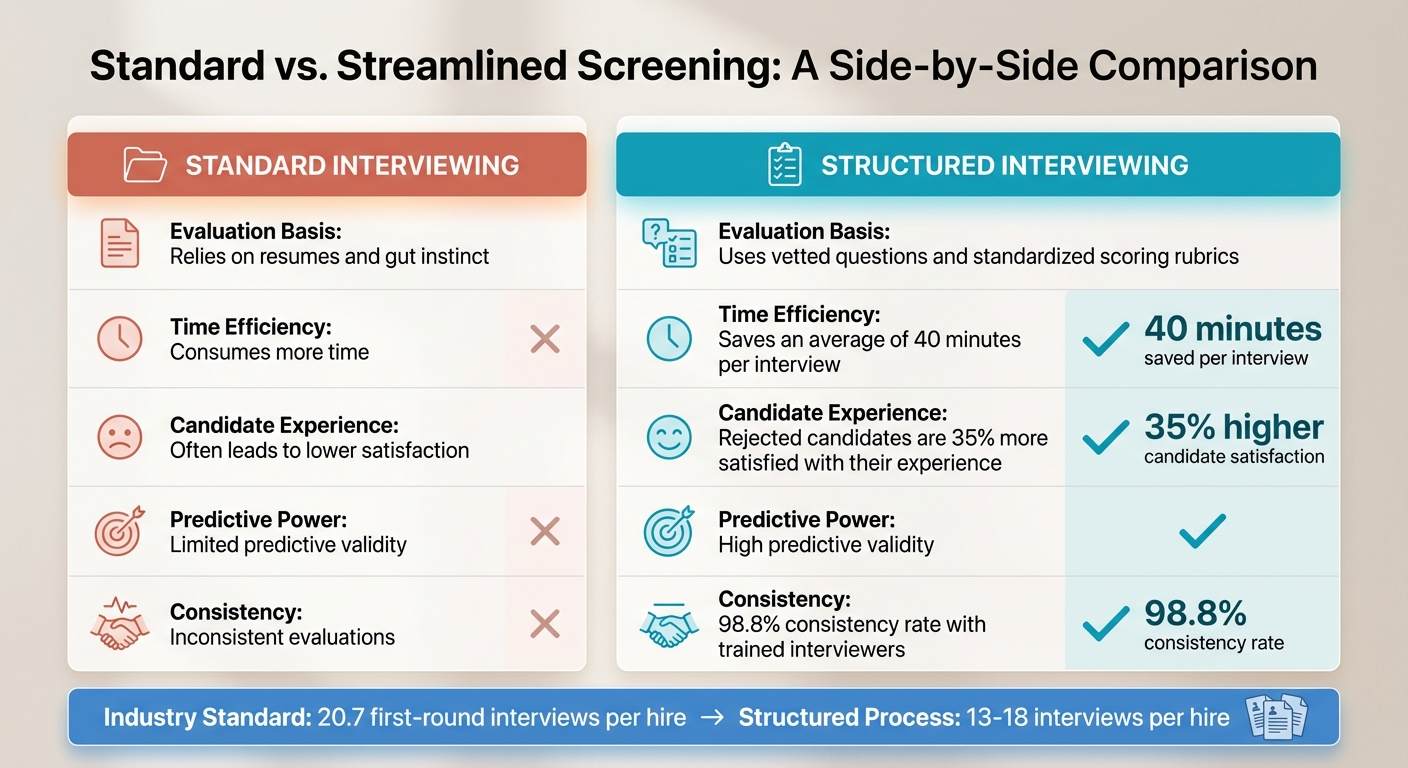 {Standard vs Structured Interview Process Comparison}
A structured interview process ensures consistency by using the same set of questions, grading scales, and predefined qualifications for every candidate. This approach reduces the need for extra "tie-breaker" evaluations that often result from vague or subjective feedback.
On average, engineering teams dedicate 40 hours to interviewing and screening candidates for a single role. While the industry standard involves 20.7 first-round technical interviews per hire, companies employing structured interviews often cut this number to between 13 and 18 interviews. Additionally, when interviewers are properly trained, structured interviews achieve an impressive 98.8% consistency rate in hiring recommendations.
Use Standard Question Sets
Begin by conducting a job analysis to identify the key attributes needed for success in the role. For instance, Google evaluates candidates based on four specific attributes: general cognitive ability, leadership, "Googleyness" (a mix of cultural fit and adaptability), and role-related expertise. Once these attributes are defined, develop a set of vetted questions that include both behavioral inquiries - designed to uncover past patterns - and hypothetical scenarios to gauge how candidates might handle future challenges.
Avoid brainteasers like "How many golf balls fit in a 747?" Research shows they fail to predict job performance. Instead, focus on role-specific questions that provide clear and measurable insights. To maintain consistency, create standardized scoring guides with examples of poor, mixed, good, and excellent responses. This ensures all interviewers have a shared understanding of what constitutes quality. Dr. Melissa Harrell, a Hiring Effectiveness Expert at Google, highlights the value of this approach:
"Structured interviews are one of the best tools we have to identify the strongest job candidates (i.e., predictive validity). Not only that, they avoid the pitfalls of some of the other common methods."
Train a dedicated team of interviewers on the scoring rubric rather than relying on ad hoc interviewers. This minimizes bias and promotes uniformity. Additionally, have interviewers document their evaluations to support evidence-based hiring decisions. Candidates notice the difference - those who are rejected report being 35% more satisfied with their experience when a structured interview process is used compared to an unstructured one.
These structured methods stand in stark contrast to traditional approaches, as detailed below.
Comparison: Standard vs. Streamlined Screening
| Metric | Standard Interviewing | Structured Interviewing |
|---|---|---|
| Evaluation Basis | Relies on resumes and gut instinct | Uses vetted questions and standardized scoring rubrics |
| Time Efficiency | Consumes more time | Saves an average of 40 minutes per interview |
| Candidate Experience | Often leads to lower satisfaction | Rejected candidates are 35% more satisfied with their experience |
| Predictive Power | Limited predictive validity | High predictive validity |
| Consistency | Inconsistent evaluations | 98.8% consistency rate with trained interviewers |
Hiring engineers?
Connect with developers where they actually hang out. No cold outreach, just real conversations.
Use Collaborative and Practical Assessments
To streamline the hiring process and reduce the number of steps, collaborative assessments are an effective solution. These methods combine technical and teamwork evaluations into a single session, cutting recruitment stages from 6–7 down to about 4. This approach has proven to save time and resources, reducing the engineering hours per hire from 60 to just 14. Moreover, companies that utilize skill-based assessments are 24% more likely to hire employees who exceed performance expectations.
Task-based evaluations are becoming the standard. By 2025, 66% of developers preferred task-oriented assessments over algorithmic ones. These practical tests not only offer a better prediction of job performance but also significantly lower hiring costs - from $14,076 to $3,349 per hire. By blending technical skills testing with collaboration-focused evaluation, hiring decisions can be faster, more accurate, and more insightful. Here’s how collaborative assessments can simplify the process while delivering actionable results.
Pair Programming Sessions
Pair programming is a powerful way to evaluate both technical skills and teamwork in one sitting. The session is structured with the candidate acting as the "driver" (writing the code) and the interviewer as the "navigator" (providing guidance and feedback). For this to work effectively, the interviewer must stay actively engaged - otherwise, it risks becoming just another coding test.
Using a real-world company problem as the challenge offers a dual benefit: it provides a realistic work sample and allows you to observe the candidate’s thought process, adaptability, and openness to feedback. Ihor Shcherbinin, VP of Recruiting at DistantJob, highlights the importance of these qualities:
"Sometimes getting the solution right isn't as important as having a communicative or humble candidate".
When candidates face challenges, ask guiding questions to gauge their problem-solving approach rather than offering direct solutions. This method not only tests their technical abilities but also their ability to think critically under pressure.
Keep the session concise - under one hour - and use the same problem for all candidates to ensure fairness and consistency. Share the evaluation criteria ahead of time so candidates understand the balance between coding and communication. Additionally, use an IDE that supports the candidate’s preferred programming language to create a comfortable environment. This approach minimizes hiring mistakes, which can cost up to 30% of an employee’s first-year salary.
Practical Problem Solving
In addition to pair programming, practical problem-solving tests provide further insights into a candidate’s real-world coding abilities. Instead of abstract algorithmic puzzles, focus on tasks like debugging, refactoring code, or extending an application. These tests evaluate multiple aspects at once - such as code quality, maintainability, architectural decisions, and testing strategies. Notably, 68% of developers feel that traditional coding tests fail to reflect their actual skills.
To respect candidates’ time, design assessments that can be completed in 3–4 hours. Include clear specifications with a detailed problem description, deliverables, requirements, and time limits. Before rolling out the test, try it internally - if an in-house engineer can complete it in one hour, it’s appropriately scoped for a four-hour candidate session.
Provide setup instructions in advance so candidates can dedicate their time to solving the problem rather than technical setup. Allow them to use their own IDEs, libraries, and documentation to replicate a real work environment. After the test, schedule a follow-up discussion to review their thought process, assumptions, and how they’d improve the code with more time. Use a consistent rubric focused on observable criteria to ensure fair evaluations across different interviewers.
Match Role Requirements with Targeted Sourcing
Cut down on wasted engineering hours by honing in on precise technical requirements and filtering candidates early in the hiring process. A significant amount of time is often spent on applicants who don’t meet the core technical skills needed for the job. By clearly defining requirements upfront and using targeted sourcing methods, you can reduce the size of the candidate pool while improving its overall quality. This initial step lays the groundwork for a more efficient and effective hiring process.
Identify Required Skills First
Before drafting a job description or reaching out to potential candidates, take the time to analyze the specific needs of the role. Identify the Knowledge, Skills, Abilities, and Other characteristics (KSAOs) essential for success in the position. Work closely with subject matter experts to differentiate must-have skills - like experience with certain programming languages - from nice-to-have skills that can be learned on the job.
Develop a screening checklist to capture the non-negotiables, such as proficiency in specific tools, frameworks, or programming languages, as well as salary expectations. For instance, if the role demands a minimum of five years of Python experience, applicants lacking this qualification should be filtered out early in the process.
Defining technical requirements early also allows you to implement asynchronous, computer-scored technical assessments to replace traditional first-round phone screens. These assessments save both time and money, as the typical first-round technical phone screen costs around $400 per candidate when factoring in engineering hours. Companies adopting this approach report saving over 15,000 engineering hours annually and cutting engineering time spent on recruiting by 60%. By using standardized rubrics focused on the identified KSAOs, you ensure that candidate evaluations are consistent and reflect actual performance, not interviewer bias. This structured process ensures only the most qualified candidates advance to the next stages.
Target Candidates with daily.dev Recruiter
Once your requirements are clearly defined, leverage tools like daily.dev Recruiter to connect with developers who already meet the technical profile for your role. This platform taps into a network of developers actively engaged in the tech community, allowing you to reach passive candidates - those who may not be actively job hunting but are open to opportunities.
daily.dev Recruiter aligns its custom screening process with your specified KSAOs, connecting you with candidates who are both qualified and genuinely interested. The platform enables you to target developers based on criteria like programming languages, frameworks, years of experience, and other technical qualifications. This approach reduces the number of unnecessary screens while maintaining a high standard of candidate quality.
Instead of spending time on dozens of unqualified applicants, you begin with a smaller, more focused pool of engineers who already meet your technical requirements. This strategy not only minimizes the number of interviews needed but also ensures that the candidates progressing to later stages are well-suited for the role, saving time and improving hiring outcomes.
Conclusion
Cutting down the number of screens per hire can help eliminate inefficiencies without lowering hiring standards. Automated technical assessments play a key role here, quickly filtering out unqualified candidates before they take up valuable engineering time .
The financial upside is hard to ignore. By streamlining the hiring process, companies can significantly lower costs and reduce the time engineers spend per hire, as highlighted by industry benchmarks .
To make the most of your screening process, start by clearly defining the technical requirements that are absolutely essential. Tools like daily.dev Recruiter can help you connect with developers who already meet those qualifications, so you're only evaluating candidates who fit the bill. Adding skills-based tests right after the initial application is another smart move - these tests validate technical abilities in realistic scenarios.
Standardizing your interview process is another game-changer. Using pre-vetted questions and scoring rubrics not only saves about 40 minutes per interview but also reduces bias while improving the overall candidate experience. Interestingly, even candidates who are rejected report being 35% more satisfied with the process when structured interviews are used .
FAQs
How does daily.dev Recruiter streamline the pre-screening process for engineering roles?
daily.dev Recruiter streamlines the pre-screening process for engineering positions by providing tools designed for precision and efficiency. Using data-driven assessments, it evaluates candidates based on the specific skills required for the role, cutting down on the need for excessive screening rounds.
By tailoring technical evaluations to match job requirements, daily.dev Recruiter eliminates unnecessary steps while maintaining top-notch hiring standards. This not only saves recruiters valuable time but also ensures a more seamless and engaging experience for candidates.
What are the advantages of using skills-based tests early in the hiring process for engineering roles?
Using skills-based tests early in the hiring process allows recruiters to zero in on candidates with the right abilities, rather than relying on résumé keywords. This method not only makes evaluations more objective but also improves the accuracy of predicting how well a candidate will perform on the job. Plus, it helps reduce bias, leading to better hiring decisions. Many companies that use this approach report faster hiring timelines and fewer mismatches in their hires.
Another big advantage? It saves time and money. By identifying unqualified applicants early, teams can drastically cut down on the hours spent on interviews that don’t go anywhere. For instance, one study showed that engineering time per hire dropped from 60 hours to just 14, while recruiter time went from 42 hours to 11 - resulting in thousands of dollars saved per hire. On top of that, these tests help pinpoint skill gaps and create a more streamlined and fair process for candidates, making the entire experience efficient for everyone involved.
How do structured interviews improve the hiring process for engineering roles?
Structured interviews bring a level of consistency and fairness to the hiring process. By asking every candidate the same set of questions and evaluating their responses with a standardized rubric, this method ensures a transparent and impartial experience. For candidates, it creates a sense of equity and respect, as everyone is assessed on the same criteria without unexpected curveballs.
From a recruiter’s perspective, structured interviews make decision-making more straightforward. They allow for quick, objective comparisons between candidates and have been shown to better predict job performance compared to unstructured interviews. This approach not only reduces the need for extra screening rounds but also saves time and resources, all while maintaining high hiring standards and offering a smoother experience for candidates.
.png)