Hiring software engineers takes too long - and it’s costing you top talent and money. In 2026, the average time-to-hire has stretched to 95 days, far above the ideal 15–20 days that leading companies achieve. Every unfilled role costs $500–$1,000 per day, while stretched-out timelines increase candidate drop-offs and stress for your team.
Here’s the solution:
- Identify bottlenecks like resume screening delays, interview scheduling, and slow decision-making.
- Build warm pipelines to have pre-qualified candidates ready before roles open.
- Streamline technical assessments with automation and structured evaluations to save time.
- Speed up offers with pre-approved budgets and same-day feedback.
By cutting inefficiencies, you can hire faster without sacrificing quality. Companies using these methods fill roles in as little as 15 days with 90%+ offer acceptance rates and strong retention.
Want to hire smarter and faster? Let’s dive into the details.
::: @figure 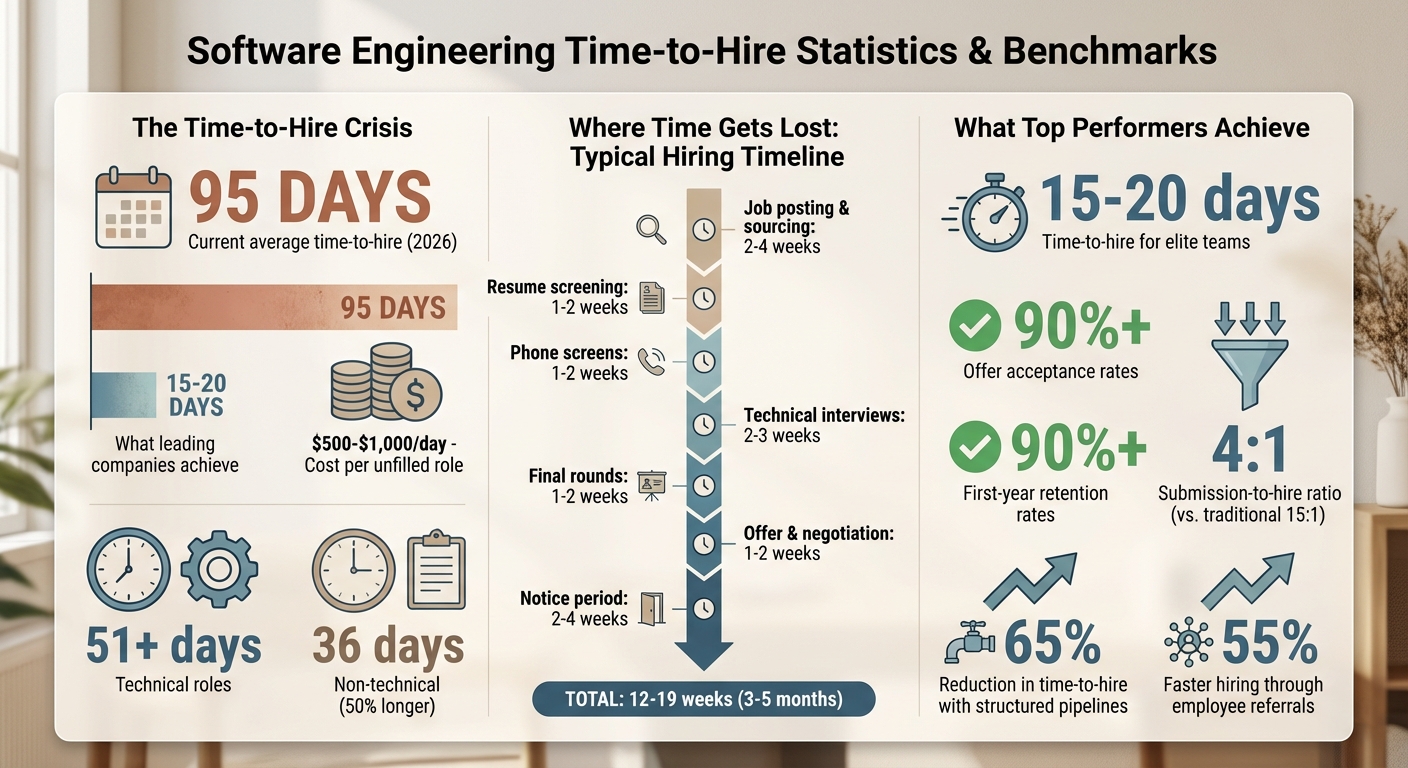 {Software Engineering Time-to-Hire Benchmarks and Costs}
Industry Benchmarks and Why Your Hiring Takes Longer
Average Time-to-Hire for Software Engineers
In 2026, hiring software engineers has become a lengthy process, with the average time-to-hire stretching to 95 days . Traditional hiring methods take even longer - up to 126 days - and filling senior roles can take anywhere from three to six months . On average, technical positions remain unfilled 50% longer than non-technical roles, with a typical vacancy lasting 51+ days compared to just 36 days for other industries .
Here’s a breakdown of a typical hiring timeline for software engineers:
| Phase | Duration |
|---|---|
| Job posting and sourcing | 2–4 weeks |
| Resume screening | 1–2 weeks |
| Phone screens | 1–2 weeks |
| Technical interviews | 2–3 weeks |
| Final rounds | 1–2 weeks |
| Offer and negotiation | 1–2 weeks |
| Notice period | 2–4 weeks |
| Total Timeline | 12–19 weeks (3–5 months) |
Candidate drop-offs further complicate the process. In the U.S., only 61% of candidates complete their technical interviews . Drop-off rates are high across the board, averaging 45–60% at the application stage and 20–30% after technical assessments .
These numbers highlight why it’s essential to pinpoint delays and optimize recruitment funnel conversion rates and address them effectively.
Why Hiring Timelines Get Extended
Several bottlenecks often drag out the hiring process, many of which are preventable. For instance, reactive hiring - waiting to start sourcing until a role is vacant - can add 2–3 weeks to the timeline compared to proactive efforts like maintaining a warm pipeline through proactive sourcing strategies . Geographic limitations also play a role. Companies that restrict their search to local candidates face fierce competition for a limited talent pool, which significantly slows the process .
Recruiters spend a significant amount of time - 60% of their workload - sifting through unqualified resumes from general job boards . Meanwhile, senior developers, who are often involved in candidate evaluations, dedicate 8–10 hours per week to the process, pulling them away from their primary responsibilities and creating scheduling conflicts .
Scheduling multiple interview rounds is another challenge. Many companies require 4–6 rounds, and technical assessments alone can add 7–14 days to the timeline . This explains why only 37% of tech recruiters manage to fill senior engineering roles within 60 days . Specialized roles, like machine learning or security engineers, demand even more time, often taking 50–65 days to fill .
Understanding these delays is the first step toward streamlining your hiring process and reducing time-to-hire.
Where Time Gets Wasted in Your Hiring Funnel
Finding Delays Across Each Stage
Delays in the hiring process often pile up at specific stages. For example, sourcing can be a major holdup. Recruiters spend 60% of their time screening unqualified resumes , which is often because they wait until a role is officially open instead of building a warm pipeline in advance.
Scheduling interviews is another time sink. Coordinating a single phone screen via email can take 4–7 days . These delays tend to snowball, dragging out the entire process. Adding to the slowdown, technical assessments can tack on another 7–14 days , especially when results are reviewed one at a time instead of simultaneously.
Decision-making is another bottleneck, particularly when too many stakeholders are involved. Thoughtworks experts point out that requiring approval from founders or senior leaders for every hire can create significant delays. In competitive markets, this hesitation can cost you top candidates. For instance, taking more than 7 days to provide interview feedback or requiring multiple layers of approval for an offer can lead to candidates accepting other opportunities .
Understanding where these delays occur is the first step toward streamlining your hiring process.
Using Metrics to Spot Bottlenecks
Once you've identified where delays happen, tracking metrics can reveal actionable insights. Start by distinguishing between two key metrics: time-to-fill (from requisition approval to offer acceptance) and time-to-hire (from when a candidate enters the pipeline to offer acceptance) . Time-to-fill measures overall efficiency, while time-to-hire focuses on the speed of your recruitment process.
Break your hiring funnel into clear stages - resume screening, hiring manager review, phone screens, technical assessments, and final interviews - and measure how long candidates spend in each. Set clear SLAs (service-level agreements) for each step, such as reviewing resumes within 24 hours or providing interview feedback within 24–48 hours . Tracking your interview-to-hire ratio can also uncover inefficiencies. If you’re conducting too many interviews per hire, it could signal unclear role requirements or poor initial screening .
Pipeline conversion rates are another critical metric. If candidates frequently fail at the technical assessment stage, it might mean your screening process needs adjustment. Research from AIHR shows that 82% of companies now see data as essential for talent acquisition decisions . However, many still rely on instinct instead of metrics. By using data to guide decisions, you can cut time-to-hire for roles like software engineers and make your process more efficient.
Pre-Pipeline Optimization: Getting Ready Before You Hire
Define Role Requirements and Align Hiring Managers
A common pitfall in technical hiring is waiting until a position opens to figure out what’s actually needed. This lack of preparation often leads to delays caused by unclear requirements and misaligned expectations between recruiters and hiring managers.
Start by conducting a technical skills inventory to assess your team’s current capabilities and identify future gaps. From there, create detailed role profiles that outline specific technologies, experience levels, and performance expectations. A practical approach like the 70/30 rule - hiring candidates with 70% of the required skills while leaving 30% for on-the-job learning - can attract motivated talent eager to grow while keeping the role challenging .
Alignment is key. Use a standardized hiring manager intake form to clarify job requirements before sourcing begins . Define success metrics for the first 30, 60, and 90 days, and establish scoring rubrics and evaluation frameworks early on. This ensures every interviewer evaluates candidates consistently. When hiring teams agree upfront on "must-haves" versus "nice-to-haves", you can avoid unnecessary delays like round-robin interviews or scheduling conflicts .
Once everyone is on the same page about the role, the next step is to secure headcount and budget approvals well in advance.
Get Headcount and Budget Approved Early
Reactive hiring - starting from scratch each time a position opens - can add 2–3 weeks to your timelines . Worse, waiting for approvals after finding the perfect candidate increases the chances they’ll accept an offer elsewhere. With unfilled developer positions costing $500–$1,000 per day in direct and indirect expenses, these delays can get expensive fast .
To avoid this, secure headcount and budget approvals before roles open. Use talent forecasting models that rely on historical hiring data and align with strategic goals. Rank roles by their impact and hiring difficulty, then allocate budgets accordingly. Benchmark compensation during the planning phase to ensure competitive salary ranges, preventing last-minute scrambling when candidates are juggling other offers. By managing headcount and budgets proactively, you can reduce hiring timelines by 2–3 weeks and improve your chances of landing top talent.
Building Warm Pipelines Before Roles Open
Proactive sourcing eliminates the delays that come with starting recruitment from scratch. By focusing on pre-pipeline optimization, you can create warm talent pools that turn hiring into a proactive, ongoing process. This means identifying and engaging potential candidates before you need them, so when a position opens, you already have a pool of pre-qualified, interested developers ready to go, often using a tech candidate fit analyzer to ensure quality.
RecruitBPM: "Proactive recruitment strategies flip that dynamic entirely. Instead of posting and praying, proactive hiring means building relationships, pipelines, and systems before a vacancy ever opens."
Warm pipelines help companies avoid the scramble of last-minute hiring by treating talent acquisition as a continuous function. Businesses that use structured talent pipelines report cutting time-to-hire by up to 65% . Employee referrals, another form of warm sourcing, can reduce hiring time by 55% compared to traditional job postings . This approach not only saves time but also lays the groundwork for targeted outreach, which is explored further in the next section.
Connect with Passive Candidates Through Developer Networks
The top software engineers aren’t spending their time scrolling through job boards. They’re busy learning new technologies, reading technical content, and engaging with professional communities. Generic outreach often falls flat, with response rates from senior talent dipping below 3% . To change this, you need to meet developers where they already are - on developer networks and in the communities they trust.
Platforms like daily.dev Recruiter offer a way to connect with passive candidates who are active and engaged in their professional growth. Instead of sending cold, impersonal emails, these platforms allow for mutual and proactive engagement. This makes them a strong alternative to SeekOut and other scraping-based tools. This approach fosters trust from the very first interaction and typically leads to much higher response rates.
Other ways to engage passive talent include:
- Joining niche professional communities and developer networks.
- Attending industry conferences or virtual events.
- Revisiting your internal ATS for "silver medalists" - strong candidates from previous searches who weren’t hired but remain a great fit for future roles .
Building talent communities also keeps potential candidates engaged. These are groups of developers who opt in by attending webinars, subscribing to newsletters, or downloading resources. Even when no immediate role is available, these connections ensure your pipeline remains warm .
Year-round employee referral programs are another way to maintain a steady flow of introductions. Rewarding employees for introducing high-quality talent, even if the referral doesn’t lead to a hire, ensures your pipeline stays active . And don’t forget about internal mobility - current employees can often fill new roles faster, reducing ramp-up time while reinforcing a culture of growth .
While initial outreach is critical, maintaining those relationships over time is what truly sets a warm pipeline apart.
Maintain Relationships for Faster Sourcing
Finding candidates is only part of the equation. Keeping them engaged until the right role opens is what transforms a warm pipeline into a valuable resource. Regular check-ins help confirm a candidate’s current availability and interest, avoiding wasted time when a position becomes available .
Using a recruiting CRM, you can stay connected with warm candidates and prevent attrition. Pre-vetted talent pools take this one step further. These are candidates who have already passed initial technical assessments and cultural fit evaluations, so when a role opens, you can move straight to final interviews . Segmenting these pools by technical skills and experience ensures precise matching when the time comes .
The move from reactive to proactive sourcing is gaining momentum. Today, 84% of talent leaders globally plan to integrate AI into their recruitment strategies to support proactive sourcing and pipeline management. By 2026, 52% of employers aim to add autonomous AI agents to their recruitment teams . These tools can monitor pipelines, identify passive candidates based on career trends, and even initiate outreach before a job is officially posted.
Companies with strong employer brands report cutting their cost-per-hire by 50% . Yet, 45% of employers still struggle to find qualified candidates because they rely on reactive "post and pray" methods instead of building proactive pipelines . With warm pipelines in place, moving into faster sourcing and technical screening becomes a natural next step.
Faster Technical Screening and Assessment
Once you’ve established a warm pipeline, the next priority is speeding up technical screening and assessment to avoid bottlenecks. On average, technical assessments add 7–14 days to the hiring process . Senior developers often dedicate 8–10 hours each week to these evaluations , which takes time away from their primary work. This delay can cost you top candidates, especially if competitors move faster. The key here is to streamline the process while maintaining consistency.
Use Automated Coding Assessments
Automated coding assessments act as an efficient first filter, allowing hiring teams to handle a large volume of applications without tying up recruiters or engineers. Instead of requiring senior developers to review every code sample manually, these tools can cut evaluation time by up to 40% . Plus, they use standardized scoring rubrics, ensuring candidates are assessed fairly and objectively.
Timing is critical. Aim to have candidates complete their technical assessments by the end of the second week of the hiring process. If the process drags beyond 45 days, the likelihood of losing candidates increases significantly . Avoid tests that are overly complex, as they can discourage applicants.
"A screening test should be given to all applicants equally to ensure a more accurate and fair hiring process." - PeopleForce
For U.S.-based roles with a $60,000 salary, companies can save between $7,800 and $22,500 by reducing mis-hires through skills-based hiring . Automated assessments provide clear, data-driven insights to identify strong candidates early. After these tests, a brief live screening can validate results and pave the way for further evaluation.
Implement Structured Phone Screens
Structured phone screens are another effective tool, helping to filter out 60% to 70% of candidates with consistent, standardized questions. This step is essential for ensuring fairness and avoiding the inefficiency of unstructured calls, which can make comparisons between candidates difficult.
Keep these phone screens short - between 15 and 30 minutes - and focus on four key areas: problem-solving skills, basic system design, familiarity with tools and methods, and practical application. Use a Behaviorally Anchored Rating Scale (BARS) to convert subjective impressions into objective scores. For example, a candidate who clearly explains their approach, reasoning, and trade-offs might score a "4" for communication.
"Technical screening acts as one of the first hurdles to check a candidate's basic tech skills. It's a faster, more automated step... It shrinks the number of candidates from the start." - Ihor Shcherbinin, VP of Recruiting, DistantJob
During these calls, ask candidates to explain their thought process out loud. This helps interviewers evaluate reasoning skills, not just final answers. Use this time to confirm logistical details like salary expectations, notice periods, and work preferences. This ensures you don’t waste time on candidates who won’t move forward due to mismatched expectations. Prepare a script and scoring criteria ahead of time, and offer preset time slots to minimize scheduling delays.
Eliminating Interview Scheduling Delays
Once you've optimized your sourcing and screening, the next challenge is tackling interview scheduling delays - often a major bottleneck in the hiring process. For technical roles, the process typically involves 4 to 6 interview stages , requiring input from several decision-makers. Coordinating these schedules can stretch timelines by weeks, and in a competitive market where candidates frequently accept the first strong offer, every day counts.
Use Scheduling Tools to Save Time
Automated scheduling tools can drastically reduce the back-and-forth emails that slow down coordination. Platforms like GoodTime use AI to automate interviewer selection, balance workloads, and identify bottlenecks, handling up to 90% of interview management tasks . For example, Joe Albano, Director of Talent Acquisition, shared that his team cut their time-to-fill from 60 days to 45 days after adopting GoodTime .
For urgent or high-volume hiring, conversational AI tools like Paradox streamline scheduling even further. These tools can arrange interviews through SMS or WhatsApp in under three minutes .
Derek B, Head of Recruitment, highlighted, "Olivia helped us shave our response time from 7 days to under 24 hours" .
Delays longer than a week often signal inefficiencies to candidates . Self-scheduling platforms like Greenhouse, HireVue, and Lunacal empower candidates to select from pre-set availability windows, reducing scheduling time by 50% to 73% . These tools sync in real-time with Google and Outlook calendars, minimizing double-booking and cutting administrative errors by 62% . To avoid burnout from back-to-back meetings, make sure to include buffer times between interviews.
Once scheduling is streamlined, using standardized interview templates can further speed up the process and ensure consistency.
Create Standard Interview Templates
Standardized interview templates simplify planning by offering pre-defined, role-specific questions that cover key competencies, saving time on preparation.
Molly Weaver, Director of Talent Acquisition at Children's Mercy Hospitals & Clinics, stated: "Having [HireVue Scheduling] now as part of our HireVue platform has drastically cut back on our recruiter's scheduling time - giving them time to focus on candidates, not calendar logistics" .
Panel interviews are another effective way to simplify scheduling. Instead of arranging multiple one-on-one interviews, panels allow several stakeholders to assess a candidate in a single session, reducing the number of interview rounds. Tools like GoodTime and VidCruiter can sync calendars to find mutually available times for all panel members .
Templates also help eliminate redundant questions across interview stages. When each interviewer follows a clear framework - focusing on areas like system design, coding expertise, or cultural alignment - you avoid repeating questions and wasting candidates' time. This structured approach can reduce overall assessment time by up to 40% while ensuring evaluations remain consistent and thorough.
Faster Decision-Making and Offer Approvals
Once interviews are streamlined, the next big challenge is speeding up internal decision-making. Filling technical positions takes an average of 51 days - about 50% longer than non-technical roles. Even a short delay of three days can result in losing top candidates to competitors .
Use Scorecards for Same-Day Debriefs
Structured scorecards are a game-changer for quick, fair evaluations. They ensure all interviewers assess candidates using the same objective criteria - like system design skills, code quality, and problem-solving approaches. This consistency makes comparing candidates much easier . Without such tools, decision-making slows down as interviewers rely on inconsistent or subjective criteria. Full Scale explains:
"Traditional technical assessments provide inconsistent evaluations. Different interviewers focus on varied criteria when judging candidates. This inconsistency undermines efficient decision-making processes." - Full Scale
Setting a rule for same-day or 24-hour feedback keeps the process moving. Pair this with panel interviews to let stakeholders evaluate candidates together, cutting assessment time by up to 40% . Providing prompt feedback while the interview is still fresh ensures decisions are made quickly, maintaining momentum.
Pre-Approve Comp Bands and Streamline Offers
Delays in budget approval can stretch out the hiring process by weeks. Pre-approved compensation bands solve this issue by eliminating the need for last-minute approvals . Use current salary benchmarks to set competitive ranges. For example, entry-level software engineers in major U.S. tech hubs often start at $120,000, with local market rates exceeding global averages by 30% to 40% .
CodersLink highlights a key point:
"When a software engineer or developer looks for a job, they are almost always applying at multiple companies and will accept the first legitimate offer they are given." - CodersLink
Make the final interview the last step in the process. With pre-approved salary ranges and data-driven scorecards, you can issue offers within 24 hours, avoiding unnecessary delays and securing top talent quickly.
The Speed vs. Quality Tradeoff: Cutting Time Without Cutting Corners
Worried that speeding up your hiring process might lead to sacrificing quality? It doesn’t have to. Top hiring teams have shown it’s possible to achieve a time-to-hire of 15-20 days while maintaining an impressive 90%+ first-year retention rate . The secret lies in eliminating unnecessary steps while keeping the critical ones intact. Let’s explore how data and structured processes can help you balance speed with quality.
Track Quality Metrics Alongside Speed
Streamlining your hiring process is just the beginning - you also need to track the right metrics to ensure quality isn’t slipping. Keep an eye on key indicators like the submission-to-hire ratio (elite teams manage a 4:1 ratio compared to the traditional 15:1), technical assessment pass rates, and new hire performance at 30, 60, and 90 days. A lower submission-to-hire ratio means your sourcing efforts are more precise, delivering better candidates faster.
Carlos A. Vázquez, CEO and Founder of CodersLink, underscores the importance of focusing on quality:
"The cost of bringing on an employee only to let him or her go within a month or two is costly and stressful. We highly recommend doing the up-front work to hire the right candidate." - Carlos A. Vázquez, CEO/Founder, CodersLink
Ultimately, first-year retention rates serve as a key indicator of success. If you’re achieving 90%+ retention while reducing hiring time, it’s clear you’re moving quickly without cutting corners .
Use Data to Maintain Consistency
Efficient hiring isn’t about rushing - it’s about using data to make better decisions. For example, standardized scoring rubrics can reduce subjective bias across interviewers and locations, cutting assessment time by up to 40% . Using a data-driven hiring process with automated prescreening tools also helps filter out unqualified candidates early, saving valuable time for your team. Same-day debriefs using scorecards prevent "decision drift", where quality standards slip under pressure to fill roles quickly.
It’s also important to calibrate assessments to validate skills without discouraging top candidates. For software engineers, the sweet spot for completing the hiring process is 30 days. If your process stretches beyond 45 days, you risk losing top-tier talent . By combining structured evaluations with faster coordination, you can hit that 30-day goal while maintaining high hiring standards.
Conclusion
Reducing the time it takes to hire software engineers isn’t about rushing decisions - it’s about eliminating inefficiencies while maintaining high standards. The strategies outlined here demonstrate how top-performing teams achieve hiring cycles of just 15–20 days with offer acceptance rates exceeding 90%. They do this by focusing on proactive sourcing, standardized assessments, efficient coordination, and data-driven decision-making . These approaches ensure you can act quickly without compromising on quality.
In today’s competitive market, what developers want often involves juggling multiple offers. A swift and well-structured hiring process is essential to secure them. Meeting benchmark timelines is critical to avoid losing candidates .
To optimize your process, evaluate your metrics to identify inefficiencies, apply the 70/30 rule , maintain warm talent pipelines, implement panel interviews, and ensure feedback is delivered within 24–48 hours . These steps create a hiring framework that balances speed with thoroughness.
The data supports this approach: you can move faster without sacrificing quality. For example, elite teams achieve submission-to-hire ratios of 4:1, compared to the traditional 15:1, proving that streamlined processes deliver results . By cutting out waste while upholding rigorous evaluations, you can build a hiring process that works smarter, not harder.
FAQs
What’s a realistic time-to-hire goal for engineering roles?
With well-organized processes in place, hiring for engineering roles can realistically take around 21 to 28 days. That’s a noticeable improvement compared to the industry average of 43 days. By refining steps such as sourcing, screening, and making decisions, you can speed up the timeline without sacrificing quality.
Which hiring metrics should I track to find bottlenecks fast?
To spot bottlenecks in your hiring process, focus on tracking metrics like time to hire and application drop-off rate. These numbers can reveal where delays are happening, making it easier to identify trouble spots in your recruitment funnel. Fixing these problem areas can help make your hiring process more efficient and smooth.
How do I build a warm pipeline before roles open?
Building a warm pipeline requires thoughtful planning and regular interaction. Begin by reaching out to potential candidates well in advance through networking, attending industry events, and maintaining open lines of communication. Keep an organized database of qualified professionals and stay connected with passive candidates through platforms like social media or professional networks. A strong employer brand can also keep candidates intrigued, making it easier to fill roles quickly when opportunities arise.
.png)