Ghosting in hiring - when candidates or employers abruptly stop communication - is a growing issue, especially in tech recruitment. It wastes time, increases costs, and damages reputations. Candidates often ghost due to unclear job descriptions, slow communication, or mismatched expectations. Employers also contribute by failing to update candidates or offering vague details about roles and culture.
The solution? Transparency. Clear job postings, consistent updates, and open communication build trust and reduce dropouts. Tools like daily.dev Recruiter help by connecting engaged developers with employers through detailed role briefs and mutual interest. Metrics like ghosting rates, communication frequency, and candidate satisfaction can track improvements.
Key Takeaways:
- 61% of candidates expect salary ranges upfront.
- 70% want weekly updates during hiring.
- Transparent hiring improves offer acceptance and reduces ghosting.
Start with clear expectations, timely updates, and honesty at every step.
::: @figure 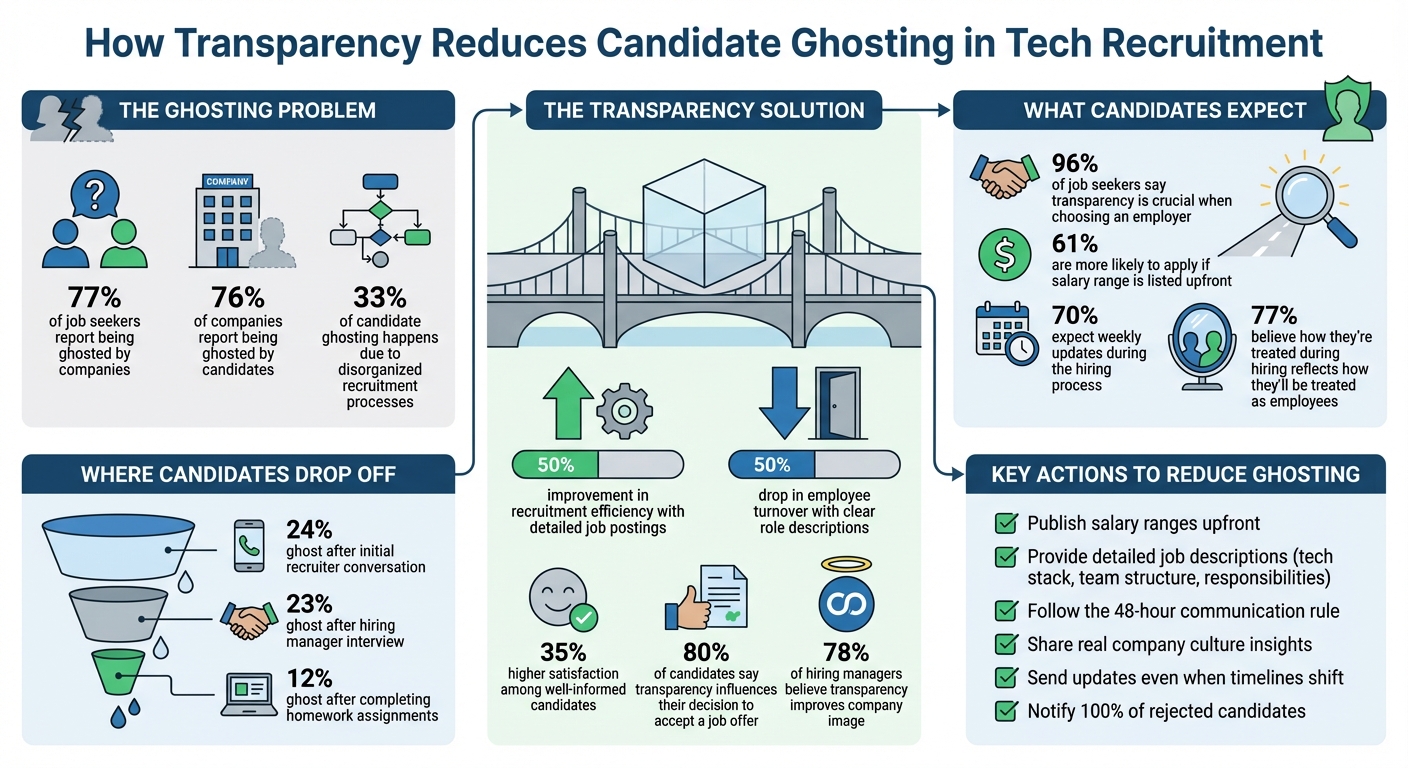 {How Transparency Reduces Candidate Ghosting in Tech Recruitment}
Why Candidates Ghost Employers
Candidates often disappear when recruitment practices fall short. Research shows that one-third of candidate ghosting happens because of disorganized recruitment processes . Developers notice red flags like vague job descriptions, unprepared interviewers, or complete silence after interviews. These issues leave a lasting impression, making candidates think, "If this is how they handle hiring, what’s it like to work there?"
Unclear Job Descriptions and Hiring Processes
When job postings lack specifics, they fail to engage candidates. Without clear details about responsibilities, required skills, or team dynamics, candidates are left guessing. This is a problem because 96% of job seekers say transparency is crucial when choosing an employer . Yet, many job descriptions are so generic they could fit countless roles.
Delays in the interview process make things worse. Rescheduled meetings, interviewers who aren’t prepared, and long periods of silence all scream disorganization. Grant D'Arcy, VP of Talent and Learning at Coinbase, sums it up perfectly:
"Ambiguity about the role or recruiting process only leads to confusion and mutual wasted time" .
Salary transparency - or the lack of it - is another sticking point. 61% of job seekers are more likely to apply if the salary range is listed upfront . But many companies hold off sharing this information until late in the process. When candidates finally learn the pay doesn’t meet their expectations - after spending hours interviewing - they often ghost rather than explain. This approach wastes time and erodes trust right from the start.
Then there’s the "black hole" effect. 70% of candidates expect weekly updates on their application status , but many hear nothing for weeks - or even months. In a competitive hiring market where top developers expect interviews to happen within a week, slow responses almost guarantee losing talent to faster-moving companies .
These process flaws don’t just waste time; they hint at deeper problems that require you to fix common developer hiring issues within the organization.
Culture Misalignment and Trust Issues
Beyond logistical hiccups, a chaotic hiring process can signal a problematic workplace culture. 77% of applicants believe the way they’re treated during hiring reflects how they’ll be treated as employees . When the process feels disorganized, impersonal, or even dishonest, candidates assume the work environment will be the same.
Inconsistent messaging is a major trust-breaker. For example, if a job posting advertises remote flexibility but an interviewer says, "We prefer people in the office", it feels like a bait-and-switch. Unrealistic expectations are another red flag - like asking a project manager to debug code or requiring 15 years of experience in a field that’s only existed for a decade. When candidates notice these disconnects, they often decide to quietly walk away .
Ghosting also feeds into a vicious cycle. 77% of job seekers report being ghosted by a company , and those who’ve experienced it are more likely to ghost employers in return . This creates a culture of mistrust and minimal commitment on both sides. As Travis Taborek from Workable explains:
"The real culprits [of ghosting]? Hiring managers and C-suite executives who create cultures of opacity and inefficiency" .
For developers, cultural mismatches around remote work options, team collaboration, or technical autonomy are often deal-breakers. When companies fail to be upfront about these factors, candidates may decide it’s better to ghost than to engage in what feels like a losing battle. Without clear cultural signals, companies not only confuse candidates - they actively drive them away.
How Transparent Company Culture Reduces Ghosting
Transparent hiring creates trust from the start, making candidates less likely to ghost during the process. When companies are upfront about roles, expectations, and workplace culture, candidates can make informed decisions early on. This approach significantly lowers the chances of candidates disappearing mid-process. In fact, 96% of job seekers value working for a company that prioritizes transparency . The numbers back this up: 35% of well-informed candidates report higher satisfaction with their hiring experience .
One of the biggest issues transparency tackles is misaligned expectations. When companies clearly communicate what they offer - and what they don’t - only genuinely interested candidates tend to move forward. This self-filtering process reduces dropouts and increases engagement. As Neil Patel aptly puts it:
"We like people who are transparent, so it makes sense that we like companies who are transparent, too. It's about being a real person, a real leader, and a real company" .
By setting clear expectations from the very beginning, businesses not only attract the right talent but also minimize the risk of candidates dropping out later.
Clear and Detailed Job Postings
Vague job descriptions are a recipe for wasted time. When postings don’t provide specifics - such as the tech stack, team structure, or daily responsibilities - candidates can’t determine if they’re a good fit. The result? They apply anyway, discover the mismatch during interviews, and then ghost. detailed job postings and coding-focused candidate sourcing tools help candidates self-select more accurately.
Companies with detailed job postings see a 50% improvement in recruitment efficiency and a 50% drop in employee turnover . Moreover, 61% of job seekers are more likely to apply when salary details are included upfront . This highlights how crucial compensation transparency is for attracting the right candidates.
A well-crafted job posting should include technical requirements, team structure, salary range, and an outline of the interview process. For example:
- Specify the programming languages and frameworks the team uses.
- Describe the technical challenges the team is currently addressing.
- Outline success metrics for the first 30, 60, and 90 days in the role.
- Detail team dynamics, including who the new hire will report to and collaborate with.
- Clearly state the salary range and benefits, sparing candidates the need to ask.
- Map out the interview process, including the number of stages, types of assessments, and the expected timeline.
This level of detail shows respect for candidates’ time and fosters trust even before the first conversation.
Clear Interview Processes and Timelines
After clear job descriptions, a structured and transparent interview process is the next step to building trust. Once candidates apply, uncertainty becomes the biggest hurdle. 70% of candidates expect weekly updates about their application status , yet many companies go silent for weeks. This lack of communication increases ghosting by 34% . The solution? Consistent and proactive communication.
Grant D’Arcy, VP of Talent and Learning at Coinbase, highlights the importance of clarity:
"Ambiguity about the role or recruiting process only leads to confusion and mutual wasted time. When you clearly share what a candidate can expect, you allow them to focus on putting their best foot forward" .
A practical approach is the "48-hour rule": ensure no more than 48 hours pass without some form of communication . This doesn’t mean making hiring decisions every two days - it could be as simple as sending an update about the timeline. Elizabeth Turner, Senior Business Recruiter at SeatGeek, emphasizes this:
"We do our best to put ourselves in candidates' shoes and recognize any update is better than nothing" .
Companies that excel in this area often provide candidates with interview preparation documents, self-scheduling tools to reduce back-and-forth, and regular status updates when timelines shift. These small but meaningful actions show respect for candidates and keep them engaged rather than seeking other opportunities.
Sharing Real Company Culture
Giving candidates a genuine view of company culture helps prevent misunderstandings that lead to ghosting. For many applicants, how they’re treated during the hiring process reflects how they’ll be treated as employees. 77% of candidates believe this to be true . That’s why companies must go beyond just talking about their culture - they need to show it. This means sharing the reality of the workplace, including its challenges, team dynamics, and daily environment.
Some companies take creative approaches to this. For example:
- SeatGeek provides candidates with a "virtual welcome" deck featuring photos, videos, and insights into their workplace, along with tips for remote interviewing .
- Coinbase uses structured interviews where candidates collaborate on real-world projects with the team they’d join, giving them a true sense of the work environment .
- Google offers new hires access to product roadmaps and holds weekly "TGIF" meetings where co-founders answer employee questions .
Authenticity is key. As the Talent Team at Madrona advises:
"Transparency in recruiting is your team's competitive advantage... Embrace your entire startup identity - the one that kicks ass but also makes mistakes" .
How daily.dev Recruiter Enables Transparent Hiring
daily.dev Recruiter offers a refreshing approach to hiring by focusing on transparency and fostering genuine connections. Unlike traditional platforms that rely on mass outreach - often leading to distrust and ghosting (an issue reported by 76% of companies) - daily.dev Recruiter builds its hiring process within an active developer community. Here, trust and openness take center stage.
Employers connect with developers who are already engaged and learning on daily.dev, avoiding the impersonal nature of mass communication. Every interaction begins with mutual interest and clear context, sidestepping the spam-like experiences that often push candidates away. This developer-focused approach addresses the root causes of ghosting by prioritizing transparency at every stage.
Double Opt-In Introductions
One of the standout features of daily.dev Recruiter is its double opt-in system, where both employers and developers must agree before a conversation begins. This ensures that only genuinely interested parties engage, creating a foundation of honesty rather than obligation.
This method resonates with what candidates seek. In fact, 80% of candidates say that transparency heavily influences their decision to accept a job offer. By filtering out uninterested applicants from the start, companies save time and reduce candidate withdrawals - often by as much as 50%.
Moreover, this approach respects developers as thoughtful individuals, not just resumés in a database. As Maksym Lushpenko, Founder of Brokee, explains:
"Transparency in AI-assisted candidate assessments is crucial, especially in aligning the expectations of both the employer and the potential employee".
When developers know exactly what they’re agreeing to, they’re far less likely to disappear mid-process. This initial clarity sets the stage for deeper trust in future interactions.
Detailed Culture and Role Information
Vague job descriptions are a major culprit behind ghosting. daily.dev Recruiter addresses this by enabling employers to share transparent developer job posts and cultural insights before any introductions take place. These briefs include specifics like technical challenges, team structure, salary range, and core company values, giving developers a clear understanding of the role upfront.
This level of detail helps developers assess their fit before committing to the process, ensuring only genuinely interested candidates move forward. It’s no surprise that 78% of hiring managers believe transparency improves their company’s public image. Additionally, clear role information reduces the uncertainty and anxiety that often cause candidates to drop out.
Real-Time Connections with Engaged Developers
daily.dev Recruiter facilitates real-time connections with developers who are actively participating in the daily.dev community. These developers are already reading articles, exploring new technologies, and engaging with peers, making them highly receptive to opportunities. This immediacy ensures that interactions happen promptly, not weeks after a profile update, which helps maintain momentum and trust.
For developers, the candidate experience speaks volumes about a company’s values. In fact, 78% of job seekers see it as a direct reflection of how a company treats its people. By offering context-rich introductions rather than impersonal outreach, daily.dev Recruiter ensures developers feel respected and valued. This trust-driven approach transforms recruiting into a matchmaking process that minimizes ghosting and creates a hiring experience built on mutual respect and transparency.
Hiring engineers?
Connect with developers where they actually hang out. No cold outreach, just real conversations.
Measuring the Results of Transparent Hiring
Tracking reductions in ghosting requires clear and actionable metrics. These metrics not only help identify weak points but also guide adjustments to keep the hiring process transparent and effective.
Metrics to Track
Transparent job postings and streamlined interview processes are great starting points, but how do you ensure they’re working? By monitoring specific metrics that reveal where candidates drop off. For example, a survey by Greenhouse found that 24% of candidates ghost after the initial recruiter conversation, 23% after the hiring manager interview, and 12% after completing homework assignments. These numbers highlight the stages where transparency might need a boost.
Offer acceptance rates are another key indicator. When candidates have a clear understanding of salary, benefits, and role expectations from the outset, they’re more likely to accept offers. In fact, 61% of job seekers are more inclined to apply when salary ranges are disclosed upfront. This same clarity translates into higher acceptance rates, as mutual expectations are aligned from the beginning.
Communication consistency is equally important. Candidates expect regular updates, with 70% preferring weekly communication. Maintaining a maximum 48-hour gap between touchpoints ensures engagement stays strong throughout the process.
Don’t overlook rejection notifications. Only 4% of companies reach out to all rejected candidates, yet providing closure - especially with personalized feedback for those in later stages - can safeguard your employer brand. Poor recruitment experiences are often shared, with 72% of candidates reporting that they’ve talked about negative experiences with others.
| Metric | What to Measure | Success Indicator |
|---|---|---|
| Ghosting Rate | Interview no-shows and unresponsive candidates | Decrease from baseline |
| Offer Acceptance | Percentage of offers accepted | Increase in acceptance within budget |
| Communication Frequency | Time between candidate touchpoints | Maintain a 48-hour maximum gap |
| Candidate Satisfaction | Post-process survey scores | 35% reduction in dissatisfaction |
| Rejection Notifications | Percentage of rejected candidates contacted | Move toward 100% notification rate |
Improving Through Candidate Feedback
Direct feedback from candidates provides valuable insights into these metrics. Sending out short surveys to candidates who complete the interview process can uncover what’s working and what’s not. Questions like “Did you feel well-informed throughout the process?” or “What would have improved your experience?” can reveal areas to refine. Research shows that candidates who feel informed are 35% less likely to be dissatisfied with their hiring experience.
Transparent communication also involves asking candidates about their preferred method of contact - whether it’s email, text, phone, or messaging platforms. This small step can prevent ghosting caused by mismatched communication styles rather than a lack of interest.
It’s essential to foster a no-blame culture when discussing feedback. As Greenhouse explains:
"The only thing people learn from being blamed is to be better at hiding their mistakes. And that is detrimental to transparency".
By creating an environment where hiring teams can openly discuss issues - whether it’s a delayed decision, unclear job descriptions, or an overly lengthy process - you can address systemic problems instead of assigning blame.
Feedback can also help streamline the hiring process. For instance, removing unnecessary interview rounds that lead to candidate fatigue can shorten the overall timeline. Claire Stroh, an HR Consultant and Career Coach, emphasizes:
"If you leave a candidate floating out there with no feedback after an interview, the chances of being ghosted go up".
Conclusion: Transparency Solves Ghosting
Ghosting doesn’t have to be part of the hiring process - it’s often the result of poor communication and unclear expectations. When companies keep salary ranges hidden, fail to outline timelines, or don’t give candidates a real sense of their workplace, developers lose interest. The solution? Start with transparency from the very first interaction.
The numbers back this up: 96% of job seekers prioritize transparency, and detailed job postings improve efficiency by 50% while cutting churn in half. When developers know what’s coming - whether it’s technical requirements, interview stages, or compensation - they remain engaged. But when they’re left guessing, they’re likely to move on.
Transparency isn’t just about job descriptions; it’s about every step of the hiring process. Providing timely updates, like adhering to a 48-hour response rule, sharing progress during delays, and offering personalized feedback to rejected candidates, signals respect. As Grant D’Arcy, VP of Talent and Learning at Coinbase, explains:
"Too many times I see companies treat recruiting as a one-way street to get a hire, without turning the mirror on themselves for the candidate's benefit".
To address these challenges, tools like daily.dev Recruiter are designed to streamline the process. Features such as double opt-in introductions ensure both parties are genuinely interested before engaging. Developers gain access to detailed role descriptions and insights into company culture upfront, while employers connect with pre-qualified, motivated candidates. This approach eliminates the "black hole" effect that often fuels ghosting in traditional hiring.
Start simple: publish salary ranges, clearly outline your interview process, and maintain consistent communication. Monitor key metrics like ghosting rates, offer acceptance, and candidate satisfaction to identify areas for improvement. Transparency isn’t a one-time effort - it’s an ongoing practice of respecting developers as professionals. By aligning expectations from the start, transparent hiring not only reduces ghosting but also fosters a workplace culture that values and retains top talent.
FAQs
How do clear and transparent job descriptions help reduce candidate ghosting?
Transparent job descriptions that spell out role responsibilities, salary range, and hiring timelines go a long way in building trust with potential hires. When you set clear expectations from the start, you eliminate much of the guesswork, creating a process that feels open and fair. This clarity can significantly reduce the chances of candidates losing interest or disappearing entirely.
When candidates have a clear picture of what lies ahead, they're more likely to stay engaged throughout the hiring journey. This level of openness cultivates mutual respect, paving the way for stronger connections and smoother communication.
How can company culture help reduce ghosting during the hiring process?
Building a workplace culture that emphasizes transparency and respectful communication goes a long way in earning candidates' trust and keeping them engaged during the hiring journey. When people feel appreciated and kept in the loop, they’re less likely to lose interest or disappear without notice.
Focusing on open conversations, setting clear expectations, and responding quickly creates a smoother experience for candidates. It also reduces any ambiguity they might feel. A transparent approach shows that the company values meaningful connections, encouraging candidates to respond with the same level of respect.
Why is clear and consistent communication crucial during the hiring process?
Clear and steady communication plays a crucial role in building trust and ensuring a positive experience for candidates. When recruiters share regular updates about timelines, next steps, and feedback, it demonstrates respect and professionalism. This approach reduces the chances of candidates losing interest or "ghosting" during the hiring process. Transparency removes uncertainty - one of the biggest frustrations job seekers face.
Keeping the lines of communication open also helps accelerate the hiring process. By aligning expectations and maintaining momentum, you save time and resources while keeping top candidates engaged. This reduces the risk of them accepting offers from competitors. Tools like daily.dev Recruiter make it easier to deliver timely, personalized outreach, helping establish trust and connection with candidates right from the start.
Consistent communication doesn’t just prevent misunderstandings - it builds trust, enhances your company’s reputation, and creates a smoother, more successful hiring journey for everyone involved.
.png)