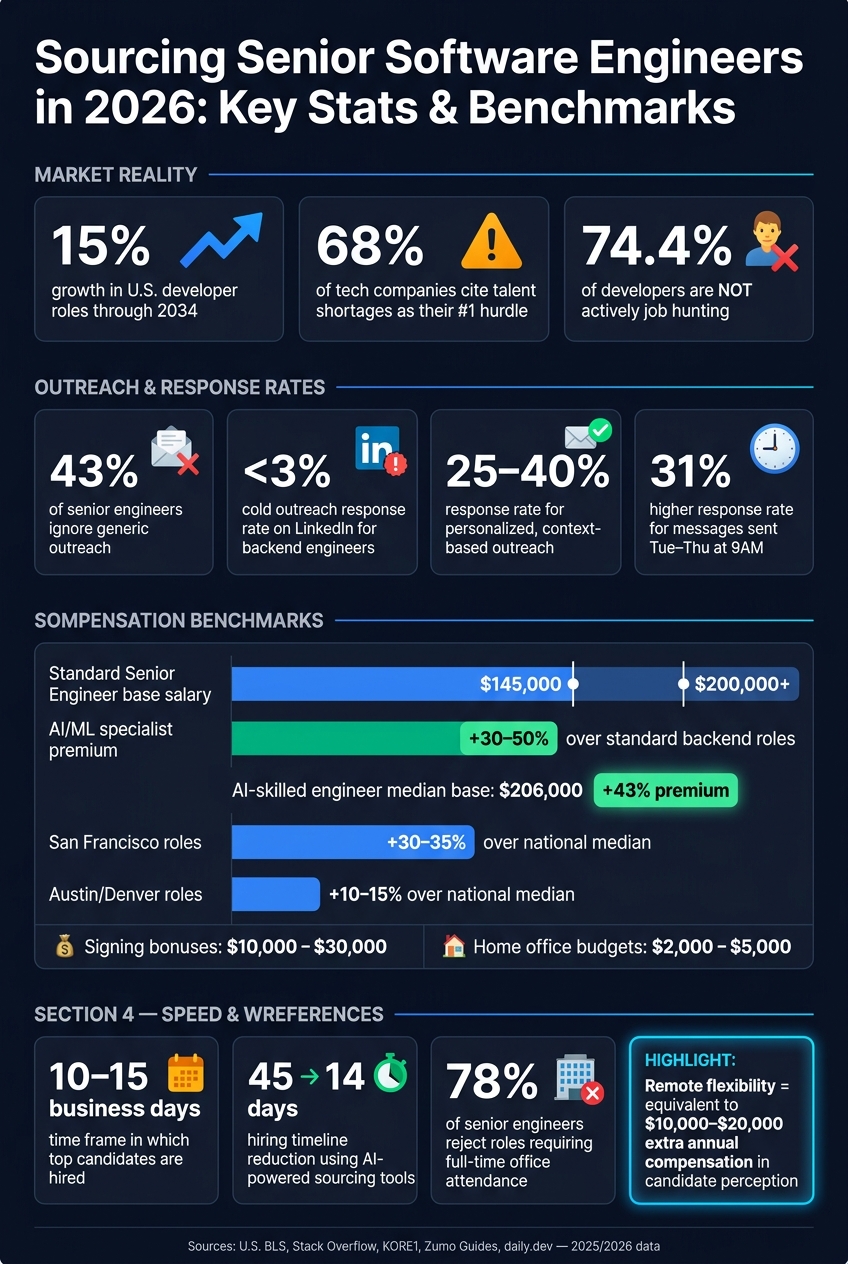
Finding senior software engineers in 2026 is more challenging than ever. Demand far exceeds supply, with U.S. developer roles growing 15% through 2034, but 68% of tech companies cite talent shortages as their biggest hurdle. Traditional methods like LinkedIn and job boards are no longer sufficient, as 74.4% of developers aren't actively job hunting, and 43% of senior engineers ignore generic outreach.
To succeed, you need a targeted approach:
- Define the role clearly: Focus on system design, cloud expertise, and AI fluency.
- Meet engineers where they are: Platforms like GitHub, Stack Overflow, and daily.dev Recruiter are key.
- Offer competitive compensation: Salaries range from $145,000–$200,000+, with AI roles demanding a 30–50% premium.
- Prioritize remote work: 78% of senior engineers won’t consider roles requiring regular office attendance.
- Leverage niche communities and events: Build relationships in smaller developer groups and attend tech conferences like QCon.
Speed matters. Top candidates are hired within 10–15 business days, and delays can cost you the best talent. Combine personalized outreach, transparent compensation, and remote-friendly roles to stand out in this competitive market.
Define the Senior Software Engineer Profile Before You Start Sourcing
Before diving into sourcing, it’s crucial to define exactly what you’re looking for in a senior software engineer. Without a clear profile, outreach efforts can become inefficient, dragging out the hiring process. On average, startups in 2026 spend 43 days hiring a senior engineer. An undefined profile can stretch this timeline even further, especially in a competitive market where talent is already scarce.
Key Traits of Senior Software Engineers
In 2026, being a senior engineer is about much more than just experience or writing clean code. With AI coding assistants now commonplace, producing syntactically correct code is no longer a differentiator. What sets senior engineers apart is their ability to exercise sound judgment. They can debug and refine AI-generated code, identify flawed approaches, and make critical architectural decisions.
"Theory without application is just trivia. Senior engineers aren't just people who write better code. They're people who can evaluate tradeoffs, make a defensible decision, and explain their reasoning clearly." - Hayk Simonyan
When defining your ideal candidate, focus on these key areas:
- System design expertise: Look for engineers who excel in designing scalable systems.
- Cloud experience: Proven skills with AWS, Azure, or Google Cloud are essential.
- AI-driven feature development: Candidates with experience in building and scaling features like RAG systems or integrating production-ready LLMs are increasingly valuable.
- AI fluency: By late 2024, over 70% of developers reported using AI coding tools regularly. Senior engineers must know how to leverage these tools effectively to boost productivity.
It’s also worth noting that only 3 out of 10 candidates typically meet the technical standards for senior roles. A well-defined profile can help you avoid wasting time on candidates who aren’t a fit.
Setting Realistic Expectations Using U.S. Market Data
Compensation is often where hiring efforts falter, even before sourcing begins. Senior software engineers with 7+ years of experience generally earn base salaries ranging from $145,000 to $200,000+. Specialized roles in machine learning or AI can demand an additional 30–50% premium over standard backend positions.
"Compensation is the #1 reason developers accept or reject offers. Yet many recruiters rely on outdated salary surveys or gut instinct." - Zumo Guides
Despite the prevalence of remote work, location still plays a role in salary expectations. For example:
- San Francisco roles: Typically offer a 30–35% premium over the national median.
- Austin or Denver roles: Tend to carry a 10–15% premium over the national median.
If your budget is capped at $120,000, it’s better to adjust your expectations and target mid-level candidates instead of senior-level talent. Attempting to hire senior engineers at mid-level pay will likely result in a prolonged search - potentially 2–3 times longer.
When base salary constraints exist, consider offering non-cash incentives to make the role more appealing. Options include:
- Signing bonuses ranging from $10,000 to $30,000
- Remote work flexibility
- Home office stipends
By aligning your budget with market realities, you can set clear expectations and streamline the hiring process.
How Your Defined Profile Shapes Where You Source
Once you’ve nailed down your technical and compensation requirements, they’ll directly influence your sourcing strategy. For instance:
- Specialized technical skills: If the role demands expertise in Rust or Go, focus on niche developer communities or open-source platforms rather than broad professional networks.
- Remote roles: For fully remote positions, expand your search to national or global talent pools and prioritize platforms where distributed engineers are active.
Defining these parameters upfront isn’t just a preparatory step - it’s the foundation for more focused and efficient sourcing strategies. By knowing exactly who you’re looking for and what you can offer, you’ll be better equipped to identify the right candidates from the start.
Source from Developer-Native Networks and Communities
Once you’ve defined the ideal candidate profile, the next step is to connect with senior engineers where they naturally spend their time. These professionals don’t typically browse job boards - instead, they focus on contributing to and engaging with developer communities. This shift in sourcing strategy aligns with technical hiring best practices that meet developers on their own turf.
Use daily.dev Recruiter to Reach Developers Where They Already Are
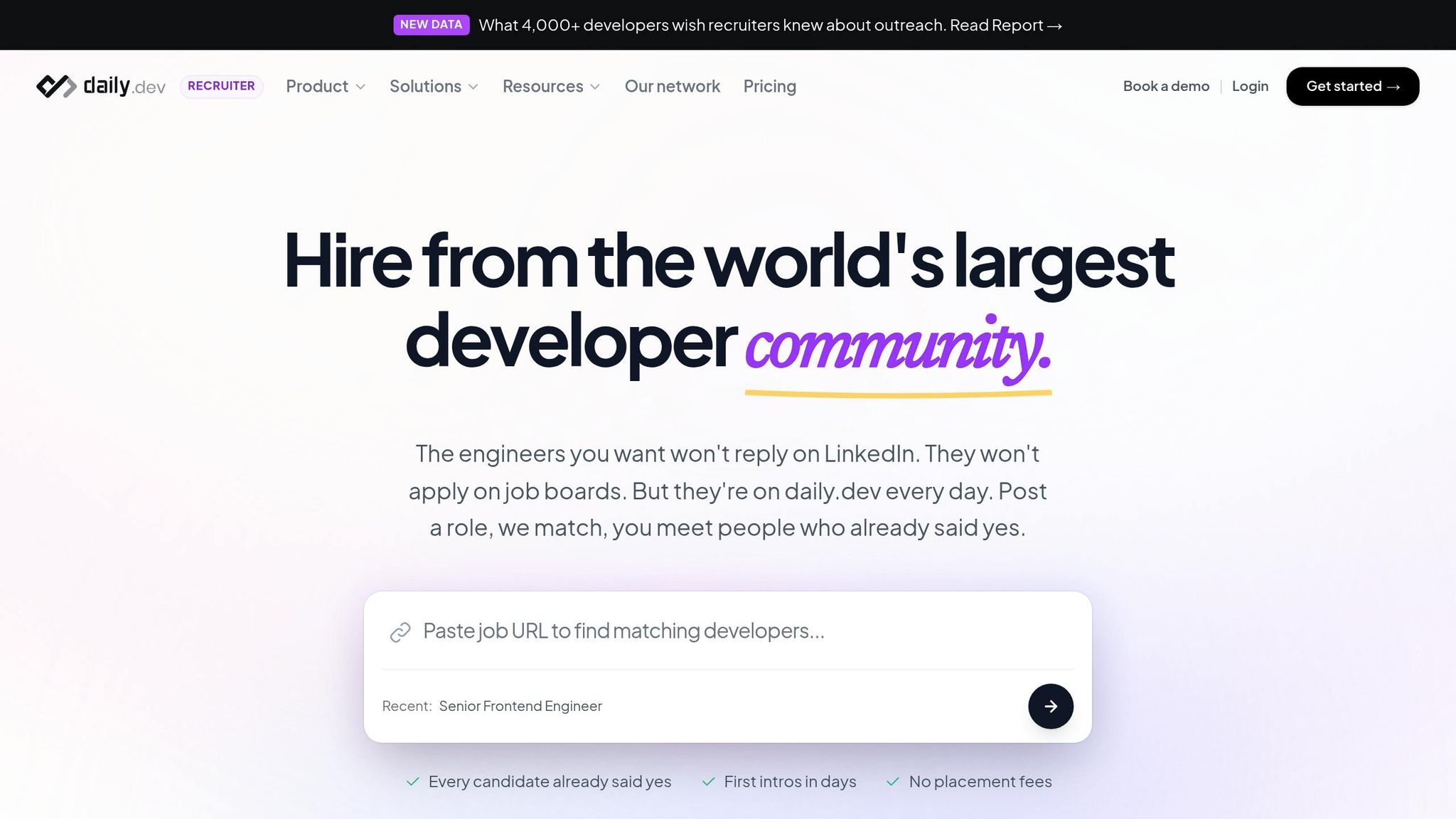
daily.dev Recruiter taps into real-time developer behavior, tracking what engineers are reading, exploring, and building. This data helps surface candidates who match your needs. The platform’s matching engine automatically verifies details like seniority, tech stack, location, and timezone. Once a match is found, your job opportunity is presented privately using a double opt-in approach, which has been shown to triple reply rates compared to traditional cold outreach .
As Nimrod Kramer, CEO of daily.dev, puts it:
"The bottleneck is replies. Getting a passive senior engineer to actually respond to your outreach is the hardest part of technical recruiting today."
The process is simple: you describe the role, the engine matches and pitches it, and you receive a warm introduction directly in your inbox or ATS. Additionally, integrations with popular ATS platforms like Greenhouse, Lever, Ashby, and Workable streamline the workflow, removing the need for manual data entry .
Find Candidates on Code and Collaboration Platforms
Platforms like GitHub and Stack Overflow are treasure troves for sourcing talent. GitHub, with over 100 million developer profiles , offers direct insight into the code engineers produce. You can filter by programming language and recent activity to find candidates with the specific skills you need. Stack Overflow, on the other hand, allows you to assess a developer’s problem-solving abilities and expertise by examining their reputation and contributions to relevant tags like "kubernetes" or "distributed systems."
When reaching out, referencing a specific contribution or answer can make your message stand out. For instance, Stripe has successfully identified infrastructure engineers by targeting top contributors on GitHub, using their activity to evaluate practical skills early in the hiring process .
For more specialized roles, smaller communities can provide equally valuable talent pools.
Engage Niche Developer Communities
Senior engineers often gather in smaller, specialized groups outside the major platforms. Communities like Discord servers, subreddits such as r/ExperiencedDevs, and professional associations like IEEE are excellent for finding candidates with niche expertise. However, the key to success in these spaces is to contribute meaningfully before recruiting. Simply posting job links won’t get much attention. Instead, participate in discussions, answer questions, and build relationships over time. When you do reach out, referencing shared community experiences makes your approach feel more personal and less transactional. Additionally, reviewing profiles for preferred contact methods ensures you respect their communication preferences .
| Platform | Best For | Key Signal |
|---|---|---|
| daily.dev Recruiter | Passive senior talent | Real-time interest in specific frameworks/topics |
| GitHub | Verifying code quality | Public repositories and commit history |
| Stack Overflow | Problem-solving & communication | Reputation scores and technical answers |
| Kaggle | Data Science & ML roles | Competition medals and peer-reviewed notebooks |
Use Professional Networks and In-Person Opportunities
In addition to developer-specific communities, professional networks and in-person events can help you connect with senior engineers who are active in broader professional circles. Combining these methods with developer-focused channels creates a well-rounded approach to sourcing top tech talent in 2026.
Make the Most of Professional Networking Platforms
LinkedIn offers extensive reach, but fewer than 50% of engineers actively engage on the platform. This makes precision critical. Use targeted LinkedIn Boolean searches, such as senior AND (python OR golang) AND startup, to zero in on relevant profiles . Timing is also key - messages sent between Tuesday and Thursday at 9:00 AM receive a 31% higher response rate. Personalized outreach from hiring managers, especially when referencing a candidate's specific technical contributions, consistently outperforms generic messages .
That said, response rates for cold outreach, particularly to backend engineers at mid-stage startups, have dropped below 3% . This highlights the importance of using LinkedIn as one part of a broader strategy rather than relying on it exclusively. Digital outreach is essential, but combining it with in-person interactions can significantly enhance your efforts.
Attend U.S. Tech Conferences and Meetups
In-person events provide unique opportunities to connect with senior engineers. Focus on conferences and meetups that attract experienced talent.
- QCon: Held in Boston in June and San Francisco in November, this conference is ideal for engaging senior-level professionals. Nearly half of attendees are Technical Team Leads or higher, and 30% are Senior Developers or Engineers . With an attendee-to-speaker ratio of 11 to 1, there’s plenty of room for meaningful conversations .
- WeAreDevelopers World Congress: Taking place in San Jose from September 23–25, this event draws over 10,000 developers and 2,000 decision-makers in a massive expo space .
- Grace Hopper Celebration: Scheduled in Anaheim from October 27–30, this is the largest tech event focused on hiring women and non-binary technologists .
When attending these events, avoid relying solely on booths. The best connections often happen in hallways, during breaks, or at side events. After the event, follow up within 48 hours, referencing something specific - like a talk they gave or a session you both attended. These personal touches make your outreach stand out .
Leverage Alumni Networks for Senior-Level Talent
Alumni networks can be a powerful tool for reaching passive candidates. Personalized messages that reference a shared university or former employer see a 28% response rate, compared to just 7% for generic outreach .
"One senior hire brought in three former colleagues. The network effect took 8 months but resulted in zero regrettable attrition."
Referred hires from alumni or former colleague networks tend to stay 45% longer and perform 15% better in their first year . For long-term talent pipelines, consider sponsoring capstone projects at top engineering schools or encouraging your senior engineers to give guest lectures at their alma maters. These efforts build your brand and can pay off when today’s students grow into tomorrow’s senior engineers .
Adjust Your Sourcing Approach to 2026 Market Trends
Shifting market dynamics call for sourcing strategies that resonate with candidates' evolving work preferences and compensation expectations.
Match Candidates' Remote and Hybrid Work Preferences
Remote work has moved from being a perk to a baseline expectation. In fact, 78% of senior engineers turn down roles requiring full-time office attendance . Many candidates equate remote flexibility to an additional $10,000–$20,000 in annual compensation . A strict return-to-office policy can significantly narrow your talent pool.
When promoting remote roles, clarity is essential. Specify whether the position is fully remote, hybrid, or asynchronous-first. Include details about required time zone overlaps within the U.S. Steer clear of vague phrases like "flexible work environment", as these can lead to misunderstandings and mismatched expectations.
Understand Compensation and What Candidates Expect
By 2026, senior engineers with 7+ years of experience are earning base salaries ranging from $145,000 to over $200,000. Engineers with AI expertise command even higher pay, with a median base salary of $206,000, representing a 43% premium over peers without AI skills . With salary transparency laws now in place across 15 U.S. states , including pay ranges in job postings not only complies with regulations but also demonstrates respect for candidates' time, reducing negotiation hurdles.
Compensation packages should go beyond salary. Consider including:
- Equity options
- Home office budgets ($2,000–$5,000)
- Learning stipends for professional growth
Speed is another critical factor. Top candidates are often hired within 10 to 15 business days . Delays can cost you the best talent.
"The companies losing the best candidates are the ones taking 50 to 70 days. By week five, every strong candidate in your pipeline has two or three other offers sitting in their inbox." - KORE1
Clearly defining work preferences and compensation is only part of the equation. Your sourcing process must also prioritize diversity.
Build Diversity Into Your Sourcing Process
Creating a diverse pipeline of senior engineers requires intentional adjustments to your hiring approach. Start by rethinking job descriptions. Instead of rigid lists of required tools or years of experience, use language that highlights qualities like "business impact", "ownership," and "problem-solving." This approach appeals to a wider range of candidates .
Expand your reach beyond traditional platforms and developer networks. While LinkedIn remains a popular choice, 75% of developers are outside its active candidate pool . To find untapped talent, explore developer-specific platforms, niche communities, and open-source repositories. These channels allow you to evaluate candidates based on real-world technical contributions rather than keyword-heavy resumes.
Conclusion: Key Takeaways for Sourcing Senior Software Engineers in 2026
Finding senior engineers in 2026 requires a focused and strategic approach. The competition is fierce, most top talent isn’t actively job hunting, and the best engineers have plenty of options. In fact, many of them aren’t even on traditional professional networks. To succeed, recruiters need to meet engineers where they actually spend their time - in spaces like code repositories, technical forums, and developer-focused platforms such as daily.dev.
Instead of fixating on resumes, it’s smarter to build a presence on these platforms. Tools like GitHub, Stack Overflow, and open-source projects allow recruiters to assess candidates based on their real-world contributions - Git commits, technical answers, and collaborative projects. This approach provides a much clearer picture of a candidate's skills than a keyword-stuffed profile ever could. Plus, outreach that’s personalized and rooted in context sees response rates jump significantly - often reaching 25–40% .
Speed is also a critical factor. Top engineers move fast, and teams using AI-powered tools and community-based sourcing have managed to cut their hiring timelines dramatically - from 45 days to just 14 . Combine this with transparent compensation, remote-friendly roles, and equity options, and you’ll stand out from the competition.
"The sourcing data is incredible, scanning 850M+ profiles with recruiter-level precision to uncover perfect-fit candidates I'd never find otherwise." - Nick Poloni, President, Cascadia Search Group
Finally, while speed and competitive offers are important, diversity must remain a priority. Building diverse teams isn’t just about ticking boxes - it improves overall team performance and resilience. Achieving this requires deliberate efforts, such as sourcing from varied channels, crafting inclusive job descriptions, and implementing referral programs that extend beyond the usual networks. Recruiters who embrace these practices as strengths, rather than obligations, will create more dynamic and adaptable engineering teams for 2026 and beyond. These strategies are the key to thriving in the ever-changing tech talent landscape.
FAQs
How do I confirm an engineer is truly senior from public work?
To assess someone's seniority in their field, examining their GitHub or open-source contributions can be a great starting point. Here’s what to look for:
- Repository Quality: Check for original projects that are well-documented and actively maintained. A clear structure and thoughtful updates often indicate a higher level of expertise.
- Contribution Frequency: Look for consistent activity, such as making at least three commits per week. Regular involvement shows dedication and ongoing skill development.
- Code Quality: Review their code to see if it’s well-organized, thoroughly tested, and properly documented. Clean, maintainable code is often a hallmark of experienced developers.
- Project Complexity: Pay attention to their participation in large or technically demanding projects. Tackling complex challenges often highlights advanced problem-solving skills.
These elements can provide valuable insights into senior-level proficiency and active engagement in their craft.
What’s a good 10–15 day hiring plan for senior roles?
When hiring for senior positions, a focused and efficient plan is crucial. Here’s a breakdown of how to streamline the process over 10–15 days:
Days 1–6: Start by clearly defining the role requirements. Use developer communities and AI-driven tools to pinpoint professionals actively contributing to relevant fields. This helps you target the right talent from the start.
Days 7–12: Shift your focus to personalized outreach. Craft messages that resonate with candidates, showing you understand their expertise. During this time, evaluate their skills through technical screenings or by reviewing past projects.
Days 13–15: Wrap up with final interviews and extend offers quickly. In a competitive market, speed is key to securing top talent.
This approach balances precision with efficiency, ensuring you attract and hire the best candidates within a tight timeframe.
How should I define “remote” to avoid mismatches?
To avoid misunderstandings, it's important to clearly spell out remote work expectations. Be specific about whether the position is fully remote, hybrid, or offers flexible arrangements. Mention any preferences regarding location or time zones. Additionally, provide details about working hours, communication guidelines, and whether employees need to be available during specific core hours. This level of detail helps candidates grasp what "remote" means for your company, ensuring their expectations match your requirements.
.png)