LinkedIn is no longer the best place to find developers. Many developers avoid it due to spam, outdated profiles, and its inability to showcase real skills. Instead, they’re active on platforms like GitHub, Stack Overflow, and Discord, where their expertise is visible through their work, problem-solving, and discussions.
Here are sourcing strategies that work to find developers in 2026 and connect with them effectively:
GitHub: Review repositories, contributions, and coding activity to assess skills.
Stack Overflow: Analyze answers and reputation scores for problem-solving abilities.
Dev.to, Hashnode, Medium: Look for technical blogs that highlight expertise and communication skills.
Reddit: Monitor developer discussions in subreddits like r/programming and r/devops.
Discord and Slack: Join technical communities to observe active contributors.
Coding Challenge Platforms: Platforms like LeetCode and HackerRank showcase algorithmic skills.
Key Tip: Tailor your outreach. Personalize messages by referencing specific work or contributions. Avoid generic recruiter language to improve response rates.
To succeed, adopt a multi-channel strategy, focus on platforms that match your hiring needs, and track performance metrics like response rates and cost per qualified candidate. This approach ensures you connect with the right talent where they actively engage.
Why LinkedIn Fails for Developer Sourcing
LinkedIn may still hold value for recruiting in general, but when it comes to sourcing developers, it has some glaring limitations. For starters, nearly 30% of software engineers don’t even have a LinkedIn profile. And for those who do, it’s often treated as a static resume that’s updated only sporadically.
The main issue? LinkedIn isn’t designed to showcase technical expertise. Developer profiles are filled with self-reported buzzwords, which offer little proof of actual skills. Meanwhile, developers are more likely to highlight their abilities on platforms where their work speaks for itself - like GitHub, Stack Overflow, or other technical communities.
This disconnect is further compounded by spam, outdated information, and a lack of meaningful engagement from developers on the platform.
Developers Avoid LinkedIn to Escape Spam
For many developers, LinkedIn has become synonymous with recruiter spam. They’re flooded with impersonal messages that often miss the mark - non-spammy outreach that reflects their actual skills and interests. This constant barrage of irrelevant messages drives developers to either deactivate their accounts or ignore LinkedIn altogether.
Privacy concerns also play a role. Developers aren’t keen on having every career update broadcasted or their activities monitored by recruiting tools. Instead, they prefer to keep a low profile and avoid the noise.
Profiles Are Outdated and Skills Are Unverified
One of LinkedIn’s biggest challenges is how quickly profiles become outdated. Around 30% of candidate data becomes obsolete every year, yet many developers only update their profiles when they’re actively job hunting. This means job titles and skills listed on LinkedIn may no longer reflect their current expertise, leaving recruiters with inaccurate information.
Even more problematic is the lack of verification. LinkedIn relies entirely on self-reported claims, which can’t compare to platforms like GitHub or Stack Overflow, where developers can showcase their abilities through tangible work - whether it’s contributing to open-source projects or solving complex coding problems. Without this kind of proof, recruiters may waste time chasing candidates whose profiles look polished but don’t reflect their actual skills.
Developers Don’t Actively Use LinkedIn
Unlike some other professionals, developers don’t spend much time on LinkedIn. They’re not scrolling through feeds or engaging with posts because the platform doesn’t align with their daily routines. Developers are busy coding, learning new frameworks, and solving technical challenges - activities they pursue on platforms like GitHub, Stack Overflow, Discord, or even through writing technical blogs.
This lack of active participation creates a disconnect. While LinkedIn thrives on networking and visibility, developers build their reputations through their work, not their connections. For recruiters relying heavily on LinkedIn, this means missing out on a large segment of talented developers who are more focused on their craft than maintaining an online presence.
Next, we’ll dive into the platforms where developers actively showcase their skills and how recruiters can tap into these spaces.
Hiring engineers?
Connect with developers where they actually hang out. No cold outreach, just real conversations.
Where to Find Developers in 2026
::: @figure 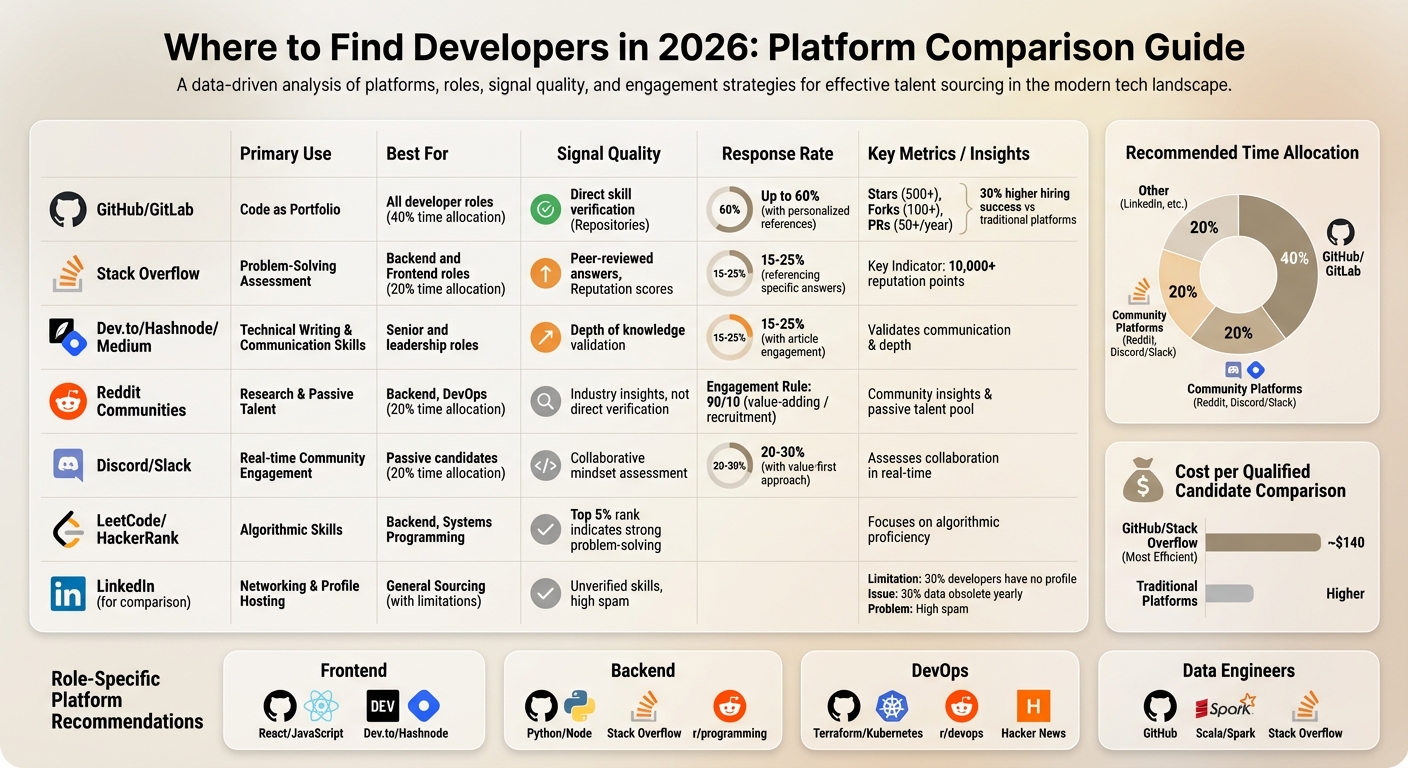 {Best Platforms to Find Developers in 2026: Skills Assessment and Response Rates Comparison}
Developers gravitate toward platforms where their skills are on full display - places like GitHub for code, Stack Overflow for troubleshooting, Dev.to for sharing insights, and Discord for live discussions.
These platforms offer concrete proof of abilities. A GitHub repository showcases coding style and collaboration skills. A Stack Overflow answer reveals problem-solving approaches. A well-written blog post demonstrates the ability to clarify complex topics. This kind of evidence is far more reliable than LinkedIn's endorsements or self-reported skills.
Each platform serves a unique role in the developer ecosystem. Knowing where to look and how to engage can make all the difference when searching for the right talent. Here’s a closer look at what each platform offers.
GitHub and GitLab: Code as a Portfolio
GitHub is a treasure trove for assessing technical skills. By reviewing code and project documentation, you can gauge a developer’s expertise. Prioritize original repositories over forks, as pinned repositories often highlight their best work. The contribution graph reveals consistency in coding, while README files show whether they can communicate technical ideas effectively.
To narrow your search, use specialized sourcing tools or GitHub's advanced search. For example, search terms like language:python location:"New York" followers:>100 can help you find developers with specific skills in your area. For niche roles, look at the "Contributors" list of popular open-source projects in your tech stack. Developers who contribute to these projects have already proven their ability to write production-ready code.
When reaching out, make it personal. Reference a specific repository or commit that stood out to you. This thoughtful approach can lead to response rates as high as 30%, far exceeding generic messages sent on LinkedIn.
GitHub is ideal for assessing coding skills, while Stack Overflow offers insights into problem-solving capabilities.
Stack Overflow: Problem-Solving in Action
Stack Overflow provides a window into how developers tackle challenges and communicate solutions. Reputation scores are a key metric - developers with 10,000+ points have consistently delivered helpful answers. Check their "Top Tags" to see their areas of expertise; for example, heavy tagging in React, TypeScript, and GraphQL signals a focus on modern front-end development.
Dive into their answers to evaluate their communication skills. Do they explain complex topics clearly? Include working code examples? Update their answers when better solutions arise? These traits often translate into strong team collaboration.
Keep in mind that Stack Overflow has strict rules about recruiter outreach. Always disclose your company, specify the role, and provide full details like tech stack, salary range, and work setup. Reference a specific answer they’ve written to show you’ve done your homework - this can make your outreach stand out.
Next, explore developers' communication abilities through their technical writing.
Dev.to, Hashnode, and Medium: Technical Writing
Blogging platforms like Dev.to reveal a developer’s depth of knowledge. Writing about technical topics requires a solid understanding - no one can fake their way through a detailed tutorial on Kubernetes deployment.
Search for articles related to the technologies you’re hiring for. A developer who publishes in-depth pieces on Next.js likely has hands-on experience. Their writing also highlights communication skills, which are critical for senior and leadership roles.
Engagement metrics matter too. Developers with consistent likes, comments, and followers have built credibility in their field. Check their comment history to see how they interact - do they help others solve problems? Handle criticism constructively?
When reaching out, mention a specific article or technique they’ve shared that resonated with you. This shows you value their expertise and separates your message from generic recruiter spam.
While blogs validate expertise, platforms like Reddit offer insights into broader developer discussions.
Reddit Communities for Developers
Reddit hosts lively developer communities where professionals share advice, discuss technical challenges, and debate industry trends. Subreddits like r/programming, r/cscareerquestions, and r/ExperiencedDevs attract thousands of contributors.
Direct recruitment isn’t allowed on Reddit, but the platform is invaluable for research. Monitor discussions to understand what developers care about, what frustrates them about hiring processes, and what they value in an employer. If you engage, follow the 90/10 rule: spend 90% of your time adding value through helpful comments and insights, and only 10% on recruitment-related activities.
Some developers include contact details in their profiles. If you find someone whose contributions demonstrate expertise, you can reach out via their listed email or LinkedIn. Be sure to reference the specific Reddit thread that impressed you to establish a genuine connection.
For real-time conversations, Discord and Slack are the go-to platforms.
Discord and Slack Communities
Discord and Slack host active technical communities where developers discuss frameworks, languages, and problem-solving in real-time. Communities like Reactiflux (for React developers), Python Discord, and the Rust Programming Language server are prime examples.
Joining these spaces gives you a front-row seat to see who the active contributors are. Developers who regularly answer questions, share resources, and engage in discussions often make excellent hires. Their participation history can reveal both technical expertise and a collaborative mindset.
Most of these communities have strict rules against public recruiting, but many offer designated job boards or career channels. Always respect the community guidelines and focus on building relationships over time rather than jumping straight to job postings.
For roles requiring algorithmic expertise, coding challenge platforms are another great resource.
LeetCode, HackerRank, and Codewars
Coding challenge platforms showcase a developer’s ability to solve algorithmic problems. These sites are particularly useful for roles that demand strong knowledge of data structures and algorithms, such as backend engineering or systems programming. A top 5% rank on LeetCode, for example, signals a developer who excels in tackling complex challenges.
Keep in mind that many developers use these platforms to prepare for interviews, not to be contacted by recruiters. If you do reach out, connect their achievements on the platform to your role’s requirements. Clearly explain how the position aligns with their skills and interests.
Some platforms offer features for recruiters, like job boards where developers can opt in to being contacted. Always use these official channels instead of sending unsolicited messages, which can harm your reputation.
Building a Multi-Channel Sourcing Strategy
When it comes to finding top developer talent, relying solely on LinkedIn just won't cut it. A well-thought-out multi-channel approach is essential to connect with developers on the platforms they actually use. Different roles demand different strategies, and not every platform offers the same level of insight. The trick is to align your sourcing efforts with modern tech stack interview questions for the specific role you're hiring for and then track what works best.
Matching Platforms to Developer Roles
Frontend developers often showcase their skills on GitHub through repositories featuring React or JavaScript projects. Platforms like Dev.to and Hashnode are also great for finding developers who write about UI/UX-related topics. To identify strong candidates, use GitHub filters like language:javascript or language:react to locate contributors with well-documented projects. Validate their expertise by reviewing repositories or technical blogs that dive into tools like Tailwind CSS or Next.js.
Backend developers shine on GitHub with repositories focused on APIs or databases (e.g., language:python or language:node). You can also find them answering complex server-side questions on Stack Overflow or engaging in technical discussions on Reddit’s r/programming. Look for contributions to projects using frameworks like Django or Node.js, where you can assess their experience with microservices or SQL optimization.
DevOps specialists are active on Reddit (e.g., r/devops), Hacker News, and GitHub, particularly in repositories related to infrastructure-as-code. For example, using GitHub filters like language:terraform location:San Francisco can help you find candidates with Kubernetes or automation tool expertise. Similarly, data engineers are often involved in GitHub projects for ETL pipelines (e.g., language:scala paired with Spark) or answering big data queries on Stack Overflow.
To maximize your efforts, allocate your sourcing time strategically:
Spend 40% on GitHub for all roles.
Dedicate 20% to community platforms like Reddit, Discord, and Slack to engage passive talent.
Use 20% on Stack Overflow and Dev.to for backend and frontend roles.
Reserve the remaining 20% for other platforms.
Track which channels yield the best results for each role and adjust your focus as needed.
Comparing Signal Quality Across Platforms
GitHub is unmatched when it comes to skill verification. Reviewing repositories and contributions offers direct proof of a developer's abilities. Metrics like stars and forks can highlight the quality of their work, while active contributors tend to align closely with practical job requirements. In fact, candidates who are active on GitHub have a 30% higher success rate in hiring processes compared to those sourced from traditional platforms.
Stack Overflow provides a different kind of insight, focusing on problem-solving through peer-reviewed answers. While platforms like Reddit, Discord, and Slack don’t offer direct evidence of coding skills, they’re excellent for reaching passive talent - developers who might not be actively job hunting but are open to the right opportunity.
The trade-off is clear: GitHub excels in providing verifiable skill evidence, while community platforms are invaluable for connecting with passive candidates.
Platform-Specific Outreach Tactics
Once you’ve identified the right platforms, your outreach strategy needs to align with the culture and norms of each one.
On GitHub, personalized messages are essential. Reference specific repositories or commits to show you’ve done your homework:
"Hi [Name], I was impressed by your React optimization in [repo name]. We’re tackling similar challenges in our frontend team - would you be open to a quick chat?"
This kind of tailored outreach can double your response rates compared to generic messages.
For Reddit, Discord, and Slack, focus on adding value before making any recruitment pitch. On Reddit, for instance, post in hiring threads or send direct messages with a clear connection:
"I saw your post about Kubernetes on r/devops - it’s exactly the kind of expertise we’re looking for in our infrastructure team."
In Discord and Slack communities, join relevant channels and contribute meaningfully - whether by sharing resources or engaging in discussions. Following the 90/10 rule - spending 90% of your time adding value and only 10% on direct recruitment - can boost response rates to 20–30%, far higher than cold outreach.
On Stack Overflow, reference specific answers to demonstrate genuine interest:
"Your solution to [question] aligns perfectly with the challenges we’re working on in our backend team. Would you be open to discussing a role?"
For blogging platforms like Dev.to, Hashnode, and Medium, engage with thoughtful comments on articles before reaching out:
"I really enjoyed your post on Next.js performance. We’re looking for frontend developers with expertise in this area - would you be interested in chatting?"
Keeping your messages concise and focused on the value you see in their work can lead to response rates of 15–25%. By showing genuine interest and avoiding generic recruitment language, you’ll stand out and build stronger connections. Continuously monitor your results to refine and improve your multi-channel strategy.
Tools and Automation for Developer Sourcing
Using automation tools can help streamline your multi-channel sourcing strategy and simplify managing multiple platforms.
Finding developers across various platforms can feel like juggling too many balls at once. Automated candidate sourcing helps scale your efforts, ensuring you stay efficient while staying within legal and ethical boundaries - and avoiding spam. These tools are a great way to make sure you don’t miss out on promising candidates.
Platform Scrapers and Data Aggregators
Stick to official APIs when collecting public data. For instance, GitHub’s API lets you gather key metrics like stars, forks, and pull requests. Here’s why these metrics matter:
A repository with 500+ stars shows strong industry recognition.
100+ forks indicate that other developers find the code useful enough to build upon.
50+ pull requests in the last year suggest consistent, up-to-date activity.
By using official APIs and approved tools, you ensure compliance and avoid potential issues. Once you’ve collected this data, the next step is tracking developer activity to identify the most engaged talent.
Tracking Developer Activity and Engagement
Collecting data is just the beginning. Monitoring developer activity helps you identify candidates who are actively participating in their professional communities. Tools that track activity on platforms like GitHub, Stack Overflow, or technical blogs can highlight developers who are contributing valuable insights or projects. This is especially useful for spotting passive candidates who aren’t actively job hunting but are still highly engaged.
Set up alerts for specific keywords, technologies, or projects. For example, if you’re looking for a Kubernetes expert, track developers contributing to Kubernetes-related repositories or answering relevant questions on Stack Overflow. This gives you a natural way to connect with them by referencing their recent public work. Just be sure to respect privacy and keep your tracking limited to public, professional contexts.
Measuring Success Across Sourcing Channels
Tracking performance across different platforms is key to identifying which channels deliver the best return on investment (ROI). Without solid metrics, you risk overspending on channels that don’t deliver strong results.
Let’s dive into some essential metrics to evaluate channel performance.
Cost per Qualified Candidate by Platform
To calculate the cost per qualified candidate, take the total expenses for sourcing on a platform and divide it by the number of candidates who pass your initial screening. Be sure to include all costs - such as time spent, subscription fees, and tool expenses. For example, if you spend 5 hours per week sourcing on GitHub (valued at $50/hour) and pay $100 monthly for API access, and you end up with 8 qualified candidates in a month, your cost per qualified candidate comes out to about $140. Comparing this across platforms helps you see where your investment has the most impact.
Platforms like GitHub and Stack Overflow often offer better cost-efficiency because their built-in tools make verifying skills easier. On the other hand, platforms requiring more manual research or deeper engagement may take more time and money but can help you discover passive talent that isn’t visible on mainstream sites.
While cost is important, it’s only part of the picture. Metrics like response and conversion rates provide a deeper understanding of channel performance.
Response Rates and Conversion Tracking
Response rates can vary widely based on your outreach strategy. For instance, on GitHub, referencing a specific commit or pull request can lead to response rates as high as 60% . On the flip side, generic messages might only yield 10–15%.
Beyond response rates, track how candidates progress through your hiring funnel. Measure phone screen conversions, technical interview success rates, and final hire rates for each platform. For example, a channel with a 30% response rate but a 50% hire conversion might outperform one with a 60% response rate but only a 10% conversion to hires. The goal isn’t just to get replies - it’s to engage with candidates who are genuinely interested and well-suited for the role.
Conclusion
In today’s hiring landscape, where developers gravitate toward dynamic, skill-driven platforms, depending only on LinkedIn can severely limit your talent pool. While LinkedIn still has its place, its static profiles and spam-heavy outreach often fall short of reaching the most sought-after candidates, highlighting the ongoing debate between social media vs. cold emails in tech hiring. The best developers are showcasing their skills on GitHub, contributing to discussions on Stack Overflow, and actively participating in communities where their work speaks louder than any written profile.
Adopting a multi-channel sourcing approach allows you to tap into platforms where you can evaluate skills in real time and connect with passive candidates who might ignore unsolicited messages. To get started, here are some practical tips to guide your efforts.
Begin with a focused approach. Pick two or three platforms that align with the roles you’re hiring for. For example, GitHub and Dev.to are excellent for frontend developers, while Stack Overflow and Reddit communities are among the best platforms for finding backend developers. Dedicate time each week to understand how these platforms operate, observe community interactions, and identify contributors who stand out before making your move.
Respect the communities you’re entering. Developers can easily spot recruiters who lack genuine understanding. Reference specific contributions, ask meaningful questions, and avoid spamming. Your goal should be to build authentic relationships, not just fill open roles.
As you refine your strategy, track your progress across all channels. Monitor metrics like response rates, cost per qualified candidate, and hires made. Over time, you’ll uncover which platforms yield the best results for different roles, helping you maintain a balanced and effective sourcing strategy.
FAQs
How do I find a developer’s email from GitHub or Stack Overflow?
To locate a developer's email on GitHub, you can add ".patch" to the end of a repository's URL. This will show commit metadata, which often includes email addresses. Another method is to browse the repository's commit history, where emails are sometimes visible alongside commit messages.
On Stack Overflow, emails might be available on user profiles if the user has chosen to make them public. You can also check for linked profiles that may provide additional contact details. However, this approach is less consistent.
Always ensure you respect privacy and follow platform guidelines when attempting to gather contact information.
What are the best signals to judge real skill on GitHub?
When evaluating contributions, some of the strongest indicators include the quality and complexity of the work, how often commits are made, the variety of repositories involved, and the ability to handle tough challenges. Pay attention to insightful code reviews and evidence of active collaboration - these not only demonstrate technical expertise but also showcase teamwork skills.
How do I recruit in Discord or Reddit without getting banned?
Recruiting on platforms like Discord or Reddit requires a thoughtful approach to avoid bans and build genuine connections. Start by familiarizing yourself with each community's rules - these guidelines are crucial for understanding what’s acceptable. Make an effort to actively participate in discussions and offer value to the group before attempting any outreach. This helps you build trust and credibility.
When reaching out, customize your messages based on the person's contributions or interests. Avoid sending out generic pitches, as they often come across as insincere. If you decide to use private messaging, ensure it’s appropriate and aligns with the community's norms around opt-in communication.
Finally, steer clear of overposting or spamming. Focus instead on meaningful engagement - quality over quantity is key. This approach not only reduces the risk of getting banned but also enhances your reputation within the community.
.png)