Spammy outreach doesn’t work in developer hiring. Developers ignore generic, impersonal messages, and irrelevant job offers damage both recruiter and company reputation. Here’s why:
- Generic outreach fails: Only 8.5% of cold emails get responses. Developers can easily spot templates and irrelevant pitches. Personalized emails perform six times better.
- Mismatch in job offers: Sending roles that don’t align with a developer’s skills frustrates them and wastes time. Developers value roles that match their expertise and preferred tech stack.
- Reputation risks: Spammy messages harm trust and tarnish a company’s image. Developers share negative experiences, spreading the word about poor practices.
The solution? Shift to trust-based recruiting:
- Personalize outreach: Research candidates' skills and projects to craft tailored messages.
- Target relevant offers: Collaborate with technical leads to ensure roles align with candidates’ expertise.
- Leverage opt-in platforms: Tools like daily.dev Recruiter connect recruiters with developers who are open to opportunities, using real-time data and mutual interest.
Prioritizing quality over quantity builds meaningful connections, improves response rates, and strengthens your company’s reputation.
::: @figure 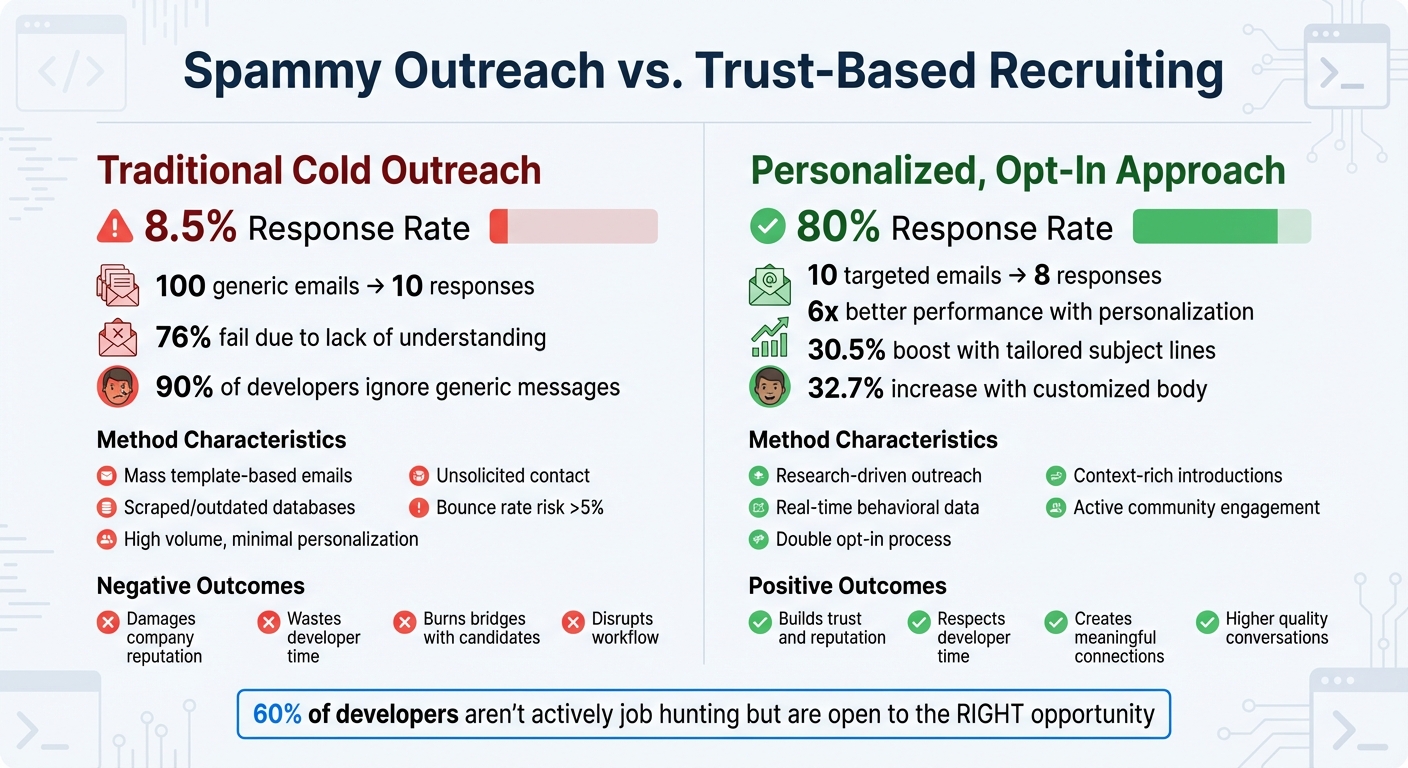 {Spammy Outreach vs Trust-Based Recruiting: Response Rates and Methods Comparison}
Why Spammy Outreach Fails in Developer Hiring
Generic Messages Don't Work
Here’s a hard truth: only 8.5% of cold outreach emails get a response . Developers can spot a generic message from a mile away - they’ve seen the same cookie-cutter templates over and over. It screams, “I don’t understand you as a candidate.”
The solution? Put in the effort to personalize. Emails with tailored subject lines see a 30.5% boost in response rates, while customizing the email body can increase responses by 32.7% . Even better, personalized emails achieve six times the response rate of mass-sent templates . But here’s the catch: developers spend just 8 seconds skimming an email . That means your personalization has to be obvious and genuinely relevant right from the start.
The key to standing out is specificity. Instead of blasting 100 generic emails, top recruiters focus on crafting 10 highly researched ones - and they see better results . This might mean diving into a developer’s GitHub to see what they’ve been working on recently, rather than relying on outdated LinkedIn profiles. It’s about showing you’ve done your homework.
But even with a personalized message, sending irrelevant job offers can quickly undo your efforts.
Job Offers Don't Match Developer Skills
Nothing frustrates developers more than receiving job offers that don’t align with their expertise . Just like personalization improves response rates, sending targeted offers requires digging deeper into a candidate’s skills. For instance, pitching a Python specialist a Java role - or offering a front-end developer a backend position - sends a clear signal: you didn’t bother to understand their background.
Here’s another wrinkle: 60% of developers are passive candidates who aren’t actively job hunting but are open to the right opportunity . Sending irrelevant offers not only wastes their time but can also burn bridges with someone who might’ve been interested if approached thoughtfully. After salary and location, developers care most about working with their preferred tech stack .
"If the recruiter clearly demonstrates that they know what I do and what I can do, then they probably have something genuinely relevant for me." - Petr Belousov
So, how do you get it right? Collaborate with your technical leads. Work with engineering managers to identify why a candidate’s code or projects stand out. Then, include those specifics in your outreach. This level of detail shows that you’ve done your research and that the opportunity isn’t just another generic pitch.
Sending mismatched offers doesn’t just waste time - it can also hurt your company’s reputation.
Spam Damages Recruiter and Company Reputation
Irrelevant messages do more than annoy developers - they can tarnish your company’s image . Seventy-six percent of cold outreach fails because the sender doesn’t understand the recipient’s background or needs .
When developers receive spammy outreach, it damages their trust in both the recruiter and the company . That negative impression can linger, making it harder to engage with them in the future. Even worse, if your bounce rate climbs above 5%, it can harm your company’s domain reputation and even lead to vendor blocks . This doesn’t just affect your recruiting - it impacts all email communications.
The old-school approach of blasting hundreds of messages doesn’t just fail to get responses - it actively hurts your long-term efforts. Developers talk to each other, and word spreads quickly about companies that spam. On the flip side, 40% of candidates prefer conversational, natural messages over stiff, formal language . Avoiding recruiter clichés and jargon can go a long way toward building trust and authenticity.
What Developers Say About Recruiting Spam
While we've touched on how generic outreach often misses the mark, developers themselves have been vocal about the specific frustrations they face. Their experiences, shared in forums and surveys, paint a clearer picture of where the recruitment process often goes wrong.
How Job Descriptions Impact Developer Hiring
A recurring complaint among developers is job descriptions that don’t align with their skills or experience. For instance, some postings demand impossible qualifications, like “5 years of Angular 2” shortly after its release . Others advertise roles with mismatched experience levels and compensation .
"I have no idea why I'd want to work for you. You haven't announced a salary or described the tasks." - Maksym, Developer
Vague descriptions add to the frustration. When postings fail to detail compensation, the tech stack, or specific responsibilities, developers quickly lose interest . The irritation only deepens when roles advertised as remote or flexible turn out to require rigid in-office schedules during later interview stages . These inconsistencies leave developers feeling that recruiters haven’t done their homework.
Lack of Research Before Reaching Out
Another major gripe is the lack of effort recruiters put into understanding a developer's background. Top-tier programmers often receive dozens of emails weekly , and many of these miss the mark entirely. This constant flood of irrelevant messages not only wastes time but also damages trust - not just in recruiters but in the companies they represent .
Instead of focusing on actual skills or achievements, many recruiters prioritize superficial credentials, like prestigious degrees or big-name employers, over a candidate's ability to solve real-world problems . For developers who have built tangible products and gained meaningful experience, this approach feels dismissive and transactional.
Cold Outreach Disrupts Their Work
Unsolicited recruiter messages don’t just frustrate developers - they actively disrupt their work. This is especially true when you recruit senior software engineers who are frequently bombarded with cold outreach . These interruptions chip away at productivity and also harm a company’s reputation . Developers often describe the recruitment process as unnecessarily noisy, with excessive interview loops and overly complicated outreach .
"If your process feels like hazing, great people will self-select out. Not because they can't do it. Because they won't." - Nimrod Kramer, CEO, daily.dev
Adding to the annoyance are irrelevant memes or overly personal messages, which only make the interruptions feel more intrusive . When developers do engage, they expect transparency - details about salary, the tech stack, and job responsibilities should be upfront . Anything less feels like a waste of their time.
How daily.dev Recruiter Eliminates Spammy Outreach
Developers often share why they ignore recruiters and their frustrations with cold outreach, but daily.dev Recruiter offers a refreshing alternative. It connects recruiters and developers within a vibrant community where engineers are already actively participating. Instead of relying on scraped profiles or sending out generic messages, the platform integrates directly into this network, where developers are busy reading, learning, and engaging.
How daily.dev Recruiter Works
Forget the outdated methods of relying on static databases or impersonal cold contact lists. daily.dev Recruiter operates on real-time behavioral data from an active developer community. Developers on this platform aren’t just profiles - they’re active participants. By analyzing their interests, skills, and activity, the platform ensures recruiters are matched with candidates who are genuinely relevant.
Here’s the key: every connection is based on a double opt-in process. Developers explicitly indicate their openness to new opportunities, and only then can recruiters reach out. No more disruptive cold emails - every introduction is packed with context, including details on the role, tech stack, and compensation. Recruiters can even pre-screen candidates using custom criteria, ensuring conversations begin with aligned expectations.
This targeted, respectful approach not only improves interactions but also leads to better outcomes, like higher response rates.
Benefits of a Developer-First Platform
This developer-centric model changes the game. Because developers choose to engage and receive detailed information upfront, response rates skyrocket compared to traditional cold outreach. Recruiters save time by avoiding irrelevant contacts, and developers appreciate the thoughtful, tailored approach. Trust replaces the noise.
It’s not just about efficiency - it’s about reputation. When every interaction is intentional and respects a developer’s time, your company becomes known for offering quality opportunities instead of spam. Developers willingly engage, knowing their time and skills are valued. For recruiters, this means focusing less on sending endless messages and more on having meaningful conversations with pre-qualified candidates who are genuinely interested.
Spammy Outreach vs. daily.dev Recruiter
The contrast between traditional cold outreach and daily.dev Recruiter is striking when you look at the methods side by side:
| Metric | Spammy/Cold Outreach | daily.dev Recruiter |
|---|---|---|
| Method | Mass, template-based emails sent unsolicited | Personalized, double opt-in introductions with context |
| Effort Required | High volume, minimal personalization | Targeted, data-driven, and pre-screened |
| Data Source | Scraped profiles or outdated databases | Real-time data from an active, engaged community |
This shift from quantity to quality creates a more trust-driven, effective recruiting process for everyone involved.
Hiring engineers?
Connect with developers where they actually hang out. No cold outreach, just real conversations.
How to Move from Spammy Outreach to Trust-Based Recruiting
Shifting to trust-based recruiting means prioritizing quality over sheer volume. Instead of treating recruitment as a numbers game, think of it more like lead generation in sales. The goal of your initial outreach isn’t to overwhelm but to make a meaningful connection and demonstrate that you’ve done your research.
Focus on Quality Over Quantity
Here’s a striking fact: sending just 10 well-targeted emails can lead to an 80% response rate, while blasting out 100 generic messages might only get you 10% . The takeaway? You can achieve similar - or even better - results with far less effort when you focus on personalized, thoughtful communication.
To make your outreach resonate, collaborate with technical leads to review candidates’ work on platforms like GitHub or Stack Overflow. By referencing specific projects or skills, you can craft messages that align with a candidate’s expertise and interests. Remember, many developers aren’t actively looking for jobs, but a well-crafted, relevant message can spark their interest.
Building these relationships also means engaging with developers in the spaces where they naturally spend their time.
Use Developer Networks
Developers are far more likely to be found in communities where they connect, learn, and share with peers than on traditional job boards. Reaching out to them on platforms they already trust can make a huge difference. For example, daily.dev Recruiter operates in an environment where developers actively consume technical content. This approach is effective because candidates sourced directly from these communities are five times more likely to be hired compared to those who apply through inbound methods .
By focusing on active developer networks, you’re not just minimizing disruptions - you’re building connections in a space where developers feel comfortable and engaged.
Use High-Context, Opt-In Methods
Every message you send should be packed with meaningful context. Be specific about the role, including details like the tech stack, challenges they’d tackle, and a clear salary range to ensure developers don't misunderstand the job description. Transparency like this helps overcome developers’ natural skepticism and builds instant credibility .
This approach aligns with the principles of daily.dev Recruiter’s double opt-in system, which emphasizes mutual interest. Use language that focuses on the candidate’s background and achievements. For example, saying, “We noticed your expertise in serverless architecture for fintech” is far more compelling than generic compliments.
When it comes to follow-ups, aim for a respectful cadence. Send one follow-up a week after your initial message, and if you don’t hear back, try again a few months later if circumstances might have changed . Timing is also key - developers’ openness to new opportunities often aligns with their current tenure. For instance, if a candidate typically stays at a job for 2–3 years and is nearing that point, a polite check-in could be perfectly timed.
Conclusion
Key Takeaways
Spammy outreach does more harm than good - it wastes time, damages reputations, and erodes trust. Generic messages are largely ineffective: 90% of developers ignore them, only 15% are actively job hunting, and 60% of passive developers remain untouched by mass-mailing approaches .
The solution isn’t sending more emails but crafting smarter, more personalized messages. When outreach is tailored - mentioning specific projects or contributions - it can achieve an 80% response rate with just 10 targeted messages. Compare that to the 10% response rate you’d get from blasting 100 generic templates . Tools like daily.dev Recruiter take it a step further, using a double opt-in model that ensures both recruiters and developers express mutual interest before any conversation starts. This shifts recruitment from intrusive to intentional.
These strategies point to a future where recruiting is built on meaningful, respectful interactions.
The Future of Developer Hiring
Recruitment today revolves around trust. Developers expect transparency from the start - details like salary, tech stack, and team challenges should be upfront. They also want to be approached in spaces where they already spend their time, such as communities they trust and actively engage with, rather than through cold, impersonal messages on platforms they rarely use.
As Joel Spolsky, Chairman and Co-founder of Stack Overflow, famously said:
"The great software developers, indeed, the best people in every field, are quite simply never on the market" .
The future of developer hiring is about meeting candidates where they thrive. By focusing on high-quality, opt-in environments tailored to developers' needs, recruitment becomes more efficient and respectful. This approach not only helps fill roles faster but also builds a reputation that naturally attracts top-tier talent.
FAQs
Why does personalized outreach matter when hiring developers?
Personalized outreach plays a key role in hiring developers because it respects their time, aligns with their interests, and helps build trust. Generic, mass-sent messages often come across as spam and are usually ignored. But when messages are tailored - mentioning specific projects, skills, or career goals - they tend to grab attention and improve response rates.
Developers appreciate clear communication and meaningful engagement. Personalizing your outreach shows you’ve done your research, making your message feel thoughtful instead of intrusive. By prioritizing relevance and intent, recruiters can foster stronger connections and open the door to more productive conversations.
How do irrelevant job offers affect a company's reputation?
Sending out job offers that miss the mark can make a company appear out-of-touch and unprofessional. Developers might start seeing the brand as spammy, which can erode trust and leave a lasting negative impression. Over time, this can harm the company's reputation and make it harder to connect with top talent.
Developers appreciate outreach that feels genuine and tailored to their expertise, interests, and career aspirations. Ignoring these factors not only shows a lack of effort but also signals a disregard for their time and goals. This can drive potential candidates away and undermine the company’s credibility in the long run.
Why are opt-in recruiting platforms more effective for hiring developers?
Opt-in recruiting platforms bring a respectful and personalized touch to the hiring process. Instead of cold outreach, developers give explicit consent to be contacted, which naturally leads to much higher response rates. This approach not only makes interactions more meaningful but also builds trust between recruiters and candidates.
For recruiters, the benefits go beyond just better engagement. These platforms streamline the process by focusing only on developers who have shown genuine interest, cutting down on time wasted reaching out to uninterested candidates. Developers, in turn, receive opportunities that are relevant and tailored to their skills and goals. The result? Recruiters connect with pre-qualified talent, and developers find roles that truly align with their interests - creating a win-win situation for everyone involved.
.png)