Technical recruiting requires more than just matching resumes to job descriptions. Recruiters need to understand programming languages, frameworks, and tools to connect with engineers and hiring managers effectively. Without this knowledge, 96% of tech employees feel recruiters can't assess candidates properly, leading to prolonged hiring times, missed targets, and costly bad hires.
Key takeaways from this guide include:
- Understanding technical basics: Learn about programming languages (Python, JavaScript, Java), frameworks (React, Django), and tools like AWS, Docker, and Kubernetes.
- Sourcing smarter: Use platforms like GitHub, Stack Overflow, and Boolean search to find passive candidates (70% of the tech workforce).
- Building credibility: Reference candidates’ GitHub projects, ask informed questions, and collaborate with hiring managers to align on job requirements.
- Certifications and training: Programs like AIRS CTR and TechMap help recruiters gain technical fluency, with returns like a 15% increase in placements.
- Staying current: Follow trusted tech sources and engage in developer communities to keep up with trends like AI and skills-based hiring.
Recruiters who invest in technical knowledge and genuine collaboration with engineering teams can improve hiring outcomes, earn engineers' respect, and boost their own careers.
The Technical Knowledge Gap in Recruiting
What Happens When Recruiters and Engineers Don't Align
A staggering 96% of tech employees doubt recruiters' technical evaluations, and 66% even believe their coworkers could recruit better . These stats reveal a serious disconnect between recruiters and technical teams, one that creates both operational inefficiencies and financial strain.
Without technical insight, the relationship between recruiters and hiring managers often becomes transactional - focused on executing tasks like keyword searches and processing rejected resumes. This approach results in prolonged open positions, with only 50% of hiring goals met and reducing time to hire increasing by 69% . Clearly, technical recruiter training isn’t just helpful - it’s critical.
The financial repercussions of this gap are massive. A bad hire in a technical role can cost anywhere from 6 to 27 times that employee's base salary . Many recruiters rely on exact keyword matches, like searching for "Kubernetes", while overlooking candidates who describe their expertise differently. Shifting to skills-based searches can uncover talent pools that are 6.1 times larger than those identified through traditional title-based methods .
Why Developers Expect Recruiters to Understand Their Work
Beyond operational issues, a recruiter's technical knowledge - or lack thereof - directly impacts what developers want from recruiters. Engineers can quickly spot when a recruiter doesn’t grasp the basics. For example, sending a generic message about "exciting opportunities" or confusing Java with JavaScript signals a lack of effort and understanding . Unsurprisingly, cold email response rates plummeted to just 5.1% in 2025, reflecting the fallout from such missteps .
Developers don’t expect recruiters to know how to code, but they do expect enough technical familiarity to hold informed conversations. Simple actions, like referencing a candidate’s GitHub projects, asking thoughtful questions about their tech stack, or explaining why a specific framework matters, can go a long way in building credibility. Scott King from Randstad highlighted this when he noted that after introducing technical training for recruiters, candidates began saying:
Thanks for being a recruiter that knows what they're talking about.
This shift led to a 15% increase in placements and a $2.30 return for every dollar spent on training .
Being honest about knowledge gaps, rather than pretending to know everything, fosters trust and ultimately drives better results in recruitment efforts.
Technical Fundamentals Every Recruiter Should Know
Programming Languages and Frameworks You'll Encounter
You don’t need to be a programmer, but having a basic understanding of programming languages can make your outreach much more effective and avoid common reasons developers ignore job posts. For instance, Python plays a central role in AI, machine learning, and data science roles . JavaScript, which powers web development, accounts for about 20% of hiring demand, while TypeScript is often chosen for large-scale projects . Meanwhile, Java is a go-to for enterprise applications and Android development, holding 13% of the market share .
When candidates mention frameworks like React, Django, or Spring, they’re highlighting specialized skills. For example, Django is a Python framework used for building web applications. Go is commonly used for cloud infrastructure at companies like Google and Uber . And C++? It’s still a top choice for high-performance systems - NASA relies on it for mission-critical projects .
The programming languages a candidate lists can tell you a lot about their expertise. For example, someone with Python and PyTorch experience is likely working on machine learning models. On the other hand, a candidate who mentions JavaScript, React, and Node.js is probably a full-stack developer building web applications. Recognizing these patterns allows you to distinguish between roles like backend engineers and frontend specialists without needing to write a single line of code.
Beyond programming languages and frameworks, understanding infrastructure and deployment concepts is just as essential for evaluating today’s technical roles.
Cloud Platforms, Databases, and DevOps Explained
To complement your knowledge of programming languages, it’s valuable to understand cloud platforms, databases, and DevOps practices. These areas are critical for identifying candidates with the well-rounded expertise modern roles demand.
Cloud platforms handle the servers and infrastructure behind most applications. The "Big Three" - AWS, Azure, and Google Cloud Platform (GCP) - dominate this space . For example, AWS EC2 provides computing power, S3 offers storage, and Lambda enables serverless functions.
Databases come in two main types. SQL databases like PostgreSQL and MySQL organize data in structured tables, making them essential for financial systems and traditional applications. Meanwhile, NoSQL databases like MongoDB are better suited for handling unstructured data and scaling modern web applications. Nearly every tech role interacts with databases in some capacity .
DevOps focuses on bridging the gap between development and operations. Key practices include CI/CD (Continuous Integration/Continuous Deployment), which automates testing and deploying code, and containerization with tools like Docker, which ensures software runs consistently across different environments. Searches that focus on skills like these can uncover talent pools 6.1 times larger than traditional job title-based searches, which is a key tactic when sourcing technical candidates on a budget. For AI-related roles, this multiplier jumps to 8.2 times .
You don’t need to configure an AWS instance or write database queries yourself. But understanding that a "Full-Stack Engineer with AWS and PostgreSQL experience" is capable of building complete web applications using Amazon’s cloud services and structured databases equips you with the context to hold informed conversations. By mastering these technical basics, you’ll not only enhance your credibility but also improve your ability to connect with both candidates and hiring managers effectively.
How to Source and Screen Developer Candidates
Once you have a solid understanding of technical fundamentals, it’s time to put that knowledge to work and effectively source and screen developer candidates.
Using Boolean Search and Developer Platforms
Finding skilled developers often requires looking beyond the usual job boards. Platforms like GitHub offer a direct view of a developer's work - real code, open-source contributions, and projects they’re passionate about. Check pinned repositories for clean code, thorough documentation, and recent activity to gauge their expertise .
Stack Overflow is another excellent resource. By reviewing Q&A participation and reputation scores, you can assess problem-solving skills and technical knowledge. For niche roles, dive into communities on Discord, Reddit's r/cscareerquestions, or Hacker News to connect with developers who are deeply engaged in their field.
Boolean search and other developer sourcing tools are indispensable for technical recruitment. Using operators like AND, OR, and NOT, you can refine your searches to locate specific profiles. For example, an X-ray search on Google such as site:github.com "python" "location:San Francisco" can help uncover GitHub profiles . Skills-based searches are especially effective, as they can expand your talent pool by over six times compared to title-based searches . However, keep in mind that Boolean searches depend on precise keywords and might overlook some qualified candidates.
Given that cold email response rates are projected to drop to 5.1% in 2025, a multi-channel approach is essential. Combine email, LinkedIn, and SMS outreach to boost response rates up to 48% . Personalize your messages by referencing specific projects or contributions on GitHub - generic outreach often gets ignored. Even though 70% of the global workforce is passive, nearly 45% of developers are open to new opportunities when approached thoughtfully .
Once you’ve identified promising candidates, the next step is evaluating their resumes and portfolios to see how their skills align with your needs.
What to Look for in Developer Resumes and Portfolios
A resume provides a snapshot of a developer’s background, but their portfolio is where you’ll see their true capabilities. For front-end and full-stack roles, look for live projects that feature polished user interfaces and fully functional features. Review README files, commit histories, and collaborative pull requests to understand their coding habits and teamwork.
Pay close attention to the technologies listed on their resume. Do they align with the requirements of your role? For example, a candidate with Python, TensorFlow, and Kubernetes experience is likely well-versed in machine learning and cloud deployment, while someone listing React, Node.js, and MongoDB is likely a full-stack JavaScript developer. Work with your hiring manager to differentiate between "must-have" and "nice-to-have" skills so you can focus on candidates who are a strong fit.
Consistency matters. If a candidate claims expertise in React but their GitHub only features outdated tutorials, it’s worth digging deeper. Look for recent activity, such as ongoing open-source contributions or personal repositories that show a commitment to learning and improving their craft.
With a clear understanding of a candidate’s skills and work samples, you can then evaluate any potential red flags in their technical background.
How to Spot Red Flags in Technical Backgrounds
Watch out for exaggerated skill claims - most developers excel in just a couple of core technologies.
Inconsistent work histories can also be a concern. Frequent job changes without clear progression may indicate underlying issues. While employment gaps aren’t necessarily disqualifying, they should be explored during the interview process. Be cautious of vague descriptions like "worked on a team that built…" without specifying personal contributions - this can signal a lack of hands-on involvement.
Also, check whether their technology stack is up to date. A senior developer relying on outdated tools or showing no skill growth over the years might struggle in modern environments. During discussions, ask candidates to explain their GitHub or portfolio projects. If they can’t articulate what they built or why, it could suggest limited involvement or understanding of their own work.
Working Effectively with Engineering Hiring Managers
Becoming a better technical recruiter isn't just about learning the jargon or understanding technology; it’s about building a strong partnership with engineering leaders. Too often, the recruiter-hiring manager relationship feels like a transactional exchange - engineers list their needs, and recruiters deliver candidates. While this approach might occasionally work, it can fall short when the stakes are high. Real success comes from working together as a team with shared goals and ongoing alignment .
When recruiters and engineers are out of sync, it can lead to costly hiring mistakes. By combining technical knowledge with a collaborative approach, recruiters can avoid these pitfalls and improve hiring outcomes. Trust is the foundation here - earning it from engineering leaders is key to placing the right candidates and avoiding missteps.
Showing Technical Understanding Without Pretending to Be an Engineer
You don’t need to know how to code to gain respect from engineering hiring managers, but you do need to show that you understand the tech world. This means being familiar enough with the field to have meaningful conversations about job requirements and candidate qualifications .
Once you’ve built a solid technical foundation, focus on strengthening your relationship with hiring managers. Start by taking charge of the intake meeting. Instead of just collecting a job description, use this opportunity to audit your tech hiring stack and dig deeper. Ask about the development environment, deployment practices, and the team’s tech stack. Show that you’re not just a recruiter but a hiring process expert . If you don’t know something, be honest - admitting gaps in your knowledge builds credibility . Engineers value authenticity, so steer clear of pretending to know more than you do.
During calibration, ask thoughtful questions to uncover what’s truly essential for the role. For instance, asking, “Would you consider someone with 3 years of Go experience instead of 5 years of Java?” helps clarify where there’s flexibility and prevents wasted effort on mismatched candidates . When submitting candidates, include a concise explanation of how their skills align with the role. This shows you understand both the position and the candidate’s technical abilities .
Consider this example: In 2025, a $4 billion staffing company rolled out TechMap technical recruiter training for its team. The program boosted successful placements by 15% and delivered a return of $2.30 for every $1 invested . One recruiter who completed the program received this feedback from an engineering manager:
Thanks for being a recruiter that knows what they're talking about. – Scott King, Randstad .
Keeping Communication Clear Between Recruiters and Engineers
Clear and precise communication is essential for building credibility and keeping the hiring process on track. Miscommunication between recruiters and engineers can slow everything down or lead to mistakes. To avoid this, work with engineering leaders to create standardized screening scripts. This ensures your evaluations align with what the team is looking for .
Use accurate role definitions and match your language to that of your engineering counterparts . Quick follow-ups are also critical - schedule screening calls within 24–48 hours of a candidate’s response. Speed matters, especially when 65% of tech hiring managers say finding skilled professionals has become harder over the past year .
Stay informed about the latest tech trends by following trusted sources like Ars Technica or CRN. While you don’t need to be an engineer, being able to discuss relevant technologies intelligently will strengthen your position as a trusted partner rather than just another recruiter submitting resumes . This ongoing effort to stay informed further cements your role as a valuable resource for engineering teams.
Certifications and Training Programs for Technical Recruiters
::: @figure 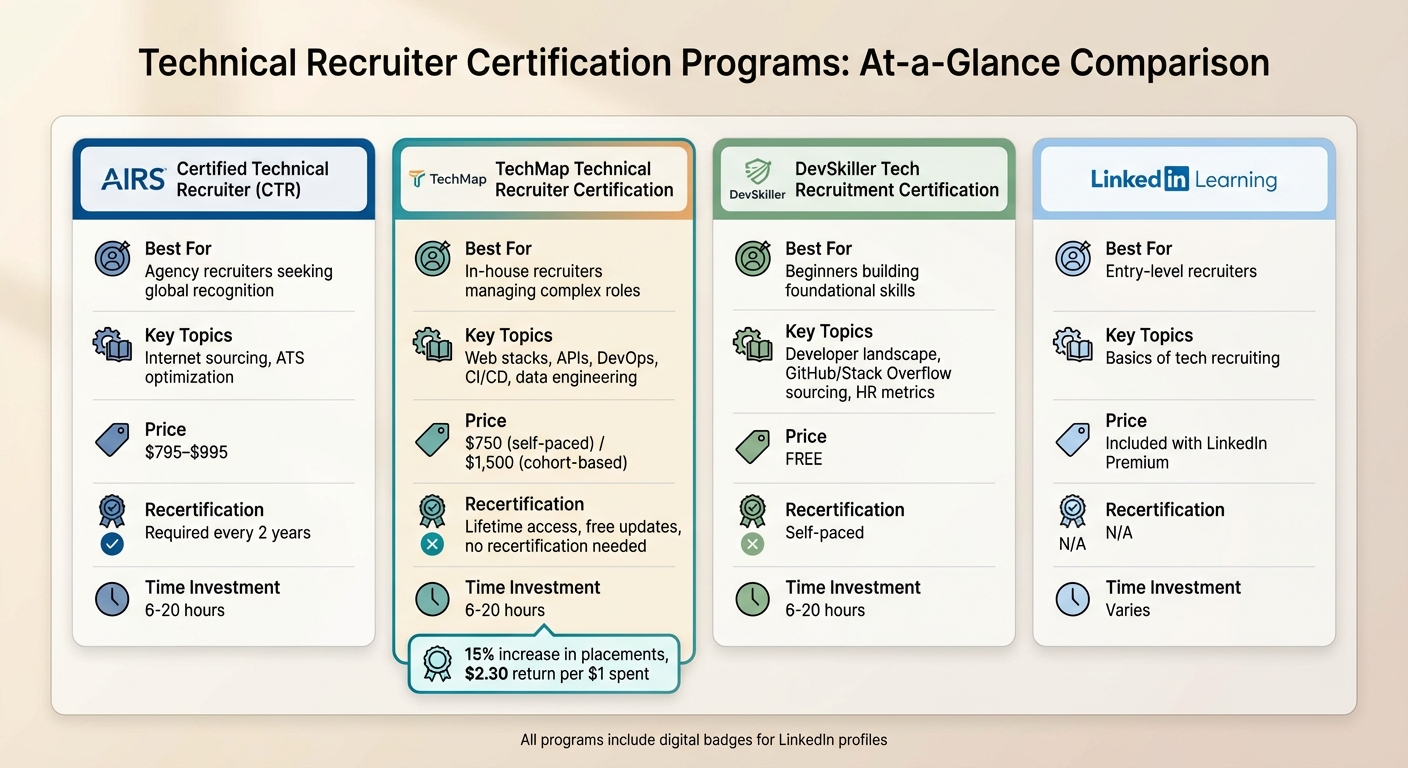 {Technical Recruiter Certification Programs Comparison Guide}
Formal certifications and training programs can help close the technical knowledge gap while boosting a recruiter's credibility. These programs not only reinforce your technical skills but also distinguish you from general recruiters. The key is to choose certifications that align with your specific needs in sourcing and technical fluency.
Recommended Certifications for Technical Recruiting
One of the most recognized credentials in the staffing industry is the AIRS Certified Technical Recruiter (CTR). This certification, priced between $795 and $995, focuses on internet sourcing and optimizing applicant tracking systems (ATS) . It’s particularly useful for agency recruiters who want a globally acknowledged credential. However, keep in mind that recertification is required every two years to maintain its validity .
For recruiters looking to deepen their technical expertise, the TechMap Technical Recruiter Certification is a strong option. It provides training in areas like web stacks, APIs, DevOps, CI/CD, and data engineering. Pricing starts at $750 for self-paced learning, while cohort-based training is available for $1,500. Both options include lifetime access and free updates, eliminating the need for recertification. Notably, in 2025, a staffing company investing in TechMap training saw a 15% increase in placements and a return of $2.30 for every $1 spent .
LinkedIn Learning offers accessible, entry-level courses included with LinkedIn Premium . For beginners, the DevSkiller Tech Recruitment Certification is a free, self-paced program. It covers topics like understanding the developer landscape, sourcing candidates on platforms like GitHub and Stack Overflow, and HR metrics such as Quality of Hire . Another option is the Tech Recruitment Academy, which provides individual modules on topics like IT terminology and technical talent sourcing, priced at around $297 per module .
| Certification | Best For | Key Topics | Price |
|---|---|---|---|
| AIRS CTR | Agency recruiters seeking global recognition | Internet sourcing, ATS optimization | $795–$995 |
| TechMap | In-house recruiters managing complex roles | Web stacks, APIs, DevOps, CI/CD, data engineering | $750–$1,500 |
| DevSkiller | Beginners building foundational skills | Developer landscape, GitHub/Stack Overflow sourcing | Free |
| LinkedIn Learning | Entry-level recruiters | Basics of tech recruiting | Included with Premium |
How to Measure the Value of Training Programs
Once you’ve completed a certification, it’s important to track measurable improvements in your recruiting performance. Metrics like time-to-fill, cost per hire, and quality of hire can provide clear insights into the program’s impact .
Most certifications require a time investment of 6 to 20 hours, making them manageable even with a full-time workload . Look for programs that offer recertification or periodic updates to ensure your knowledge stays current - credentials that expire after two years are designed to keep your skills relevant . Additionally, certifications that include digital badges for your LinkedIn profile can highlight your expertise to both candidates and hiring managers .
While certifications demonstrate dedication, many engineering leaders place greater emphasis on practical results and a genuine interest in technical topics over credentials alone .
Keeping Up with Technology Trends
Building a System to Stay Current
The tech industry moves at lightning speed, but staying effective doesn't mean mastering every new framework. The key is creating a system that helps you separate the valuable updates from the noise. Many top technical recruiters rely on curated information sources, often referred to as "Feeders." For example, bookmark trusted sites like Ars Technica, CRN, Baseline Magazine, and IDC to stay informed. Tools like GetStation can help you organize this information, while automation platforms like Zapier can streamline updates, ensuring you're not overwhelmed.
Beyond digital tools, relationships are critical. Connect with influential contacts - or "Dealers" - such as university job coordinators, leaders of computer science clubs, or hackathon organizers. These connections can offer early insights into new technologies . When paired with technical recruiter training, this system keeps your knowledge sharp and helps you adapt to industry developments with ease.
Identifying Which Trends Matter for Recruiting
Once you have a system in place, the next step is figuring out which trends deserve your attention. Not every buzzword or new tool will impact recruiting. Instead, focus on trends tied to market demand. For instance, AI and machine learning job postings surged by 163% year-over-year in 2025, with 49,200 new positions created. Additionally, 85% of employers now emphasize skills-based hiring over traditional credentials . This makes it crucial to distinguish between essential and optional skills.
To refine your priorities, use intake meetings with hiring managers to clarify requirements. Ask questions like, “Would three years of Go experience work as a substitute for five years of Java?” This helps align your recruiting strategy with actual needs.
Finally, immerse yourself in the best communities for sourcing developers to gain firsthand insights into emerging technologies. Join Discord servers dedicated to languages like Rust, Go, or Elixir, or participate in Reddit communities such as r/experienceddevs. Engaging in these spaces not only builds credibility but also keeps you ahead of the curve by revealing which tools and skills are gaining traction .
Conclusion
Technical recruiting thrives on a foundation of continuous learning and genuine collaboration. Recruiters who excel in this space understand that developers can easily spot superficial technical knowledge. To truly connect, they dive deep into technical terminology, stay updated on industry trends, and approach conversations with humility and curiosity.
But technical recruiting isn’t just about understanding the numbers - it’s about building meaningful relationships. The dynamic between recruiters and engineering teams is pivotal and can determine the success or failure of the hiring process . For instance, asking thoughtful calibration questions like whether three years of Go experience can substitute for five years of Java showcases a nuanced grasp of technical realities. Similarly, referencing a candidate's GitHub projects in outreach rather than sending generic messages reflects a genuine respect for their work and expertise.
The tech talent shortage remains a pressing challenge. With 129,200 new software developer roles projected annually through 2034 and unemployment rates for roles like security analysts as low as 2.1% , competition for top talent is fiercer than ever. The recruiters who stand out will be those who treat learning as an ongoing journey rather than a one-time achievement.
Mastering technical fundamentals is key to transforming recruiter-candidate interactions. Continuous upskilling - whether through certifications, engaging with developer communities, or refining intake processes - enhances both credibility and performance. Every well-executed intake meeting and each new technical concept learned brings you closer to becoming the kind of recruiter developers trust and respect.
Start small: create a tech cheat sheet, follow trusted sources like Hacker News, and collaborate with engineers to fill in knowledge gaps. The goal isn’t perfection - it’s steady progress.
FAQs
What tech basics should I learn first as a recruiter?
To begin, concentrate on building a solid foundation in core technical skills such as programming languages, frameworks, cloud platforms, databases, and DevOps tools. It's also important to understand the software development lifecycle (SDLC) - even if you're not an engineer. On top of that, develop the ability to analyze developer resumes to spot essential skills and technologies. Mastering these fundamentals will help you communicate more effectively with engineers, establish credibility, and refine your sourcing and screening techniques.
How can I tell if a developer’s GitHub actually shows real skill?
To get a clear picture of a developer's skills on GitHub, pay close attention to their contributions, not just the count of repositories or stars. Look at their commits, pull requests, and how they engage in collaborative projects. Understanding terms like repositories, forks, and issues can help you better evaluate their activity. Focus on the quality, complexity, and consistency of their open-source work to get a sense of their coding and problem-solving abilities.
What metrics show that technical recruiter training is effective?
Metrics that highlight the impact of technical recruiter training include a reduction in time to proficiency, a faster ramp-up to baseline performance, and observable behavioral changes. These improvements directly contribute to more efficient and effective recruitment processes.
.png)