Hiring for tech roles is often slow, reactive, and inefficient. It takes an average of 170 days to fill a position, causing delays and productivity losses. By setting up a structured recruitment pipeline, companies can cut this time by 65%, reduce hiring risks, and secure better talent. Here's how to build a streamlined pipeline:
- Focus on Active vs Passive Developer Recruitment: Target skilled professionals who aren’t actively job hunting but are open to opportunities.
- Track Key Metrics: Monitor pipeline volume, response rates (25%+), and time-to-offer (<30 days) to identify bottlenecks.
- Build Relationships Early: Engage with potential hires before roles open to reduce time-to-hire by up to 50%.
- Use Tools Wisely: Platforms like daily.dev Recruiter simplify sourcing by connecting you with pre-qualified, interested candidates.
- Streamline Processes: Automate repetitive tasks and reduce delays in screening, interviews, and approvals.
A well-structured pipeline saves time, improves hire quality, and boosts offer acceptance rates. Learn how to optimize each stage, from sourcing to closing offers, while tracking performance with actionable metrics.
What a Healthy Technical Recruitment Pipeline Looks Like
::: @figure 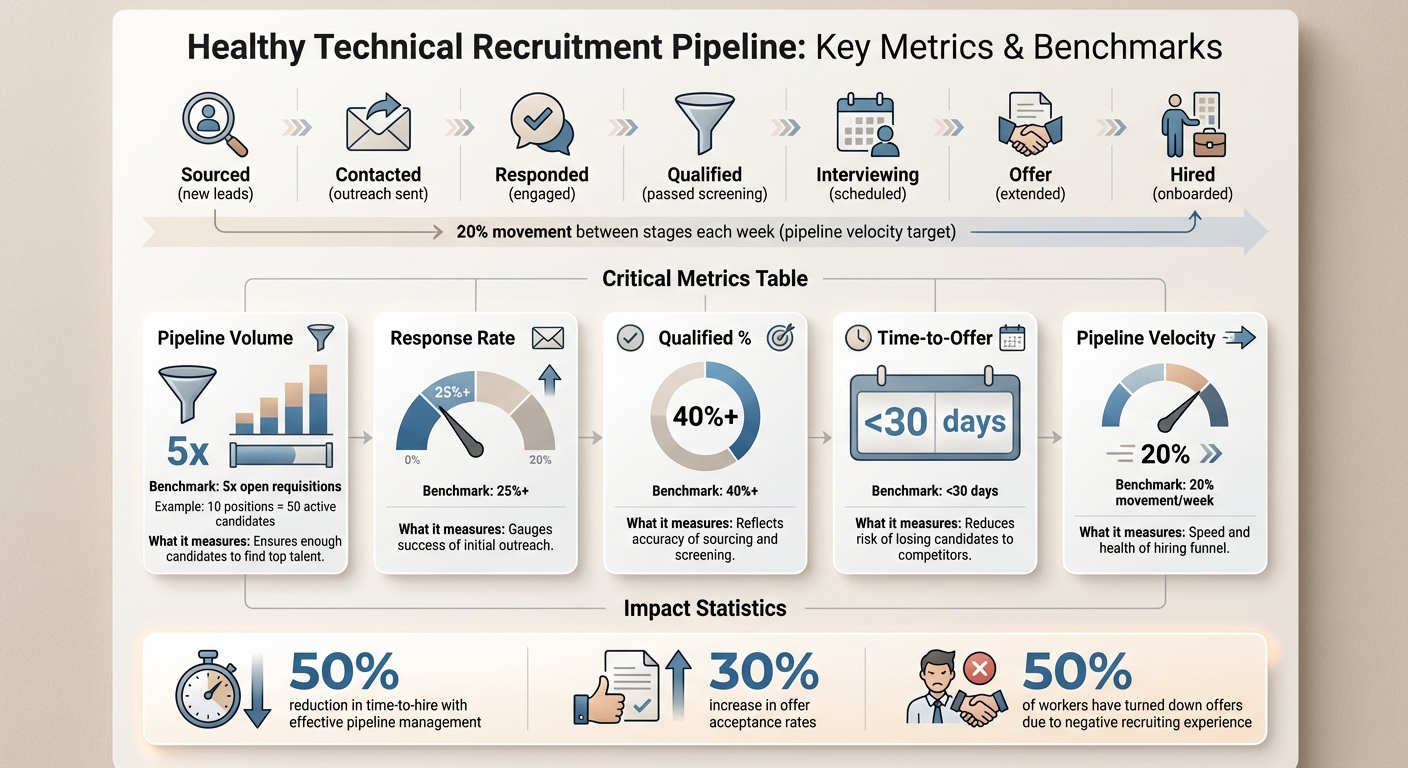 {Technical Recruitment Pipeline Metrics and Benchmarks}
A well-functioning developer hiring pipeline strikes a balance between speed and quality across seven key stages: Sourced (new leads), Contacted (outreach sent), Responded (engaged), Qualified (passed screening), Interviewing (scheduled), Offer (extended), and Hired (onboarded) . Tracking conversion rates at each stage helps identify where potential candidates drop off.
One of the most important metrics to monitor is pipeline velocity - how quickly candidates progress through the process. A good target is 20% movement between stages each week . Keeping the process moving is essential to maintaining candidate interest, especially as delays between outreach and the first phone screen can lead to losing top talent to faster-moving competitors. By managing the pipeline effectively, companies can reduce time-to-hire by 50% and increase offer acceptance rates by 30% .
Alongside speed, maintaining a robust candidate pool is critical. Aim for a pipeline volume that’s five times the number of open roles. For instance, if you’re hiring for 10 positions, you should have 50 active candidates in the pipeline . This buffer ensures you’re prepared for setbacks, such as candidates declining offers or withdrawing mid-process. Two indicators of a healthy top-of-funnel are a 25% or higher response rate to outreach and a 40% or higher qualification rate among those who respond .
While volume and speed are essential, quality should always take priority. High conversion rates lose their value if they result in poor hires or high turnover. In fact, 50% of workers have turned down a job offer due to a negative recruiting experience , highlighting the need to understand what developers want from the process .
| Metric | Healthy Benchmark | What It Measures |
|---|---|---|
| Pipeline Volume | 5x open requisitions | Ensures enough candidates to find top talent |
| Response Rate | 25%+ | Gauges the success of initial outreach |
| Qualified % | 40%+ | Reflects the accuracy of sourcing and screening |
| Time-to-Offer | <30 days | Reduces the risk of losing candidates to competitors |
| Pipeline Velocity | 20% movement/week | Measures the speed and health of the hiring funnel |
These benchmarks provide a solid framework to evaluate and improve each stage of the recruitment process. By focusing on these metrics, you can build a pipeline that delivers not just speed, but also the right talent.
Pipeline Architecture: The 6 Stages of Technical Recruitment
To strike the right balance between speed and candidate quality, a well-structured recruitment pipeline is essential. The technical recruitment process typically unfolds across six key stages: Sourcing, Screening, Technical Assessment, Culture Fit Evaluation, Offer, and Closing. By understanding each stage's role, you can identify bottlenecks and improve how efficiently candidates move through the pipeline.
While it's normal to see a significant dropoff from sourcing to final hire, the goal is to ensure candidates exit for valid reasons - like a lack of fit - rather than due to inefficiencies or confusion in your process. Keeping each stage focused and actionable is critical. Let’s break down these stages to see how you can refine the flow.
Sourcing
Sourcing is where the pipeline begins, filling it with potential candidates. This involves proactive outreach on LinkedIn, posting on job boards, leveraging employee referrals, and attending tech events. In 2026, the most effective sourcing strategies consist of 30% referrals, 25% Boolean search, 20% social media, 15% AI tools, and 10% events . The goal here is to rapidly populate the pipeline with qualified prospects to meet headcount targets .
Referrals, in particular, should take priority since they often bypass the initial application queue, going straight to recruiters or sourcers . For challenging roles or skills you frequently hire for, invest in crafting Boolean search strings and tapping into diverse talent pools. Tools like daily.dev Recruiter can streamline this step by providing pre-qualified developer talent already engaged with technical content, reducing the need for cold outreach.
Screening
Screening is where you separate qualified candidates from those who don’t meet basic criteria. This begins with a quick resume filter to shortlist candidates for the next step . Afterward, a recruiter phone screen - lasting 15 to 30 minutes - helps confirm experience, gauge motivation, and assess soft skills .
"The dropoff is usually the steepest at this step [resume screening]. From hundreds of resumes, only a few dozen profiles tend to have a recruiter screening call." - Gergely Orosz, Author, The Tech Resume Inside Out
During phone screens, use a fit score system and advance only those scoring 8 or above . To save time, include knockout questions in application forms - like “Do you have experience with React?” - to filter out unqualified candidates before they reach human review .
Once screening is complete, the focus shifts to technical evaluations and cultural alignment.
Technical Assessment and Culture Fit
Technical assessments validate a candidate’s hard skills through methods like phone screens, coding challenges, or take-home assignments . For senior positions, this stage often includes systems design interviews, where candidates demonstrate their ability to architect scalable solutions .
Culture fit evaluations typically occur during the hiring manager interview, which emphasizes soft skills, alignment with company values, and team dynamics . A helpful framework here is the "5 C's": Capability, Confidence, Concern, Command, and Communication . Structured interviews with scorecards can ensure consistent evaluations across all candidates, minimizing unconscious bias . Be transparent with candidates by sharing details about each interview panel’s focus areas .
Closing Offers
In a competitive market, the closing stage becomes all about speed and precision. This step involves extending the offer and securing the candidate’s commitment. It often includes background checks, negotiations, and managing counter-offers from other companies .
"Generally speaking, the smaller the company is, the more details you should be able to get, and the deeper the relationship should be with your recruiter." - Blake Stockman, Recruiter (Google, Facebook, Uber)
Act quickly - candidates with in-demand skills are likely juggling multiple offers . Tailor your offers to align with the candidate’s motivations, and be prepared to compete on perks like signing bonuses and equity packages, especially against larger tech firms.
Top-of-Funnel: Building a Sourcing Engine That Scales
Creating a sourcing engine that can grow with your needs is key to improving both conversion rates and the speed of moving candidates through your technical hiring process. By building proactive pipelines - where relationships are established before roles even open - you can cut hiring timelines by 30–50% and see a 20% increase in employee retention .
"Building a real talent pipeline is about finally getting off the hiring hamster wheel. It's how you stop the frantic, last-minute scramble and start building relationships with great people before you even have an open job." – Nicolas Pamart, RedactAI
Recruiting teams that excel in this area often achieve conversion rates as high as 60% from pipelined candidates to the interview stage .
Passive Talent Sourcing
Passive candidates - those not actively seeking a new job - are often some of the most valuable hires. However, reaching them requires a more thoughtful approach than generic mass emails or LinkedIn scraping. Personalized outreach is the key to engaging this group effectively.
Tools like daily.dev Recruiter vs. LinkedIn Recruiter can help by connecting you with developers who are already immersed in technical content, ensuring that every introduction feels genuine and is double opt-in. This approach builds trust and leads to reply rates that far exceed industry norms. In fact, personalized outreach has been shown to significantly increase reply rates, which directly speeds up your pipeline.
You can also target niche communities like GitHub, Stack Overflow, and Behance. AI-driven talent intelligence tools can scan massive global directories - some with as many as 1.2 billion profiles - to help you uncover hidden talent using natural language searches . When reaching out, take a few minutes to reference specific achievements, like recent open-source contributions. This extra effort shows genuine interest and can dramatically improve response rates .
Don’t forget to leverage your Applicant Tracking System (ATS) to tag and re-engage with pre-vetted candidates from past hiring cycles . Additionally, internal networks can amplify your efforts when combined with personalized outreach.
Referrals and Events
Beyond personalized outreach, referrals and live events are powerful tools for expanding your candidate pool. Employee referrals, in particular, are a goldmine. They allow candidates to bypass the initial application process and head straight to recruiters. However, many companies struggle to maintain a steady flow of referrals because their processes are overly complicated.
"If it's difficult for employees to refer a candidate, you'll get fewer referrals." – LinkedIn
Simplify the process by asking employees for just a name and contact information, rather than requiring a full application form . To encourage participation, offer incentives for referrals that result in interviews. These could include cash bonuses, public recognition during company meetings, or even acknowledgment in performance reviews .
Employee Resource Groups (ERGs) can also play a crucial role in sourcing candidates from underrepresented backgrounds, helping you meet diversity goals . For example, while sourcing from Historically Black Colleges and Universities (HBCUs) is a common strategy, only 9% of Black college students attend HBCUs, compared to 53% who attend predominantly white institutions . ERG-driven referrals can help you tap into these broader networks.
Tech events, whether in-person or virtual, are another excellent way to connect with potential candidates. Meeting face-to-face allows for deeper, more immediate relationship-building than digital outreach . After meeting someone at an event, follow up quickly and connect on LinkedIn to keep the relationship alive . Even if they’re not ready to make a move now, staying in touch can pay off down the line.
For remote teams, hosting virtual events in the metaverse is an emerging option for showcasing your company culture without geographic limitations . Whether physical or virtual, the goal remains the same: build genuine connections that can eventually turn into qualified candidates for your pipeline.
Mid-Funnel: Screening Efficiently Without Losing Candidates
The mid-funnel is where many hiring processes hit snags. Did you know that 58% of hiring delays happen after the interview stage, not before? . The problem often lies in the process itself. When candidates are left waiting for feedback or stuck in lengthy approval chains, they lose interest - or worse, accept offers elsewhere. In fact, top technical talent is usually off the market within days, not weeks.
"Speed isn't about cutting corners. It's about cutting delays that were never necessary to begin with." – uRecruits Inc
On average, a single role goes through 5+ people before an offer is made, with each additional approval adding 3–5 days . Meanwhile, recruiters spend 40% of their week on repetitive manual tasks that could easily be automated . This creates a bottleneck where qualified candidates sit idle while your team handles administrative work. To prevent this, fine-tune your screening process to reduce delays and keep candidates engaged.
Screening Tools and Processes
Start by auditing your system. Clearly define "must-haves" in the job brief from day one to avoid shifting requirements mid-process . Use role-based competency frameworks and structured interviews instead of casual, unstructured conversations. This ensures objectivity, speeds up decision-making, and keeps your recruiting process aligned with your goals. A great question to ask candidates is, "What does success look like in 12 months?" - this helps align expectations with actual needs .
Leverage automation wherever possible. automated tools for screening developer resumes can quickly match keywords and rank candidates based on qualifications, freeing your team to focus on meaningful interactions . Tools like AI chatbots can answer candidate questions instantly, improving their experience . For technical roles, prioritize practical, role-specific assessments that are quick and relevant. Long, drawn-out tests often lead to drop-offs from highly sought-after talent.
Simplify the approval chain by reducing the number of decision-makers and pre-approving salary packages before the screening begins. This eliminates unnecessary delays when it's time to extend an offer . Build urgency into your process with automated handoffs and reminders. A hiring process that should take 10 days often drags out to 35 because feedback gets stuck in limbo .
The right screening tools not only speed up evaluations but also keep candidates interested and engaged.
Reducing Candidate Ghosting
Ghosting is less about candidates and more about how the process is managed. 50% of workers say they’ve rejected a job offer due to a poor recruiting experience . When candidates hear nothing, they assume the company isn’t interested and move on.
Set up communication triggers to provide timely updates at every stage, even if the update is as simple as, "We’re still reviewing applications" . Transparency goes a long way. If there’s a hiring freeze or delay, it’s better to communicate openly than to go silent. This builds trust and keeps the door open for future opportunities .
"When recruitment is treated not just as a transaction but as a relationship-building process, it benefits everyone involved." – Jerry R. Miller
Make sure your application process is mobile-friendly, as many top developers browse and apply via mobile devices . Share industry insights and provide prompt feedback to keep candidates engaged. Remember, the best talent often disappears from the market in just a few days . By treating screening as a relationship-building exercise rather than a simple transaction, you’ll reduce ghosting and see more top-tier candidates make it to the offer stage.
Bottom-of-Funnel: Closing Offers in a Competitive Market
Once you've successfully navigated sourcing, screening, and assessment, the final challenge is sealing the deal with top candidates in a competitive market. You've built a connection with a standout candidate, but now comes the tricky part: getting their commitment. With turnover rates climbing, companies are rethinking how they present offers . While offering top-tier pay might grab a candidate's attention, it rarely guarantees they'll accept - especially when they're juggling multiple offers from well-funded competitors.
"While market leading pay might entice talent to take an interview, it is not enough to get them in the door or retain them in the long run." – Chris DeBrusk and Carolyn Vo, Oliver Wyman
Losing candidates at the offer stage often points to earlier missteps . If you haven’t aligned the role with what the candidate values most, even an appealing package can fall short. The offer should feel like a collaborative checkpoint, not a one-sided proposition. Before sending out the formal offer, take time to confirm the candidate’s priorities and ensure mutual clarity on what success in the role looks like . This requires a thoughtful, tailored approach that prioritizes connection over formality.
Competing with FAANG Offers
Facing off against offers from tech giants like FAANG companies can feel daunting, especially when matching their salary levels isn’t realistic. However, engineers often prioritize more than just pay. Factors like work-life balance, meaningful projects, psychological safety, and collaboration frequently outweigh salary alone . A LinkedIn survey of 70,000 respondents revealed that by 2025, the top three priorities across industries will be compensation, work-life balance, and flexible work arrangements .
Another way to stand out is by showcasing your commitment to modern technology. Talented engineers often shy away from companies stuck with outdated systems or obscure programming languages. For instance, in 2021, a regional bank made headlines by sending its entire risk department - both business and IT teams - to a "cloud camp" to signal its dedication to modernizing legacy systems. This initiative not only attracted top talent but also demonstrated their focus on cutting-edge work . If your role involves modernization, frame it as a chance to lead transformation efforts rather than just maintaining outdated platforms .
Highlighting the strength of the team is another powerful strategy. Engineers value working alongside skilled peers, so emphasize the expertise and accomplishments of their potential colleagues during the closing process . Use recruitment marketing - via blogs, social media, and testimonials from your engineering team - to show how technical staff drive business success . Additionally, diversify interview panels to reflect inclusivity, signaling to candidates that they’ll be welcomed and valued .
Ultimately, while competing on salary alone may not be feasible, crafting an offer tailored to the candidate’s specific needs and aspirations can make all the difference.
Personalizing Offers
Generic offers often fall flat, especially with engineers who value organizations that invest in professional growth and data-driven performance metrics . Clearly outline career advancement opportunities and provide tangible support for upskilling, such as training leave or certifications. Interestingly, while HR professionals tend to highlight inclusivity, engineers often prioritize other factors - so align your messaging with what matters most to the candidate .
Position the role as a solution to their career pain points. Are they burned out from long hours? Highlight your flexible work policies. Are they looking for more impactful work? Emphasize their chance to lead meaningful projects. By focusing on their priorities rather than simply listing what you’re offering, you can create a compelling case for joining your team .
"People buy from people whom they like." – Michael O'Leary, HRM Recruitment
Building an emotional connection is key. Show how the candidate’s values align with your company’s mission through honest, relatable storytelling . If there are any shortcomings in the role or organization, address them openly and frame them as opportunities for growth . Keep in mind that 50% of workers have turned down job offers due to poor candidate experiences . How you close the deal is just as important as the offer itself.
Pipeline Metrics That Matter
Once you've mapped out the structure and stages of your technical recruitment pipeline, the next step is to dive into the numbers. Tracking key metrics helps you spot where candidates drop off, find the best sourcing channels, and evaluate how competitive your offers are.
"Recruitment without data is guesswork. Failure to measure the hiring process means organizations miss the opportunity to understand what is working, what is wasting time, and where great candidates are being lost." – Elisa Yang, JOIN
For context, the industry average time-to-fill is 41 days , and the average cost per hire falls between $4,129 and $4,700 . But these benchmarks only scratch the surface. What really matters is digging into your own pipeline to uncover bottlenecks and areas for improvement.
Time-to-Fill and Source-of-Hire
Time-to-fill measures the total time from job requisition approval to offer acceptance, while time-to-hire focuses on how quickly candidates move through the pipeline after applying . Breaking time-to-fill into smaller stages - like "screening to first interview" - can help you identify where delays occur .
On the other hand, source-of-hire tells you which channels bring in the best candidates. For example, internal applicants have a 45% success rate, while referrals come in at 25% . By tracking where candidates come from and linking that to long-term success, you can focus on channels that deliver the strongest results .
Stage Conversion Rates
Understanding how candidates progress through each stage of your pipeline is crucial for spotting leaks. Start with the application completion rate, which highlights friction points in the application process. For instance, job applications with 25+ questions see an average completion rate of just 10.6% . Simplify the process - especially for mobile users - and avoid asking for full resumes or manual data entry early on .
Another key metric is the interview-to-hire ratio. Ideally, this should be 3:1, meaning three interviews for every hire. Higher ratios might signal issues with screening processes or unclear criteria . To dig deeper, send automated surveys to candidates who drop out. This can reveal problems like slow communication, poor interview experiences, or unappealing offers . Finally, analyze how well your offers convert, as this is a direct reflection of your pipeline’s success.
Offer Acceptance Rate
Your Offer Acceptance Rate (OAR) is a clear indicator of how competitive your offers are and how well you’ve aligned with candidate expectations . A strong OAR typically falls between 90-95% . Keep in mind that 55% of candidates expect a job offer within two weeks of their first interview, and 70% lose interest if they don’t hear back within one week . This means speed and personalization are critical. Instead of relying solely on industry averages, compare your metrics to your best-performing quarters or departments to get a more accurate picture .
ATS Setup and Pipeline Management Tools
When it comes to managing your hiring pipeline, a well-configured ATS (Applicant Tracking System) can make all the difference. It goes beyond spreadsheets by offering better automation, integration, and visibility. One essential feature to prioritize is pipeline visualization - tools like TalentWall let you clearly see where candidates drop off in the process . This kind of insight is crucial when juggling multiple roles and helps you identify and address bottlenecks before they disrupt your hiring goals.
Another key factor? Mobile optimization. If your system requires clunky account creation or only works on desktops, you risk losing candidates. In fact, half of workers have declined job offers due to a bad recruiting experience . That’s a wake-up call to ensure your ATS is streamlined and user-friendly.
For sourcing, integrate external platforms that support real-time data sync, automated deduplication, and data enrichment. This ensures candidate records remain unique while offering valuable insights into their technical skills, learning preferences, and career paths. For example, platforms like daily.dev Recruiter can prevent recruiters from accidentally contacting the same person twice, cutting down on manual errors and making outreach more tailored and meaningful.
Automation doesn’t stop there. Use your ATS to set up communication triggers, automate interview scheduling, and send follow-up reminders to keep candidates engaged during critical stages . Additionally, configure your system to track DEIB (Diversity, Equity, Inclusion, and Belonging) metrics throughout the candidate journey. This helps ensure that diverse candidates progress at the same rate as others . To stay on top of your pipeline, review metrics weekly rather than monthly. Early declines can snowball quickly, and frequent check-ins let you address problems before they escalate .
Scaling the Pipeline: From 5 to 50 Hires Per Quarter
Scaling your recruitment pipeline by tenfold requires a complete overhaul in how you approach candidate sourcing and engagement. It’s not just about filling roles as they open - it’s about creating a proactive system that keeps a steady flow of pre-vetted candidates ready to step in when needed . This method saves both time and money compared to starting fresh with every new position.
Before diving into ambitious hiring goals, take a step back and crunch the numbers. A capacity calculator can help determine if your team has the bandwidth to handle the increased workload of sourcing, screening, and interviewing . Instead of tracking individual job openings, segment your pipelines by broader categories like "Engineering" or "Marketing - Manager Level." This approach brings clarity to larger volumes and simplifies the process .
To handle scaling effectively, automation and smarter screening are non-negotiable. Transitioning from basic keyword searches to AI-driven matching can make a huge difference. This technology looks beyond resumes, analyzing factors like side projects, learning habits, and professional interests to identify candidates who truly fit the role. Tools like daily.dev Recruiter use machine learning to deliver warm, opt-in introductions, turning cold outreach into meaningful conversations. This not only improves efficiency but also reduces ghosting, as candidates are already engaged and interested in the role.
Maintaining quality while increasing volume is another challenge. One way to tackle this is by adding up to three custom screening questions in your sourcing platform. These questions help confirm technical qualifications before recruiters get involved. Combine this with AI-driven matching and integrations with your ATS (Applicant Tracking System) to automate tasks like data entry, deduplication, and candidate routing. This frees up your team to focus on meaningful interactions rather than administrative work.
Finally, keep a close eye on your screen-to-hire ratios. Review ATS reports weekly to spot and address bottlenecks in the hiring stages. This ensures you’re moving the right number of candidates through the pipeline to hit your quarterly targets . Scaling isn’t just about volume - it’s about engaging the right talent efficiently.
Conclusion
Building a technical recruitment pipeline requires dedication and a shift in mindset. As Nicolas Pamart from RedactAI aptly puts it:
"Building a real talent pipeline is about finally getting off the hiring hamster wheel" .
This shift moves companies from reactive hiring to a proactive strategy, anticipating talent needs 1–3 years ahead. It’s like moving from the quick tactics of checkers to the strategic planning of chess. The payoff? Companies embracing pipelining hire 30–50% faster, improve retention by 20%, and cut time-to-hire from 170 days to just 60 days .
The process begins with an upfront investment - three to six months to set up your ATS, define sourcing channels, and nurture relationships with passive candidates. By the 6–12 month mark, the pipeline starts delivering pre-vetted, ready-to-hire talent exactly when needed.
The key is treating your pipeline as a dynamic, evolving network. This aligns with the importance of managing your ATS effectively and focusing on personalized engagement. For instance:
- Quarterly touchpoints: Stay connected with passive candidates.
- Value-driven content: Share insights and updates rather than generic job alerts.
- Tailored outreach: Reference specific projects to make communication more meaningful.
Why does this matter? Because 81% of candidates prefer ongoing communication during recruitment, and 75% research an employer’s brand before applying .
Tools like daily.dev Recruiter support this proactive approach by connecting you with developers in their natural environments - where they’re reading, learning, and engaging with technical content. With warm, double opt-in introductions, you eliminate the ghosting that often plagues initial outreach, turning cold emails into genuine, trust-based conversations.
Finally, track your progress. Focus on metrics like:
- Pipeline conversion rates: Aim for 40–60%.
- Time-to-fill: Target 20–30 days for pipelined roles.
- Offer acceptance rates: Strive for above 90% .
Regularly reviewing these metrics helps identify bottlenecks and refine your strategy. With consistent effort and the right tools, recruitment evolves from a reactive expense into a strategic driver for growth.
FAQs
How many candidates do I need in my tech recruiting funnel?
The number of candidates you’ll need in your tech recruiting funnel depends on two things: your hiring goals and your stage conversion rates. Let’s say your goal is to make 5 hires in a quarter. Based on typical drop-off rates at each stage, you might need to source anywhere from 25 to 50 candidates to hit that target. The key is to tailor your sourcing efforts to match your specific pipeline metrics and how candidates tend to progress through your process.
What’s the fastest way to stop candidate ghosting after outreach?
The fastest way to cut down on candidate ghosting is by keeping communication steady, meaningful, and relevant throughout the hiring process. Make sure your messages are engaging, prompt, and tailored to the individual. Take a close look at your hiring process - streamlining it and making it more candidate-focused can help reduce drop-offs. Consistent follow-ups, especially before interviews or offers, show candidates that you value their time and interest, which makes them less likely to disappear.
Which recruiting metrics should I review every week?
Make it a habit to review metrics like pipeline conversion rates, source-of-hire, stage-to-stage transition rates, and offer acceptance rate every week. These numbers give you a clear picture of how well your recruitment process is working and can quickly highlight any issues or bottlenecks that need attention.
.png)