Finding top-tier developer talent in 2025 is challenging, with 91% of U.S. tech leaders struggling to fill roles in AI, cybersecurity, and cloud architecture. This guide compares five platforms - daily.dev Recruiter, GitHub, Stack Overflow, Toptal, and LinkedIn - based on key factors like vetting, reducing time-to-hire, pricing, and access to passive candidates.
Key Takeaways:
- daily.dev Recruiter: Focuses on real-time developer activity; great for targeting passive candidates.
- GitHub: Highlights coding skills via public repositories; ideal for assessing technical expertise.
- Stack Overflow: Uses peer-validated reputation scores; excellent for identifying problem-solving ability.
- Toptal: Offers rigorously vetted developers (top 3%); best for urgent, high-stakes projects.
- LinkedIn: Largest professional network; effective for senior and executive roles.
Quick Comparison:
| Platform | Strengths | Weaknesses | Cost (USD) | Best For |
|---|---|---|---|---|
| daily.dev Recruiter | Real-time developer insights | Limited reach | Transparent, varies | Passive candidates |
| GitHub | Coding activity/repositories | Limited visibility for private work | Free (basic) | Technical skill assessment |
| Stack Overflow | Peer-validated expertise | Manual outreach required | $400–$600 per job post | Problem-solving skills |
| Toptal | Top 3% vetted developers | High hourly rates | $100–$200+/hour, $500 deposit | High-stakes, specialized roles |
| Large professional network | Limited for niche tech roles | $1,680+/month (Recruiter Lite) | Senior/executive roles |
Each platform caters to different hiring needs, so choosing the right one depends on your goals, budget, and the type of talent you're seeking.
::: @figure 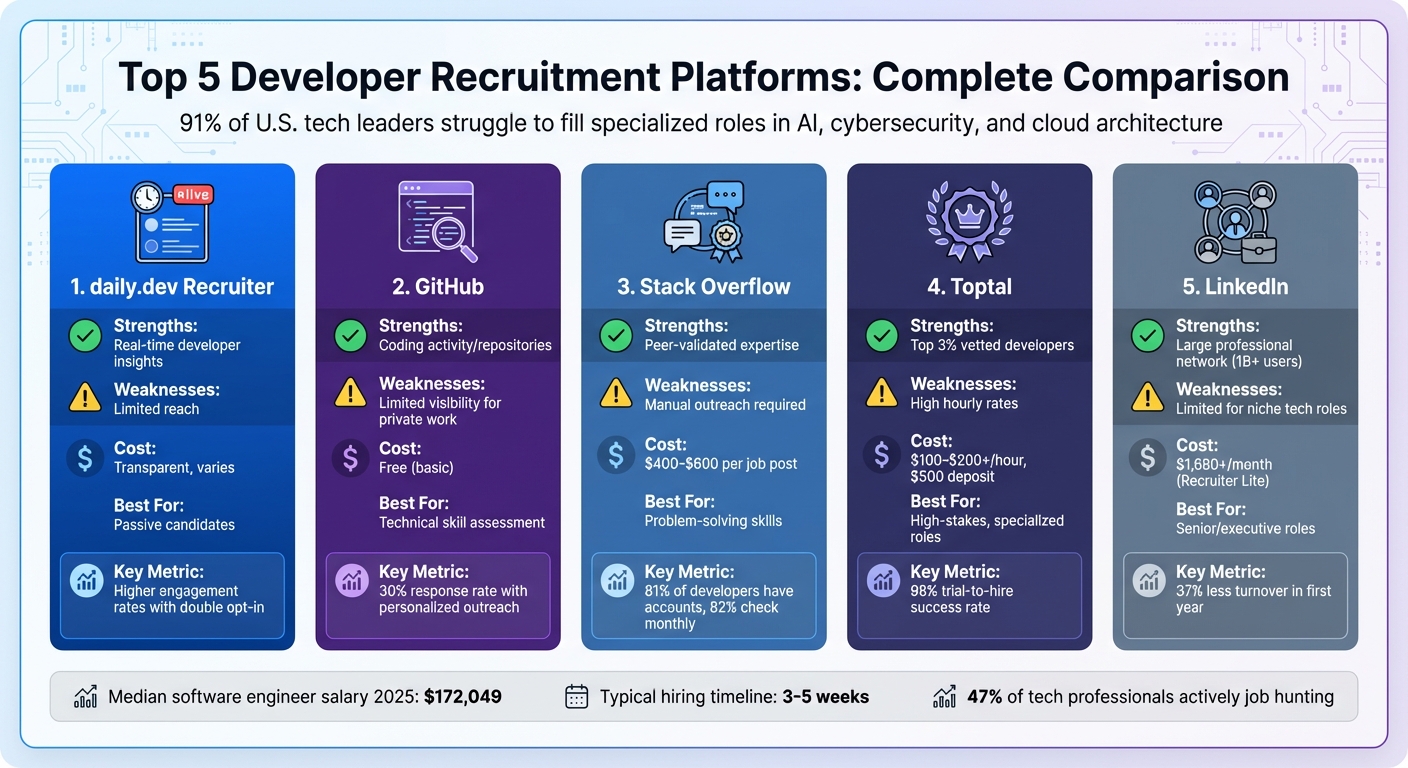 {Top 5 Developer Recruitment Platforms Comparison 2025}
1. daily.dev Recruiter
Talent Quality Signal
daily.dev Recruiter redefines how recruiters evaluate developer talent by focusing on a "Developer Identity" built from real-time activity rather than static resumes. Instead of relying on outdated snapshots of experience, the platform tracks what developers read, the technologies they follow, and how they engage with the tech community. By analyzing content consumption patterns, it provides a dynamic way to verify expertise based on actual interactions with technical articles.
This approach tackles a key challenge in U.S. tech hiring: identifying candidates who are not only skilled but actively engaged in learning. While traditional profiles often emphasize past achievements, daily.dev Recruiter highlights ongoing development and up-to-date knowledge. For recruiters navigating a competitive market - where 47% of tech professionals are actively job hunting and often receive multiple offers within 2–3 weeks - these insights are incredibly useful. This dynamic data powers the platform's advanced candidate search tools.
Search & Targeting Capabilities
The platform goes beyond standard filters like job titles and years of experience. Recruiters can narrow their search using criteria such as specific technology interests, reading habits, and community engagement levels. Since daily.dev Recruiter operates within a developer-focused network where engineers naturally spend their time reading and learning, it allows recruiters to connect with talent in a non-intrusive way, avoiding the pitfalls of cold outreach.
With these targeted filters, the platform enables recruiters to establish meaningful connections with candidates.
Engagement Model
daily.dev Recruiter prioritizes trust in every interaction. Developers receive job briefs tailored specifically for technical audiences, and they can choose to respond only if they’re genuinely interested. This approach replaces generic outreach with intentional, well-matched conversations, leading to higher engagement rates - particularly with active vs passive developer recruitment strategies for candidates who may not actively be applying but are open to the right opportunity.
Cost & Suitability for US Hiring
In a landscape where 91% of U.S. tech leaders face challenges in filling specialized roles, speed and efficiency are critical. daily.dev Recruiter offers transparent pricing and integrates seamlessly with applicant tracking systems (ATS), simplifying workflows across tech hubs like Austin, Silicon Valley, and beyond. This makes it a practical choice for recruiters aiming to find top talent quickly and effectively.
2. GitHub
Talent Quality Signal
GitHub acts as a live showcase of a developer's skills, offering insights into their coding style, problem-solving approach, and technical expertise through their repositories. It also distinguishes original work from forks. The platform’s contribution graph - which tracks commits, pull requests, issues, and code reviews - provides a snapshot of a developer’s activity and engagement over time. However, only a small fraction of users are highly active: less than 20% contributed any code in the past year, and just 1.6% had over 99 public contributions.
Community validation comes through metrics like "Stars" and "Followers." For instance, 100 stars signal solid work, while 1,000 stars can elevate a developer to "programmer-famous" status. Similarly, having more than 50 followers often indicates significant professional influence. That said, many skilled developers work on proprietary projects in industries like finance or healthcare, which means their public GitHub profiles might not fully reflect their expertise. Despite this limitation, GitHub remains a powerful tool for identifying talent, especially with its search capabilities that help recruiters zero in on the right candidates.
Search & Targeting Capabilities
GitHub’s advanced search tools, combined with Boolean search techniques, make it easier for recruiters to identify candidates based on factors like programming language, location, and repository engagement (e.g., stars and forks). For example, a search query like site:github.com "software engineer" location:austin can narrow down potential candidates effectively.
Codility’s technical recruiting team demonstrated the platform’s potential in 2023 by filling two positions through GitHub sourcing. They achieved a 30% response rate by having hiring managers co-author personalized outreach emails that referenced specific projects candidates had starred or forked.
"Using these tactics, the tech recruiting team here at Codility achieves a 30% response rate when reaching out to developers on GitHub."
- Ruslan Khalilov, Technical Recruiter, Codility
Engagement Model
GitHub is especially effective for reaching passive candidates - developers who aren’t actively job hunting but might be open to the right opportunity. Personalized messages that reference specific contributions or projects can significantly improve response rates. When hiring managers send the initial email, it adds a layer of technical credibility that resonates with developers.
Unlike platforms that depend on real-time activity signals, GitHub offers a deeper, repository-focused view of a candidate’s expertise. Reviewing the "Issues" section on a profile can also provide valuable insights into a developer’s communication and collaboration skills.
Cost & Suitability for US Hiring
With free accounts and advanced search features, GitHub is a budget-friendly option for sourcing skilled talent in competitive U.S. tech markets. This is especially relevant as 91% of U.S. tech leaders report difficulties in filling specialized roles in areas like AI and cybersecurity. Considering that the median software engineer salary is projected to hit $172,049 by 2025, GitHub stands out as a practical way to find community-vetted talent in hubs like Silicon Valley, Austin, and Seattle.
3. Stack Overflow
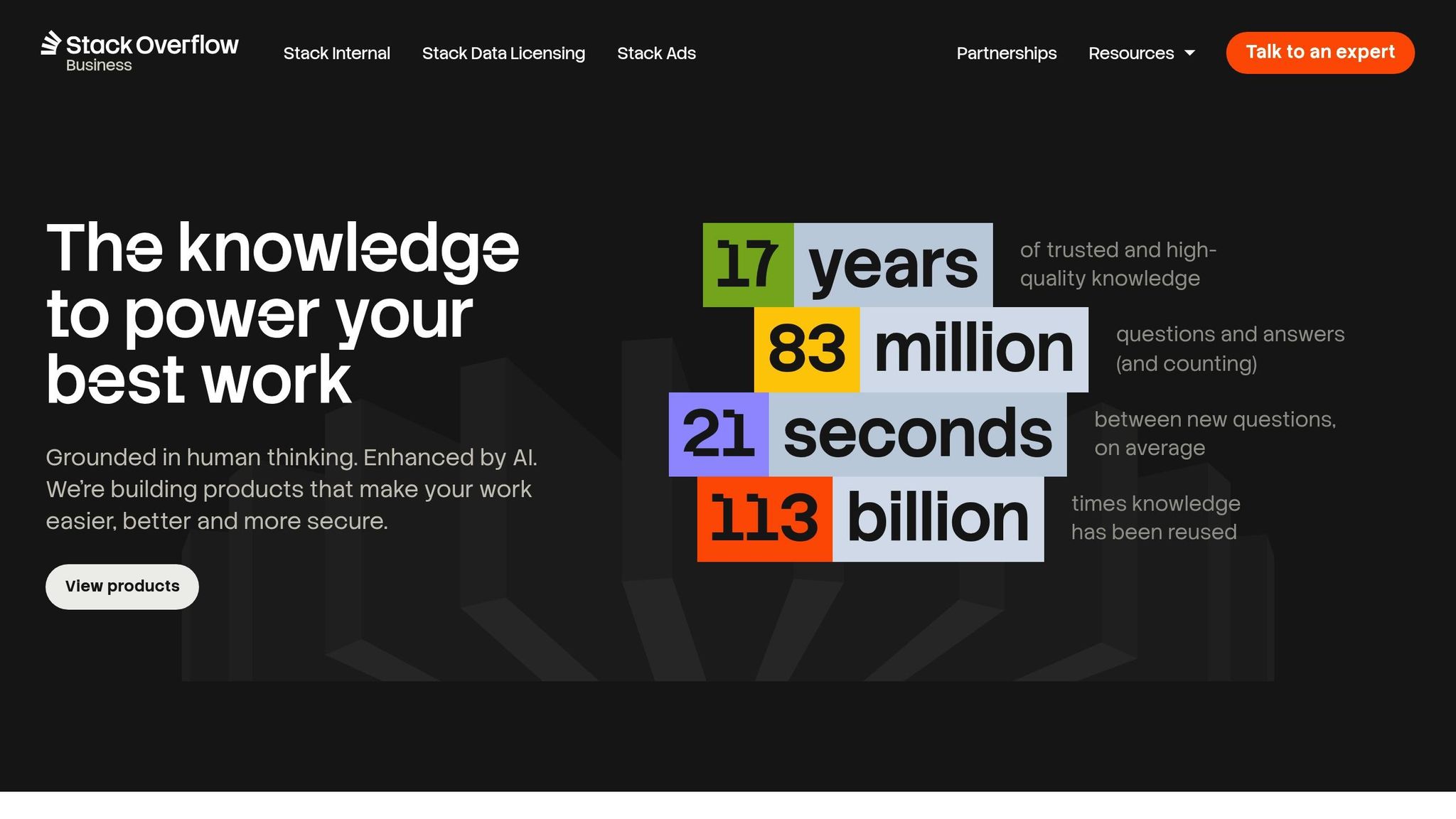
Stack Overflow brings a developer-focused angle to the hiring process, emphasizing community-driven validation as a key feature.
Talent Quality Signal
Stack Overflow's reputation system offers a transparent way to gauge a developer's expertise. Instead of relying on resumes that can be exaggerated, the platform awards reputation points based on consistent, high-quality contributions, validated through peer voting . This creates an objective measure of technical skill. By using technology-specific tags like Python, C++, or React, recruiters can zero in on developers with proven expertise . Reviewing answers on the platform reveals not just technical know-how but also problem-solving abilities and communication skills . This makes it a powerful tool for identifying skilled developers who might not be actively job hunting .
"We look for developers who are passionate and excited about their work... who learn quickly and solve complex problems efficiently, and who - put simply - get things done."
- Stack Overflow Blog
Search & Targeting Capabilities
Stack Overflow's talent pool is deeply engaged. As of 2025, 81% of developers have accounts on the platform (up from 74% in 2023), and 82% check in at least monthly, with 25% visiting daily . With data from its Annual Developer Survey, recruiters can target candidates based on trending technologies, preferred programming languages, or workplace preferences like remote work . Tools such as Stack Ads allow recruiters to connect with developers directly within their technical workflows . These targeting capabilities make outreach efforts more effective and tailored.
Engagement Model
Stack Overflow takes a developer-first approach, integrating job opportunities and sponsored content seamlessly into its problem-solving environment. This approach helps build trust without interrupting the user experience . Recruiters can improve response rates by personalizing outreach by understanding what developers want and referencing their specific contributions . User profiles often include links to external projects, such as GitHub repositories or personal websites, offering further insights into a candidate’s skills. Framing opportunities around the technical challenges or growth areas that developers show interest in can also lead to better engagement . To respect the community-driven nature of the platform, recruiters should avoid overly promotional language .
Cost & Suitability for US Hiring
In the competitive U.S. tech market, Stack Overflow's standard 30-day job postings cost between $400 and $600 . Additional fees apply for features like tag targeting and custom branding . For larger hiring campaigns, options include banner ads, topic tag sponsorships, and premium placements in podcasts or newsletters, with pricing based on minimum spending requirements . With 91% of U.S. tech leaders reporting challenges in finding skilled professionals for specialized roles like AI and cloud architecture, Stack Overflow's community-validated expertise can support competitive hiring strategies. In 2025, median software engineer salaries reached $172,049, and the typical hiring timeline ranged from 3 to 5 weeks, tapping into a community of over 20 million active developers .
4. Toptal
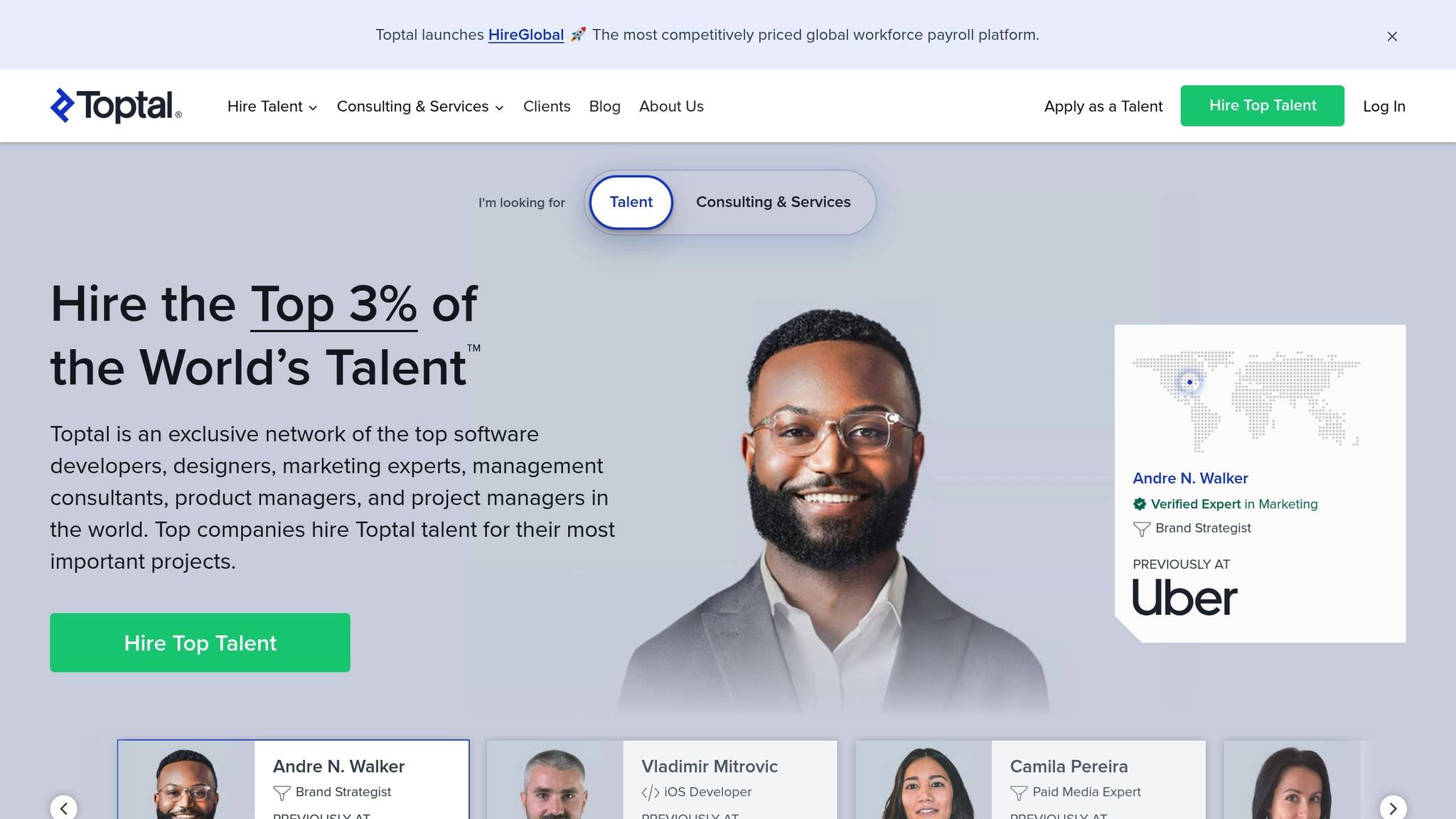
Toptal is a highly selective platform that accepts fewer than 3% of the 200,000 applicants it reviews annually through a rigorous screening process . This exclusivity appeals to U.S. companies handling critical projects where the cost of failure outweighs higher hourly rates.
Talent Quality Signal
Toptal’s five-step vetting process is no joke - it takes between 3 to 8 weeks and includes language and personality assessments, technical evaluations, live screenings, and a real-world test project . The numbers speak for themselves: only 26.4% pass the initial language and personality review, 7.4% make it through the technical assessment, 3.6% clear live screenings, and just 3.2% complete the final test . This intense selection process supports Toptal’s “Top 3%” reputation, which is further validated by an impressive 98% trial-to-hire success rate . Plus, every engagement comes with a no-risk trial period of up to two weeks - if the client isn’t happy, they don’t pay a dime .
Search & Targeting Capabilities
Toptal’s approach to matching talent is as precise as its vetting. Unlike platforms that rely solely on algorithms, Toptal employs industry experts, known as talent matchers, to handpick candidates - often within 24 hours . Their Talent Navigator tool even allows searches to be refined by U.S. time zones (Pacific, Central, Eastern) for seamless collaboration . Most candidates are ready to start within 48 hours . In 2025, Toptal expanded its reach with HireGlobal, a platform that simplifies global hiring, payroll management, and compliance, making it easier for U.S. companies to manage international teams .
Engagement Model
Toptal offers flexibility with hourly, part-time, and full-time engagement options . Once onboarded, talent becomes an integral part of the client’s team . A great example of Toptal’s efficiency is its collaboration with the Cleveland Cavaliers during the NBA Playoffs. The team needed a fast turnaround to launch their "Wine & Gold Nation" fan engagement platform. Toptal connected them with skilled developers in just a few days, enabling the platform to go live before Game 1 of the Finals. The result? A successful launch that engaged millions of fans worldwide .
Conor Kenney, VP of Product and Technology at the Cleveland Cavaliers, shared his experience:
"With the pressure on and millions watching the Cleveland Cavaliers during the NBA Playoffs, Toptal delivered the talent and expertise needed to launch a brand-new fan engagement platform" .
Ian Stokes-Rees, a partner who has worked with Toptal engineers for years, added:
"I have been working with Toptal engineers for several years now. They have all been exceptionally talented, very professional, highly productive, great team players, good communicators, and willing to go above and beyond."
Cost & Suitability for U.S. Hiring
Toptal’s pricing reflects its premium talent pool. Hourly rates for standard developers range from $100 to $200, while senior AI specialists command between senior AI specialists command between $150 and $250 per hour50 and $250 per hour . While these rates might seem steep, they align with the total employment costs of senior Silicon Valley engineers, who earn $170,000 to $220,000+ annually when factoring in benefits, taxes, and equity . For context, as of June 2024, the average annual pay for U.S. developers was $96,247, with senior roles in tech hubs like San Francisco reaching $223,035 . To start the hiring process, clients need to pay a $500 deposit . With a 4.9/5 average rating from 39,656 reviews, Toptal is a go-to choice for U.S. companies seeking top-tier talent, particularly in specialized fields like AI, blockchain, and cloud architecture .
Hiring engineers?
Connect with developers where they actually hang out. No cold outreach, just real conversations.
5. LinkedIn
LinkedIn connects recruiters to a network of over 1 billion professionals, making it the largest platform for finding developer talent . Its vast reach allows access to both active job seekers and passive candidates - those who might not be actively searching but are open to the right opportunity.
Talent Quality Signal
LinkedIn combines its massive user base with precise tools to simplify developer recruitment. Using AI-powered features, the platform highlights relevant skills and experiences, helping recruiters identify top talent. Behavioral signals like "Open to work" status, "Interested in your company" indicators, and historical InMail acceptance rates make it easier to spot high-intent candidates . These tools are effective - developers hired through LinkedIn are 37% less likely to leave their job within the first year compared to hires from other sources .
To ensure technical skills align with job requirements, recruiters can search for specific proficiencies like JavaScript, Python, Java, C/C++, and Go. Additionally, portfolios showcasing past projects offer valuable insights into a candidate's expertise . These features, combined with advanced search tools, streamline the process of finding the right developer.
Search & Targeting Capabilities
LinkedIn's advanced targeting tools help recruiters zero in on the perfect candidate. With LinkedIn Recruiter, users can apply 40+ advanced filters to narrow down talent pools by skills, job titles, locations, and even languages spoken . The "Hiring Assistant" AI agent takes this further by automatically reviewing thousands of applicants to identify those with the most relevant experience.
For example, Siemens implemented this AI tool in 2024 and reported impressive results. According to Vincent Mercandetti, Senior Talent Acquisition Partner at Siemens, the team saved an average of 4+ hours per user per role and reduced sourcing time by 50%, all while reviewing 62% fewer profiles to find qualified matches . Additionally, the "Recommended Matches" feature uses machine learning to suggest candidates based on past successful hires, boosting InMail acceptance rates by up to 35% .
For U.S.-specific hiring, LinkedIn's Talent Pool reports provide a bird’s-eye view of developer supply and demand across different cities. For instance, Java developers are highly sought after in San Francisco and New York, while cities like Denver and Minneapolis-St. Paul offer better recruitment opportunities with less competition .
Engagement Model
LinkedIn's InMail feature is a cornerstone of its engagement strategy, enabling direct outreach to passive candidates. Recruiter accounts include 150 InMails per month, while Recruiter Lite offers 30 . InMails are highly effective, achieving a 300% higher response rate than traditional emails with the same content . AI-assisted messaging further enhances this, delivering a 55% higher candidate response rate compared to standard messages .
The platform also supports bulk messaging and integrates with Applicant Tracking Systems through Recruiter System Connect, giving recruiters real-time candidate data in one place .
"[Hiring Assistant] cut our sourcing time by at least half, allowing us to focus on other critical tasks." - Vincent Mercandetti, Sr. Talent Acquisition Partner, Siemens
Cost & Suitability for U.S. Hiring
LinkedIn offers flexible pricing to match different hiring needs. Recruiter Lite is ideal for smaller-scale hiring, providing 20+ filters and 30 InMails per month . For larger or more competitive hiring efforts, LinkedIn Recruiter includes 40+ advanced filters, 150 InMails per month, and unlimited network access . Pricing is tailored based on company size and requirements, with optional Talent Insights for real-time data on developer supply and demand .
With 7 people hired on LinkedIn every minute , the platform delivers strong results for U.S. companies seeking to connect with both active and passive developer candidates. It integrates seamlessly with broader recruitment strategies, making it a powerful tool for tech talent acquisition.
Strengths and Weaknesses
Breaking down the strengths and weaknesses of various platforms highlights the trade-offs recruiters face when choosing the right tool for their hiring needs. This understanding helps align choices with specific goals, budgets, and timelines, or sourcing candidates on a tight budget.
daily.dev Recruiter simplifies the hiring process by replacing cold outreach with warm, double opt-in introductions. Its developer-focused approach leads to higher reply rates and genuine interest from passive candidates. However, its specialized network may not match the reach of larger, general professional platforms.
GitHub provides a transparent view of a developer's coding abilities through public repositories. That said, less than 20% of users contributed code in the past year, and only 1.6% had more than 99 public contributions . Additionally, proprietary or private projects can limit visibility into a developer’s work.
While GitHub focuses on code, Stack Overflow emphasizes peer validation. Developers can showcase their expertise through community-validated reputation scores, which reflect their problem-solving skills. However, because Stack Overflow isn’t designed specifically for recruitment, finding and reaching out to candidates often requires manual effort.
Toptal is known for connecting companies with top-tier talent, thanks to its rigorous vetting process that accepts fewer than 3% of applicants. This results in an impressive 98% trial-to-hire success rate . However, this comes at a premium cost - hourly rates range from $100 to over $200, and there’s a $500 deposit required , making it ideal for high-stakes projects that demand elite talent.
LinkedIn boasts a massive U.S. network of over 200 million professionals . It’s particularly effective for filling senior and executive roles. However, it may not be as effective for sourcing highly specialized technical talent . Pricing begins at around $1,680 per month for Recruiter Lite, with full Recruiter access costing up to $8,999 annually per seat .
Conclusion
The analysis above showcases how different platforms meet varying hiring needs. LinkedIn stands out for senior and executive roles, connecting you to a massive pool of over 200 million U.S. professionals. Pricing for Recruiter Lite starts at approximately $1,680 per month . For companies tackling urgent, high-stakes projects, Toptal offers access to top-tier talent in under 48 hours, with hourly rates ranging from $100 to $200+ .
For hiring developers, GitHub and Stack Overflow shine by providing insights into candidates' coding abilities and problem-solving skills through their community contributions. Meanwhile, daily.dev Recruiter takes a developer-focused approach, replacing cold outreach with double opt-in introductions. This method leads to higher engagement rates by connecting with passive candidates who are genuinely interested in new opportunities.
The right platform depends on your specific hiring needs - whether it’s high-volume recruitment requiring broad reach or specialized roles that demand access to pre-vetted or community-driven networks. With 91% of tech leaders reporting difficulties in finding skilled talent for roles in AI, cybersecurity, and cloud architecture , carefully weighing each platform’s strengths in vetting, speed, and access to passive candidates can help you align your recruitment strategy with your goals.
FAQs
What should I look for in a platform to hire top developer talent?
When selecting a platform to hire developers, it's crucial to focus on quality and vetting. Platforms that use rigorous methods like technical assessments, coding challenges, or thorough reference checks help ensure you're connecting with highly skilled professionals. Pay attention to platforms that emphasize verified expertise or showcase strong performance metrics, such as high client ratings or consistent success stories.
You should also weigh the size and relevance of the talent pool. Platforms with a wide network can speed up the hiring process, but those specializing in developers may be better suited for niche or highly technical roles. Consider practical factors like time-to-hire and pricing models - whether subscription-based, hourly, or pay-as-you-go - and make sure these align with your budget and hiring needs.
Lastly, examine how well the platform supports skill verification and engagement. Look for features that highlight a developer's real-world contributions, such as open-source work or collaboration history, as these can offer valuable insight into their abilities. Additional tools like applicant tracking systems, compliance support, or satisfaction guarantees can simplify the hiring process and save you time on administrative tasks.
How does daily.dev Recruiter help find passive candidates?
daily.dev Recruiter leverages cutting-edge tools and techniques to pinpoint and engage passive candidates - those talented professionals who aren't actively searching for jobs but are open to exploring new opportunities. By examining developer activity, interests, and contributions, it identifies highly skilled individuals who match your hiring requirements.
This method allows you to reach candidates who are not just qualified but also genuinely interested in the right opportunities, streamlining your recruitment efforts and making them more precise.
What are the costs of using different platforms to hire developers?
The cost of hiring developers can vary widely based on the platform you choose. Some platforms cater to exclusive networks of top-tier talent, offering premium rates. These services often use flexible pricing models, such as hourly or project-based rates. While this approach provides flexibility, it can make it harder to predict costs.
On the other hand, marketplace-style platforms offer a broader range of pricing options, from entry-level to senior-level rates. They usually charge a percentage-based service fee on each transaction, making them a good fit for businesses with varying budget needs.
Subscription-based platforms are becoming increasingly popular as well. These platforms provide access to skilled developers for a fixed monthly fee, offering a more predictable and potentially cost-efficient solution for companies needing ongoing support without the fluctuations of hourly billing. By understanding these pricing models, you can better align your choice of platform with your budget and hiring needs.
.png)