Trust between technical hiring managers and recruiters often falters due to key issues:
- Mismatch in candidates: Recruiters frequently send underqualified or irrelevant candidates, often due to a lack of technical knowledge or over-reliance on keyword searches.
- Poor communication: Delayed updates, ghosting, and generic outreach frustrate both hiring managers and candidates.
- Unrealistic job descriptions: Vague or inflated requirements waste time and discourage qualified candidates.
- Lack of accountability: Without structured feedback, recruiters and hiring managers struggle to align on goals, leading to inefficiencies.
- Limited technical understanding: Misunderstanding key technical roles or market trends undermines credibility and hiring success.
Key Stats:
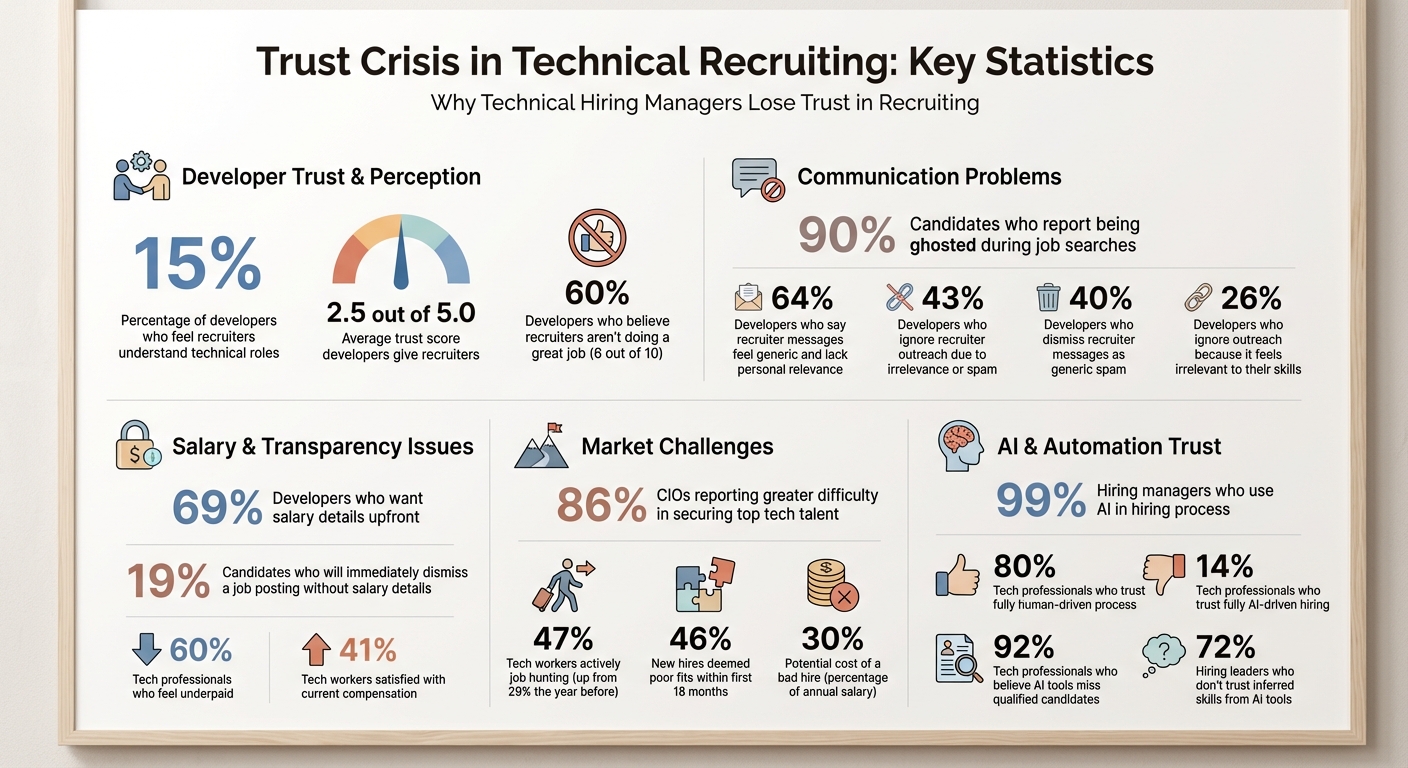
- Only 15% of developers feel recruiters understand technical roles.
- 43% of developers ignore recruiter outreach due to irrelevance or spam.
- 90% of candidates report being ghosted during job searches.
Solutions:
- Align early with hiring managers on role specifics, including tech stack, salary, and work model.
- Improve recruiter technical knowledge through training and collaboration with engineers.
- Use structured feedback systems and clear timelines to ensure transparency.
- Learn how to write developer job descriptions that are realistic that reflect market trends and fair compensation.
By addressing these gaps, recruiters can rebuild trust, improve hiring outcomes, and strengthen relationships with hiring managers and candidates alike.
Sending Underqualified or Mismatched Candidates
Sending candidates who don’t meet the job requirements can seriously damage trust. Imagine a hiring manager looking for a senior backend engineer with expertise in distributed systems but instead receiving junior-level candidates familiar only with monolithic applications. This mismatch signals that the recruiter doesn’t fully understand the role.
Data highlights this disconnect: 6 out of 10 developers believe recruiters aren’t doing a great job. And the consequences are costly - 46% of new hires are deemed poor fits within their first 18 months, with a single bad hire potentially costing up to 30% of that employee’s annual salary.
The main culprits? A lack of technical understanding and over-reliance on keywords. As Nathaniel Chapman, a STEM recruiter, explains:
"If your recruiter or interviewer doesn't grasp the difference between validation and verification, or between SCADA and PLC, they'll struggle to recognize excellence when they see it. AND THEY WILL WASTE YOUR TIME".
This keyword-driven approach often overlooks candidates with real-world experience that isn’t neatly reflected on their LinkedIn profiles. Platforms like GitHub, where hands-on contributions shine, are frequently ignored. To fix this, recruiters need to set clear benchmarks and improve their technical know-how.
Setting Clear Technical Benchmarks
The first step is establishing a strong foundation through kick-off meetings between recruiters and hiring managers. These meetings should clarify must-have skills versus nice-to-have qualifications, as well as identify essential certifications. Reviewing past successful hires can also help define what excellence looks like, from the technologies mastered to key projects delivered and soft skills demonstrated.
Involving technical experts early in the process is another game-changer. Recruiters who consult with engineers before posting a job gain the context needed to properly assess candidates. This collaboration ensures that recruiters can filter out unqualified candidates and focus on those who truly fit the role.
Closing Recruiter Knowledge Gaps
Of course, setting benchmarks is only half the battle. Recruiters also need the training to apply those benchmarks effectively. Companies that use the best developer assessment tools to standardize evaluations see 40% fewer hiring mistakes compared to those relying on unstructured methods. Training recruiters to use frameworks like STAR (Situation, Task, Action, Result) can help them objectively evaluate technical experience. Preparing specific behavioral questions for software engineers ensures these interviews remain structured and effective.
In addition, involving hiring managers in interviews for specialized roles and creating candidate personas based on traits of successful past hires can refine the process. Regularly auditing AI-driven screening tools is also crucial. 92% of tech professionals believe AI tools miss qualified candidates who don’t optimize their profiles for keywords, and 72% of hiring leaders don’t trust inferred skills from these tools. This makes human oversight indispensable when making final hiring decisions.
Poor Communication and Lack of Transparency
Silence in the hiring process can have a devastating impact. When recruiters fail to provide timely updates, it creates an unclear and frustrating experience - hiring managers are left in the dark about the interview progress, while candidates are left questioning if their applications were even seen. This lack of communication doesn’t just harm individual relationships; it also affects a company’s reputation. In fact, 75% of job seekers say they won’t apply to companies with negative interview reviews about the process.
Ghosting is another widespread issue. A staggering 90% of candidates report being ghosted during their job search. This isn’t just an annoyance - it’s driving people out of the industry. About 30% of tech professionals are considering leaving the field altogether, citing frustrations like poor transparency and a lack of feedback during hiring.
The problem goes beyond slow responses. Sixty-four percent of developers say recruiter messages feel generic and lack personal relevance. On top of that, 19% of candidates will ignore outreach entirely if salary details aren’t included in the first message. Even when communication happens, it often lacks critical details like the tech stack, compensation, or work model.
The solution? Using a developer hiring checklist to establish clear feedback systems to restore trust and improve the candidate experience.
Creating Communication Protocols
Setting clear timelines is essential. For example, candidates should receive feedback within three business days after an interview, and hiring managers should update recruiters within 48 hours of receiving candidate submissions. These simple steps help avoid the "black hole" effect that frustrates applicants and damages employer branding.
Accountability is also key. Implementing three-way feedback loops between candidates, recruiters, and hiring managers can make a big difference. Ian Alexander, Co-Founder of Survale, highlights this approach:
"Trust issues are no longer a problem [when] feedback-driven approach removes all doubt about what's going on and provides the data needed to make improvements through shared understanding".
Real-time surveys after each interview stage can pinpoint where communication is breaking down, helping all parties improve. Even when there’s no new update, sending a quick note to confirm ongoing consideration can ease candidate anxiety and keep them engaged.
Using Automation for Better Transparency
While standardized updates are a great start, automation can take transparency to the next level. Tools like automated scheduling systems can eliminate the hassle of back-and-forth messages to set up interviews, while notification systems can send candidates updates after important milestones. However, there’s a trust gap - while 99% of hiring managers use AI in the hiring process, only 14% of tech professionals trust a fully AI-driven approach.
The solution lies in blending automation with a human touch. AI can handle tasks like scheduling and initial screenings, but feedback and final interview decisions should always come from humans to maintain trust. Some companies are even using "match scoring" tools, which show candidates how well they align with the role and notify them once a human review has been completed.
Being upfront about AI usage is crucial. With 55% of candidates suspecting their applications are evaluated by AI without their knowledge, companies need to clearly communicate when AI is involved. Offering a secondary human review for automated decisions can further reassure candidates and build trust.
Unrealistic Job Descriptions and Expectations
Vague or overly ambitious job descriptions are another major trust killer in the hiring process. When recruiters post unrealistic "Frankenstein" roles - like asking a project manager to debug code or expecting a social media manager to handle technical SEO - it wastes everyone's time. Qualified candidates skip over these postings because they seem absurd, while hiring managers end up reviewing applicants who don’t meet their needs.
The data backs this up. Seventy-one percent of developers care most about the tech stack and role scope, and 69% want salary details upfront. Yet, many job postings either bury this information or leave it out entirely. Unsurprisingly, 19% of candidates will immediately dismiss a job posting that doesn’t include salary details. Vague or inflated descriptions not only attract the wrong candidates but also drive away the right ones.
Seniority mismatches add to the problem. For example, labeling a job "Junior" but requiring 2–3 years of experience across multiple systems, or offering junior-level pay for a "Senior" role, sends a clear message: the company is out of touch with market realities.
Clarifying Role Requirements
The solution starts with the basics. Every job description should clearly list the tech stack, salary range, and work model (remote, hybrid, or onsite) right at the top. These are the key details developers use to filter roles, and omitting them makes your posting less competitive.
Recruiters also need to challenge unrealistic requests from hiring managers. If a manager wants a "unicorn" who can juggle five specialized roles, it’s the recruiter’s job to push back and advocate for a more realistic job definition. Nimrod Kramer, CEO & Co-Founder of daily.dev, puts it bluntly:
"If your process feels like hazing, great people will self-select out. Not because they can't do it. Because they won't".
Another quick fix? Audit job descriptions for impossible requirements, like asking for 5 years of experience in a framework that’s only been around for 2 years. These kinds of errors undermine credibility and make your company look careless.
Aligning Compensation with Responsibilities
In today’s market, being transparent about pay isn’t just nice - it’s a competitive advantage. Nearly 60% of tech professionals feel underpaid, and only 41% are satisfied with their current compensation. This dissatisfaction is fueling change: 47% of tech workers are actively job hunting, up from 29% the year before.
When salary ranges don’t align with the responsibilities listed, trust takes a hit. For example, a "Senior Engineer" role that demands 7+ years of experience, expertise in multiple programming languages, and leadership skills shouldn’t come with mid-level pay. Companies need to ensure their compensation reflects current market trends using a tech hiring budget calculator and matches the scope of the role.
Being upfront about salary and ensuring it aligns with the job’s demands builds trust and credibility. Candidates appreciate transparency and are more likely to apply when they know the role offers fair pay. This approach not only attracts serious applicants but also helps maintain trust throughout the hiring process.
Lack of Accountability and Feedback Mechanisms
When feedback is missing, trust takes a hit. Developers rate their trust in recruiters at a concerning 2.5 out of 5. Without structured feedback systems, both recruiters and hiring managers are left guessing about what’s working and what’s not. Stephanie Sands from Deeper Signals puts it bluntly:
"When feedback is withheld, the same opinions still exist, but you are left guessing about what others think".
This lack of communication creates a divide. Hiring managers may feel recruiters don't grasp the urgency or the nuances of the role, while recruiters often perceive hiring managers as undermining the process. Without a clear system for feedback, these frustrations linger, eroding relationships and dragging out hiring timelines. Stacy Pursell of The VET Recruiter sums it up perfectly:
"Time kills all deals".
Further complicating matters, the absence of feedback leaves recruiters struggling to bridge knowledge gaps. Without clarity on the tech stack or role specifics, they can’t effectively attract or sell the position to senior talent.
To fix this, a structured approach to feedback is essential.
Building Feedback-Driven Processes
The first step is creating a system for regular post-interview assessments. Scheduling debriefs between recruiters and hiring managers ensures recurring challenges - whether related to candidate quality, interview questions, or timeline mismatches - are addressed head-on.
One effective method is the AID Model, which focuses on three key areas: Action (what happened), Impact (how it affected the process), and Desired behavior (what needs to change). For instance:
"You were 15 minutes late, which reduced our technical questioning time. Arrive on time to ensure proper evaluation".
This feedback style keeps the conversation specific and actionable.
Another useful tool is a feedback dashboard. By collecting anonymous input from candidates, these dashboards promote transparency and hold everyone accountable to shared standards. Talent feedback platforms can also link candidate and manager feedback directly to specific roles, addressing critical process flaws automatically.
It’s worth noting that repairing trust isn’t instant. Research suggests it takes three positive interactions to offset one negative comment, so feedback must be constructive without damaging relationships.
While structured feedback sharpens qualitative insights, data-driven accountability ensures these improvements stick.
Using Data to Drive Accountability
To make progress measurable, recruiters and hiring managers need to track metrics that matter. Often, recruiters focus on speed and volume, while hiring managers care more about quality and retention. Aligning on shared metrics helps bridge this divide.
| Metric | Tracked By | Impact on Trust |
|---|---|---|
| Quality of Hire | 42% of teams | High: Demonstrates recruiter effectiveness to hiring managers |
| Time-to-Hire | Increased for 69% of firms | Medium: Balances speed and quality |
| Offer Acceptance Rate | 39% of teams | High: Reflects alignment with market expectations |
| Candidate Feedback | 27% of teams | Critical: Identifies process gaps and ghosting issues |
These numbers connect recruitment efforts to tangible outcomes, building trust through transparency.
Another key area to monitor is whether recruiters include "The Big Three" - tech stack, salary range, and work model - in their outreach. Many developers ignore recruiter messages because they feel generic (40%) or irrelevant to their skills (26%). Adding clarity helps identify where outreach efforts fall short.
Setting clear timelines is equally important. If the hiring process will take more than six weeks, communicate that upfront. This not only manages expectations but also showcases professionalism. Nimrod Kramer, CEO of daily.dev, puts it best:
"Silence is the fastest way to turn a neutral candidate into a detractor. Even a two-line 'no and why' beats the black hole".
Finally, standardize candidate evaluations to focus on proven skills rather than pedigree. This reduces bias and ensures consistent quality in hiring. When recruiters and hiring managers share the same data and agree on success metrics, accountability becomes a natural part of the process.
Limited Understanding of Technical Roles and Market Trends
A shaky grasp of technical roles often compounds the challenges of communication and candidate quality, further undermining trust between recruiters and candidates.
For instance, when recruiters confuse Java with JavaScript, they lose credibility instantly. Developers find it frustrating when recruiters fail to distinguish between a full-stack developer and a back-end specialist or misrepresent the specifics of a technology stack. These missteps lead to mismatched candidates and unrealistic expectations, disrupting the hiring process. It's no surprise that 86% of CIOs report facing greater difficulty in securing top tech talent.
Adding to the issue, recruiters sometimes overlook key market realities. For example, 70% of developers are at least partially self-taught, meaning a traditional computer science degree isn't always the best indicator of skill. Additionally, 60% of tech professionals feel they're underpaid compared to their peers. Without understanding these dynamics, recruiters struggle to guide hiring managers toward realistic job descriptions and competitive compensation packages.
Improving Recruiter Technical Knowledge
Bridging the technical knowledge gap is essential to rebuild trust and improve hiring outcomes.
Recruiters don’t need to become developers, but they should take time to understand the basics of the tech stack before reaching out to candidates. This includes learning the distinctions between similar tools and knowing what titles like "Senior" or "Lead" actually mean for a given role. Misunderstandings here can derail the hiring process before it even begins.
Regular check-ins with hiring managers can also make a big difference. Ask targeted questions: What skills are non-negotiable, and which are just nice-to-have? What does the tech stack look like in action? What kinds of tasks will the candidate handle day-to-day? These conversations help turn vague job descriptions into clear, actionable requirements.
Recruiters should also shift their focus from traditional credentials to tangible proof of skill. Instead of relying solely on degrees, evaluate GitHub portfolios, personal projects, or open-source contributions. This approach is particularly important given that 64% of developers feel platforms like LinkedIn don’t adequately showcase their potential. Highlighting recent coding activity offers a more accurate view of a candidate's abilities.
Finally, be transparent in your initial outreach. Include key details like the tech stack, salary range, and work model. With 69% of developers expecting salary information in the first message and 19% ignoring outreach without it, this transparency reduces the generic spam that causes 40% of developers to dismiss recruiter messages entirely.
Providing Data-Backed Market Insights
Combining technical knowledge with current market data can help recruiters set realistic expectations and build trust with hiring managers.
Sharing market data adds credibility to your recommendations. For example, the reducing the time to fill tech roles reached 47.5 days in 2023, and the average tech salary in the U.S. stands at $111,193 - rising to $141,618 in Silicon Valley. When faced with unrealistic job requirements, like a hiring manager expecting a social media manager to write code, use this data to recalibrate expectations.
This consultative approach shifts the recruiter’s role from simply filling positions to becoming a trusted advisor. By presenting insights on salary benchmarks, candidate availability, and competitive offers, recruiters can help hiring managers navigate a challenging market. With 47% of tech professionals expected to look for new opportunities in 2025, competition for talent is only increasing. Developers often ignore outreach that feels irrelevant (26% cite this as a major reason) or lacks transparency, so staying informed and providing clear, data-driven insights is critical to breaking the cycle of overpromising and underdelivering.
Building Trust Through Collaborative Frameworks
Rebuilding trust doesn’t happen overnight. It takes intentional collaboration, where both recruiters and hiring managers commit to shared standards, transparent processes, and mutual accountability. Without a solid framework in place, even the best intentions can fall flat.
The first step is alignment. Before reaching out to candidates, recruiters and hiring managers must agree on the “Big Three”: the tech stack, salary range, and work model (remote or hybrid) . These aren’t details to figure out later - they’re the baseline information candidates expect right from the start. For instance, 69% of developers want salary details upfront, and 19% will ignore outreach that doesn’t include it . Skipping this step risks starting off on the wrong foot, creating unnecessary friction and mistrust.
Creating Mutual Agreements
A formal intake meeting sets the tone for a successful partnership. During this meeting, recruiters and hiring managers dive into the specifics: distinguishing between “must-have” qualifications (like certifications or specific technologies) and flexible ones (such as years of experience). They also clarify the budgeted salary range and project deadlines that will guide the hiring timeline .
Another key element is establishing a feedback recap process. After each candidate review, recruiters should summarize the hiring manager’s feedback and share it with the team. This ensures decisions are documented and helps prevent mismatches down the line .
It’s equally important to define a candidate experience standard. This agreement should outline clear expectations for feedback timelines and interview formats upfront . When 80% of tech professionals trust a fully human-driven hiring process compared to only 46% who trust AI-human hybrids , having transparent and consistent standards builds trust from the start.
These agreements provide the foundation for a smoother process, one that can be further streamlined with the right tools.
Using Tools to Reduce Administrative Work
Administrative delays can erode trust. If hiring managers wait days to access candidate profiles or recruiters spend hours manually scheduling interviews, frustration builds on both sides.
Once mutual agreements are in place, the next step is to streamline workflows with technology. Applicant Tracking Systems (ATS) equipped with integrated portals can make a big difference. These systems enable recruiters to share candidate shortlists, while hiring managers can leave comments and flag their favorites in real time. Video interview platforms also simplify collaboration, allowing recruiters to send secure links for candidate responses that hiring managers can review without needing to navigate complex systems. Automation tools can handle tasks like scheduling interviews and sending follow-up emails, freeing up time for recruiters and managers to focus on more strategic decisions.
However, it’s crucial to strike the right balance between automation and the human touch. Amy Spurling, CEO of Compt, explains:
“AI tools should enhance human connection, not replace it. Use automation for administrative tasks like scheduling and initial resume screening, but keep all candidate communication personal and authentic.”
Tech professionals are often skeptical of overly automated processes, so keeping interactions personal is essential.
Maintaining Open Communication
Once the groundwork is laid, maintaining open communication ensures the process stays on track. Trust thrives on transparency, and both recruiters and hiring managers need to feel comfortable addressing challenges openly.
For example, if a hiring manager presents an unrealistic job description - such as expecting a social media manager to handle technical SEO - recruiters should step in with market data to recalibrate expectations . Sharing insights like salary benchmarks, candidate availability, and competitive offer trends can help set realistic timelines. With 47% of tech professionals expected to explore new opportunities in 2025 and 86% of CIOs reporting increased difficulty in attracting top talent , these discussions are more important than ever.
Timely feedback is another critical component. Establish a protocol where hiring managers provide interview feedback within 24 to 48 hours . Considering the average trust score for recruiters among developers is only 2.5 out of 5.0, and 6 out of 10 developers believe recruiters aren’t doing a good job , delays or communication breakdowns only deepen this perception.
Finally, schedule regular calibration meetings to adjust role requirements based on real-time feedback from the market . If the initial pool of candidates reveals that the salary range is too low or the tech stack requirements are overly restrictive, make changes immediately. This iterative approach shows hiring managers that you’re not just sending resumes blindly - you’re actively responding to market realities with data-driven adjustments.
Conclusion
Trust between recruiters and technical hiring managers can quickly erode when key missteps are repeated. Sending candidates who don’t match the role, withholding crucial details like salary ranges, and over-relying on automation all take a toll on credibility. The data paints a stark picture: only 15% of developers believe recruiters truly understand the technical roles they’re pitching , and the average trust score sits at a low 2.5 out of 5 .
To rebuild this trust, recruiters need to take deliberate action. First, they should align with hiring managers early on, setting realistic expectations grounded in market data. This involves pushing back on overly ambitious candidate profiles that don’t reflect the current hiring landscape. Transparency is also non-negotiable - every initial outreach should include the "Big Three": the tech stack, salary range, and work model . Beyond that, recruiters must deepen their understanding of technical roles, moving past surface-level buzzwords to truly grasp what developers do and what they value.
The hiring landscape is competitive, with 86% of CIOs reporting greater challenges in attracting top talent . To succeed, recruiters need to shift from high-volume approaches to building trust through meaningful, personalized engagement. This means treating hiring managers as partners and approaching candidates with honesty and relevance.
As Nimrod Kramer, CEO & Co-Founder of daily.dev, wisely states:
"You won't scare off good talent with honesty; you'll earn it" .
Consistency, transparency, and a genuine effort to understand technical needs and candidate strengths are the cornerstones of trust. When recruiters and hiring managers align on realistic goals and foster open communication, every successful hire strengthens not just the team but the company’s long-term potential.
FAQs
How can recruiters better understand technical roles to find the right candidates?
Recruiters aiming to excel in technical hiring should start by grasping the basics of key tech concepts and roles. For instance, knowing the distinctions between front-end, back-end, and full-stack development - as well as specialized fields like cloud computing, DevOps, and cybersecurity - can make a huge difference when evaluating candidates.
It's also essential to get acquainted with widely used tools and technologies, such as GitHub, AWS, and CI/CD pipelines. Keeping up with industry trends and consistently expanding technical knowledge not only enhances communication with hiring managers and candidates but also improves the overall hiring process. With this understanding, recruiters can craft clearer job descriptions, assess candidates more effectively, and build stronger trust with everyone involved.
How can recruiters and hiring managers improve communication to build trust?
Effective communication between recruiters and hiring managers plays a critical role in building trust and ensuring successful hires. The first step? Align expectations from the start. Have clear, upfront discussions about the role, the ideal candidate's qualifications, and timelines. This helps prevent misunderstandings or last-minute surprises.
Throughout the hiring process, maintain open and consistent communication. Regularly share updates on progress, exchange feedback on candidates, and clarify evaluations. This keeps everyone informed and working toward the same goal. Additionally, take time to agree on key technical requirements and priorities early on. Discussing essential skills and the desired traits for team compatibility ensures both sides are on the same page.
When recruiters and hiring managers commit to clear communication, regular updates, and mutual understanding, they create a partnership built on trust and collaboration.
How can recruiters create job descriptions that attract qualified candidates and set realistic expectations?
When writing job descriptions, clarity and precision are key. Stick to realistic language and avoid buzzwords like "rockstar" or "ninja", which can come across as unprofessional and may deter serious candidates. Instead, emphasize specific responsibilities, essential skills, and practical qualifications. This approach allows potential applicants to evaluate whether their experience aligns with the role.
A helpful guideline is the 80/20 rule: candidates who meet about 80% of the listed qualifications are often excellent prospects. Additionally, include details about growth opportunities, the workplace environment, and your company culture. This provides candidates with a well-rounded understanding of what the role entails. Thoughtfully written job descriptions not only attract the right talent but also build trust and set the stage for successful hiring.
.png)