AI talent matching systems are transforming how companies recruit, especially for technical roles. These tools use machine learning, natural language processing (NLP), and predictive analytics to analyze resumes, job descriptions, and hiring patterns. They go beyond basic keyword searches, identifying skills and potential that traditional methods often miss. Here's what you need to know:
- Core Technologies: Machine learning predicts candidate success; NLP extracts implied skills from resumes and job descriptions; and agentic AI automates tasks like screening and scheduling.
- Developer Hiring: These systems analyze GitHub contributions, career trajectories, and skill recency to identify top talent, including active vs passive developer recruitment strategies.
- Key Benefits: AI reduces manual sourcing time by 38%, improves retention by 18%, and enables faster hiring processes. It can also uncover hidden talent by revisiting past applicants.
- Challenges: Risks include algorithmic bias, data dependency, transparency issues, and over-reliance on automation. Regular audits and human oversight are essential.
AI systems work best when paired with human expertise. Recruiters should use these tools to streamline workflows while focusing on relationship-building and ethical hiring practices.
::: @figure 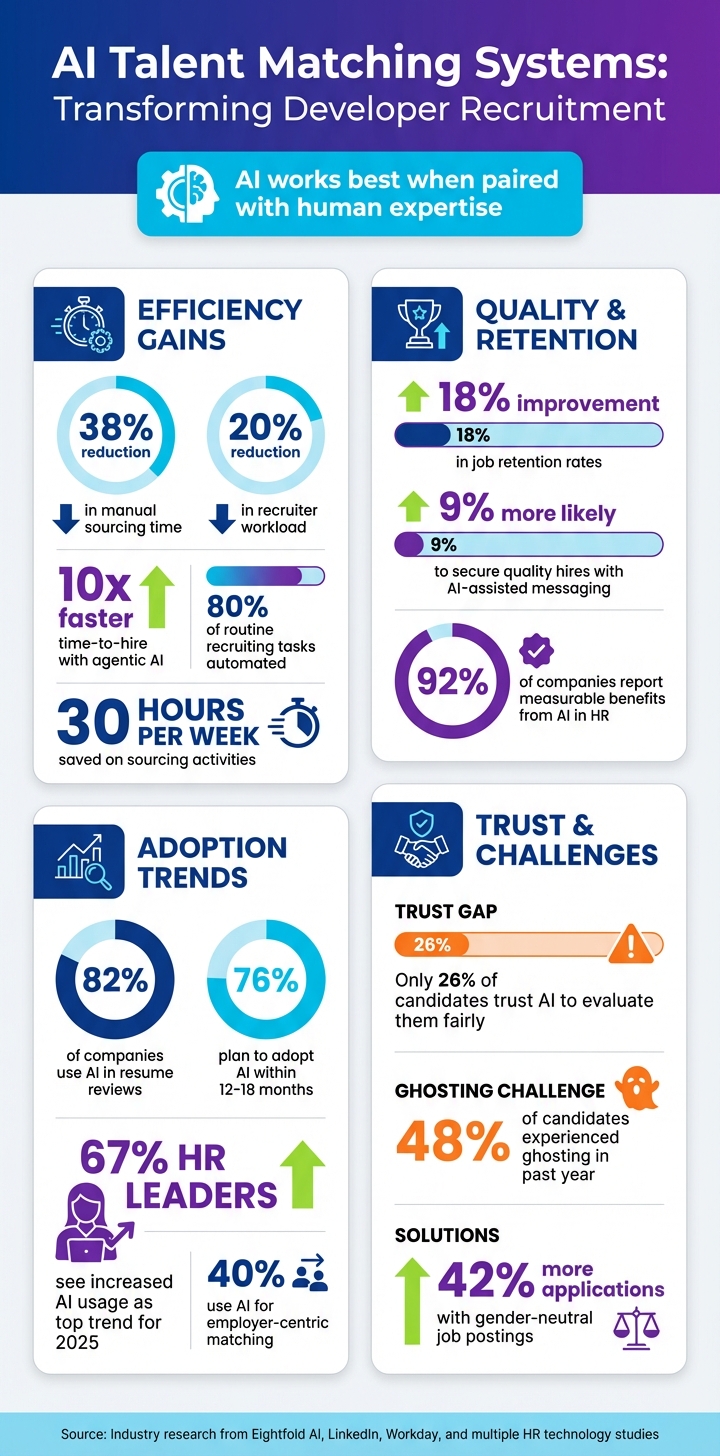 {AI Talent Matching Systems: Key Statistics and Impact Metrics}
How AI Talent Matching Systems Work
Core Processes and Technologies
AI talent matching systems take raw data and turn it into actionable insights by breaking down job requirements, analyzing candidate profiles, ranking matches, and learning from recruiter feedback. These systems rely on natural language processing (NLP) to dissect job descriptions into structured skill requirements, capturing the nuanced demands of each role . On the candidate side, they parse resumes and online contributions - like GitHub activity or professional network profiles - to standardize and organize relevant information .
Once the data is processed, machine learning algorithms step in to rank candidates. These algorithms study historical hiring data to identify patterns tied to successful hires, assigning scores to candidates based on those insights . The system doesn’t stop there - it continuously refines its recommendations by learning from recruiter decisions, ensuring the model adapts over time .
The tech stack behind these systems includes skills ontologies, generative AI for creating candidate summaries and outreach materials, and predictive analytics to forecast hiring outcomes . The impact of AI in HR is already evident: 92% of companies using AI tools report measurable benefits, and manual sourcing time has been cut by 38% .
"AI recruiting works best when it augments human expertise rather than replaces it. If you pair ethical, transparent AI tools with an empathetic, data-literate recruiting team, you will build stronger, fairer, and more resilient talent strategies."
Matching Developers: A Technical Breakdown
Finding the right developer goes beyond traditional hiring methods, requiring AI systems to dive deep into technical expertise. For instance, these systems analyze code repositories like GitHub to verify a developer’s skills, such as proficiency in specific programming languages, frameworks, or architectural patterns . This objective analysis ensures technical claims are backed by real contributions.
Recurrent neural networks (RNNs) add another layer by modeling career trajectories. These models can predict a developer’s next likely role, identifying candidates with high potential - even if they don’t yet have the job title recruiters are targeting . The system also evaluates the recency of skills, differentiating between candidates who last used a technology years ago versus those actively working with it today .
While AI can provide preliminary insights into team and cultural fit, final assessments in these areas still rely heavily on human judgment . However, AI does excel at uncovering "hidden talent." For example, it might identify that a developer experienced in microservices architecture has the foundational knowledge needed for cloud-native roles, even if their resume doesn’t explicitly mention it .
These systems need initial production data to learn an organization’s hiring patterns effectively . Once operational, agentic AI can automate up to 80% of routine recruiting tasks, allowing recruiters to focus on building relationships with top-tier candidates .
Key Features of AI Talent Matching Systems
Automated Screening and Ranking
AI has transformed the way candidates are evaluated by automating screening and ranking processes. Instead of relying on basic keyword searches, these systems analyze the intent behind job descriptions, uncovering implied skills and success factors - even when the job listing is vague . On the candidate side, AI digs deeper, identifying growth trends, leadership potential, and domain expertise, rather than just matching job titles .
The results are impressive: 82% of companies now use AI in resume reviews, with those adopting AI-driven sourcing tools reporting a 38% reduction in manual sourcing time . For recruiters who used to spend up to 30 hours a week on sourcing, this means more time to focus on building relationships and tackling strategic goals . Tools like Agentic AI further simplify workflows.
Another standout feature is intelligent talent rediscovery. AI can scan existing applicant tracking systems to identify "silver-medal" candidates - those who may have been runners-up for past roles but are now ideal for new opportunities . This turns old databases into active talent pipelines, giving recruiters a powerful edge.
Integration with Developer Networks
Top-tier AI talent matching systems don’t just sift through external databases - they integrate directly with professional developer networks, where candidates are already active and engaged. This approach moves recruitment away from cold outreach toward a more relationship-driven model, with warm, opt-in introductions . These integrations pull detailed technical data - like GitHub contributions and project work - to verify skills .
Take daily.dev Recruiter as an example. This platform connects employers with passive, pre-qualified developers through a vibrant professional community. Unlike traditional systems that rely on static profiles, daily.dev Recruiter engages developers where they already spend their time - reading, learning, and interacting with technical content. Every introduction is warm, double opt-in, and highly contextual, ensuring developers feel respected and recruiters connect only with those genuinely interested. This shifts recruitment from impersonal outreach to a trust-based matchmaking process.
These integrations also support contextual evaluations, allowing companies to assess a developer’s real-world contributions and community standing instead of relying solely on keyword matches . It’s no surprise that 40% of companies now use AI for "employer-centric matching", proactively engaging talent through these integrated networks . This approach provides deeper insights, paving the way for more accurate predictions of candidate potential.
Predictive Success Analytics
AI doesn’t stop at screening - it goes a step further with predictive analytics to forecast candidate success. By analyzing patterns among top-performing employees, machine learning models identify shared traits - skills, career paths, growth trends, and behavioral patterns - to recommend candidates with similar potential . This shifts the focus from past experience to future adaptability and learning capacity, pinpointing individuals ready for emerging technologies .
AI assigns dynamic fit scores by comparing candidate data to successful hires in similar roles. These scores evaluate not just technical expertise but also how well a candidate aligns with company culture and their likelihood of staying long-term . This reduces costly turnover, with AI-driven processes boosting retention by up to 18% .
| Feature | Traditional Ranking | Predictive AI Ranking |
|---|---|---|
| Primary Data Source | Keywords and Job Titles | Skills, Patterns, and Growth Trends |
| Decision Basis | Subjective Intuition | Data-Driven Profiles |
| Focus | Past Experience | Future Potential and Fit |
| Speed | Manual and Time-Consuming | Automated and Instant |
| Outcome | Higher Risk of Mismatch | Better Retention and Quality Hires |
Predictive systems also analyze engagement signals - such as email responses, application activity, and platform interactions - to gauge a candidate’s likelihood of accepting an offer . This helps recruiters prioritize candidates who are truly interested, not just browsing casually. As Maria Valero from Workday explains, "Sixty-seven percent of HR leaders see increased AI usage as a top talent acquisition trend for 2025" .
Benefits and Challenges of AI Talent Matching Systems
Advantages of AI Talent Matching
AI talent matching systems are reshaping the hiring landscape, delivering faster and more efficient outcomes. For instance, generative AI can reduce recruiter workloads by 20% , while agentic AI has been shown to slash time-to-hire by up to 10x . This means recruiters can focus more on relationship-building and strategic efforts, rather than being bogged down by administrative tasks.
The numbers speak for themselves: companies using AI-assisted messaging are 9% more likely to secure quality hires , and AI-driven interviewers have been linked to an 18% increase in job retention rates . Another major advantage? These systems help reduce bias by zeroing in on objective skills data . Even something as simple as auditing job postings for gender-neutral language can lead to 42% more applications .
"AI is enabling recruiting teams to be more human, not less... it also allows them to be more strategic, focusing on high-impact efforts like improving quality of hire."
- Greg Lewis, Data-Driven Content Strategist, LinkedIn
The adoption of AI in HR is gaining traction, with 67% of HR leaders identifying increased AI usage as a key talent acquisition trend for 2025 . By moving away from traditional job boards to more proactive approaches, recruiters can tap into passive talent pools, uncovering exceptional candidates through insights into their professional journeys and contributions .
Yet, as promising as these advancements are, tech recruiting in the age of AI comes with challenges that require thoughtful oversight.
Challenges and Considerations
While AI has the potential to revolutionize recruitment, it’s not without its pitfalls. Some of the key risks include bias, data limitations, and over-reliance on automation:
- Algorithmic Bias: AI systems trained on historical data can unintentionally replicate and amplify past hiring biases, such as favoring certain genders or backgrounds . Unsurprisingly, many Americans remain skeptical about AI making final hiring decisions or being solely responsible for reviewing applications .
- Data Dependency: Tools like Oracle AI Apps need at least six months of clean, high-quality production data to provide reliable recommendations . Companies with fragmented applicant tracking systems (ATS) often struggle to meet these data requirements .
- Transparency Issues: The "black box" nature of AI - where neither recruiters nor candidates fully understand how decisions are made - can erode trust and raise regulatory red flags .
- Hallucinations: Generative AI has been known to produce plausible yet incorrect candidate summaries, potentially misleading hiring teams .
- Digital Exclusion: Candidates without reliable internet access or those whose communication styles don’t align with AI training data may face disadvantages .
- Over-Automation: Leaning too heavily on automation risks losing the human touch, which is critical for evaluating team dynamics and cultural fit .
| Challenge | Impact | Mitigation Strategy |
|---|---|---|
| Algorithmic Bias | Reinforces existing hiring prejudices | Conduct regular bias audits; use anonymized data |
| Data Dependency | Requires extensive, clean data | Consolidate ATS systems; prioritize data hygiene |
| Transparency | Undermines trust in decision-making | Adopt explainable AI (XAI) for visible reasoning |
| Hallucinations | Produces inaccurate candidate information | Use human-in-the-loop reviews |
| Digital Exclusion | Disadvantages under-connected candidates | Offer manual review options; improve accessibility |
The key isn’t to abandon AI but to strike a balance between automation and human oversight. Implementing human-in-the-loop systems ensures that experts review and, when necessary, override AI-driven decisions before finalizing hires . Forming AI ethics committees with representatives from HR, legal, and tech teams can also provide ongoing monitoring, ensuring that the technology aligns with the company’s values and avoids unintended consequences .
"AI is not a cure-all. Used improperly, it can bring risks including bias amplification, lack of transparency, and regulatory challenges."
- Eightfold AI
Best Practices for Implementing AI Talent Matching Systems
Steps for Successful Implementation
To get the most out of AI talent matching systems, it's essential to follow a structured approach. Start by analyzing your current workflows to identify areas where AI can make an immediate impact. Tasks like AI resume parsing or refreshing search queries are perfect candidates for automation . Before diving into implementation, ensure your data is in top shape - clean, consolidated, and connected across systems like your ATS and CRM. Following a data-driven recruitment checklist can help ensure your infrastructure is ready. AI thrives on well-organized data to spot patterns and predict candidate success .
Once your data is ready, focus on configuring the system to go beyond simple keyword matching. Modern AI can interpret natural language inputs, such as notes from intake calls or voice recordings, to better understand technical requirements . Tools like daily.dev Recruiter excel here, offering warm, double opt-in introductions through an active professional network.
To ensure accountability, establish an AI Ethics Committee with members from HR, legal, and tech teams. This group will oversee implementation and ensure the system stays aligned with ethical guidelines . Recruiters should use AI as an assistant, not a replacement - reviewing its recommendations while prioritizing human connections .
| Implementation Phase | Key Action | Objective |
|---|---|---|
| Assessment | Map current sourcing workflows | Pinpoint inefficiencies and manual bottlenecks . |
| Data Setup | Standardize skills taxonomy | Provide AI with clean, structured data . |
| Pilot | Integrate AI in specific workflows | Test its impact on tasks like ranking or outreach . |
| Governance | Form an Ethics Committee | Ensure compliance, transparency, and bias monitoring . |
| Optimization | Measure time-to-fill and quality | Fine-tune algorithms based on hiring outcomes . |
Keep improving the system by incorporating feedback loops. For example, let the AI learn from every candidate's acceptance or rejection to improve matching accuracy . Conduct quarterly bias audits using randomized resume reviews to ensure fairness in candidate evaluation . With 76% of companies planning to adopt AI in the next 12–18 months , getting started now with a thoughtful and ethical approach can give you a competitive edge.
Once your AI system is up and running, the next step is to focus on building trust through personalized, warm interactions.
Building Trust Through Warm Introductions
A well-implemented AI system should pave the way for warm introductions - an essential part of creating trust in the hiring process. Trust isn’t something you can force; it’s built through transparency and respectful practices. With only 26% of candidates currently trusting AI to evaluate them fairly , how you approach candidates makes all the difference. Shift from impersonal cold emails to meaningful, high-context introductions where both parties have opted in.
daily.dev Recruiter stands out by connecting employers with developers in spaces where they’re already active - engaging with content, learning, and networking. Every introduction is double opt-in, ensuring developers don’t feel spammed and recruiters connect only with genuinely interested candidates. This approach transforms recruiting from a volume-driven process into one built on credibility and intent.
Be upfront about how AI is used. Use plain, transparent language like: "We use AI to help prioritize applications, but every decision is reviewed by a recruiter" . Set clear communication expectations to avoid the "ghosting" that 48% of candidates have experienced in the past year . Even candidates who don’t move forward should receive feedback, whether it’s a summary of their assessment or notes from the interview process .
"AI should make the process faster and friendlier, never colder."
Conclusion
Blending the scalability of AI with the nuanced judgment of human recruiters is transforming the way organizations hire developers. AI-powered talent matching systems are streamlining recruitment by automating up to 80% of repetitive tasks like screening and sourcing skilled developers, giving recruiters more time to focus on relationship-building and strategic decision-making . Companies leveraging these systems have reported a 20% reduction in workload - equivalent to saving an entire workday each week - and a hiring process that's up to 10 times faster . With 76% of organizations planning to adopt AI within the next 12–18 months, the focus has shifted from whether to implement these technologies to how to do it effectively .
The real magic happens when automation is paired with human expertise. While AI excels at identifying patterns and reaching passive candidates, it can't replicate the empathy and nuanced decision-making that recruiters bring to the table . As Miranda Enzor from Eightfold AI explains:
"AI isn't replacing you - it's redefining your value. By combining the analytical and operational power of AI with the empathy and strategic thinking of people, you can move from tactical executors to trusted business partners" .
A great example of this synergy is daily.dev Recruiter, which uses AI to connect with active developers on platforms they already trust. Each introduction is designed to be meaningful, using a double opt-in approach to ensure relevance and context.
For success, it's crucial to prioritize clean data, transparent workflows, and ongoing refinement. Regular bias audits and human oversight are essential . Equip your team to treat AI insights as complementary tools, not replacements, for strategic decision-making. With 92% of companies already experiencing measurable benefits from AI in HR, the potential to stay ahead of the curve is undeniable .
The future of recruiting lies in combining AI's efficiency with human insight. By starting with a pilot program, measuring outcomes, and scaling successful strategies, you can not only access the developers you need but also revolutionize your hiring process. Together, AI and human expertise can create hiring practices that are faster, fairer, and more effective.
FAQs
How do AI talent matching systems reduce bias in hiring?
AI talent matching systems aim to reduce bias by using a mix of data auditing, transparent algorithms, and human oversight. The process begins with carefully reviewing and cleaning training data to remove patterns that might lead to discrimination based on factors like gender or race. This step ensures the AI doesn't pick up or replicate unfair behaviors.
These systems also incorporate explainability tools, which help recruiters see why candidates are ranked in specific ways. When unexpected biases emerge, recruiters can provide feedback, enabling the system to adjust and refine its processes over time. Consistent monitoring and updates are essential to maintaining fairness while still benefiting from AI's efficiency in recruitment.
By focusing on fairness and clarity, AI talent matching platforms strive to make hiring more equitable without sacrificing performance.
What are the main advantages of using AI for hiring developers?
AI is reshaping the way companies recruit developers by simplifying the process and delivering more precise results. It evaluates job requirements alongside developer profiles, matching candidates based on their skills, experience, and compatibility with the team environment. Unlike traditional keyword-based searches, this method dives deeper, which is especially valuable in the highly competitive tech hiring landscape where speed and accuracy are critical.
Here’s how AI is making an impact:
- Faster hiring: By automating parts of the recruitment process, AI slashes the time needed to identify and connect with top developers, allowing companies to fill positions quickly without compromising on quality.
- Improved matches: AI considers a range of factors to recommend developers whose expertise and background align perfectly with the role. This leads to better project results and higher employee retention.
- Reduced bias: By relying on objective data, AI minimizes unconscious bias, helping companies assemble teams that are both skilled and diverse.
Platforms like daily.dev Recruiter enhance this process further. They connect employers with pre-screened developers through personalized, context-rich introductions, ensuring a hiring experience that’s efficient and built on trust.
How do AI talent matching systems improve candidate engagement?
AI-powered talent matching systems are transforming the hiring process by making it more personalized and engaging. With advanced machine learning at their core, these systems dive deep into a candidate's skills, past projects, and activity on professional networks. The result? Outreach messages that feel genuine and highly relevant to the individual. This tailored approach helps build stronger connections and boosts response rates.
Beyond personalized outreach, AI keeps candidates in the loop with instant feedback, compatibility scores, and real-time updates on their application status. No more endless waiting in the dark - this transparency makes the entire process smoother and more interactive. Tools like daily.dev Recruiter take it a step further by pairing developers with roles that match their expertise and interests, enabling connections that are meaningful, trust-based, and refreshingly unobtrusive.
.png)