Recruiters and developers are struggling to connect in 2025. Why? A lack of trust. Developers are tired of ghosting, fake job postings, and irrelevant outreach.
Here’s the problem in numbers:
- 61% of candidates report being ghosted after interviews.
- 40% of hiring managers admit to posting fake job listings.
- 77% of developers say technical assessments don’t match actual job skills.
Developers want recruiters who communicate clearly, respect their time, and understand their career goals. Trust is the missing piece - and without it, even great job offers fall flat.
Key takeaways for recruiters:
- Be transparent about salaries, job details, and timelines.
- Focus on personal, relevant outreach instead of generic messages.
- Close the loop with feedback - even if it’s a rejection.
Platforms like daily.dev Recruiter are reshaping how recruiters and developers connect by prioritizing consent, relevance, and respect. It’s time to replace outdated tactics with a trust-first approach.
::: @figure 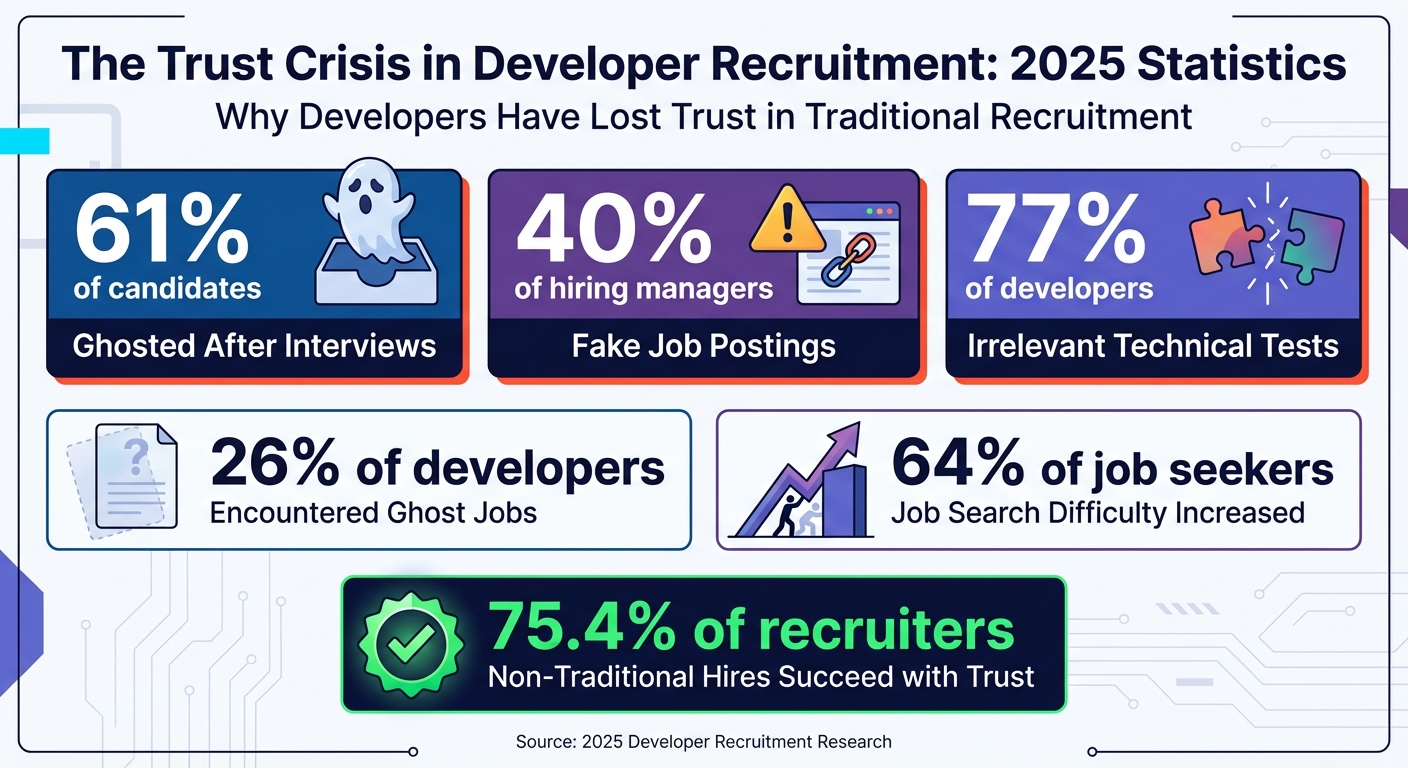 {Developer Recruitment Trust Crisis: Key Statistics 2025}
Why Trust Matters to Developers in Recruitment
How Developers View the Recruitment Process
Recruitment can be a frustrating experience for developers, often feeling disconnected from the actual work they’ll be doing. A striking 77% of developers believe technical assessments fail to reflect the skills needed for the job. Instead of tackling practical challenges with relevant tools, they’re handed abstract puzzles that have little to do with real-world tasks.
Adding to the frustration, 26% of developers report encountering ghost jobs, while 40% of hiring managers admit to posting fake listings. This lack of transparency understandably makes developers approach new opportunities with skepticism.
Poorly targeted outreach only deepens the divide. For instance, when a recruiter contacts a Java engineer about a .NET position, it signals a lack of understanding and attention to detail. Developers see this as a warning sign and often disengage. What some recruiters might consider casting a wide net is often perceived by developers as spam. These missteps underscore why trust is so essential in the hiring process.
Trust as the Foundation for Long-Term Talent Relationships
Given this skepticism, trust becomes the key to meaningful recruitment. When developers trust a recruiter, they’re more likely to accept job offers and less likely to be tempted by counter-offers from their current employers. Instead of viewing outreach as an annoyance, they begin to see it as a genuine opportunity.
Building trust transforms recruitment from a one-off transaction into a long-term relationship. Positive experiences can turn developers into advocates, creating a steady pipeline of talent. When trust is present, developers are more open to conversations that align with their technical interests, which can also streamline the hiring process.
For example, 75.4% of technical recruiters and hiring managers have successfully hired candidates who lacked a strong resume or traditional educational background. These are the kinds of hires that become possible when trust allows recruiters to look beyond surface-level credentials.
"Trust is the only edge that lasts." - Nimrod Kramer, CEO & Co-Founder, daily.dev
Without trust, even the most appealing job opportunities can fall flat. But with trust, recruitment evolves into a true partnership where both parties benefit. Addressing these trust challenges lays the groundwork for stronger, more productive relationships between developers and recruiters.
What Developers Look for in Recruiters They Can Trust
Clear Communication About Jobs and Compensation
Developers want the full picture when it comes to job opportunities. That means sharing everything upfront - salary ranges, the tech stack they'll be working with, and honest expectations about the role. If any of this is missing, especially compensation details, it can feel like the recruiter is holding back, which quickly erodes trust.
The same goes for technical specifics. If the job involves maintaining legacy code or working with older frameworks, it’s better to be upfront about it. As Nimrod Kramer, CEO & Co-Founder of daily.dev, puts it:
"You won't scare off good talent with honesty; you'll earn it."
Transparency extends to the interview process too. Developers appreciate interview tasks that mirror the actual challenges they'd face on the job. Some companies are even offering paid take-home assignments or live pairing sessions using their real tech stack . These methods not only respect a developer’s time but also provide a valuable preview of how the team operates.
When recruiters communicate clearly, they lay the groundwork for meaningful, personalized conversations.
Understanding Individual Career Goals
Building trust goes beyond detailed job descriptions - it’s about recognizing each developer's unique career aspirations. Developers want to feel like more than just a resume being matched to a job. Matt, a Principal Tech Recruiter at BWBacon, emphasizes this approach by asking:
"What does a perfect role look like to you?"
He elaborates:
"I want them to know that from that first call, this is a long-term relationship. If I'm able to hear what a great fit looks like, I can then keep an eye on the market for roles that would be better suited for that person down the line."
This personal touch is especially crucial now, as developer confidence in career growth is at its lowest point in three years . By focusing on where a developer wants to go - not just where they've been - recruiters can rebuild faith in the hiring process. Tailoring opportunities to align with a candidate’s learning goals and future ambitions, rather than just matching keywords, shows a genuine investment in their career path .
When recruiters take the time to understand these goals, they create a foundation of trust that goes beyond the immediate hiring process.
Reliable Follow-Up and Clear Timelines
Radio silence can destroy trust. Even a short rejection email - just a couple of sentences explaining why a candidate wasn’t chosen - can leave a positive impression and keep the door open for future opportunities .
Developers also value knowing what lies ahead. Clear timelines and expectations - like when they’ll hear back, how many interview rounds to expect, and how long decisions usually take - help reduce stress and show professionalism .
Amy Spurling, CEO of Compt, highlights the importance of keeping the process human:
"AI tools should enhance human connection, not replace it. Having candidates jump through hoops... to be ignored is a recipe for disaster."
While automation can handle scheduling and repetitive tasks, personal and timely communication remains the cornerstone of a trustworthy recruiter-developer relationship.
How daily.dev Recruiter Builds Trust with Developers
Daily.dev Recruiter takes a fresh approach to connecting with developers, emphasizing clear communication and mutual respect. This aligns with the growing demand for transparency and reliability in recruiter-developer interactions.
Warm, Double Opt-In Introductions
Trust begins when recruiters stop treating developers like just another number on a list. daily.dev Recruiter eliminates cold outreach by using warm introductions and a mutual opt-in system. Developers see role pitches privately within their daily.dev feed - a place they already rely on for learning and professional growth. They can review these opportunities on their own time, and recruiters only gain access to their profiles when developers explicitly agree to connect .
Rather than bombarding developers with generic messages, daily.dev integrates job opportunities seamlessly into their workflow. This makes the outreach feel relevant and non-intrusive . Nimrod Kramer, CEO & Co-Founder of daily.dev, describes this approach perfectly:
"We built a place where engineers can turn off the noise. To enter this space, you don't need a hack - you need trust."
The platform uses real-time data - what developers read, follow, and create - rather than relying on outdated résumés or keyword searches. It generates a "Fit Score" for each role based on verified activity signals. For example, if a developer frequently reads content on "Advanced State Management", this insight helps recruiters confidently pitch roles that align with their expertise . Additionally, the system automatically syncs with Applicant Tracking Systems (ATS) to prevent duplicate outreach, which can erode trust .
The impact? A staggering 90% of developers on daily.dev engage exclusively through the platform and rarely respond to outreach on other channels .
Features Built for Developers
Beyond personalized introductions, daily.dev Recruiter offers tools designed with developers in mind. Recruiters can create 2–3 custom screening questions, such as, "How do you approach state management in large Astro applications?" This makes it easier to filter for top-tier candidates while ensuring developers aren’t approached with irrelevant roles . It’s a win-win: developers avoid mismatched opportunities, and recruiters save time.
The platform also integrates seamlessly with existing ATS tools, streamlining the hiring process . These integrations help maintain an organized and professional recruitment flow, which developers value.
Daily.dev has earned widespread trust, reflected in its 4.8/5 rating from over 2,500 reviews, recognition as Product of the Year on Product Hunt, and more than 20,000 stars on GitHub . Developers already rely on daily.dev for learning and growth, so when a job opportunity appears there, it carries that same level of credibility. As Kramer explains:
"Trust is the only hack. Engineers already come to daily.dev to grow. They already trust the platform, engage daily, and treat what they see here as signal."
Hiring engineers?
Connect with developers where they actually hang out. No cold outreach, just real conversations.
Common Mistakes That Break Trust in Developer Recruitment
Even with the best intentions, recruiters can unintentionally lose credibility through avoidable errors that turn interested candidates away.
Generic or Irrelevant Outreach
When recruiters fail to personalize their approach, trust can crumble instantly. Imagine sending a .NET developer role to a Java engineer - it’s a glaring sign of insufficient research. Matt, Principal Tech Recruiter at BWBacon, highlights this issue:
"If someone reaches out to you for a C#/.NET developer role, and you are clearly a data or Java engineer, they obviously did not put the time in on the front end of their search. I consider this a red flag."
Developers often make engagement decisions in just ten seconds . Outreach that lacks specific details about the role or the candidate’s expertise often leads to immediate disinterest. With AI-generated messages flooding inboxes, developers are becoming adept at filtering out generic or irrelevant pitches . On the flip side, subject line personalization can increase open rates by 22–36% , but only when it includes meaningful, tailored details that resonate with the recipient.
Poor Communication and No Feedback
Another major pitfall is ineffective communication. 61% of candidates report being ghosted after an interview , which not only disappoints them but also tarnishes your reputation and your company’s brand. Nimrod Kramer, CEO of daily.dev, emphasizes the importance of staying responsive:
"Silence is the fastest way to turn a neutral candidate into a detractor. Even a two-line 'no and why' beats the black hole."
Developers cite slow or missing responses as a top frustration, with 29% feeling annoyed by delays and 24% pointing to a lack of feedback . Lengthy interview processes with unclear timelines or no follow-up can feel more like an endurance test than a genuine opportunity. Kramer warns against this:
"If your process feels like hazing, great people will self-select out. Not because they can't do it. Because they won't."
Closing the loop with candidates is essential. A brief explanation, such as acknowledging that another candidate’s experience was a closer match, can go a long way in preserving respect and keeping the relationship intact for future opportunities . Avoiding these missteps is key to maintaining trust and fostering positive interactions with developers.
Recruitment Strategies to Build Trust with Developers
Earning trust from developers requires intentional strategies that honor their time and priorities. The most effective recruiters move away from old-school "hunting" methods and instead focus on building genuine connections. This shift aligns with how developers prefer to be approached - through mutual respect and shared goals.
Leveraging Developer-First Platforms
Developer-centric platforms vs traditional hiring tools differ significantly, as traditional platforms often rely on outdated, self-reported data, like resumes, that may no longer reflect a developer's current skills or interests. Developer-first platforms, such as daily.dev Recruiter, take a fresh approach by using real-time behavioral insights. These platforms connect you with developers based on what they’re actively reading, learning, and building in the moment. Instead of cold outreach or static profiles, you’re engaging with professionals in environments where they’re naturally active.
This difference is reflected in the quality of interactions. When developers come across opportunities on platforms they already use to grow and learn, it feels less like a sales pitch and more like a natural fit.
Additionally, these platforms maintain a high standard for community trust. Spammy or irrelevant recruiters are removed, ensuring that legitimate opportunities aren’t lost in a sea of noise . This emphasis on quality reinforces the platform’s reputation, creating a space where developers and recruiters can connect authentically. By focusing on developers’ needs and interests, these platforms help recruiters engage with candidates in a way that feels both relevant and respectful.
Focusing on Intent-Based Targeting
Using real-time behavioral data, recruiters can go beyond traditional metrics like past job titles or educational background. Intent-based targeting focuses on what developers are working toward, not just what they’ve done in the past. Signals like their current reading habits, the topics they follow, or the projects they’re actively pursuing can reveal their future goals and interests . For example, a developer consistently engaging with AI/ML content is likely a better fit for a role in that field than someone whose resume lists backend experience but shows no recent activity in machine learning.
This approach values current actions over static credentials. Instead of prioritizing candidates based on where they studied or who they’ve worked for, recruiters can focus on how developers are evolving their skills and tackling new challenges . A developer transitioning into AI/ML and actively building projects in that space may bring more relevant experience and enthusiasm than someone with a more traditional but outdated resume. By aligning opportunities with a developer’s current interests and ambitions, recruiters can foster meaningful connections that benefit both parties.
Conclusion
Developer trust impacts recruitment success by cutting through the noise of traditional hiring tactics. With 40% of hiring managers admitting to posting fake job listings and 61% of candidates reporting being ghosted after interviews , developers have grown increasingly wary of traditional recruitment tactics. The key to success lies in treating developers as respected professionals rather than mere targets.
To build trust, it’s crucial to connect with developers where they’re already active - within the communities they rely on for learning and growth. Using double opt-in introductions and platforms like daily.dev Recruiter allows developers to explore opportunities that align with their current work and career goals. This not only boosts immediate engagement but also lays the foundation for lasting professional relationships.
Over time, a trust-driven approach pays dividends. Developers who believe in your recruitment process often become advocates for your brand, referring other talented engineers and helping create a steady pipeline of skilled candidates.
"Trust is the only hack." – Nimrod Kramer, CEO & Co-Founder, daily.dev
As mentioned earlier, trust transforms recruitment from a one-off transaction into a long-term partnership. The numbers speak volumes: 64% of job seekers feel it’s harder to find a job now than it was six months ago , and 77% of developers believe technical assessments fail to reflect the skills truly needed for the job . These statistics highlight the urgency of adopting a trust-based recruitment strategy. By tightening feedback loops, aligning interviews with real-world work, and fostering transparency, recruiters can create a process that fosters genuine trust and builds enduring connections.
FAQs
How can recruiters build trust with developers during the hiring process?
To earn the trust of developers, recruiters should emphasize clear and personalized communication. Begin with a thoughtful message that reflects genuine interest in their work or passions. Mention specific details, like a recent project or skill, and be upfront about the essentials - technical challenges, decision-making authority, and compensation. Developers appreciate honesty and effort, so showing that you’ve done your research can leave a positive impression.
Equally important is maintaining consistency. Keep developers informed at every stage of the hiring process, offer realistic timelines, and always follow through on promises. Avoid common pitfalls like disappearing mid-process or dangling opportunities that don’t exist. Building trust also means asking for their feedback, recognizing their achievements, and showing that their time and input matter. When recruiters approach hiring with transparency and respect, they create an experience that feels collaborative rather than transactional.
Why do developers often distrust recruiters?
Developers often approach recruiters with a sense of skepticism, and it's not hard to see why. Many outreach attempts feel cold and cookie-cutter - mass emails, vague job postings, and flashy perks that lack substance can give the impression of minimal effort and a lack of sincerity. When crucial details like salary, job responsibilities, or the timeline for hiring are glossed over, it only adds to the distrust.
The hiring process itself doesn’t always help matters. Developers frequently face interviews that seem more like trivia contests than opportunities to showcase their actual skills. On top of that, poor communication - whether it’s automated rejection messages or complete silence - leaves candidates feeling undervalued. These practices suggest that recruiters might be more focused on filling roles quickly than building genuine, meaningful connections, which only deepens the divide.
How does daily.dev Recruiter create a better hiring experience for developers?
daily.dev Recruiter is reshaping how developers are hired by emphasizing trust and a personalized approach. Each connection is thoughtfully crafted - it's warm, double opt-in, and specifically aligned with what the developer values, ensuring they only explore opportunities that truly resonate with them.
Gone are the days of impersonal cold outreach. Instead, daily.dev Recruiter offers meaningful, high-context introductions that developers appreciate. This method not only increases engagement but also builds authentic, trust-based relationships between developers and recruiters.
.png)