Top candidates don’t jump into recruiter conversations unprepared. They research companies, evaluate roles, and verify recruiter credibility. Here’s how they approach it:
- Research the company: They check financial health, company culture, leadership, and growth potential using tools like LinkedIn, Glassdoor, and Crunchbase.
- Verify the role: They analyze the tech stack, team structure, and job requirements to ensure alignment with their skills and goals.
- Check recruiter legitimacy: Candidates assess LinkedIn profiles, email domains, and outreach methods to avoid scams or mismatched roles.
- Prepare their online presence: They update GitHub, LinkedIn, and personal websites to showcase their skills and projects.
- Leverage networks: They seek feedback from peers and trusted contacts for honest insights about the company and role.
- Plan for conversations: They practice technical skills, prepare specific questions, and research salary benchmarks to negotiate effectively.
The takeaway? Candidates who do their homework stand out, and recruiters should match this level of preparation by following a tech recruiting cheatsheet to remain transparent, specific, and trustworthy.
::: @figure 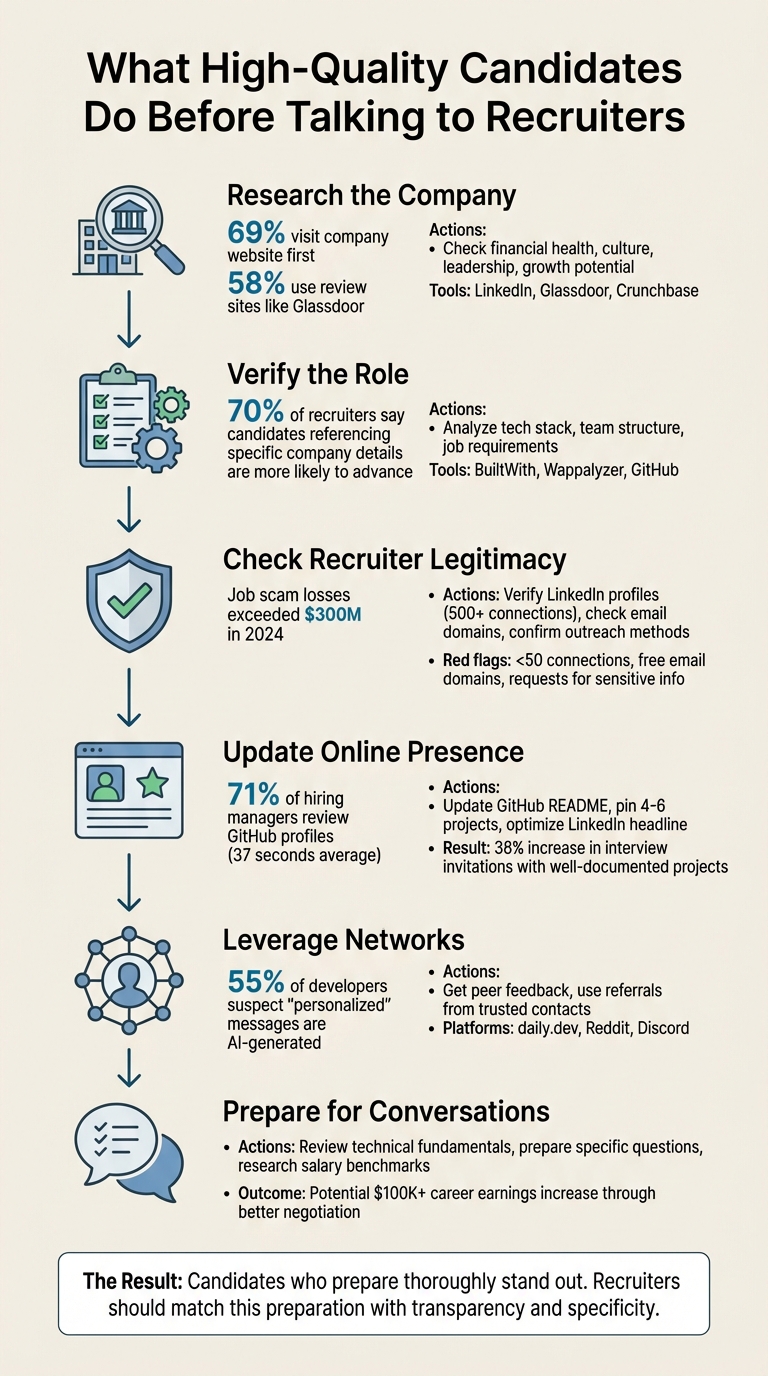 {6-Step Preparation Process High-Quality Candidates Use Before Recruiter Conversations}
Researching Companies and Roles
Before talking to recruiters, top candidates dive deep into researching companies and roles to make sure they align with their long-term career goals. For instance, 69% of job seekers visit the company website first, while 58% rely on third-party review sites like Glassdoor or Blind to gather insights . They know how to look past flashy perks and focus on meaningful factors like strong learning budgets or high promotion rates .
Checking Company Culture and Values
Candidates don’t stop at the "About Us" section. They dig deeper by using LinkedIn to track where former employees end up. If many alumni move on to top-tier companies, it’s a good sign that the organization invests in retaining top engineering talent. Another clue? Boomerang employees - those who leave and later return - often indicate a positive and dependable work culture. Platforms like Blind and Reddit provide unfiltered takes on topics like work-life balance and management stability, filling in the gaps that official channels might gloss over.
"Stop just listening to what a company claims about its culture. Look closely at where they actually spend their money and time." – AskCruit
Leadership matters, too. Candidates review the track records of executives - a CEO with a history of successfully scaling businesses inspires more trust than one associated with layoffs. Social media platforms like Facebook, Twitter, and Instagram also play a role, with 47% of candidates using them to see how companies handle complaints or celebrate employees . A defensive or overly quiet online presence can raise red flags.
Reviewing Growth Potential and Financial Stability
For public companies, candidates analyze earnings calls and 10-K reports to get a clearer picture of risks and strategic priorities. Startups require a different approach - platforms like Crunchbase help candidates track funding rounds and spot backing from top-tier VCs like Sequoia or a16z, which signals confidence from experienced investors .
Candidates also evaluate financial metrics like runway and burn rate. For example, in the B2B SaaS sector, Series A startups typically have $1M–$3M in Annual Recurring Revenue, while Series B startups reach $3M–$10M . LinkedIn Insights can reveal headcount trends, and tools like SimilarWeb help monitor web traffic, which can hint at instability when paired with high attrition or mass exits of key employees . Transparency matters, too - job postings that include salary details attract 55% more views and 65% more applications .
Once the financials check out, candidates ensure the technical environment matches their skill set.
Reviewing Tech Stack and Role Requirements
After vetting culture and finances, candidates turn to the nuts and bolts of the role. With tools like BuiltWith and Wappalyzer, they scan company websites to uncover the frameworks, languages, and tools in use. Public repositories on GitHub or Bitbucket offer a window into coding standards and preferred technologies. If a job description mentions tools like React 18, Next.js, or Tailwind, savvy candidates verify whether these are actively used in the company’s projects or just aspirational buzzwords.
Engineering blogs are another goldmine for understanding how teams approach challenges and whether there’s a focus on engineering culture. LinkedIn profiles of current employees provide clues about the skills required for daily tasks and the pace of career growth. Interestingly, 70% of recruiters report that candidates who reference specific company details during interviews are more likely to move forward in the hiring process .
Hiring engineers?
Connect with developers where they actually hang out. No cold outreach, just real conversations.
Checking Recruiter Credibility
After researching companies and roles, candidates often turn their attention to evaluating recruiter credibility. With job scam losses exceeding $300 million in 2024 , and 61% of developers expressing dissatisfaction with recruiters while 55% suspect even personalized messages are AI-generated , it's clear why candidates are cautious. This growing skepticism has led candidates to carefully verify every interaction before proceeding. High-quality candidates, in particular, take extra steps to assess recruiter profiles and outreach methods to avoid potential fraud.
Reviewing Recruiter Profiles
A LinkedIn audit is one of the first steps for top candidates. Legitimate recruiters usually optimize their recruiter profile with over 500 connections, a detailed work history that matches the company they represent, and active engagement within their professional circles, such as posts or meaningful comments . Profiles with fewer than 50 connections often raise red flags . Candidates also check the "Activity" section to see if the recruiter is genuinely involved in their professional community or merely posting generic, template-like content .
To further validate, candidates can use tools like Google Images or TinEye to perform a reverse image search, ensuring the profile photo isn't stolen or sourced from stock imagery . Another key factor is placement history. Candidates review previous roles and job descriptions to confirm the recruiter's expertise in developer recruitment. For instance, if a recruiter claims to specialize in tech roles but their experience is predominantly in non-tech industries, this could indicate a lack of relevant knowledge .
Once the recruiter's background checks out, candidates move on to verify the authenticity of their outreach.
Confirming Outreach Legitimacy
One of the simplest ways to confirm legitimacy is by checking the email domain. Genuine recruiters use official company domains (e.g., @google.com or @stripe.com), while emails from free services like @gmail.com or @yahoo.com - or suspiciously similar domains - can indicate a scam . Candidates also cross-check job listings on the company's Careers page or request specific details such as a Job ID or the hiring manager's name .
The communication medium is another clue. Scammers often stick to text-based apps like WhatsApp or Telegram, whereas legitimate recruiters are typically open to phone or video calls to discuss role specifics . Lastly, candidates should be wary of any recruiter asking for sensitive information - such as Social Security Numbers, bank details, or passport copies - before a verified offer is made. Similarly, requests for processing fees or security deposits are clear warning signs of fraud .
Platforms like daily.dev Recruiter help candidates navigate these challenges by providing warm, double opt-in introductions backed by verified company profiles, ensuring a safer and more trustworthy recruitment experience.
Updating Personal Online Presence
Your online profiles are often the first impression you make on potential employers. With 71% of hiring managers reviewing GitHub profiles and recruiters spending an average of just 37 seconds scanning them , every detail counts. The way you present your digital presence can make or break your chances of standing out.
Updating GitHub and LinkedIn Profiles
Start by crafting a GitHub profile README that highlights your expertise, current tech stack, and contact information. To further enhance your profile, pin 4–6 repositories that showcase both your range (e.g., frontend and backend projects) and depth (like solving complex algorithms or improving performance). Each pinned project should include a clear README that outlines its key features, technologies used, installation instructions, and lessons you learned while tackling technical challenges. A well-documented profile can make a big difference - one developer saw a 38% increase in interview invitations after splitting a large repository into smaller, well-documented projects.
To build credibility, include features like unit tests, CI/CD pipelines (such as GitHub Actions), and proper licensing in your repositories. Your commit history should also be clean and descriptive. Avoid vague messages like "update" or "fix." Instead, use detailed commit messages, such as:
feat(auth): add JWT login
Make your work easier to find by tagging up to 20 relevant GitHub Topics (e.g., "react", "docker", or "fintech"). This helps recruiters quickly locate projects that align with their needs.
On LinkedIn, ensure your profile matches the technical details on your GitHub. Use a professional headshot, set up a vanity URL (ideally matching your GitHub username), and utilize the "Featured" section to link to your GitHub, portfolio, or personal website. For your headline, follow a simple formula: "Target Role + Specialty + Market Keywords" (e.g., "Senior Backend Engineer | Distributed Systems | Go, Kubernetes"). This approach reinforces your professional brand and makes it easier for recruiters to understand your expertise at a glance.
For those looking to stand out even further, building a personal website is an excellent next step.
Building Personal Websites and Portfolios
A personal website can leave a lasting impression, especially for frontend developers.
"Looking at someone's actual website is thrilling, and it's a project you have total control over." – Dr. Derek Austin, Indie Game Dev & SWE
Unlike a resume, a personal website allows you to showcase both your technical and design skills in a dynamic way. It serves as a central hub for your personal brand, giving you full creative control to highlight your work.
Your website can display projects with visuals like screenshots, GIFs, or architecture diagrams, making it easier for even non-technical recruiters to understand your contributions. Use it to tell a cohesive story about your work by linking to GitHub repositories, case studies, or blog posts that demonstrate your expertise. A well-designed site not only proves your ability to write production-ready code but also shows your attention to user experience and responsive design. This comprehensive online presence helps you stand out and reinforces your technical and creative capabilities.
Using Professional Networks
Top candidates don't just rely on recruiters' claims - they tap into their professional networks to dig deeper. These networks give them firsthand insights into companies and roles, helping them separate fact from fiction. It's no surprise that skepticism is high: 55% of developers now believe that even "personalized" recruiter messages might be AI-generated .
When it comes to finding opportunities, developers trust personal referrals from friends and colleagues most, followed closely by input from developer communities .
Getting Feedback from Peers
Candidates aren't just verifying recruiter claims; they're also seeking unfiltered perspectives from their peers. Before engaging with recruiters, many turn to professional communities like daily.dev, Reddit, and Discord to uncover what working at a company is really like. These platforms act as informal reference checks, where developers openly discuss everything from tech stacks to team dynamics and management styles.
This kind of peer-to-peer exchange cuts through polished corporate messaging. As one Senior Backend Engineer put it:
"We want to skip the business BS and just have an honest conversation" .
Developers ask pointed questions about daily workflows, on-call responsibilities, code review processes, and whether a company's values align with its actions. These candid conversations often expose issues - like delayed schedules or quality concerns - that job postings conveniently leave out .
The growing popularity of double opt-in networking platforms like daily.dev Recruiter underscores this trend. Candidates now prefer "Tindev"-style matching, where both parties must show interest before starting a conversation. This approach fosters trust and reduces the noise of cold outreach .
Using Referrals from Trusted Contacts
While broad peer feedback provides a general sense of a company, direct referrals from trusted connections offer a more detailed, insider view. Candidates with contacts inside a target organization use these relationships to validate recruiter claims. These trusted sources often share the unvarnished truth about a company's development process - what the day-to-day experience is like compared to the official narrative .
Dave Smith, CTO at ObservePoint, suggests taking this vetting process a step further:
"If you want a clear picture of the team's dynamics, schedule a half-day trial" .
Some candidates go as far as requesting informal pairing sessions or deep dives into the tech stack before committing to formal interviews. This hands-on approach gives them a real taste of the work environment .
Additionally, candidates research their interviewers on LinkedIn and cross-check details with trusted contacts. By asking the same probing questions recruiters use, they can uncover inconsistencies that might hint at deeper organizational issues . This thorough vetting process helps candidates identify roles that truly align with their expectations while steering clear of companies that fail to live up to their promises.
Preparing for Recruiter Conversations
With thorough research and valuable insights from their network, candidates can now focus on sharpening their approach for recruiter interactions. After vetting companies and gathering feedback, they aim to enter these conversations with clarity, confidence, and a strong sense of direction.
Reviewing Technical Fundamentals
The best candidates make sure their technical skills are polished well before interviews. For web developers, this means revisiting key areas like JavaScript (ES202x), TypeScript, and modern frameworks such as Next.js or NestJS. Senior engineers often go a step further, refreshing system design concepts, including database trade-offs, caching strategies, and messaging queues. Additionally, they focus on essential coding patterns like sliding window, two pointers, and BFS/DFS, which form the backbone of solving complex problems .
As Formation.dev explains:
"Hard problems often just combine basic techniques. We make sure candidates master the basics first, building a foundation that allows them to tackle harder problems later" .
To further prepare, many candidates simulate interview scenarios by solving problems in plain text editors rather than relying on IDE features. This practice helps them build fluency and prepares them for whiteboard-style challenges where tools like autocomplete won’t be available .
Preparing Questions to Ask Recruiters
Smart candidates treat recruiter calls as an opportunity to uncover the true nature of the workplace. Dave Walters, CTO at Hired, emphasizes the importance of this stage:
"I think a lot of candidates perform pretty well through the beginning and middle stages of the interview and then they take for granted that final stage [asking questions]" .
To get meaningful insights, candidates ask focused questions about team structure (e.g., size, reporting lines, junior-to-senior ratio), technical processes (like version control, CI/CD pipelines, and handling technical debt), and engineering culture (decision-making processes, conflict resolution, and whether post-mortems are blameless) . For startups, they also inquire about financial stability, including funding sources, profitability, and runway .
Instead of asking vague questions like "Is the culture collaborative?", they opt for specifics: "When was the last time you needed help from another team, and what was that process?" . This approach often reveals genuine, unfiltered insights rather than pre-rehearsed responses.
Setting Priorities and Negotiation Points
Before engaging with recruiters, top candidates conduct a work values exercise to rank what matters most to them - whether it’s learning opportunities, the tech stack, work-life balance, or compensation. This helps them avoid being swayed by roles that sound appealing but don’t align with their long-term goals .
They also research salary benchmarks using platforms like levels.fyi to understand pay ranges for specific roles and levels. However, they avoid sharing this information early on, maintaining information asymmetry to keep their negotiation options open . Aline Lerner, CEO of interviewing.io, highlights:
"The reality is that negotiation is all about preparation and leverage" .
Timing is another key strategy. Candidates often schedule multiple interviews to ensure offers arrive around the same time, giving them natural leverage during negotiations . In early conversations, they listen carefully to the recruiter’s salary range rather than revealing their own expectations or history. This method can lead to significant financial gains - potentially adding up to $100,000 over an engineer’s career . These careful preparations enable candidates to approach recruiter conversations with confidence and control.
Conclusion: Matching Your Strategy to Candidate Expectations
Top-tier candidates come prepared - they dive into researching company culture, financial stability, and technical compatibility, while also verifying recruiter credibility and sharpening their questions. This meticulous preparation highlights a trust gap between candidates and recruiters .
To bridge this gap, recruiters need to move beyond generic outreach and focus on transparency. Start by sharing what candidates care about most: 69% want salary details included in the initial message . Add specifics like the tech stack and work model (remote, hybrid, or onsite) right away. When candidates have already done their homework, offering this information upfront shows you respect their time and priorities.
Candidates also evaluate your legitimacy. They’ll check your LinkedIn profile, look for a verified history of placements, and scrutinize your email domain. Use company-branded emails, maintain a credible LinkedIn presence, and link directly to job postings. These steps help counter skepticism - especially since 55% of developers suspect even "personalized" messages might be AI-generated .
When a candidate asks about team dynamics, technical debt, or your CI/CD pipeline, it’s a sign they’ve done their research. These are the kinds of candidates you want - those who approach opportunities with the same thoroughness they bring to their work. By matching their level of preparation, recruiters can foster more meaningful conversations. Share complete details upfront, ensure your profile builds trust, and include clear salary ranges - like "$150,000–$180,000 base for mid-level developers" - to boost response rates. Tools like daily.dev Recruiter help shift the focus from cold outreach to warm, mutual introductions, where developers engage willingly. This approach turns recruiting into a trust-driven process, where both sides come prepared and ready to connect. Meeting these informed expectations is essential for attracting top talent.
FAQs
How can candidates confirm if a recruiter is trustworthy?
Making sure a recruiter is trustworthy doesn’t have to be complicated. Here are a few steps to help you vet them effectively:
Start by checking their professional profile on platforms like LinkedIn. Look for a complete work history, mutual connections, and regular activity. Profiles that are incomplete, have very few connections, or contain vague details might be a red flag.
Pay close attention to how they communicate. A legitimate recruiter will usually craft messages that align with your skills and experience. Be wary of generic outreach or messages that feel overly vague or impersonal. If they mention specific companies or job roles, take the time to verify those claims by visiting the company’s website or doing your own research.
Lastly, keep an eye out for warning signs. These include pressure to make quick decisions, reluctance to speak over the phone or via video, or requests for personal information or money. Scammers often rely on these tactics to exploit job seekers.
By taking these precautions, you can confidently engage with recruiters who are credible and avoid falling victim to scams.
What should candidates research about a company before speaking with a recruiter or going into an interview?
Before you talk to a recruiter or head into an interview, it’s smart to dig into a few key areas about the company. Start by exploring their mission, values, and culture - this will help you figure out if their goals and work environment match what you’re looking for. Check out recent news, press releases, and even their social media channels to get a sense of what they’re currently focused on or proud of.
Next, take the time to understand their products, services, and market position. Look into who their competitors are and any hurdles they might be facing in their industry. If it’s a public company, reviewing financial reports can give you a clearer picture of its stability and growth trends. For a glimpse into the workplace vibe, employee reviews on sites like Glassdoor can reveal insights about job satisfaction and company culture. Covering these bases will help you craft thoughtful questions and responses that show you’re prepared and genuinely interested.
How do developers optimize their online presence to stand out to recruiters?
To capture the attention of recruiters, developers invest time in crafting a polished and professional online presence. They ensure their LinkedIn profiles are up-to-date with detailed information about their skills, work experience, and accomplishments. By incorporating relevant keywords, they boost their chances of appearing in recruiter searches.
On GitHub, developers demonstrate their technical skills by organizing repositories with clear, descriptive names and professional README files. This approach makes their work easy for recruiters to evaluate and understand.
Beyond that, developers enhance their personal brand by sharing insightful content, participating in developer communities, and openly showcasing their skills and projects. A well-maintained online presence not only highlights expertise but also reflects professionalism - qualities that help recruiters identify them as standout candidates.
.png)