Finding senior backend engineers is harder than it looks. Even the most carefully crafted search strings fall short because of how these professionals describe themselves and maintain their profiles. Here’s why:
- Keyword mismatch: Engineers use varied terms across platforms, like "Backend Developer", "Software Engineer", or even creative titles like "Django Aficionado."
- Outdated profiles: Senior engineers often don’t update their resumes or online profiles unless actively job hunting, making them harder to find.
- Focus on outcomes, not keywords: Experienced engineers highlight achievements, like "reduced latency by 30%", rather than listing skills like "Python" or "microservices."
- Job title confusion: Titles often don’t reflect true responsibilities or expertise, and filtering by them excludes qualified candidates.
- Passive talent: The majority of senior engineers aren’t actively job hunting, so traditional sourcing strategies miss them.
Solution? Intent-driven recruitment. By analyzing real-time behavior - like GitHub activity, learning habits, and contributions to technical communities - you can identify passive talent and connect meaningfully. Platforms like daily.dev Recruiter track what engineers are doing now, not just their past roles, increasing response rates and improving hiring outcomes. Forget rigid keyword searches; focus on behavior and interests instead.
Why Traditional Search Methods Fail
Traditional recruitment methods often fall short when dealing with non-standard career paths and outdated profiles. These approaches tend to assume that senior backend engineers have consistent online presences and follow predictable career journeys. However, the reality is far more complex. Profiles vary widely, and even the most carefully constructed queries can miss out on highly qualified candidates who don't fit conventional templates.
Non-Linear Career Paths and Varied Skill Descriptions
Engineers often describe their skills and experiences differently depending on the platform, which creates challenges for keyword-based searches. Instead of listing programming languages, experienced engineers frequently highlight their achievements - things like reducing latency or designing microservices architecture. These outcome-focused descriptions can make them harder to find using rigid keyword searches. While Boolean search strategies can cut screening time by up to 28% , overly strict criteria risk filtering out candidates with unconventional career paths. This mismatch between self-description and search parameters leads to many profiles being overlooked or misrepresented.
Outdated or Minimal Online Profiles
Many senior backend engineers either keep their profiles minimal or let them become outdated, particularly if they're not actively job hunting. These sparse profiles often lack key details or relevant keywords, making these candidates nearly invisible in traditional searches. This creates a bias toward individuals who are better at optimizing their profiles, rather than those with deeper technical expertise. Objective signals - like timestamped GitHub commits, contributions to Stack Overflow, or repository stars - provide a far more accurate picture of a developer's skills and activity. While keyword-based systems are about 60–70% accurate in identifying intent, AI-driven matching can increase accuracy to 85% . Over-reliance on job titles further complicates the search process, as titles often don't reflect actual responsibilities or expertise.
Too Much Focus on Job Titles and Trending Keywords
Job titles are notoriously unreliable indicators of seniority or skill. A "Senior Engineer" at a small startup might perform entirely different tasks than someone with the same title at a large tech company . Title inflation adds another layer of confusion - roles like "Principal Associate" might align closely with "Senior Software Engineer." As Raphael Moutard, VP of Engineering, explains:
"Titles are flawed and shouldn't be trusted... Don't waste time chasing a label. Spend time learning and practising your craft" .
Rigidly filtering candidates by titles like "VP of Engineering" can exclude individuals with equivalent responsibilities under different labels, such as "Engineering Manager" or "Head of Engineering." Moreover, niche keywords with fewer than 100 monthly searches often yield higher conversion rates - up to three times more than broad, trending terms . This highlights the importance of using precise, nuanced criteria to uncover highly qualified candidates who might otherwise go unnoticed.
How Intent-Driven Recruitment Works
::: @figure 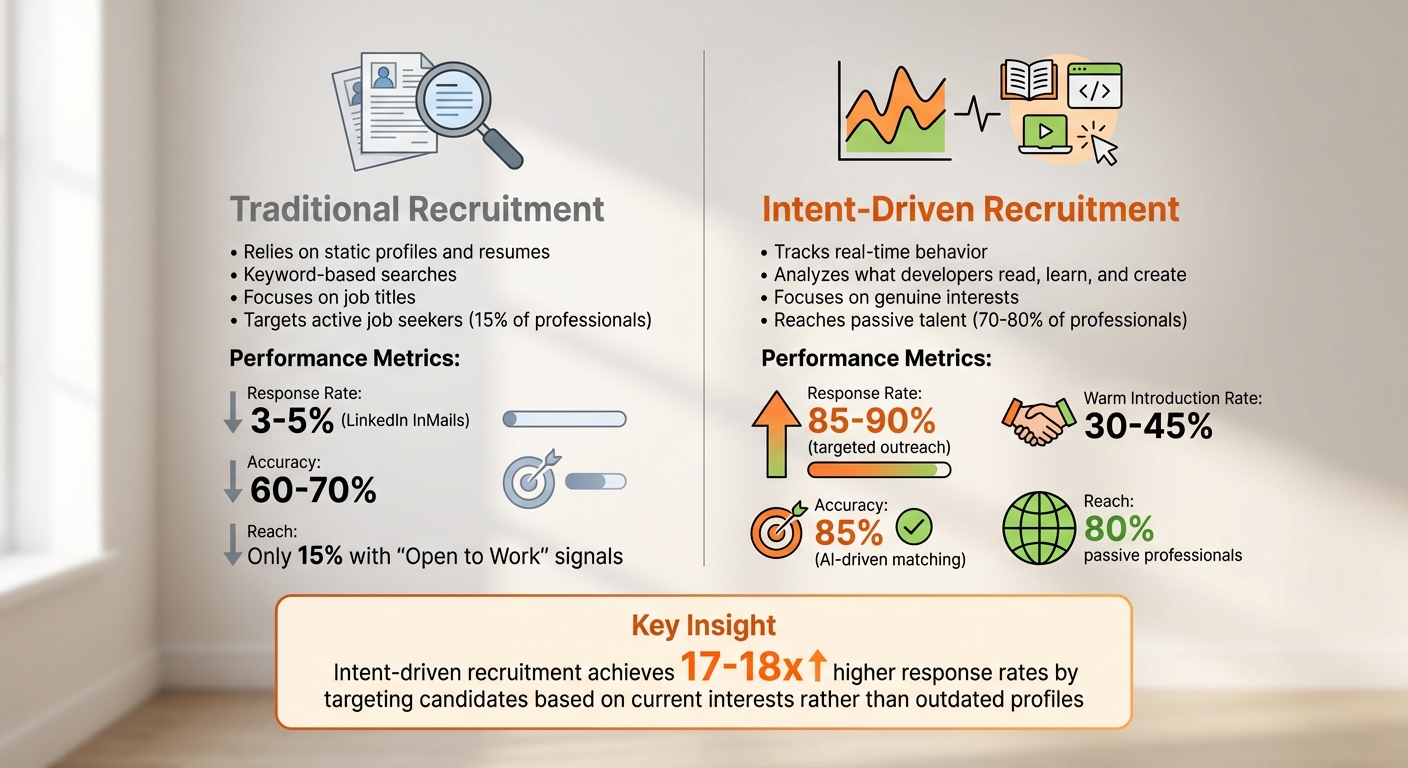 {Traditional vs Intent-Driven Recruitment: Response Rates and Accuracy Comparison}
Intent-driven recruitment reshapes how hiring is done. Instead of sticking to old-school keyword searches or generic job titles, this method zeroes in on what developers are actively doing - what they’re reading, learning, and creating. By focusing on real-time behavior, it reveals genuine interests and career goals, bypassing the limitations of outdated resumes.
Understanding Intent-Driven Recruitment
Traditional hiring methods often fall short because they rely heavily on static profiles. Intent-driven recruitment changes the game by tracking behavioral signals rather than just scanning for keywords. For example, when senior engineers explore new technologies or consistently upskill, they provide a clearer picture of their interests and expertise than a resume ever could .
This approach is especially effective for reaching passive talent - the 80% of professionals who aren’t actively job hunting - compared to the small 15% who openly signal availability with an "Open to Work" banner .
The results speak for themselves. While cold outreach typically gets a response rate below 5%, intent-driven recruitment can achieve response rates as high as 85–90%. Why? Because it targets candidates based on what they’re genuinely interested in, fixing the mismatch that plagues traditional hiring methods .
Why Warm Introductions Get Better Results
The "TinDev" model - short for the double opt-in recruitment mechanism - takes this approach even further. It ensures that both developers and recruiters agree to connect before any conversations begin . Here’s how it works: developers are presented with key role details, like the tech stack and salary range, and they only opt in if the opportunity matches their interests.
This process eliminates ghosting and guarantees 100% engagement for every introduction. By aligning interests upfront, it replaces generic outreach with meaningful, targeted connections .
Practical Ways to Find Senior Backend Engineers
Finding senior backend engineers requires moving beyond traditional search methods. Here are some strategies that can help you connect with this highly sought-after talent pool.
Using Developer-Focused Platforms
Developer-focused platforms are changing the way recruiters find senior backend engineers. Why? Because 90% of developers on specialized networks don’t respond to outreach on platforms like LinkedIn . LinkedIn often relies on outdated resumes, while developer communities showcase what engineers are learning and working on right now .
Take daily.dev Recruiter, for example. This platform analyzes developers' real-time activities - what they read, like, and engage with - giving recruiters insights into their current interests, not just their past roles. With 40% of users being senior contributors or engineering leaders , it’s a direct line to the talent tier many recruiters struggle to reach. Plus, its performance-based pricing model ensures you only pay for successful connections, making it a practical choice for teams of all sizes .
"We built a place where engineers can turn off the noise. To enter this space, you don't need a hack. You need trust." - Nimrod Kramer, CEO & Co-Founder, daily.dev
By leveraging these platforms, you can reach candidates who are actively engaged in their field and more likely to be a good fit for your team.
Tracking Developer Activity to Find Passive Candidates
Did you know that 70% of developers are passive talent ? They’re not actively looking for jobs but are open to the right opportunity. Tracking their behavior can help you identify when they might be ready to make a move. For instance, saving technical articles about distributed systems or Rust could indicate their growing expertise in these areas .
Timing also matters. Trigger events like equity vesting cliffs, leadership changes, or the completion of major projects can signal when someone might be open to new opportunities . Warm, personalized introductions work far better than cold outreach - response rates for warm introductions range from 30–45%, compared to just 3–5% for LinkedIn InMails .
Writing Job Posts That Appeal to Developers
Once you’ve identified potential candidates, your job post needs to stand out. Senior developers often receive 50+ recruiting messages per month , so generic pitches won’t cut it. Avoid vague phrases like "competitive compensation" - be upfront about salary expectations. Passive candidates typically expect a 10–20% increase in compensation , so addressing this early can save time.
Focus on the technical challenge. Instead of saying "backend development", describe the project in detail: "architecting a real-time payment system handling $100M daily" . Be specific about the tools and technologies - mentioning Java 17, Spring Boot, or Kubernetes is far more effective than generic terms.
Respect their time. Instead of pushing for an immediate call, offer a detailed technical brief they can review at their convenience . This shows you value their schedule and aren’t just sending out templated messages. Recruiters who demonstrate a basic understanding of backend systems - like knowing the difference between microservices and monolithic architectures - see much better engagement from senior developers .
Conclusion
Key Takeaways for Recruiters
Finding senior backend engineers goes beyond refining search queries - it's about transforming how you approach and connect with talent. Traditional keyword-based searches often fall short, as they rely on outdated profiles and static job titles, failing to capture the diverse career trajectories and skill sets of seasoned developers.
The move toward intent-driven recruitment is reshaping the game. Instead of depending on cold outreach, focus on establishing genuine connections through platforms where developers are already engaged. Pay attention to what developers are exploring in real time - their interests, the content they're interacting with - and craft job postings that respect their time. Prioritize personalized outreach and highlight real technical challenges rather than overused buzzwords to stand out and build credibility.
These strategies lay the groundwork for the next phase of recruitment.
The Future of Developer Recruitment
The recruitment landscape is evolving to adopt double opt-in models, where both recruiters and developers express mutual interest before initiating a conversation . This approach ensures that interactions start on the right foot, with genuine intent on both sides. Additionally, recruitment tools are becoming more sophisticated, using behavioral data to match candidates based on what they're doing now, not just their past roles .
Platforms like daily.dev Recruiter are leading this transformation. By analyzing developers' daily interactions and interests, these tools go beyond static resumes. Features like automated candidate discovery, behavioral matching, and ATS integration streamline the process, allowing recruiters to focus on building trust and fostering meaningful conversations. This human touch remains essential, even as technology handles the repetitive tasks.
FAQs
What signals show a senior backend engineer’s intent to switch jobs?
Senior backend engineers often hint at a job switch through subtle online activities. These might include updating their professional profiles, earning new certifications, interacting with technical content, or increasing contributions on platforms like GitHub. This collection of behaviors, sometimes referred to as "digital body language", can indicate they’re actively exploring options. While only a few openly display signals like an "Open to Work" status, spotting these patterns early allows recruiters to engage with candidates who are quietly considering new opportunities.
How can I find strong candidates with outdated or minimal profiles?
Finding talented candidates with outdated or sparse profiles takes a more proactive approach than just relying on keyword searches. Start by exploring niche developer hubs like GitHub or Stack Overflow, where you can spot active contributors through their projects and discussions. Leverage AI-driven tools to track behavioral signals - things like recent activity, project updates, or code contributions. And don’t underestimate the power of personalized outreach. Craft messages that show genuine interest and focus on their specific skills or recent work. This kind of thoughtful engagement can help you connect with skilled developers who might otherwise fly under the radar.
How do I use daily.dev Recruiter to reach passive senior backend engineers?
To reach passive senior backend engineers, daily.dev Recruiter takes a developer-first approach that prioritizes trust and mutual consent. This means outreach is made ONLY to developers who have explicitly agreed to be contacted, ensuring it aligns with their preferences.
Using real-time data on developers' activities and interests, you can pinpoint highly engaged backend engineers. This allows you to create tailored, meaningful outreach that connects with their expertise and aligns with their career aspirations.
.png)