Resumes are a poor tool for hiring senior engineers. Here’s why:
- Resumes oversimplify expertise: They reduce years of complex technical experience into generic bullet points, leaving out critical decision-making and problem-solving skills.
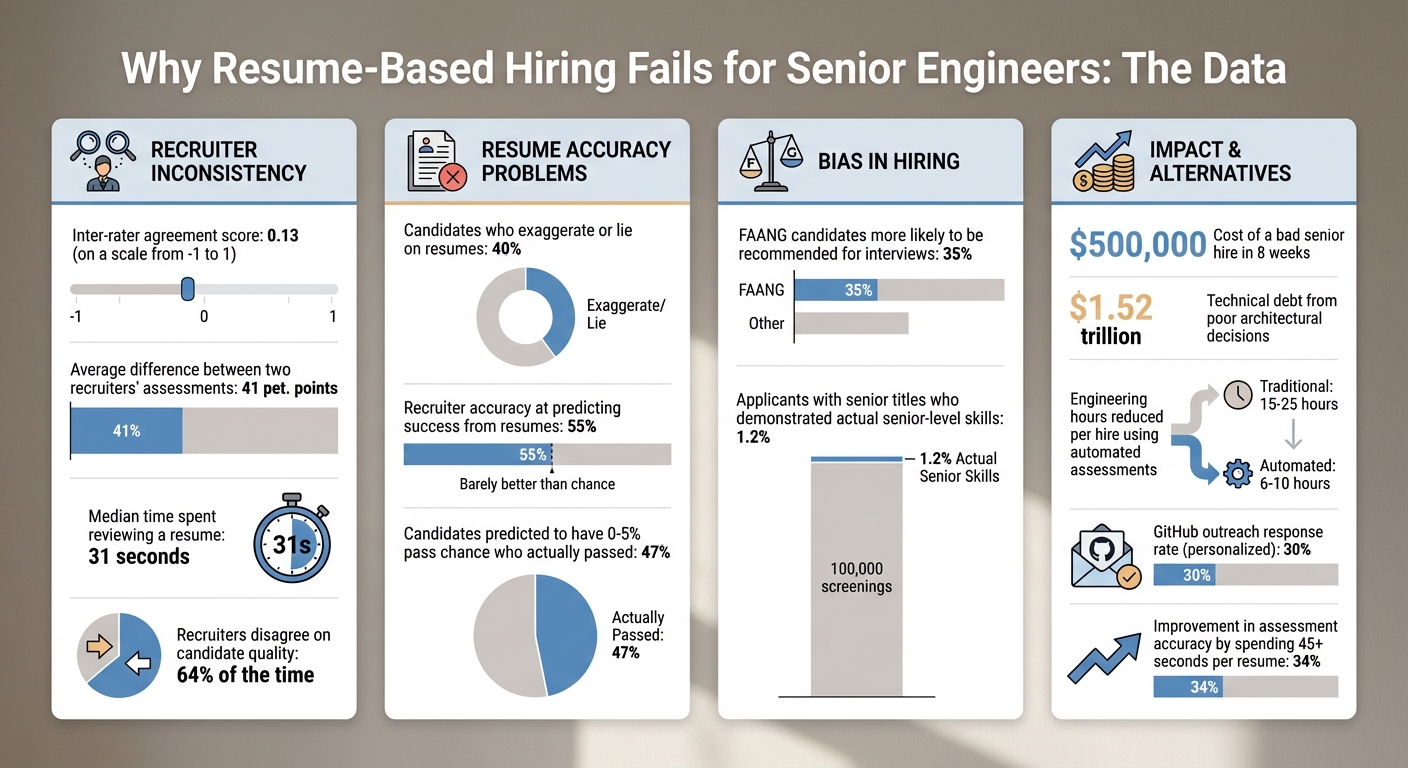
- Bias and inconsistency: Recruiters disagree on candidate quality 64% of the time and spend only 31 seconds reviewing resumes. Brand-name companies and linear career paths are unfairly favored.
- False positives and negatives: 40% of candidates exaggerate or lie on resumes, while skilled engineers with unconventional backgrounds are often overlooked.
- Titles don’t reflect skills: Many candidates with "Senior" titles fail to demonstrate senior-level expertise during evaluations.
Better alternatives include reviewing project portfolios, using structured technical interviews, and sourcing talent from the best developer communities. These methods focus on actual skills and contributions, not just polished resumes.
Why Resumes Fail to Show Senior Engineering Talent
Resumes Reduce Complex Technical Expertise to Simple Lists
Resumes often boil down years of technical expertise into generic bullet points, leaving out the nuances of an engineer's actual contributions. For instance, they don't differentiate between someone who built a distributed system from scratch and someone who simply maintained legacy code. This flattening effect makes specialized expertise look generic, reducing everyone to the same template of skills and tasks .
Even foundational technologies like LISP or Smalltalk - often indicative of deep technical understanding - can raise unnecessary concerns, as they might seem outdated to some evaluators . Resumes also tend to focus on tasks assigned rather than showcasing meaningful achievements .
Perhaps the biggest gap is the lack of context behind technical decisions, making it harder to assess technical skills without coding tests. Resumes don’t explain why an engineer chose NoSQL over SQL or the trade-offs they considered when designing a system. These are the critical thinking skills that separate senior engineers from the rest, yet they remain invisible on paper . This oversimplification not only misrepresents abilities but also opens the door to subjective judgments.
Resume Evaluation Creates Bias and Inconsistency
The process of evaluating resumes is riddled with inconsistencies. A study of 2,200 resume reviews found that the average difference between two recruiters' assessments of a candidate's potential was a staggering 41 percentage points . With an inter-rater agreement score of just 0.13 on a scale from -1 to 1, recruiters often don't agree on what defines a "strong" candidate .
Biases also creep in when evaluators prioritize credentials over actual skills. Brand-name companies and prestigious schools often tip the scales. For instance, candidates with FAANG experience are 35% more likely to be recommended for interviews, even when their technical performance doesn't back up the preference . This "brand bias" often filters out highly capable engineers from less traditional backgrounds before their skills are even assessed.
Adding to the problem, recruiters spend a median of just 31 seconds reviewing a resume. This quick glance results in decisions that are barely better than random chance . Beyond this inconsistency, the resume format itself disadvantages candidates with non-linear career paths, further skewing the hiring process.
Linear Career Paths Get Unfair Preference
Resumes also favor traditional, linear career paths, penalizing those who deviate from the norm. Take the case of Martin Harriman, a veteran engineer dismissed by most companies as just a "hardware guy" due to his decades of hardware experience and knowledge of older technologies like Perl. However, Pure Storage took a different approach, using a coding quiz instead of relying solely on his resume. Harriman not only excelled - achieving the fastest completion time in the company’s history - but also made significant contributions, such as optimizing metadata to reduce customer support calls .
"He's a hardware guy, why are we wasting our time?" - Martin Harriman (describing hiring managers’ attitudes toward his resume)
Resumes also fail to account for "distance traveled" - how far a candidate has come relative to their starting point. A self-taught developer who rises to a senior role in five years may be far more capable than someone who spent a decade coasting at prestigious companies. Yet, the resume format often makes the latter seem more impressive, masking true talent and growth potential.
Why Senior Engineers Are Harder to Hire Using Resumes
The Depth vs. Breadth Problem
Senior engineers bring more to the table than just years of experience - they're the ones who grasp the "why" behind technical decisions, not just the "how." The problem with resumes is that they fail to capture this depth. Sure, a resume might list "3 years Python" or "5 years distributed systems", but it won't reveal whether that engineer built a robust microservices architecture from the ground up or merely kept someone else's legacy system running .
Seniority isn't about stacking up technologies or years - it's about mastery through practice. Greg T., a technical interviewer at Lemon.io, explains it well:
"I've seen developers with three years of deep, intentional practice outperform those with a decade of surface-level exposure. The difference isn't years - it's depth" .
Resumes, unfortunately, favor "pattern matchers" - engineers who can apply tools in predictable ways - over those who can troubleshoot production failures or handle corrupted data with ingenuity .
Title inflation makes this issue even trickier. Ira Prokopiv, a recruiting operations analyst at Lemon.io, observes:
"Senior Developer titles have become participation trophies. We've seen candidates with 'Senior Architect' titles who couldn't explain basic system design choices in their own projects" .
This isn't just anecdotal. Data from 100,000 developer screenings revealed that only 1.2% of applicants - many boasting impressive senior titles - actually demonstrated senior-level skills during developer assessment tools . Resumes simply don't capture the depth and cross-functional expertise that define true seniority.
Important Expertise Gets Overlooked
The traditional one-page resume format forces senior engineers to leave out the very experiences that showcase their seniority. Contributions like mentoring junior developers, leading cross-functional teams, and making tough architectural trade-offs often don’t fit neatly into bullet points. And because these critical skills don’t translate into keywords, they’re often filtered out by applicant tracking systems.
Take the example of KeepSafe in 2014. The startup ditched resumes in favor of a "No Resume" hiring campaign where candidates described their projects instead. This approach led them to hire AJ Alt, an engineer whose resume might have been dismissed due to the absence of brand-name schools or companies. With a background in government cybersecurity, Alt didn’t fit the typical mold, yet he went on to co-create a major security feature and develop an open-source Android library for the company . His skills - especially in cross-functional problem-solving - were overlooked on paper but proved invaluable in practice.
Well-Written Resumes Don't Predict Performance
Resumes often measure writing skills more than technical ability. Some candidates excel at crafting polished resumes, while genuinely talented engineers struggle to showcase their strengths on paper. This disconnect is startling: when recruiters predicted candidates had only a 0–5% chance of passing based on their resumes, those same candidates passed 47% of the time . Meanwhile, engineers who can solve complex problems are frequently filtered out because their resumes don’t tick the right boxes.
How to Evaluate Senior Engineers Without Relying on Resumes
Review Projects and Portfolios Instead
When it comes to assessing senior engineers, their work speaks louder than any resume. Reviewing GitHub repositories, architectural documents, or case studies gives you a clear picture of how they think, code, and solve real-world problems. This approach cuts through the clutter of polished resumes and prestigious credentials, allowing you to focus on actual talent - especially from candidates with non-traditional backgrounds.
Studies show that project-based evaluations are far more reliable than resume screenings. For example, recruiters are only about 55% accurate at predicting success based on resumes - barely better than flipping a coin. In contrast, reviewing relevant work samples is one of the most reliable ways to gauge on-the-job performance . Companies using automated technical assessments for early screening have even reduced the engineering hours spent per hire from 15–25 hours to just 6–10 hours .
Here’s a tip: provide detailed feedback - around 3–4 paragraphs - for every candidate who completes a project assessment, regardless of whether they’re hired . Showing respect for the time they’ve invested not only enhances the candidate experience but also reflects well on your organization. After reviewing work samples, structured technical interviews can further evaluate a candidate’s technical judgment.
Use Structured Technical Interviews
The most effective technical interviews for senior engineers don’t focus on memorization or trivia. Instead, they explore how candidates apply technical concepts to real-world challenges. For example, ask candidates to walk you through a project they’ve led, explaining the tradeoffs they made and what they might do differently today .
Another strategy is to provide a messy code sample - 100–150 lines - and ask the candidate to review and refactor it. This tests their ability to spot maintainability issues and articulate their technical decisions . You can also present production-like scenarios, such as fixing memory leaks, handling corrupt data, or diagnosing performance bottlenecks . Importantly, allow candidates to use the same tools they’d rely on in the workplace, like documentation, search engines, or AI tools .
"A real senior developer should be able to draw their system architecture on a whiteboard and defend every decision. Titles don't sway us - technical reasoning does." – Greg T., technical interviewer at Lemon.io
Why does this matter? Poor architectural decisions have contributed to an estimated $1.52 trillion in technical debt , and a single bad senior hire can cost a company nearly $500,000 in just eight weeks .
Once you’ve assessed how candidates solve real-world problems, move to objective scoring. Use clear rubrics with specific technical criteria tailored to the role - like the ability to implement RESTful APIs with proper error handling - and score candidates on a 1–10 scale to minimize bias . Also, respect candidates’ time by limiting pre-screening tasks to 30 minutes and later-stage challenges to no more than three hours .
Find Talent in Developer Communities
Developer communities are often a goldmine for finding senior engineering talent. Many engineers demonstrate their skills publicly - through open-source contributions, GitHub activity, or participation in technical forums - long before they update their resumes. These activities showcase not just technical expertise, but also collaboration and problem-solving skills in real-world settings.
GitHub’s advanced search features can help you filter candidates by programming language, location, number of followers, and recent activity . For example, you can use the "Insights" tab to identify top contributors to libraries your company relies on or explore GitHub organizations for major projects like Kubernetes or React to find developers already immersed in those ecosystems .
In 2023, Codility’s recruiting team achieved a 30% response rate and successfully filled two engineering roles within a year by sending personalized outreach messages based on specific GitHub activity . The secret? They referenced actual contributions and explained why those skills were a perfect fit for the role, making the outreach feel thoughtful and relevant.
Platforms like daily.dev Recruiter also connect you with developers where they’re already engaged - reading, learning, and interacting with technical content. These introductions are warm, double opt-in, and tailored, transforming recruiting from cold emails and generic pitches into a trust-based process that prioritizes intent and credibility.
Conclusion: Better Ways to Hire Senior Engineers
Research has shown that traditional resume screening has its shortcomings. Skilled engineers from unconventional paths are often overlooked, while those with polished credentials but less depth in expertise can slip through the cracks. The financial impact of a mis-hire is no small matter - it can reach as high as $500,000 in just two months .
Instead of doubling down on resume screening, consider approaches that reveal a candidate's actual abilities. Tools like project portfolios, GitHub activity, and structured technical interviews offer a clearer picture of what a candidate can bring to the table. Take KeepSafe's "No Resume" campaign as an example: they evaluated 415 applicants based solely on their project descriptions. Through this process, they hired AJ Alt, a talented engineer whose unconventional background might have been overlooked in a traditional hiring process .
These alternative methods do more than just assess technical capability - they bridge the gap between a candidate's experience and their tangible achievements. Evidence-based hiring shifts the focus from credentials to proven skills and contributions.
This approach also aligns with where developers are most active. Platforms like daily.dev Recruiter connect you with engineers who are already engaged in building, learning, and sharing their work. This transforms recruiting into a more trust-driven and effective process. By prioritizing demonstrated accomplishments, you can build a hiring pipeline that's both accurate and fair.
Start by making small adjustments, like spending at least 45 seconds reviewing each resume - a practice that has been shown to improve assessment accuracy by 34% . Move away from abstract coding puzzles in favor of real-world challenges, and seek candidates who actively showcase their skills in professional communities. The engineers you're looking for aren't hiding - they're just being missed by outdated, resume-focused hiring practices. Adjust your strategy to uncover the talent that's right in front of you.
FAQs
Why is resume-based hiring ineffective for senior engineers?
Resumes often miss the mark when it comes to evaluating senior engineers. Why? They usually highlight surface-level details - like job titles, years of experience, or familiarity with outdated technologies - without showcasing the candidate's actual technical skills, problem-solving abilities, or the impact they've made in their roles.
Another issue is the bias resumes can introduce. For example, they might place too much importance on specific credentials or fail to recognize the value of skills developed through less conventional career paths. To get a more accurate sense of a senior engineer's capabilities, alternative methods can be far more effective. These include project-based assessments, portfolio reviews, or exploring platforms where candidates actively share and demonstrate their work. These approaches provide a clearer window into what a candidate can bring to the table.
What are the best ways to evaluate senior engineers without relying on resumes?
Evaluating senior engineers means looking past traditional resumes and zeroing in on their practical skills and experience. One great starting point is to dive into their project portfolios. These provide a window into their completed work, problem-solving approaches, and technical know-how. For a deeper look, platforms like GitHub can be incredibly useful. They offer insights into coding quality, collaboration habits, and how actively they contribute to projects.
Another smart approach is to use job-specific coding assessments that mirror the challenges they’ll face on the job. These tests let you observe their problem-solving abilities in real-time. Beyond that, engaging with candidates on platforms where they share knowledge or demonstrate their growth can be equally telling. It’s a great way to gauge their motivation and flexibility.
By prioritizing hands-on skills and continuous improvement, you can spot standout talent without leaning too heavily on traditional resumes.
Why do traditional resumes fail to identify top senior engineering talent, especially those with unconventional paths?
Traditional resumes often miss the mark when it comes to spotting senior engineers with unconventional career journeys. Why? They tend to emphasize formal education, specific job titles, and a straightforward career trajectory. This approach often overlooks critical attributes like advanced problem-solving abilities, hands-on technical skills, and unique experiences gained outside the standard path.
Many senior engineers develop their expertise through less traditional means - think open-source contributions, self-initiated projects, or work that spans multiple disciplines. Unfortunately, these accomplishments rarely shine through on a typical resume, making it tough for recruiters to see the full scope of their capabilities. To uncover top-tier talent, explore alternatives like project-based evaluations or reviewing portfolios that highlight tangible, real-world work.
.png)