Hiring senior backend engineers is harder than ever. Companies often rely on AI tools to screen candidates, but these tools fail to assess critical skills like architectural decision-making or problem-solving in complex systems. The result? 32% of technical hires in 2025 failed due to outdated or irrelevant skills, despite impressive resumes. AI struggles with nuanced evaluations, and cold, generic outreach further alienates experienced professionals.
Here’s why the process breaks down:
- AI Screening Gaps: Automated tools focus on keywords, missing deeper expertise.
- Outdated Data: Limited visibility into senior engineers’ actual work.
- Generic Outreach: Impersonal messages fail to engage qualified candidates.
The solution? Combine clear, detailed job descriptions, following a backend developer hiring checklist, warm introductions via trusted networks, and AI as a complement - not a replacement - for human judgment. Platforms like daily.dev Recruiter are leading this shift, using double opt-in models to connect companies with engineers genuinely interested in the role. By prioritizing trust and meaningful engagement, you can finally break the cycle of failed hiring attempts.
::: @figure 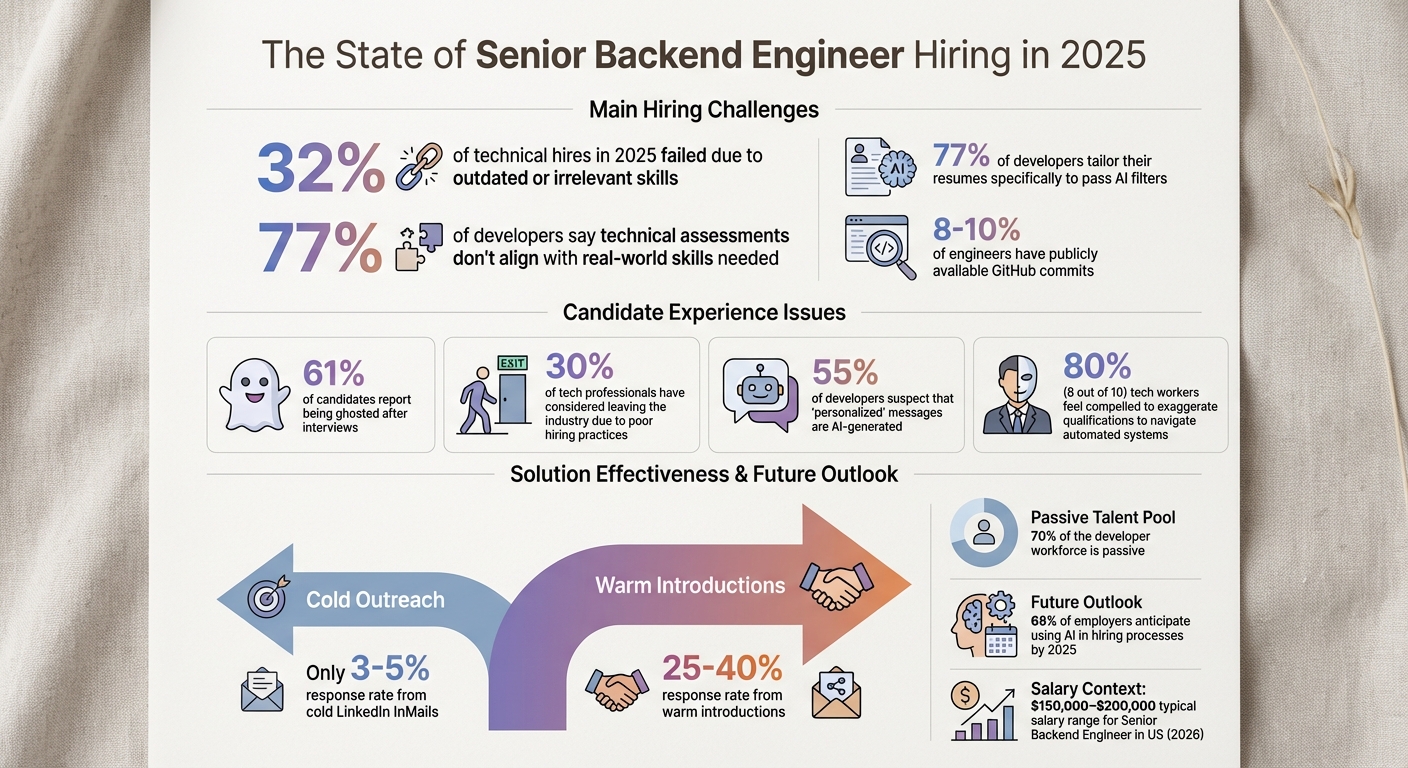 {Senior Backend Engineer Hiring Challenges: Key Statistics and Success Rates}
Why Companies Fail to Hire Senior Backend Engineers
The hiring process often stumbles when automated systems miss critical senior-level skills, outdated algorithms surface irrelevant candidates, and generic outreach fails to resonate with experienced professionals. These missteps tend to compound one another, creating a cycle of inefficiency.
AI Screening Misses Senior-Level Technical Skills
Automated screening tools focus heavily on keywords like "Kubernetes" or "Docker", but they often fail to assess the nuanced skills that senior engineers bring to the table. In fact, 77% of developers say technical assessments don't align with the real-world skills needed for their roles . While AI might be able to confirm whether code compiles, it struggles to evaluate higher-order skills like architectural decision-making or problem-solving when faced with incomplete data .
Sarah Chen, a startup founder, shared her frustrations with this process:
"The technical interviews? They were looking for puzzle solvers, not problem solvers. None of the questions had anything to do with building real products or understanding actual engineering challenges."
This disconnect has led to a game of optimization, where 77% of developers tailor their resumes specifically to pass AI filters . Unfortunately, this focus on keywords often obscures genuine expertise, leaving hiring teams with a pool of candidates that may not truly reflect the skills needed for senior backend roles.
AI Sourcing Surfaces Outdated or Irrelevant Candidates
AI-powered sourcing tools face an uphill battle due to limited and outdated data. For instance, only 8–10% of engineers have publicly available GitHub commits, and much of the work done by senior engineers is proprietary and not easily visible . This can result in profiles that seem promising on paper but lack the depth of experience required for the role. Conversely, highly qualified candidates might remain hidden because their most recent roles don't feature the "right" keywords .
Aline Lerner, founder of interviewing.io, summed it up well:
"The hard part about hiring isn't the tech. It's having the data to make good hiring decisions in the first place."
This lack of visibility often leads companies to waste time on mismatched profiles while truly qualified candidates are overlooked. In fact, eight out of ten tech workers feel compelled to exaggerate their qualifications just to navigate these automated systems . Without addressing these sourcing gaps, companies risk missing out on the talent they need.
Generic Outreach Does Not Engage Senior Developers
Even when the right candidates are identified, personalized, non-spammy outreach often undermines the hiring process. Senior backend engineers expect clear and detailed communication about the role. They want to know specifics - like the tech stack, scope of work, compensation, and success metrics. Without this information, many will dismiss a job opportunity in seconds .
As Maksym, a developer, put it:
"I have no idea why I'd want to work for you. No salary or clear task description is provided."
The problem doesn't stop there. Sixty-one percent of candidates report being ghosted after interviews, and 30% of tech professionals have considered leaving the industry entirely due to frustrations with impersonal outreach and poor hiring practices . When companies rely too heavily on AI-generated messages and fail to provide meaningful feedback, they not only lose potential hires but also risk damaging their reputation in the industry.
These challenges highlight the need for a more thoughtful and human-centered approach to hiring senior backend engineers. Without it, companies may find themselves stuck in a cycle of inefficiency and missed opportunities.
How to Fix Your Senior Backend Engineer Hiring Process
If your hiring process for senior backend engineers isn't delivering the results you'd hoped for, it's time to make some adjustments. The key lies in addressing three critical areas: crafting job descriptions that resonate with engineers, leveraging developer networks for meaningful connections, and using AI to complement - not replace - human decision-making.
Write Job Descriptions That Speak to Backend Engineers
Senior backend engineers aren't swayed by flashy buzzwords or vague job postings. They want to know the real challenges they'll tackle. Focus your job descriptions on the technical aspects that matter most, such as:
- API-first design (REST or GraphQL, versioning strategies, error handling)
- Database fundamentals (schema design, query optimization, data modeling)
- Production-scale systems (scaling challenges, high data volumes, legacy integrations) .
Work closely with your technical team to clearly define the scope of the role. Use a skills checklist to separate "Must-Haves" from "Nice-to-Haves" so you don't scare off qualified candidates with an overly demanding list of requirements . Avoid arbitrary "years of experience" requirements - strong engineers can adapt to new tools and technologies quickly. Instead, prioritize core engineering skills and the ability to solve complex problems .
Additionally, showcase your company's engineering culture. Highlight your focus on reliability, security, and performance. Be upfront about compensation, too. For context, in 2026, the typical salary range for a Senior Backend Engineer in the US is $150,000–$200,000 .
Once your job description is ready, focus on building trust with candidates through warm introductions.
Use Developer Networks for Warm Introductions
Cold outreach is rarely effective with senior engineers. In fact, only 3–5% of cold LinkedIn InMails get responses, whereas warm introductions see a much higher response rate of 25–40% . The difference? Trust. Senior engineers are inundated with generic messages - 55% of developers suspect that "personalized" messages are AI-generated - so anything that feels impersonal is often ignored.
Platforms like daily.dev Recruiter can help by facilitating warm, double opt-in introductions. This means developers review your opportunity before agreeing to connect, ensuring you're engaging with candidates who are genuinely interested. This approach transforms recruiting from a numbers game into a trust-driven process. Instead of sending countless cold emails, you're connecting with pre-qualified candidates who are already open to learning more about your role.
Considering that 70% of the developer workforce consists of active and passive candidates , tapping into developer networks where they already spend time is far more productive than relying on outdated profiles from traditional platforms.
Finally, ensure your process blends AI efficiency with human insight.
Pair AI Tools With Human Review
AI can be a powerful tool for identifying candidates and flagging relevant keywords, but it has its limits - especially when it comes to evaluating senior-level skills like architectural decision-making or problem-solving under uncertainty. The solution isn't to ditch AI but to use it strategically as a first-pass filter, with human judgment playing a central role in the final decision-making.
For example, daily.dev Recruiter integrates AI to identify developers who meet your technical criteria while also using a double opt-in model to ensure that every introduction is meaningful. This way, you're not wasting time combing through mismatched profiles. Instead, you're connecting with developers who are both qualified and genuinely interested in your role. By combining AI's efficiency with human oversight, you can avoid the pitfalls of over-relying on automation while streamlining your hiring process.
This balanced approach not only saves time but also ensures you're engaging with candidates who are a great fit for your team.
Results From Network-Driven Hiring Platforms
Switching from AI-only recruitment methods to network-driven hiring platforms can lead to better response rates, quicker hiring processes, and more accurate candidate matches. Instead of bombarding developers with unsolicited messages, these platforms connect with them in spaces they already frequent, through introductions they've willingly opted into. This creates a more targeted and effective way to engage active, interested candidates.
Take platforms like daily.dev Recruiter, for example. They address the shortcomings of traditional AI-only methods by prioritizing context-aware matching over basic keyword-based algorithms. This means they focus on developers' real-time professional activities - what they're currently working on - to confirm their expertise. So, instead of relying on candidates' claims about their skills, you're identifying engineers who are actively proving their capabilities.
On top of better matching, the double opt-in model enhances outreach by ensuring every interaction is pre-qualified. Instead of sending out countless cold messages with low success rates, you connect with developers who have already reviewed your job opportunity and shown interest. This approach cuts down on wasted time and ensures every conversation begins with a shared intent.
There's also a growing shift toward valuing proof-of-work over traditional credentials like degrees or past titles. By emphasizing what developers are actively doing now, rather than what they claimed to have done years ago, you're getting a clearer picture of their abilities. This trend fits perfectly with network-driven hiring, where real-time activity speaks louder than old resumes . It’s a method that combines AI’s speed with human insight to find and engage top senior backend talent effectively.
Conclusion
Hiring senior backend engineers demands precision and a foundation of trust. While AI offers tools to streamline certain aspects of the process, it can't resolve the trust issues central to technical recruiting. Success starts with clear job descriptions - ones that accurately detail your tech stack, salary range, and the real challenges of the role. Avoid vague postings that turn off experienced developers . Additionally, personalized outreach is essential, as seasoned engineers can quickly spot generic, copy-paste messages.
AI can assist with tasks like scheduling and initial resume screening, but human judgment is vital for assessing skills like architectural decision-making, trade-off analysis, and team compatibility . As Nimrod Kramer, CEO of daily.dev, wisely notes:
"Trust is the only edge that lasts. Use AI to free up humans - not to scale the parts candidates hate" .
Platforms like daily.dev Recruiter tackle these challenges by focusing on context over keywords. They ensure that every introduction is double opt-in, connecting you with developers who have already expressed interest in your opportunity. This shift from cold outreach to trust-based matchmaking leads to better response rates and more meaningful conversations right from the start.
The hiring landscape is evolving. By 2025, about 68% of employers anticipate using AI in their hiring processes . However, the real advantage will belong to those who combine AI's efficiency with human intuition and utilize platforms that honor the expertise of developers. This balanced approach transforms hiring into a strategic process rooted in trust and mutual respect.
FAQs
What should I test to validate senior backend skills?
When assessing technical problem-solving and system design abilities, it's essential to focus on more than just coding knowledge. The goal is to evaluate how well someone can approach complex challenges, design efficient systems, and make informed decisions when faced with tradeoffs.
To achieve this, use a mix of structured coding exercises, system design questions, and practical scenarios that mimic real-world engineering challenges. Coding tasks should test algorithmic thinking, efficiency, and clarity, while system design questions should explore scalability, reliability, and adaptability.
The key is to assess not only technical proficiency but also the candidate's ability to weigh different options and make thoughtful decisions. Look for problem-solving approaches that balance creativity with practicality, ensuring solutions are both effective and realistic.
How can I use AI screening without missing talent?
To make the most of AI screening while ensuring no potential talent slips through the cracks, it's crucial to balance technology with human insight. Pay close attention to intent signals - things like recent profile updates, new certifications, or increased activity on professional platforms. These can indicate candidates who are actively engaged and interested.
Avoid depending entirely on resumes or keyword matches, as this approach can filter out qualified individuals. Instead, use AI to create a shortlist, but rely on human-led evaluations to confirm skills and cultural fit. Additionally, crafting clear, detailed job descriptions and reaching out with personalized messages can help capture the attention of top candidates and minimize missed opportunities.
What details make senior engineers respond to outreach?
Senior engineers tend to respond better when outreach messages are tailored, specific, and demonstrate a genuine understanding of their skills and interests. Generic or impersonal messages? Those usually get ignored. To grab their attention, share key details right away - things like the tech stack, salary range, and work model. This shows you value their time. Establishing trust through clear, honest communication is crucial when connecting with seasoned developers.
.png)