Recruiting developers is less about finding talent and more about earning their attention. Automation, while efficient, often fails to build the trust necessary for meaningful engagement. Here's why trust-based recruiting works better:
- Developers distrust recruiters: 61% of developers feel recruiters don’t meet expectations, and the average trust score is just 2.5/5.
- Automation feels impersonal: 64% of developers say outreach feels copy-pasted, and 55% suspect AI-generated messages.
- Transparency matters: 69% of developers want salary details upfront, and 19% ignore messages without this information.
- Personalization builds credibility: Developers prefer outreach that aligns with their skills and goals, like referencing GitHub profiles or portfolios.
The Problem: Where Automation Falls Short
Automation was supposed to make recruitment more efficient, but instead, it’s eroding trust. A striking 64% of developers recognize outreach messages as copy-pasted, and 55% suspect they’re generated by AI . These issues highlight why trust is crucial in recruitment. Without it, automation contributes to burnout and disengagement among developers.
Generic Outreach Creates Developer Burnout
Mass outreach doesn’t just fail - it actively turns developers off. Developers are skilled at spotting generic, automated messages, and 40% ignore outreach that feels impersonal . This flood of untargeted communication has led to 43% of developers muting recruiters entirely . On top of that, only 15% think recruiters even understand the roles they’re hiring for . When automation relies on superficial keyword matching instead of a deeper understanding of skills and roles, developers can tell - and they check out.
Missing What Developers Actually Want
Automated systems tend to focus on résumés - a static snapshot of a person’s past. But developers value being assessed through their active work, with 37% preferring GitHub profiles and 17% favoring portfolios . These are insights automation often overlooks.
The lack of transparency in automated evaluations compounds the problem. When decisions come from a "black box" system with no clear criteria, candidates feel dehumanized . This opacity fosters skepticism and leaves developers questioning the process. They don’t just want a job - they want to understand why they’re being contacted, how their skills fit the role, and what the role entails. Automation usually fails to provide these answers, making the experience feel impersonal and frustrating. This disconnect doesn’t just alienate candidates - it also disrupts effective filtering, making it harder to align the right people with the right opportunities.
Quantity Over Quality Wastes Time
Automation often prioritizes volume over relevance, creating a system that values contacting as many people as possible instead of focusing on the right candidates. This approach leaves one in three applicants waiting for a response after a week of silence . The emphasis on high-volume outreach generates noise, forcing recruiters to wade through unqualified leads while ideal candidates slip through the cracks.
This over-reliance on quantity has damaged the recruitment process. Instead of fostering meaningful connections, it has created a trust deficit. Developers now approach outreach with skepticism, assuming it’s spam until proven otherwise . Automated methods only reinforce this perception, making it harder to build the genuine relationships that lead to successful hiring.
Why Trust-Based Recruiting Gets Better Results
Trust-based recruiting delivers stronger outcomes by replacing impersonal, automated outreach with meaningful, personalized interactions. This approach transforms the hiring process, leading to deeper engagement from developers and ultimately better hires.
Personal Connections Drive Higher Response Rates
Cold outreach typically starts with a low trust score of 2.5 out of 5, and generic, automated messages often result in developers tuning out entirely . On the other hand, warm introductions - whether through trusted community networks or personal referrals - completely change the game. As Nimrod Kramer, CEO of daily.dev, explains:
"This isn't a sourcing problem. It's a trust problem."
Additionally, 69% of developers expect salary details in the very first message, while 19% will dismiss outreach entirely if compensation isn’t mentioned. By being upfront and transparent about pay, recruiters not only build trust but also demonstrate respect for developers' time . This foundation of trust sets the stage for a more effective hiring process.
Better Experience for Candidates
Beyond improving response rates, trust-based recruiting enhances the overall experience for candidates. Developers no longer feel like they’re just another name in a mass email blast. Instead, they engage in thoughtful conversations about roles that genuinely align with their skills and career goals. Notably, developers value insights from their GitHub profiles (37%) or personal portfolios (17%) over traditional résumés . When recruiters take the time to understand their work, developers are more likely to respond authentically.
Stronger Hiring Results
By fostering trust and improving the candidate experience, this approach naturally leads to better hiring outcomes. Developers who feel respected and understood from the first interaction are more inclined to show genuine interest in a role. This shift - from struggling to source candidates to capturing their attention - makes trust the cornerstone of successful recruiting. It minimizes wasted time on unqualified leads and helps secure better-qualified hires who are a strong fit for the team .
How to Build Trust in Developer Recruitment
Automation has its limits, especially in developer recruitment. To rebuild trust and foster genuine connections, focus on actions that respect developers' time and priorities. Here are three practical strategies to improve those first interactions.
Use Warm Introductions Instead of Cold Outreach
Cold outreach often falls flat - it’s impersonal, intrusive, and easy to ignore . Warm introductions, on the other hand, create a more welcoming approach. Platforms like daily.dev Recruiter make this possible by enabling double opt-in connections. This means developers actively choose to engage based on their interests and activities . It’s a simple way to ensure you're reaching out to developers who are already interested, reducing skepticism from the start.
Communicate Clearly About Roles and Expectations
Clarity and transparency go a long way in building trust. For example, 69% of developers say they want salary details included in the very first message, and 19% will dismiss a recruiter outright if this information is missing . It’s not just about salary, though - developers want to know the tech stack, work model (remote, hybrid, or onsite), and other key details upfront. Instead of a vague pitch like "exciting opportunity at a fast-growing startup", try something more specific: "Senior React/Node.js role, $150,000-$180,000, fully remote US-based, working on real-time collaboration tools." This level of detail shows you respect their time and aren’t hiding anything. Skip the corporate buzzwords and focus on the technical challenges, growth potential, and clear expectations to avoid developers misunderstanding job descriptions .
Align Opportunities with Developer Goals
Generic keyword matching is outdated and misses what developers truly care about. Instead, dig deeper into their GitHub activity, portfolio, or learning interests to understand their expertise and aspirations. For example, if a developer contributes to open-source Rust projects and speaks at conferences about systems programming, tailor your message accordingly: "Lead our Rust backend team at a Series B startup, mentoring junior engineers and contributing to core infrastructure - this matches your GitHub work and your recent talk on memory safety" . When you align roles with their goals, developers are more likely to engage - even if they aren’t actively looking for a new job.
Automation vs. Trust-Based Recruitment: Side-by-Side Comparison
::: @figure 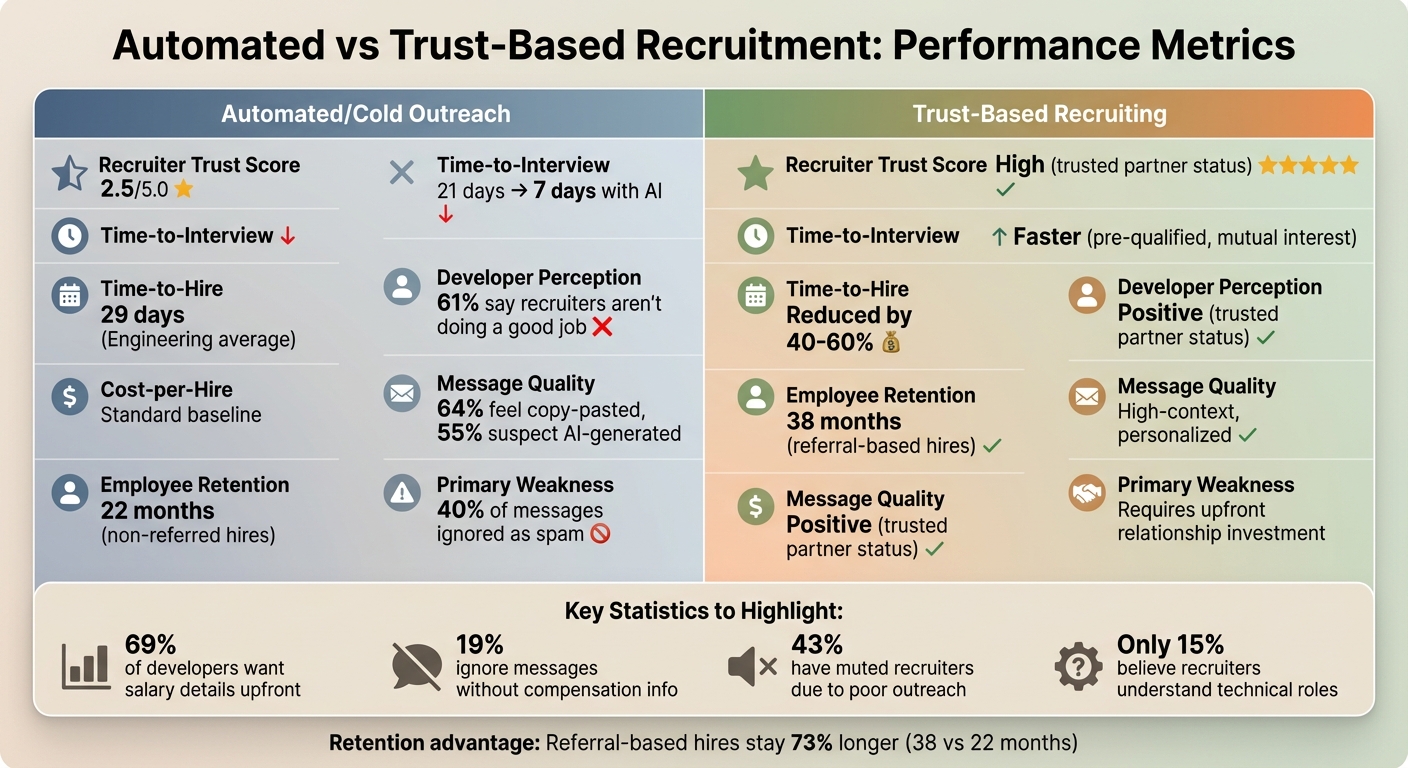 {Automated vs Trust-Based Developer Recruitment: Performance Metrics Comparison}
When it comes to hiring, the numbers tell a compelling story. Automated outreach tools may offer speed and scale, but they fall short in building genuine connections with developers. On the other hand, trust-based recruiting focuses on meaningful relationships, leading to better outcomes in retention, engagement, and overall candidate experience. Implementing candidate experience quick wins can further bridge this gap.
Performance Metrics Comparison
| Metric | Automated/Cold Outreach | Trust-Based Recruiting |
|---|---|---|
| Recruiter Trust Score | 2.5 / 5.0 | High (trusted partner status) |
| Time-to-Interview | ~21 days → 7 days with AI | Faster (pre-qualified, mutual interest) |
| Time-to-Hire | 29 days (Engineering average) | Reduced by 40–60% with targeted approach |
| Cost-per-Hire | Standard baseline | 40–60% lower |
| Employee Retention | 22 months (non-referred hires) | 38 months (referral-based hires) |
| Developer Perception | 61% say recruiters aren't doing a good job | Positive (trusted partner status) |
| Message Quality | 64% say messages feel copy-pasted and 55% suspect AI-generated | High-context, personalized |
| Primary Weakness | 40% of messages ignored as spam | Requires upfront relationship investment |
The comparison highlights a key distinction: automation may improve efficiency, but trust-based recruiting elevates the quality of outcomes. For example, while automated tools can reduce time-to-interview to as little as seven days, they often fail to establish rapport. Developers are quick to spot low-effort, generic outreach - 64% say these messages feel copy-pasted, and over half suspect they're AI-generated .
Meanwhile, trust-based recruiting takes a different approach, prioritizing personalized engagement. By investing in relationships upfront, recruiters can position themselves as trusted partners. This not only improves perceptions but also translates to tangible benefits like a 40–60% reduction in hiring costs and significantly better retention rates. Referral-based hires, for instance, stay an average of 38 months, compared to just 22 months for non-referred hires .
The trust gap is a major hurdle for automation. Only 15% of developers believe recruiters truly understand the technical roles they're hiring for, and 43% have muted recruiters due to poor-quality outreach . Trust-based recruiting addresses these issues by starting conversations from a place of credibility, ensuring that candidates feel valued rather than targeted.
Ultimately, the retention advantage speaks volumes. Referral-based hires not only stay longer but also contribute to a stronger, more stable workforce. That’s not just a better recruitment strategy - it’s a smarter business decision.
Conclusion
Bridging trust gaps is crucial for successful developer recruitment. While automation can speed up processes, it can't replace the human touch that's essential for building credibility. With trust ratings averaging just 2.5 and over 60% of developers expressing dissatisfaction, the core issue isn't efficiency - it's trust and transparency . A trust-first approach prioritizes clear communication, personalized interactions, and genuine intent over impersonal mass outreach.
As Nimrod Kramer, CEO & Co-Founder of daily.dev, aptly says:
"Trust is the currency of modern recruiting" .
This approach isn't just theoretical - it delivers results. Starting with clear, upfront role details in your initial message sets the tone for mutual respect and saves time for everyone involved . For example, 69% of developers want salary details disclosed upfront, and 19% will completely ignore messages that omit this information .
Transitioning from cold, impersonal outreach to relationship-focused recruiting doesn't mean sacrificing efficiency. Instead, it shifts the focus to quality connections. Platforms like daily.dev Recruiter exemplify this shift by facilitating double opt-in introductions and focusing on developer-first interactions. No more generic messages - just meaningful conversations with pre-qualified, engaged candidates.
Take the step toward a recruitment process built on trust. Connect with developers who value clarity, honesty, and personalized engagement.
FAQs
How can I make outreach feel human without losing speed?
To maintain a human touch in your outreach without slowing things down, prioritize personalized, context-aware communication. Mention a developer's latest project, preferred tools, or specific interests to demonstrate that you've done your homework and value their time. Thoughtful, tailored messages not only show respect but also help establish trust and meaningful connections more effectively. By striking the right balance between speed and personalization, you can keep your outreach efficient while still making it feel genuine.
What should the first message include to build trust fast?
When reaching out to a developer, the first message should feel personal and reflect a real understanding of their skills or interests. Mention specific projects they’ve worked on or platforms where they’re active. This not only shows respect for their expertise but also makes your message stand out.
Be upfront about the role, including details like responsibilities, expected challenges, the tech stack, and even the salary range. This kind of transparency builds trust and sets the tone for an honest and productive conversation.
How can I personalize outreach using GitHub or portfolios?
To make outreach more personal, dive into the developer's GitHub or portfolio and reference specific projects, contributions, or technologies they’ve worked on. Calling out particular repositories or technical details demonstrates that you’ve done your homework and genuinely understand their expertise. Craft your message to show how their skills fit the role and take a moment to acknowledge their accomplishments. Avoid sending generic messages - being specific not only builds credibility but also fosters trust, leading to stronger engagement.
.png)