Finding skilled IT professionals is challenging due to high demand and limited supply. To stand out, you need to rethink your hiring approach and focus on what developers value most: meaningful work, growth opportunities, and efficient hiring processes. Here's a quick overview of strategies to attract top IT talent:
- Write Clear Job Descriptions: Focus on impact, technical details, and growth opportunities while avoiding buzzwords.
- Build a Developer-Focused Brand: Share engineering stories, showcase your tech stack, and highlight learning opportunities.
- Adopt Skills-First Hiring: Prioritize practical evaluations and structured interviews over credentials.
- Optimize the candidate experience: Ensure a fast, transparent, and respectful process with clear timelines and feedback.
- Leverage Developer-Centric Platforms: Use tools like daily.dev Recruiter for personalized and opt-in connections.
- Personalize Outreach: Reference candidates' skills, projects, or interests for more engaging communication.
- Offer Flexible Compensation: Combine competitive pay with remote options and strong benefits.
- Design developer-friendly interviews: Focus on practical, low-stress assessments that reflect actual work.
- Invest in Engineering Tools: Provide modern tools and highlight your tech stack to attract skilled developers.
- Build Long-Term Relationships: Stay in touch with potential candidates through valuable content and low-pressure engagement.
1. Write Clear, Impact-Focused Job Descriptions
A job description is often a developer's first glimpse into your company. If it’s filled with vague requirements, buzzwords, or unnecessary jargon, you risk losing their attention - especially since skilled IT professionals in the United States often juggle multiple opportunities. In today’s competitive hiring landscape, every word matters when attracting top talent. Your goal? Show them the value of the role immediately.
Lead with impact. Start by highlighting what the developer will build and why it’s important. For example, instead of saying, "We’re seeking a passionate, self-motivated Senior Software Engineer", try something more direct and meaningful: "You’ll develop a payment platform capable of handling high-volume transactions, empowering small businesses to thrive." This approach clearly conveys the role’s significance and impact.
Be clear about your technical stack and expectations. Don’t just list tools like "Python, Django, PostgreSQL, AWS." Instead, explain how these technologies fit into the role: "You’ll use Python and Django to create APIs that drive our mobile app." Focus on the must-have skills and mark other experiences as optional. This transparency helps candidates quickly determine whether they’re a good fit.
Ditch the buzzwords. Terms like "rockstar" or "ninja" are overused and unhelpful. Instead, describe the actual problems they’ll solve, the team they’ll work with, the tools they’ll use, and how their contributions will make a difference. Specificity always wins.
Emphasize growth and learning opportunities. Developers value staying updated with new technologies and improving their skills. If your team practices modern workflows like code reviews or pair programming, or if you provide perks like conference budgets or opportunities to work on open-source projects, call these out. They can make your role stand out.
Be upfront about compensation. Transparency builds trust. Share salary ranges, equity options, retirement benefits, health insurance, and any flexibility around remote work. This openness helps candidates decide if the role aligns with their needs.
Keep it concise and easy to skim. Use short paragraphs, headers, and bullet points for technical requirements or perks. A scannable format makes it easier for busy candidates to absorb the key details.
Before posting, get feedback from developers. Ask them if the description is clear, if it outlines the role effectively, and if it highlights the challenges and opportunities. Their input can help you fine-tune the job ad and ensure it resonates with your target audience.
2. Build Your Developer-Focused Employer Brand
Developers don’t just stumble upon job opportunities - they actively research companies before applying. They’ll dig into your GitHub, browse your blogs, and skim your social media channels. If they don’t see evidence of a thriving engineering culture, chances are they’ll move on. To attract top talent, you need to showcase what makes your team stand out.
Share real engineering stories. Developers appreciate authentic, technical content. Start a blog where your engineers share their experiences - whether it’s solving tricky technical problems, making architecture decisions, or learning from production challenges. Posts about debugging a distributed system or transitioning to a new database can give candidates a glimpse into the kind of work they’d be doing and the technical environment they’d join.
Highlight your team’s involvement in the developer community. Encourage your engineers to speak at conferences, contribute to open-source projects, and share their expertise. When candidates see your team actively participating in the wider tech world, it signals that your company values growth and innovation.
Be transparent about your tech stack and processes. On your careers page, go beyond job descriptions. Detail the tools, frameworks, and practices your team uses daily. Developers want to know if you’re working with modern technologies, using continuous integration and deployment, or maintaining high code quality. This helps them envision their potential role and assess if it aligns with their skills and interests.
Show your commitment to learning and development. Make it clear that you invest in your team. Highlight perks like conference sponsorships, internal tech talks, mentorship programs, and dedicated learning time. If your engineers have access to training budgets or opportunities to experiment with new tools, let candidates know.
Put your team members front and center. Feature real people from your engineering team. Use video interviews or written Q&As to share their stories - projects they’re proud of, challenges they’ve overcome, or lessons they’ve learned. This personal touch helps candidates imagine themselves as part of your team.
Be upfront about challenges. If your team is tackling technical debt, migrating legacy systems, or scaling infrastructure, don’t shy away from mentioning it. Developers respect honesty and appreciate knowing the kinds of problems they’ll help solve. Transparency about challenges shows that you’re realistic and focused on improvement.
Document your engineering principles. A public engineering handbook or README can go a long way. Outline your team’s workflows, like how you handle code reviews, testing, deployments, and on-call rotations. This not only demonstrates professionalism but also gives candidates a clear sense of your team’s values and practices.
Building a developer-focused employer brand takes effort and consistency. By being transparent and showcasing your team authentically, you’ll attract developers who share your values and are excited to tackle the challenges you’re working on.
3. Use a Skills-First Hiring Process
Traditional hiring often emphasizes degrees, years of experience, and big-name companies. But these factors don’t necessarily prove a developer’s ability to write clean code, debug effectively, or work well with a team. A skills-first hiring process shifts the focus to what candidates can actually do, helping uncover talented individuals who might otherwise be overlooked. This approach ensures your assessments genuinely reflect a candidate's abilities.
Start by defining the key technical skills your team needs. Collaborate with your engineering team to identify specific requirements - like optimizing database queries, building scalable APIs, or working with containerization tools such as Docker. Clear, detailed requirements allow you to design skill-based tests that measure real-world competencies rather than relying on proxies like job titles or academic credentials.
Next, use practical evaluations that simulate real tasks. Consider take-home challenges, live coding sessions, or pair programming exercises. Keep these assessments concise and relevant to the work your team does. Respect candidates’ time while ensuring the tasks provide meaningful insights into their abilities.
Focus on problem-solving skills instead of rote memorization. Ask candidates to explain their reasoning, the trade-offs they considered, and how they handle edge cases. A developer who can think critically and adapt to challenges often brings more value than someone who simply recalls textbook solutions.
Be open to non-traditional backgrounds. Self-taught developers, bootcamp graduates, or career changers who have built applications, contributed to open-source projects, or solved real-world problems deserve a fair shot. A skills-first approach gives these candidates the opportunity to shine, leveling the playing field.
To ensure fairness, implement structured interviews with clear rubrics and multiple interviewers. This approach ensures every candidate is evaluated consistently, reducing bias and making the process more predictable.
Also, test for collaboration. Include exercises where candidates explain their code, respond to feedback, and work with others. Developers rarely work in isolation, so assessing their communication and teamwork skills is just as crucial as evaluating their technical expertise.
Finally, be transparent about the skills being tested and the assessment format. This helps reduce candidate anxiety and shows that your process is fair and well thought out. Top candidates notice and appreciate this level of clarity.
4. Create a Fast and Transparent Candidate Experience
When it comes to hiring top developers, speed and clarity are everything. A sluggish or unclear process can leave candidates frustrated, but you can optimize recruitment funnel conversion rates to prevent competitors from swooping in. To stand out, your hiring process needs to reflect both efficiency and respect for the candidate’s time.
Set expectations early. From the moment a candidate enters your pipeline, let them know what to expect at each stage. Be upfront about the timeline, the steps involved, and who they’ll meet. For instance, you could say: "Our process includes a 30-minute recruiter call, a one-hour technical interview, a take-home assignment (3–4 hours), and a final team interview. The entire process typically wraps up within two weeks." This kind of transparency helps candidates plan and reduces unnecessary stress.
Act fast between stages. Developers often juggle interviews with multiple companies, so delays can be costly. Aim to schedule follow-up interviews within 2–3 business days. If something causes a delay, communicate it clearly - don’t leave candidates guessing.
Offer timely and constructive feedback. After each stage, touch base with candidates within 24–48 hours. Even a quick update acknowledging their progress or providing a timeline goes a long way. And if a candidate isn’t moving forward, specific and thoughtful feedback shows respect for their effort and leaves a positive impression.
Keep communication consistent. Assign a single point of contact for candidates throughout the process. This ensures they always know who to reach out to and keeps them informed at every step, preventing them from feeling lost or forgotten.
Streamline interview scheduling. Respect candidates’ time by organizing interviews efficiently. Consider panel interviews or back-to-back sessions to minimize disruptions. If possible, offer remote interviews to cut out unnecessary travel time and make the process even smoother.
Make the process predictable. Developers appreciate structured and transparent evaluations. Clearly explain the purpose of each stage and what you’re assessing. This reinforces that your process is thoughtful and focused on finding the right fit - not just ticking boxes.
Creating a fast and transparent candidate experience isn’t about rushing - it’s about being organized and communicative. By valuing candidates' time and keeping them informed, you not only improve their experience but also enhance your reputation as an employer. In a competitive hiring market, these details can make all the difference.
5. Use Developer-First Sourcing with daily.dev Recruiter
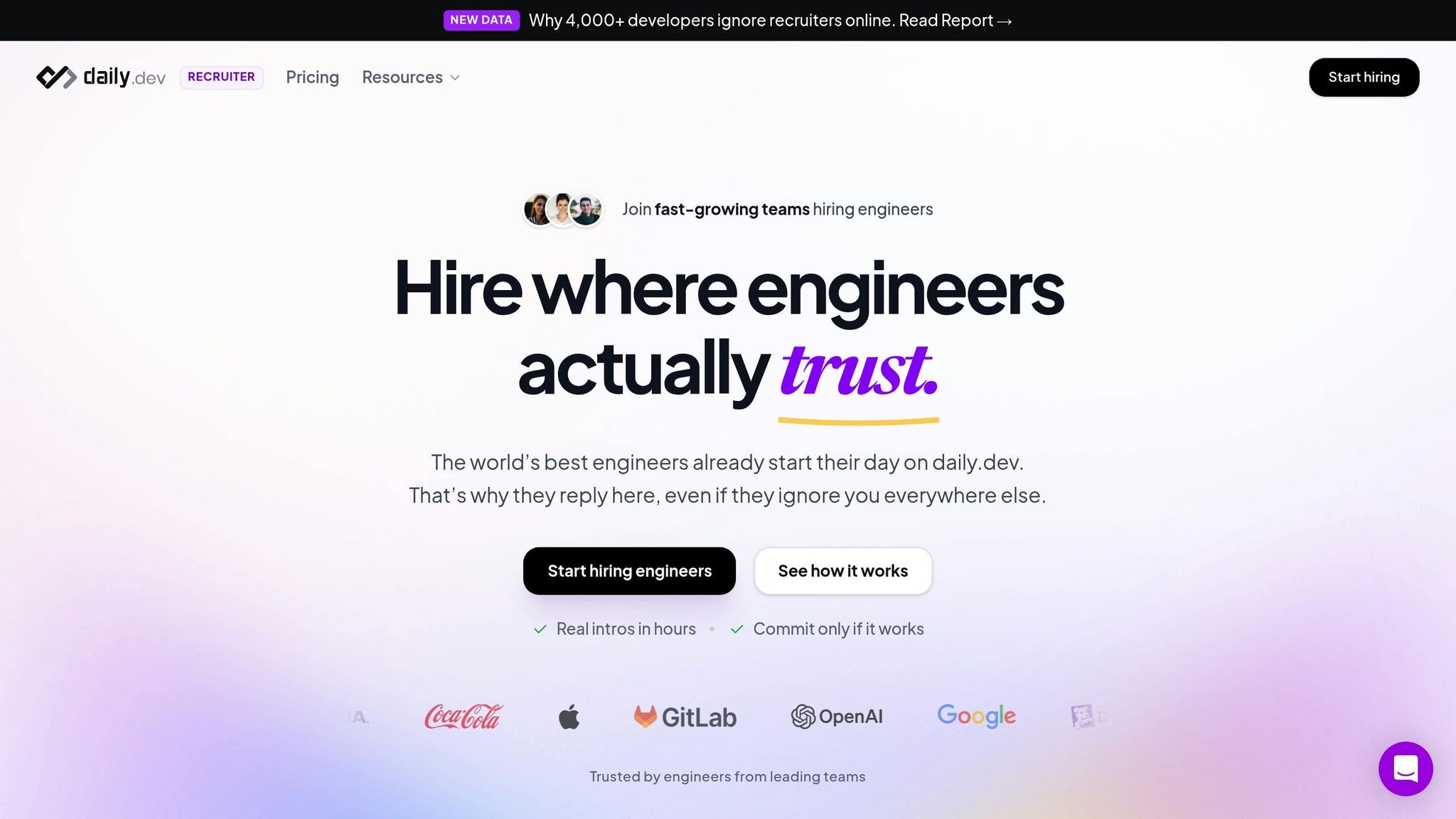
The usual methods of sourcing candidates - like mass emails, scraping LinkedIn profiles, or relying on outdated resume databases - often fall flat in today’s fast-paced hiring environment. These approaches can feel impersonal, lead to low response rates, and leave candidates frustrated.
daily.dev Recruiter takes a different path. Instead of bombarding developers with cold messages, it connects you with software engineers through warm, double opt-in introductions. This means every developer you interact with has already shown interest in your opportunity, cutting out the noise of spam and generic outreach.
Here’s how it works: daily.dev is a platform where developers stay engaged with tech news and learning resources. When you post a job through daily.dev Recruiter, it’s shared with developers who are already active on the platform. If a developer is interested, they opt in to connect with you. This ensures you’re only speaking with candidates who are genuinely open to hearing about your role.
The double opt-in process makes a big difference. Unlike traditional tools that simply give you access to profiles and contact details, daily.dev Recruiter ensures that intent is part of the equation. This leads to better response rates, more meaningful conversations, and a quicker hiring process.
Another perk? The developers you connect with are actively engaged in the tech community. Since they regularly use daily.dev, they’re likely to have up-to-date skills and be part of a vibrant professional network.
And it doesn’t stop there. daily.dev Recruiter respects how developers prefer to be approached. By using job briefs that clearly outline the tech stack, challenges, team dynamics, and overall impact, it builds trust right from the start. This developer-first approach aligns with transparent hiring practices and creates a smoother, more personalized recruitment experience.
6. Personalize Your Outreach to IT Professionals
Once you've nailed clear job descriptions and streamlined the candidate experience, the next step is making your outreach personal. IT professionals, especially developers, can spot a generic message from a mile away - and they tend to ignore it.
Start by highlighting specific skills or projects from their background. Instead of a vague "I see you're a software engineer", dive into the details. Say something like, "I noticed you've been working with Rust and WebAssembly on recent projects." This shows you’ve done your homework. If they've contributed to open-source projects, built an interesting side project, or published technical articles, bring it up. A message like, "Your caching optimization in Project X caught my attention - especially how you handled concurrent reads", instantly feels more thoughtful and engaging.
Pay attention to what they share and engage with online. Developers often showcase their work on platforms like GitHub, so check out their repositories and contributions. If they write blogs or speak at conferences, reference that. Mentioning their involvement in specific tech communities or forums signals that you’re reaching out to them as an individual, not just another name in a database.
Keep your message short and to the point, and front-load the most relevant details. Developers decide quickly whether to keep reading or move on. Lead with what caught your eye about their work, then briefly explain why your opportunity aligns with their skills and interests. Avoid corporate jargon - use a conversational, straightforward tone and effective candidate engagement strategies instead.
Timing and context can make or break your outreach. If a developer recently published an article about microservices architecture and your role focuses on distributed systems, use that as a connection point. For example: "I just read your article on event-driven architecture - it’s exactly what we’re working on." This kind of timely, targeted message stands out and feels relevant.
Tools like daily.dev Recruiter simplify this process by connecting with developers who’ve already opted in, making it easier to replace cold outreach with a genuine connection.
Personalized outreach isn’t just about being polite - it works. Developers are far more likely to respond when they see you’ve taken the time to understand their expertise and interests. It shows respect for their skills and signals that you’re serious about finding the right fit, not just filling a role.
Hiring engineers?
Connect with developers where they actually hang out. No cold outreach, just real conversations.
7. Offer Competitive and Flexible Compensation
Once you've fine-tuned your hiring process, pairing it with a compelling compensation package can seal the deal with top candidates. IT professionals expect a well-rounded, market-aligned offer. Start by researching current market rates, paying attention to variations based on location, experience level, and specific technical skills. Benchmarking your salary offers against industry norms ensures you're staying competitive.
Equity can be a game-changer, particularly for startups or companies in growth mode. If equity is part of your offer, provide clear details about vesting schedules and long-term benefits. Transparency here helps candidates grasp the true value of what you're putting on the table.
In today's job market, flexible work options are no longer just perks - they're often expected. Many IT professionals prioritize remote or hybrid work opportunities. Be upfront about whether your company supports these arrangements and explain how they’re structured.
Finally, a strong benefits package ties everything together. Health insurance, generous time off, and opportunities for professional development make your offer stand out. By presenting a complete and transparent compensation package in your job postings, you not only build trust but also make the hiring process smoother and more efficient.
8. Design a Developer-Friendly Interview Process
Creating a smooth and respectful interview experience is just as important as offering a competitive salary. Developers value processes that reflect their actual work and don’t waste their time. A poorly designed interview process - one that feels irrelevant, overly stressful, or unnecessarily drawn out - can drive top candidates away. And let’s not forget: developers talk. Word spreads quickly about companies with inefficient or frustrating interview practices. The goal is simple: assess real skills, respect candidates’ time, and leave a positive impression, no matter the outcome.
Prioritize real-world skills over puzzles. The best technical assessments simulate the kind of work developers will handle on your team. Forget obscure brainteasers or abstract algorithm challenges. Instead, focus on tasks like debugging code, reviewing a pull request, implementing a feature, or designing a system component. For instance, if you’re hiring a backend developer, asking them to design a rate-limiting service provides a practical and relevant challenge. Let candidates work within a realistic codebase using the languages and frameworks your team uses. This gives you a better sense of how they’ll perform in their day-to-day role.
Consider replacing whiteboard exercises with collaborative coding in a shared editor or IDE. This allows candidates to use their usual tools - linters, documentation, and their preferred setup - making the experience more natural and less stressful. If you opt for take-home assignments, keep them brief (2–3 hours) and clearly outline what you expect. Some companies even compensate candidates for longer projects, which demonstrates respect for their time and effort, especially outside of regular work hours.
Respect candidates’ time. Most developers are balancing interviews with full-time jobs, so time is a precious resource. A well-structured process might include three to four short stages, such as:
- A 20–30 minute recruiter screen
- A 45–60 minute technical screen
- A 60–90 minute panel interview
- An optional final conversation
Keep total live interview time under 3–4 hours, and make sure each stage has a specific purpose. For example, if the technical screen already covered coding skills, use the panel interview to evaluate architectural thinking or teamwork. Avoid cramming multiple interviews into a single, exhausting day, and offer virtual options to minimize travel time - especially across U.S. time zones.
Lower stress without losing rigor. Send candidates a detailed interview agenda several days in advance. Include topics, formats (like pair programming or design discussions), technologies, and a list of interviewers. Sharing sample questions or problem types can help candidates prepare and reduce anxiety. During the interview, start with a friendly chat to build rapport and encourage candidates to think aloud. Be ready to clarify questions and avoid adversarial tactics or trick questions that only heighten stress without adding value. Allowing candidates to reference documentation or other resources mirrors real-world problem-solving and helps you see how they approach challenges.
Use structured evaluation to ensure fairness. A structured rubric is key to evaluating candidates fairly. Define role-specific criteria such as code quality, problem-solving, communication, and collaboration. Create behavior-based rating scales with clear examples for each level of performance. Before conducting interviews, align your team on what "meeting expectations" looks like for the role and its seniority level. During the interview, have each interviewer score independently based on the rubric, using objective notes like "identified performance bottleneck and suggested indexing strategy" instead of vague impressions. Afterward, discuss as a panel. This approach reduces bias and ensures consistency, which is increasingly important for organizations committed to equity and inclusion. Research from the U.S. Office of Personnel Management shows that structured interviews are more predictive of job performance and help minimize bias.
Be clear and move quickly. Transparency is crucial. Share the full interview process upfront, including the number of stages, estimated duration, and an overall timeline. For example: "Our process has three stages over 1–2 weeks, with decisions made within three business days of the final interview." Use scheduling tools to accommodate U.S. time zones and offer flexible slots like early morning, lunchtime, or late afternoon. Always start and end interviews on time. If an interview runs long, ask for the candidate’s permission to continue. A slow or disorganized process can discourage candidates - especially in high-demand roles.
Provide meaningful feedback. Whether a candidate gets the job or not, timely and specific feedback leaves a lasting impression. Instead of vague statements like "We went in a different direction", offer constructive insights tied to job-related criteria. For example: "We were looking for more depth in system design tradeoffs, particularly around scaling and data consistency." To avoid legal risks, keep feedback focused on documented criteria, steer clear of references to protected characteristics, and use neutral, professional language. Even brief, thoughtful feedback can significantly boost your company’s reputation. Talent Board’s North American Candidate Experience studies highlight that timely communication and feedback are among the strongest predictors of candidate satisfaction and their likelihood to recommend the company.
Adapt for remote and hybrid work. With remote and hybrid roles becoming the norm - 74% of teams now hire for remote positions - your interview process must work seamlessly in virtual settings. Developer-friendly virtual formats include live coding in browser-based editors, screen sharing from the candidate’s IDE, virtual whiteboarding for system design, and asynchronous take-home tasks where appropriate. Be mindful of time zones when scheduling multi-hour interviews and offer multiple time slots to avoid inconveniencing candidates in any region.
9. Invest in Engineering Culture and Tools
Creating a strong engineering culture goes hand in hand with having a smooth hiring process. Skilled developers care about more than just a paycheck - they look closely at the work environment, the tools they'll use, and the overall company ethos. A modern tech stack and cutting-edge tools signal that you're serious about fostering a forward-thinking engineering team.
Highlight your tech stack. Be upfront about the frameworks, languages, and cloud architectures your team uses. Explain how these tools help tackle real-world challenges. If you're in the process of upgrading from older systems, don't shy away from sharing your plans. Framing this as a chance to innovate can appeal to candidates eager to leave their mark on meaningful projects.
Equip your team with the right tools. Fast CI/CD pipelines, reliable testing frameworks, and modern IDEs can make a world of difference. These tools not only reduce inefficiencies but also allow engineers to focus on solving the interesting, complex problems they signed up for. Investing in better infrastructure shows your dedication to both quality and your team's success. This foundation is also essential for retaining top engineering talent long after the initial hire.
10. Build Long-Term Relationships with Future Candidates
In the world of talent acquisition for engineering teams, not every talented professional is ready to make a career move right away. Instead of treating these interactions as one-off conversations, think of them as the beginning of a meaningful, long-term connection. The goal is to stay on their radar in a way that feels natural and valuable over time.
Be visible without being intrusive. Instead of sending generic check-ins, share something that genuinely matters to them. It could be an article about a technology they're passionate about, updates on an open-source project your team is involved in, or an invite to a virtual tech talk hosted by your company. The idea is to contribute to their professional growth, not just remind them you exist.
Offer content that resonates. Developers thrive on learning and staying informed. If your company has engineering blog posts, technical case studies, or behind-the-scenes insights into your development process, use these as conversation starters. When sharing, keep your message short and explain why you thought it would interest them, referencing any prior discussions you've had.
Keep track of the details. Take note of what excites each developer - whether it’s their favorite tech stack, long-term career goals, or side projects they’re passionate about. These details make your follow-ups more personal and relevant. For instance, if a new position aligns with their aspirations or your team adopts a technology they love, you’ll have a solid reason to reconnect.
Create low-pressure ways to engage. Beyond one-on-one communication, consider hosting events like meetups, hackathons, or webinars. These give developers a chance to experience your company culture without any pressure. Even if they aren’t actively looking for a job, a positive experience can leave a lasting impression.
Respect their preferences and timing. Some developers might appreciate occasional updates about your company, while others prefer to reach out when they’re ready. Always honor their preferences - it shows you value their time and are more interested in building trust than just filling an open role.
Conclusion
Hiring top IT talent in today’s competitive market isn’t just about offering bigger paychecks or posting job ads everywhere. It’s about understanding what truly matters to developers and shaping your hiring process around those priorities. The strategies outlined here all revolve around one key idea: treat developers as the skilled professionals they are - not just as a collection of resumes.
Start by crafting job descriptions that highlight the real impact of the role. Build an employer brand that resonates with developers by showcasing your company’s culture through authentic engineering blogs, open-source contributions, and transparency about how your teams work. Move away from rigid, credential-focused screening and instead use skills-based assessments to evaluate what candidates can actually do.
Speed and clarity matter. Developers talk, and reputations are built on how companies treat candidates during the hiring process. Streamline your interviews with clear timelines, constructive feedback, and formats that feel more like collaborative problem-solving rather than rigid questioning. And don’t overlook your sourcing strategy - meet developers where they already are. Tools like daily.dev Recruiter help connect you with pre-qualified, engaged developers , replacing cold outreach with meaningful, trust-based connections.
When reaching out to candidates, make it personal. Tailor your approach to their background, interests, and priorities. While competitive pay is important, flexibility often carries just as much weight. Options for remote work, opportunities for career growth, and benefits that support a healthy work-life balance can make all the difference for top-tier talent.
Beyond these immediate tactics, focus on building long-term relationships. Recruitment doesn’t end with a single hire. By staying visible - whether through valuable content, hosting technical events, or maintaining genuine, pressure-free connections - you reinforce the strategies discussed here and position your company as a place developers want to work.
Ultimately, standing out in a crowded market means committing to these approaches consistently. It requires effort, adaptability, and a willingness to rethink traditional recruiting methods. Skilled developers have plenty of choices, so your hiring process needs to reflect the respect and professionalism they expect.
FAQs
How can companies write job descriptions that attract top IT talent without overusing buzzwords?
To draw in top IT professionals, companies need to create precise and detailed job descriptions. Focus on outlining the essential skills, technologies, and responsibilities tied to the role. Skip overused buzzwords like "rockstar" or "ninja", and instead, share specific information about the projects candidates will tackle and the contributions they can make.
Use language that connects with developers in a straightforward and relatable way. Be sure to include insights about your team, the tools they’ll use, and your company’s work environment. This not only helps attract well-suited candidates but also fosters trust and gives applicants a clear picture of what they’re stepping into.
How can we create an employer brand that appeals to top IT professionals?
Building an employer brand that resonates with developers starts by understanding what matters most to them. Transparency, opportunities for growth, and a thriving tech environment top the list. Make it clear in your messaging that your company values innovation, supports work-life balance, and prioritizes professional development.
To connect with developers, meet them where they already are - on tech forums, coding platforms, and at industry events. Share your team’s successes, give a peek behind the scenes, and encourage your developers to talk about their experiences. This not only builds credibility but also shows that your company is a place where IT professionals can succeed and grow.
Don’t overlook the power of a strong careers page and personalized outreach. Use straightforward, genuine language to communicate your mission and highlight the meaningful contributions developers can make by joining your team. In today’s competitive job market, a well-thought-out employer brand can set you apart and attract the talent you need.
What makes a skills-first hiring approach more effective for finding top IT talent?
A skills-first hiring approach puts the spotlight on a candidate's practical abilities and hands-on experience, rather than focusing solely on traditional markers like degrees or previous job titles. This method aligns a candidate's capabilities more closely with the role's actual demands, leading to quicker onboarding and improved performance.
What’s more, this approach actively supports diversity and inclusion by creating opportunities for individuals from non-traditional paths who possess the expertise but may lack formal credentials. By emphasizing what a candidate can deliver rather than where they’ve been, you can attract and keep top IT talent, even in a highly competitive job market.
.png)