Hiring engineers in 2026 is no longer a simple task. The platform you choose can drastically affect how fast you hire, how much it costs, and whether you find the right talent. Specialized platforms now let you hire in as little as 24 hours, compared to traditional methods that can take months. Different platforms to source software developers serve various needs - from full-time employees to freelancers or contract developers. Here's a quick breakdown:
- daily.dev Recruiter: Connects with senior developers via a pay-per-introduction model. Best for specialized roles like AI or Kubernetes experts.
- Wellfound (AngelList Talent): Ideal for startups hiring candidates interested in equity and fast-paced environments.
- Hired: Focuses on pre-vetted candidates for permanent, contract, or executive roles.
- Toptal: Premium freelance marketplace with top 3% talent for high-stakes projects.
- Stack Overflow Jobs: Leverages a trusted tech community for full-time hires.
- LinkedIn Recruiter: Access to a massive database for full-time, contract, and freelance roles.
- Upwork: Flexible freelance marketplace for short-term projects.
- Dice: Tech-specific job board for active job seekers in fields like AI and cybersecurity.
- Indeed: Broad job board for high-volume hiring but requires extensive screening.
- GitHub Sourcing: Free access to developers’ code contributions, ideal for passive talent.
Quick Comparison
| Platform | Best For | Pricing Model | Hiring Speed | Candidate Type |
|---|---|---|---|---|
| daily.dev Recruiter | Specialized senior developers | Pay-per-introduction | Hours to days | Passive, engaged talent |
| Wellfound | Startup-focused roles | Free to $499+/month | Weeks | Equity-driven talent |
| Hired | Pre-vetted talent | Custom, relationship-focused | 2–4 weeks | Full-time, contract |
| Toptal | High-stakes freelance work | $500 deposit + $79/month | 48 hours | Top-tier freelancers |
| Stack Overflow Jobs | Full-time tech hires | $400–$600 per listing | 3–5 weeks | Active job seekers |
| LinkedIn Recruiter | High-volume hiring | Annual subscription | 1–4 months | Broad talent pool |
| Upwork | Short-term freelance projects | Dual-fee structure | Under 24 hours | Freelancers |
| Dice | Tech-specific roles | Premium monthly plans | Weeks | Active tech talent |
| Indeed | High-volume hiring | Pay-per-click/application | Weeks | Broad audience |
| GitHub Sourcing | Passive tech talent | Free (manual search) | Variable | Skilled developers |
The best platform depends on your hiring needs, timeline, and budget. For startups, Wellfound is great for equity-driven roles. For quick freelance hires, Upwork or Toptal works well. If you need specialized talent, daily.dev Recruiter or GitHub Sourcing offers targeted options.
::: @figure 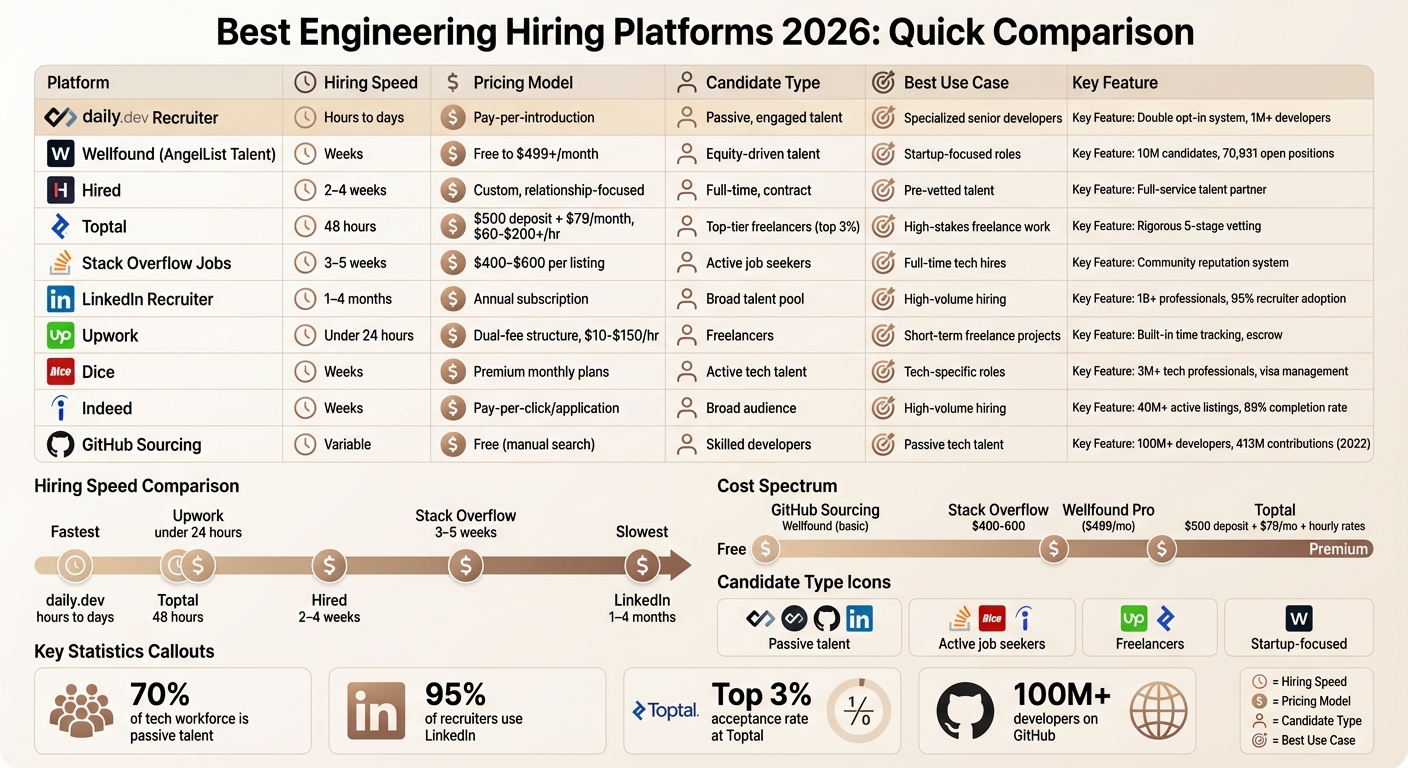 {Engineering Hiring Platforms Comparison 2026: Speed, Cost, and Candidate Types}
1. daily.dev Recruiter
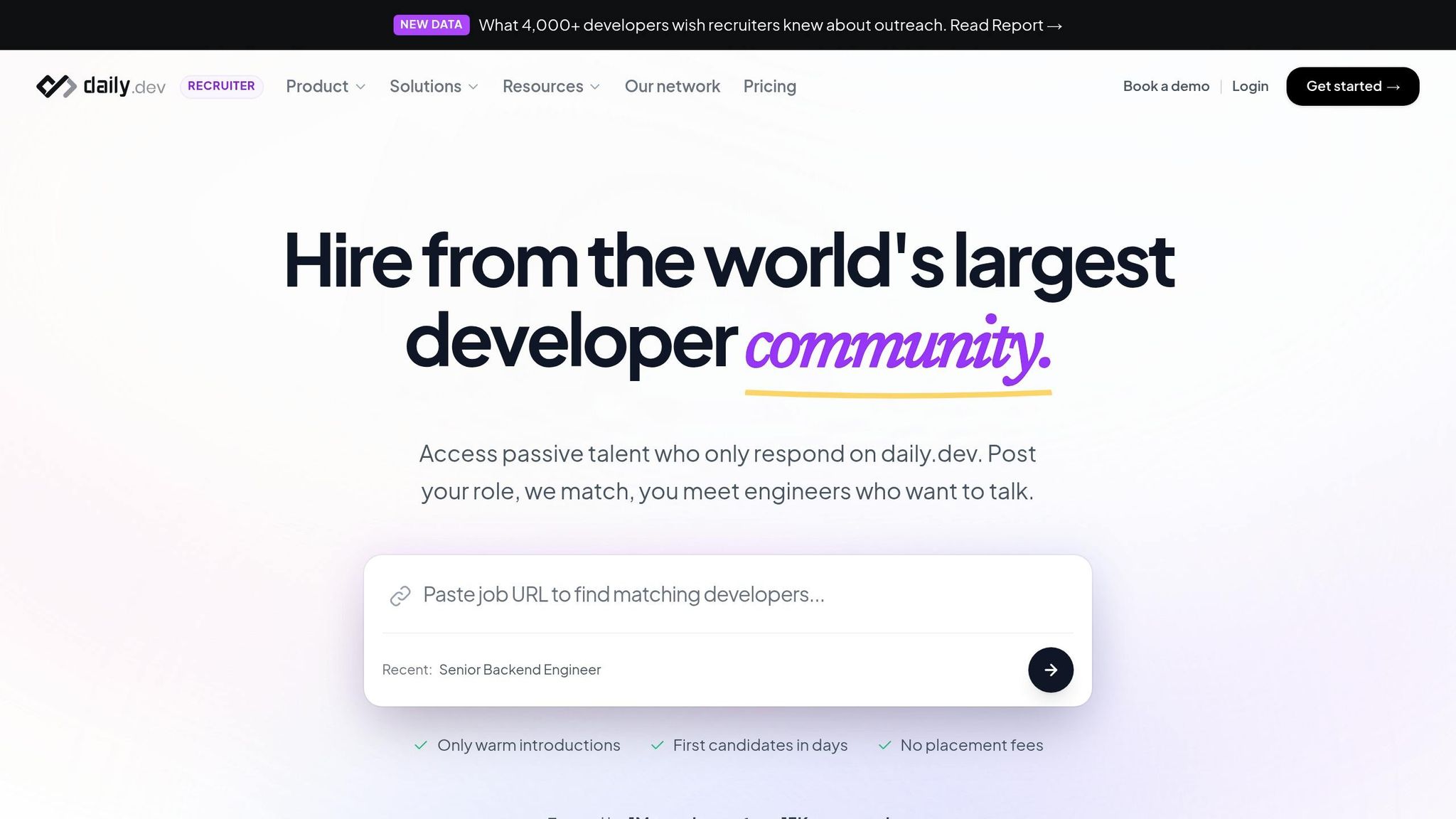
daily.dev Recruiter taps into a network of over 1 million developers who engage with the platform daily. Instead of relying on traditional outreach methods, this tool integrates directly into developers’ workflows - where they’re already reading about tech, learning new skills, and staying up to date with industry trends.
What sets this platform apart is its double opt-in system. Developers express interest first, so you’re only connecting with candidates who are genuinely open to opportunities. Plus, there are no placement fees or salary-based commissions - you simply pay for introductions, not hires .
Candidate Profile
The platform connects you with senior developers and engineering leaders who are committed to professional growth. These are highly engaged individuals who regularly consume technical content and participate in the developer community. While they may not be actively job searching, they’re open to the right opportunity. By analyzing behavioral signals, daily.dev ensures you’re reaching developers who are serious about staying at the forefront of their fields and sharpening their skills.
Best Use Case
daily.dev Recruiter is especially effective for filling specialized roles, such as experts in AI, Rust, or Kubernetes. It’s also perfect for passive sourcing, helping you connect with top-tier talent before they actively start job hunting. Since daily.dev is a platform developers use daily for growth, it allows you to engage with potential candidates early - before they hit the broader job market .
Pricing
With a pay-per-introduction model, the costs are straightforward and predictable. There are no placement fees or salary-based commissions, so you’re not pressured to make quick hiring decisions to save money. This approach ensures you can focus on finding the right fit while accessing a dynamic pool of developers who are committed to advancing their careers. And since introductions happen within hours, the platform helps you reduce time to hire without sacrificing quality .
Hiring engineers?
Connect with developers where they actually hang out. No cold outreach, just real conversations.
2. Wellfound (AngelList Talent)
Wellfound, previously known as AngelList Talent, is a platform tailored for startups, connecting employers with over 10 million candidates focused on startup roles . Unlike many job boards, it cuts out third-party recruiters, allowing direct communication with founders and internal hiring teams. As of early 2026, the platform features around 70,931 open engineering positions , covering a wide range of specialties like mobile, web, and cutting-edge technologies.
Candidate Type
Wellfound's candidate pool is made up of professionals who thrive in startup environments. These individuals are often drawn to the unique challenges and rewards of startups, including equity compensation and fast-paced growth. Job postings on the platform clearly display salary ranges and equity options upfront , ensuring transparency and attracting candidates who are aligned with these priorities. This makes Wellfound particularly effective for startups looking for nimble, motivated team members.
Best Use Case
Wellfound is best suited for early-stage to growth-stage startups, typically ranging from seed funding to Series B. It’s especially useful for companies operating in fast-moving, dynamic industries. However, if your hiring needs lean toward more traditional corporate roles or candidates who prefer stability over equity, this platform may not be the ideal choice. To date, Wellfound has facilitated over 8 million matches between candidates and employers . Many users report that up to half of their successful hires come directly from Wellfound.
"What Wellfound did for me as the hiring manager is... it gave me time back. There's so much noise on the other platforms, we didn't find that on Wellfound."
- David Lokshin, Founder, Trace
Pricing
Wellfound offers several pricing tiers to accommodate startups at different stages of growth:
- Access: Free of charge, this tier includes unlimited job postings, applicant reviews, branded company profiles, and a built-in applicant tracking system (ATS) .
- Recruit Pro: Priced at $499/month, this option adds advanced sourcing strategies and filters, personalized pitch templates, resume access, and unlimited messaging .
- Autopilot: For a more hands-off approach, this tier provides a dedicated sourcing expert who delivers 5–10 pre-screened candidates weekly . This pre-qualification process ensures higher quality matches and faster onboarding.
- Curated: Focused on efficiency, this plan offers access to the top 10–20% of pre-vetted candidates who are ready for immediate interviews .
Each pricing tier is designed to help startups find the right talent without unnecessary complexity.
3. Hired
Hired acts as a full-service talent partner, focusing on connecting companies with pre-vetted candidates rather than operating as a typical job board. It specializes in roles within technology and data, such as software engineering, cybersecurity, data analytics, and IT leadership .
Candidate Type
Hired supports a variety of hiring needs, including permanent placements (full-time), contract staffing, and executive searches . This versatility makes it a strong option for building core engineering teams, filling short-term project roles, or recruiting senior technical leaders. To stay on track, companies can use a developer hiring timeline planner to manage these various engagement types. Candidates are thoroughly vetted for their skills and experience before being introduced to employers.
Best Use Case
Hired works best for companies that value quality over quantity and prefer a relationship-focused hiring process. Its curated matching system simplifies recruitment by connecting employers with pre-screened professionals, making it an excellent choice for organizations looking to assemble specialized technical teams.
Pricing
Hired follows a full-service partner investment model, which differs from standard pay-per-listing or subscription pricing . Costs are negotiated based on factors like hiring volume, the complexity of roles, and the type of engagement. While this approach typically involves a larger upfront commitment, it provides a more tailored and personalized recruitment experience. This pricing structure is ideal for businesses seeking a customized, relationship-driven hiring solution.
4. Toptal
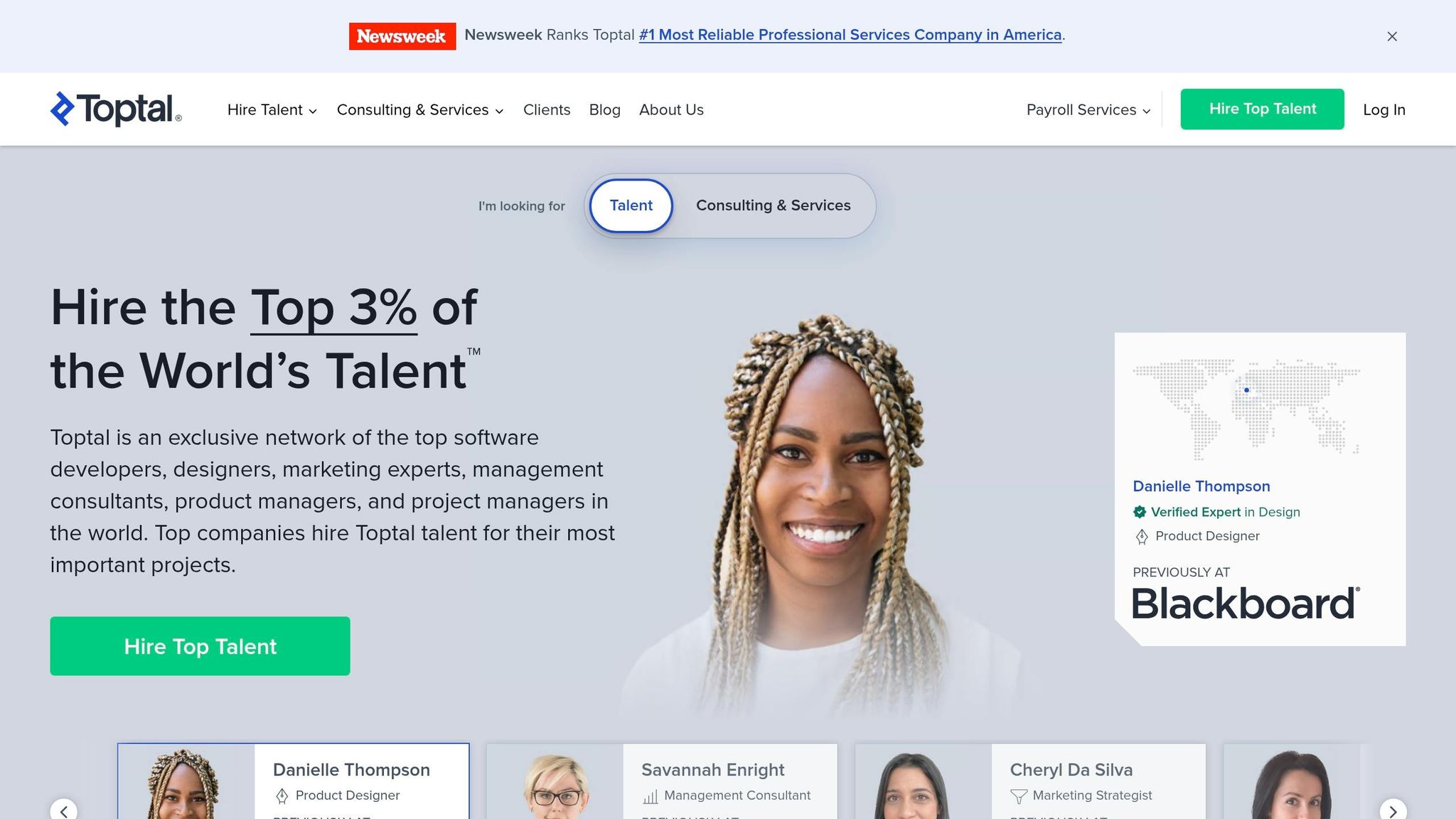
Toptal is a high-end freelance marketplace that accepts fewer than 3% of applicants . Their rigorous five-stage vetting process - covering language skills, technical reviews, live coding, and practical tests - takes between 2 to 5 weeks, ensuring only the most qualified candidates make the cut . This rigorous approach is a benchmark for how to identify qualified technical candidates efficiently.
Candidate Type
Toptal focuses exclusively on freelance and contract engineers who are available for hourly, part-time, or full-time projects . Unlike platforms offering traditional W-2 employees, Toptal is strictly for contract-based work. This makes it ideal for businesses seeking specialized, top-tier professionals for specific projects or to temporarily fill critical gaps in their teams without committing to permanent hires.
Best Use Case
Toptal is the go-to choice when you can't afford to make a bad hire. It's perfect for high-stakes scenarios like security-sensitive projects, major launches, or when you need someone who can deliver results immediately . For example, the Cleveland Cavaliers used Toptal developers in 2015 to create their "Wine & Gold Nation" fan engagement platform just days before the NBA Finals. The project included a membership portal with secure payment capabilities, designed to handle millions of global users . Similarly, Adcrush Media, a marketing agency, tapped into Toptal's talent pool to hire 10 developers who automated their paid media buying process, allowing them to grow their client base and boost revenue significantly .
Pricing
Toptal’s premium service comes with a $500 refundable deposit and a $79 monthly subscription fee . Hourly rates range from $60 to over $200, while part-time engagements cost $1,000–$1,600 per week, and full-time commitments range from $2,000–$3,200 per week . Their pricing model uses an "all-in" blended rate, which includes the freelancer’s pay, platform fees (estimated at 30–50%), and payroll taxes . For example, hiring a senior engineer at $120 per hour translates to an annual cost of approximately $249,600 (you can estimate your own costs using a hiring budget calculator) - a significant jump compared to the $206,000 total cost of a U.S.-based hire with a $165,000 base salary plus benefits .
Next, we’ll look at more platforms to expand your hiring options.
5. Stack Overflow Jobs
Stack Overflow Jobs is a tech job board and one of many developer sourcing channels that was relaunched in May 2024 through a partnership with Indeed . It leverages the massive Stack Overflow developer community - where engineers actively solve problems and demonstrate their skills - to connect talented professionals with hiring companies.
Candidate Type
This platform is best suited for full-time, permanent hires rather than short-term or freelance roles . While contract positions can be posted, the lack of tools for standardizing contract rates makes it less practical for temporary engagements. Community feedback also suggests that freelance work falls outside the platform’s main focus . By concentrating on long-term opportunities, Stack Overflow Jobs ensures that job postings attract candidates looking for stable, full-time positions.
Best Use Case
Stack Overflow Jobs is ideal for companies looking to strengthen their presence within the tech community while hiring highly specialized technical talent. It’s particularly effective for businesses that want to connect with developers who are actively engaged in the platform. As noted in the Stack Overflow Blog :
"At Stack Overflow, one of our main missions is to close the gap between companies and developers during the hiring process... we are also a talent platform, and are in a unique position to connect developers with companies and jobs that they are best suited for."
- Stack Overflow Blog
The platform’s unique community-driven approach allows developers to build reputations through their contributions and earn technology-specific tags. This system helps employers identify candidates with proven expertise. Typically, the hiring process on this platform takes about 3–5 weeks , giving companies access to a focused pool of qualified, full-time technical professionals.
Pricing
Job postings are priced between $400–$600 per listing . While the pricing is straightforward, companies should be prepared to invest time in screening candidates, as the platform relies on community reputation rather than detailed pre-screening processes. This balance makes Stack Overflow Jobs a cost-effective option for sourcing technical candidates on a budget.
6. LinkedIn Recruiter

LinkedIn Recruiter is a premium recruiting tool that provides access to a pool of over 1 billion professionals. According to a 2024 SHRM report, 95% of recruiters rely on LinkedIn, highlighting its dominance in the hiring landscape . Over the years, the platform has transitioned from manual Boolean searches to AI-driven sourcing tools, cutting search times by more than 70% .
Candidate Type
This platform is ideal for recruiting full-time, contract, and freelance professionals, with a particular strength in reaching passive candidates - those not actively job hunting but open to opportunities. Its vast database includes talent at all levels, from entry-level developers to senior engineers and leadership roles, making it a versatile choice for various hiring needs.
Best Use Case
LinkedIn Recruiter shines when you need to reach a broad audience, especially for roles experiencing rapid growth. For example, LinkedIn has identified AI Engineers and Heads of AI as some of the fastest-growing positions in the U.S. by 2026 . Back in summer 2025, the platform handled about 11,000 applications per minute , showcasing its unparalleled reach and activity.
To get the most out of LinkedIn Recruiter, adopting a "career advisor" approach is key. The platform’s AI tools analyze candidates' profiles and digital activity to suggest personalized talking points, improving response rates . These advanced features, combined with its massive database, justify its premium pricing, though many teams now compare LinkedIn Recruiter alternatives to find better developer engagement.
Pricing
LinkedIn Recruiter operates on an annual subscription model with pricing available upon request . For smaller recruiting teams, Recruiter Lite offers a more affordable alternative, providing additional InMails and advanced search filters compared to the free version . However, the platform's upfront cost makes it a better fit for companies with ongoing, high-volume hiring needs rather than those filling occasional roles.
7. Upwork
Upwork is a popular freelance marketplace that connects millions of professionals worldwide. With ratings ranging from 4.3 to 4.6 on G2, it’s a go-to platform for hiring freelance talent . It offers tools like built-in time tracking, escrow services, and project management features.
Candidate Type
Upwork caters to freelance engineers, making it suitable for both short-term projects and ongoing retainers. Hourly rates vary widely, from $10 to $150, allowing businesses to find talent that fits their budget and experience requirements . For fixed-price projects, escrow ensures payment security, while the "Work Diary" feature provides hourly contract transparency with screenshots . This diverse talent pool makes it easier to find freelancers for a variety of needs.
Best Use Case
Upwork is ideal for companies seeking quick access to technical expertise for short-term projects. However, since the platform operates as an open marketplace, you’ll need to vet technical skills yourself to ensure quality . While the large talent pool covers nearly every tech stack or niche, screening candidates can take time. It is also essential to assess technical and soft skills to ensure a cultural fit. Be aware of potential misrepresentation issues, particularly with agency profiles.
Pricing
Upwork uses a dual-fee structure, meaning both clients and freelancers pay service fees for each contract . Clients can select between Marketplace (Basic) and Business Plus plans, each offering different features and fee levels . Additionally, a one-time Contract Initiation Fee - ranging from $0.99 to $14.99 - applies to most new contracts . While this pricing model offers flexibility, fees can accumulate on larger projects, so it’s worth considering for businesses with adaptable budgets.
8. Dice

Dice is built specifically for tech hiring, offering access to a network of over 3 million skilled professionals . It uses AI-powered tools and advanced Boolean search to help employers find candidates with precise technical expertise . One standout feature is its ability to manage visa status and work permits, making it especially helpful for hiring international engineers . These features make Dice a go-to platform for companies focused on tech recruitment.
Candidate Type
Dice caters to active job seekers in the tech industry, including roles like software developers, data analysts, cybersecurity experts, and IT technicians . A notable trend: as of February 2026, 74% of tech professionals are planning to switch jobs within the next year. This shift is partly fueled by rising burnout rates, which have increased from 31% to 46% . While this means an eager talent pool, it also highlights growing concerns about job stability and security.
Best Use Case
Dice is ideal for mid-sized to large companies hiring for multiple technical positions, especially in fields like AI/ML, cloud computing, or cybersecurity . However, for businesses filling only one or two roles, the platform's premium pricing might not be worth it. It's also wise to double-check some candidate details manually .
Pricing
As a premium platform, Dice is designed for companies with ongoing technical hiring needs . Monthly plans include features like branding tools and ATS integration, which can enhance hiring efficiency for enterprises . While pricing details aren't openly available, the platform's focus on tech hiring and advanced tools make it a strong fit for businesses with consistent recruitment demands.
9. Indeed
As a popular alternative to LinkedIn Recruiter, Indeed is one of the largest job boards out there, boasting over 40 million active listings and reaching a massive audience . It supports various job types, including full-time, part-time, contract, and freelance roles, catering to professionals at all levels - from entry-level developers to senior architects.
Candidate Type
Indeed attracts a broad range of active job seekers, covering all experience levels. Around 60% of its users are general professionals . However, unlike niche tech platforms, Indeed operates on a DIY screening model. This means you'll likely receive a high volume of applications, but not all will meet your specific technical needs. While this wide reach is a plus, it introduces challenges for targeting specialized roles.
Best Use Case
Indeed shines when it comes to high-volume hiring, especially if you're looking to quickly fill multiple entry- to mid-level engineering positions . It’s particularly effective for local hiring if your company has strong brand recognition. However, for specialized roles like machine learning engineers or senior backend architects, you may need to dedicate significant time to filtering applications. With response rates averaging just 1% to 2% , the platform often has a low signal-to-noise ratio for niche positions. To streamline the process, you can use Indeed Assessments and other best hiring tools for technical roles to pre-screen candidates, cutting down on manual effort .
Pricing
Indeed offers free job postings, but these can lose visibility quickly as new listings are added . The platform provides two main pricing options:
- Pay-Per-Application (PPA): You pay only for applications that meet specific mandatory criteria.
- Pay-Per-Click (PPC): You set a daily or monthly budget, and costs depend on clicks.
Pricing is dynamic, varying by job title, location, and market competition. Sponsored postings significantly boost your chances of hiring, making you 4.5 times more likely to secure a candidate .
Candidate Pool Focus
Indeed’s major strength lies in its vast reach, appealing to active job seekers across industries. It boasts an impressive application completion rate of 89%. However, salaries on Indeed tend to be 15% to 30% lower compared to more focused platforms . Given its broad candidate pool and pricing structure, a strategic screening process is essential to identify specialized engineers. This makes Indeed a strong choice for companies focusing on high-volume hiring for entry- to mid-level technical roles, while it works best when paired with platforms targeting more specialized talent pools.
10. GitHub Sourcing
GitHub stands out as a sourcing platform because it gives you direct access to developers' actual coding work. With over 100 million developers showcasing their code, GitHub serves as a living portfolio, offering a transparent view of technical skills. Instead of relying solely on resumes, you can dive into commit histories, pull requests, and open-source contributions to assess coding proficiency. In 2022, the platform recorded an impressive 413 million open-source contributions, making it a goldmine for evaluating real-world expertise .
Candidate Type
GitHub is ideal for finding passive developer candidates - developers who may not be actively job hunting but are deeply involved in coding and contributing to projects. This is significant since around 70% of the global tech workforce falls into this passive category . The platform hosts a diverse range of professionals, from junior developers to senior architects, working across nearly 500 programming languages . Their code contributions provide a clear window into their skills and experience.
Best Use Case
GitHub is particularly effective when you're seeking specialized technical talent with proven skills in specific technologies. Whether you're hiring for roles like distributed systems architects, Rust developers, or Kubernetes specialists, GitHub's advanced search filters let you target candidates by location, programming language, and tech stack .
For example, Ramp reported cutting their time-to-hire by 60% in early 2026 by leveraging AI-driven tools that analyzed GitHub contributions instead of relying on keyword searches . To get the best results, outreach efforts should be personalized. In 2023, Codility's technical recruiting team achieved a 30% response rate by sending tailored emails that referenced specific repositories and engineering challenges . Generic messages won’t work - candidates need to see that you've reviewed their work. Having a hiring manager send the first email can also add credibility and increase engagement .
Pricing
Browsing public repositories and profiles on GitHub is completely free . However, many recruiters streamline the process by using AI-driven sourcing tools like PeopleGPT, which aggregate GitHub data and allow for natural language searches instead of complex Boolean strings . While manual searching costs nothing, it can be time-consuming.
Candidate Pool Focus
GitHub excels at surfacing developers who are actively improving their skills. These are individuals who spend their time reading documentation, solving tough problems, and contributing to meaningful projects. To gauge their impact, look at metrics like repository stars - 100+ stars indicate solid community recognition, while 1,000+ stars suggest significant influence . Additionally, descriptive commit messages (e.g., "feat: Add user login") and clear pull request descriptions demonstrate strong communication skills .
With over 90% of Fortune 100 companies using GitHub for collaborative development , you're accessing the same talent pool as the world's top employers. By focusing on real-world contributions, GitHub gives you an edge in identifying the best technical talent for your team.
Platform Comparison: Pros and Cons
Choosing the right hiring platform often involves weighing factors like cost, speed, and the quality of candidates. Some platforms focus on providing pre-vetted talent quickly, though they come with higher fees. Others offer broader access at lower costs but may require more effort in vetting candidates. The goal is to align the platform's strengths with your hiring needs, whether you're looking for full-time employees, remote workers, or contractors for short-term projects. Below, you'll find a quick-reference table summarizing the advantages and drawbacks of each platform, complementing the detailed breakdowns provided earlier in the article.
| Platform | Pros | Cons |
|---|---|---|
| daily.dev Recruiter | • Warm, double opt-in introductions reduce cold outreach • Access to developers focused on continuous learning • High response rates from pre-qualified candidates |
• None |
| Wellfound | • Tailored for startup hiring and equity-based roles • Free basic job postings • Candidates with a strong interest in startup environments |
• Limited reach beyond the startup ecosystem • Minimal candidate vetting requires extra screening |
| Hired | • Pre-vetted candidates save screening time • Data-driven matching improves fit • Typical hiring timeframe: 2–4 weeks |
• Higher placement fees • Primarily suited for full-time roles |
| Toptal | • Rigorous vetting (top 3% of applicants) • Matches talent within 48 hours for urgent needs • Managed service oversees project delivery |
• Premium rates: $65–$200+/hr, plus $500 deposit and $79/month subscription • Not ideal for simpler projects |
| Stack Overflow Jobs | • Community trust and reputation validate technical skills • Specializes in tech roles • Trusted by developers |
• Average hiring time: 3–5 weeks • Smaller pool of active job seekers |
| LinkedIn Recruiter | • Extensive candidate database • Familiar tool for most recruiters • Effective for high-volume hiring |
• Hiring timeframe: 1–4 months • Requires significant manual screening • High noise-to-signal ratio with cold outreach |
| Upwork | • Quick turnaround for simple tasks (under 24 hours) • Flexible for short-term projects • Broad range of skill levels and rates |
• Quality varies, requiring careful screening • Dispute resolution concerns on Trustpilot • Employers handle all candidate vetting |
| Dice | • Focused on tech roles with a targeted audience • Well-known in the engineering field • Affordable job posting options |
• Primarily attracts active job seekers, not passive talent • Less effective for senior or niche positions |
| Indeed | • Massive reach as the largest job board • Pay-per-click model offers budget control • Simple job posting and management |
• High volume of unqualified applicants • Generic platform lacks tech-specific features • Requires extensive screening |
| GitHub Sourcing | • Access to public profiles and code samples for skill validation • Great for engaging passive talent (70% of tech workforce) • Free to use |
• Manual outreach is time-intensive • Personalized messaging needed for decent response rates (30%) • No built-in applicant tracking tools |
For startups operating on tight budgets, Wellfound is a standout choice, as it attracts candidates specifically interested in equity and startup roles . On the other hand, platforms like Upwork and LinkedIn offer flexibility and scale but demand more effort from employers. The key is to align the platform's strengths - whether it's speed, cost-effectiveness, or access to passive talent - with your specific hiring goals.
Conclusion
When choosing a hiring platform, your decision will largely depend on what matters most: speed, cost, or candidate quality. Some specialized platforms can significantly shorten hiring timelines - from the typical 60–120 days to just 24 hours or up to 2 weeks .
For teams focused on saving costs, platforms with access to global talent pools can cut expenses by 50–70% compared to hiring full-time U.S.-based employees, without compromising on quality . For startups, Wellfound is a standout option for finding candidates who prioritize equity and thrive in startup environments. On the other hand, Upwork is ideal for short-term, flexible projects where quick results are essential. These cost and time savings are especially critical in today’s competitive job market.
If your goal is to connect with active vs. passive talent, daily.dev Recruiter offers a unique approach. By using warm, double opt-in introductions, it ensures you’re engaging only with developers who are genuinely interested, cutting out the need for cold outreach and delivering meaningful, high-intent conversations.
For high-volume hiring, platforms like LinkedIn Recruiter and Indeed provide extensive reach but may require additional time for screening candidates. Meanwhile, GitHub Sourcing offers free access to passive talent but relies heavily on personalized outreach to achieve solid response rates. The key is to align these platform strengths with your specific hiring needs.
Your hiring stage and constraints should guide your platform choice. Early-stage startups often benefit from speed and flexibility, while growth-stage companies might prioritize platforms with thorough vetting processes and seamless integration into existing workflows . By carefully considering your budget, the roles you need to fill, and your hiring timeline, you can select the platform that best meets your goals.
FAQs
What's the best free platform to hire developers?
If you're looking for a way to connect with talented developers in 2026, daily.dev Recruiter stands out as a top choice. This platform introduces you to skilled, passive developers through a space they already frequent for tech content. The result? You get warm introductions and higher engagement rates.
What makes it so effective is that developers don’t need to actively search for jobs to be on your radar. This approach saves time and resources, making it a smart and cost-efficient way to discover top-notch talent.
Is LinkedIn still the best way to hire engineers?
LinkedIn continues to be a major player in hiring engineers in 2026, thanks to its extensive professional network and AI-driven features like InMail that simplify the sourcing process. That said, the emergence of specialized platforms aimed at attracting passive, highly skilled talent means LinkedIn may no longer be the only go-to solution. Pairing it with niche platforms tailored for developers can help recruiters tap into more specific skill sets, leading to better hiring results.
How much does it cost to hire an engineer through a platform?
Hiring an engineer through a platform in 2026 involves several factors, including the hiring model, the engineer's experience, and their location. For full-time engineers based in the U.S., annual salaries typically range between $100,000 and $180,000, with total costs (including taxes and benefits) climbing to $70,000–$300,000 or more.
If you're considering nearshore developers from Latin America, you could reduce expenses by 50–70%. Offshore developers in regions like Asia or Eastern Europe generally cost between $60,000 and $150,000 annually. Keep in mind that platform commissions and other fees can further increase the overall cost.
Which platform is best for hiring remote engineers?
When it comes to hiring remote engineers in 2026, daily.dev Recruiter stands out as a prime choice. It connects you with passive, skilled developers who are actively honing their craft through learning and coding. This developer-first platform is perfect for sourcing top talent that isn’t actively job hunting. For senior-level projects, Toptal is a strong contender, offering access to experienced professionals. Meanwhile, platforms like Upwork and Fiverr are great options for short-term projects or when working within a tighter budget. Ultimately, the best platform for you will depend on your specific needs - whether you prioritize quality, speed, or flexibility.
.png)