Evaluating cultural alignment in technical hiring is essential to building productive, diverse teams. However, traditional methods often introduce bias, favoring candidates who resemble existing employees. This guide provides actionable strategies to assess alignment objectively while promoting diversity:
- Define Core Values as Behaviors: Translate abstract values like "ownership" into measurable, work-related actions.
- Connect Values to Business Goals: Tie alignment criteria to team objectives, such as managing uncertainty or managing technical debt.
- Focus on Professional Behaviors: Avoid evaluating personality traits; assess work-related actions like problem-solving and communication.
- Use Structured Interviews: Standardize questions and scoring to eliminate bias and improve decision-making.
- Leverage Technology: Tools like blind screening and analytics can help reduce unconscious bias in early hiring stages.
- Adopt "Culture Add" Thinking: Prioritize candidates who align with values but bring new perspectives and skills.
- Build Diverse Hiring Panels: Include varied perspectives to ensure balanced evaluations.
- Track Metrics and Audit Regularly: Monitor data to identify biases and refine hiring processes over time.
Define Your Organization's Core Values and Expected Behaviors
To truly evaluate alignment with your organization's culture, it's essential to define measurable, observable behaviors. Vague statements about values can lead to confusion and subjective interpretations, especially in technical hiring. Instead, focus on translating your organization's values into specific actions that are relevant to technical roles.
Start by engaging your current technical team. Ask developers, project managers, and senior engineers what behaviors drive success in your workplace. For instance, what does "ownership" look like during high-pressure incidents? How does "direct communication" play out in code reviews? Tools like the Organizational Culture Assessment Instrument (OCAI) can help categorize your culture - whether it's collaboration-focused, innovation-driven, results-oriented, or structured . Use this feedback to create a culture manifesto that details expected work styles and success metrics .
The key is to turn abstract values into three to four concrete actions. For example, if "adaptability" is a core value, define it with a behavior like: "Describes a situation where they shifted technical direction based on new data or stakeholder feedback." This gives interviewers clear criteria for evaluation .
"When you don't define 'culture fit' in observable behavioral terms, every interviewer applies their own definition... The result is a proxy for 'people like me'" - Calvin D., Head of Enterprise Solutions
Once these measurable values are established, the next step is to align them directly with your organization's goals.
Connect Cultural Fit Criteria to Business Objectives
Cultural fit shouldn't exist in isolation - it must tie directly to your team's goals. For example, if your company is growing rapidly and needs engineers who can manage uncertainty, then "comfort with ambiguity" becomes a measurable value tied to business needs. Similarly, if reducing technical debt is a priority, look for behaviors like advocating for long-term solutions or refactoring legacy code.
"The focus tends to be, 'Is this person a fit socially for me? How do I feel when interacting with this person? Rather than, is this person well suited for our organizational mission and strategy?'" - Lauren Rivera, Professor of Management, Kellogg School of Management
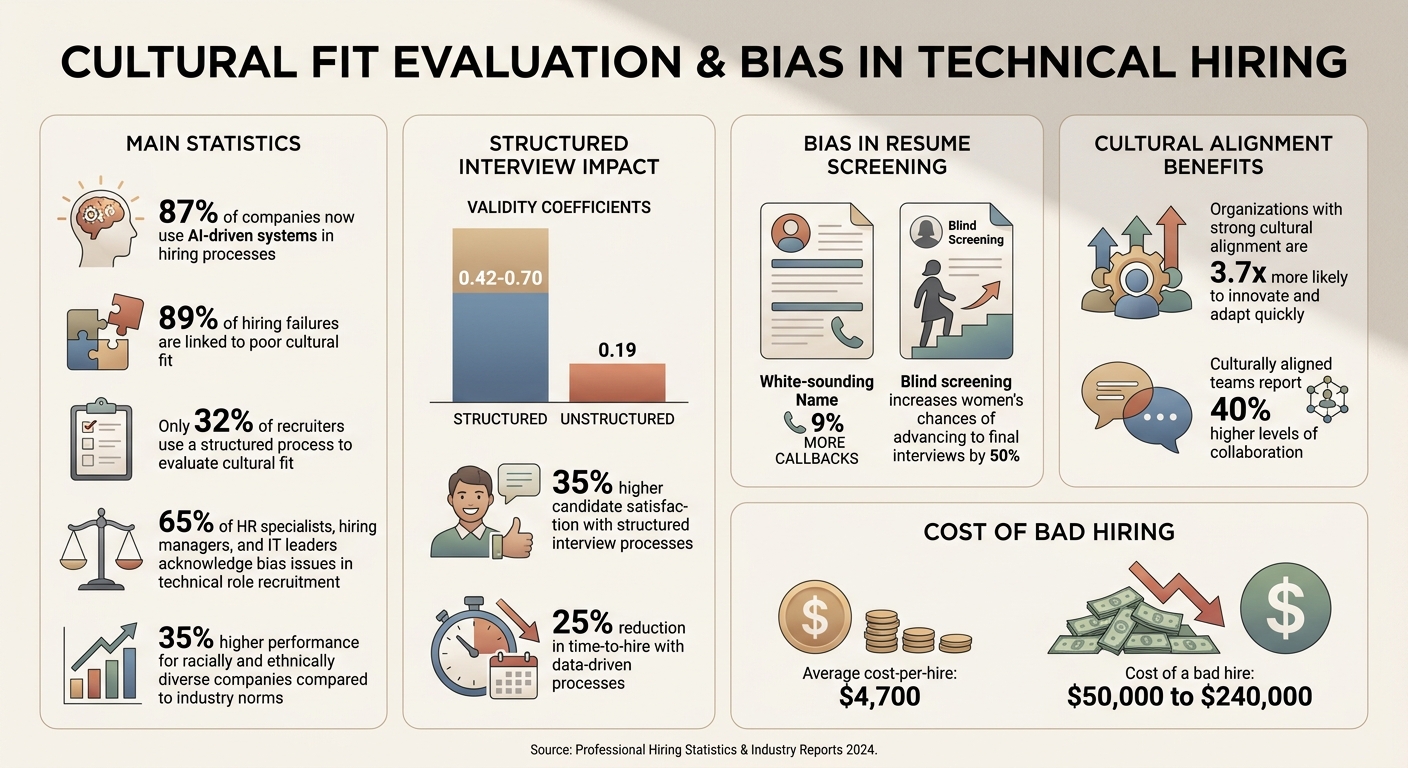
Data shows that organizations with strong cultural alignment are 3.7 times more likely to innovate and adapt quickly. Additionally, culturally aligned teams report 40% higher levels of collaboration . By tying cultural criteria to business objectives, you're not just hiring someone who fits in socially - you’re hiring someone who will actively contribute to your company’s success.
Make sure senior developers are involved in defining these behaviors. Document how cultural values connect to business goals so that interviewers focus on evaluating mission-critical skills rather than personal rapport.
Focus on Professional Values, Not Personality Traits
Once your values are clearly defined, it’s important to separate professional behaviors from personal traits. A common mistake in technical hiring is confusing how someone works with who someone is. Questions like, "Would I grab a beer with this person?" shift the focus from work-related skills to social compatibility, often leading to bias in hiring decisions.
Professional values are tied to work behaviors - how someone handles disagreements, solves problems, or communicates under pressure. Personality traits, like introversion or hobbies, reveal little about job performance. When companies conflate the two, they risk creating homogeneous teams that struggle to adapt to change.
"Firms are defining the pipeline in a very narrow way that's going to limit racial diversity" - Lauren Rivera
To ensure fairness, apply this test: Can the behavior be observed in a work context? As mentioned earlier, values should always translate into specific actions. Here’s an example of how values can be tied to observable technical behaviors:
| Value Example | Observable Behavior (Technical Context) |
|---|---|
| Direct Communication | Provides specific, actionable feedback during code reviews instead of vague comments. |
| Ownership | Shares a project outcome that didn’t go as planned, detailing their role and accepting responsibility. |
| Adaptability | Describes a time they shifted technical direction after receiving new data or feedback from stakeholders. |
Focusing on professional behaviors over personality traits not only ensures a fairer process but also helps protect your organization legally. Rejecting candidates based on undefined "culture fit" can pose liability risks. By documenting values as observable actions, you create a clear, defensible hiring process while building a diverse, high-performing team .
Use Structured Interviews and Objective Scorecards
Structured interviews, rooted in clearly defined values, turn subjective impressions into measurable data. By sticking to observable, pre-determined criteria, you can assess all candidates fairly and avoid biases like snap judgments or confirmation bias .
Here's why structured interviews matter: they boast validity coefficients ranging from 0.42 to 0.70, compared to a mere 0.19 for unstructured interviews . Plus, candidates who aren't selected in a structured process report being 35% more satisfied with their experience . This isn't just about making better hires - it's about safeguarding your employer brand.
"Structured interviews are one of the best tools we have to identify the strongest job candidates. Not only that, they avoid the pitfalls of some of the other common methods."
– Dr. Melissa Harrell, Former Hiring Effectiveness Expert, Google
The secret lies in replacing gut feelings with standardized rubrics. When every interviewer uses the same questions and scoring criteria, inconsistent interpretations and biases are eliminated. For instance, in 2025, a technical staffing firm in Irvine, California, helped a client reconsider a backend engineer they'd previously rejected three times for "not being a culture fit" and seeming "uncomfortable on camera." By introducing a structured 1-4 scoring rubric focused on specific competencies, the candidate scored 3.8 out of 4.0 and was hired. Eleven months later, she had become one of the highest-performing engineers on the team .
Create Interview Questions for Developer Roles
Start by aligning your interview questions with the cultural values you've identified. For example, if "ownership" is a core value, skip generic questions like "Are you a self-starter?" Instead, ask behavioral questions that reveal real-world actions, such as: "Tell me about a project where something went wrong in production. What was your role, and how did you handle it?" This approach pushes candidates to provide tangible examples rather than rehearsed responses.
For technical positions, you can merge cultural assessments with technical challenges. If "direct communication" is a priority, observe how candidates explain their code during a live coding session. Do they articulate specific, actionable reasoning? Can they accept feedback and adapt their approach? These interactions reveal much more than simply asking, "How would you describe your communication style?"
To ensure fairness, pre-script follow-up questions. For instance, if a candidate offers a vague answer about teamwork, have a follow-up ready: "Walk me through the specific feedback you received and how you incorporated it." This ensures every candidate gets the same opportunity to showcase depth .
Use a 1-4 scoring scale without half-points to encourage decisive ratings . Define what each score means for every competency. For instance, for "adaptability", a score of 3 might mean: "Described a situation where they shifted technical direction based on new data; provided clear reasoning for the change." A score of 4 might add: "Proactively identified the need to pivot before being told; influenced team consensus around the new approach." This clarity ensures consistency across interviews.
Standardize Scorecards Across All Interviewers
To complement structured questions, introduce standardized scorecards for objective evaluations. Start with calibration sessions where interviewers independently score the same recorded interview, then compare results . If scores differ by two or more points, your scoring criteria may need adjustment.
Each scorecard should include 6–12 core competencies, with weights assigned based on the role . For example, for a senior backend developer, "System Design" might carry a weight of 20%, while "Coding Quality" could be 25%. Meanwhile, "Security Judgment" might only account for 5%. This weighting ensures no single weakness overshadows an otherwise strong candidate. Additionally, include evidence-based notes to justify each score . Stick to the 1-4 scale for consistency.
Require interviewers to complete scorecards independently before group discussions . This prevents groupthink and avoids undue influence from senior team members. During debriefs, shift the focus from vague comments like "I liked this person" to specific, evidence-backed observations such as "My scorecard shows…" This method saved a Google hiring team 40 minutes per interview .
"'Would this person be fun to grab a beer with' is not an interview criterion. It is a discrimination lawsuit waiting for a deposition."
– Tom Kenaley, Senior Partner, KORE1
Regularly audit your scorecards. If certain interviewers consistently grade too easily or harshly, it's time to recalibrate. The goal isn't to force identical scores but to ensure that a "3" from one interviewer reflects the same level of performance as a "3" from another. This approach turns subjective opinions into reliable, defensible data .
Use Technology to Reduce Screening Bias
Technology can spot biases that human reviewers might overlook. In fact, 87% of companies now use AI-driven systems in their hiring processes . These platforms focus on skills and professional values, helping to standardize workflows, anonymize candidate details, and flag patterns that humans might miss.
Take blind screening as an example. This method removes names, photos, gender, age, and academic institutions from resumes, allowing a candidate's technical abilities to shine through before unconscious associations come into play. For instance, resumes with white-sounding names receive 9% more callbacks compared to those with Black-sounding names . Blind screening has been shown to increase women's chances of advancing to final interviews by 50% .
Of course, technology isn’t foolproof. Without proper oversight, it can reinforce existing biases. In 2018, Amazon discovered its internal AI recruitment tool penalized resumes containing the word "women" (e.g., "women's chess club captain"). Since the algorithm was trained on predominantly male resumes, it ended up favoring men . More recently, in August 2023, iTutorGroup settled a $365,000 lawsuit with the EEOC after its AI software automatically rejected female applicants aged 55 or older and male applicants aged 60 or older. This impacted over 200 qualified candidates . These examples highlight the need for auditing training data to avoid replicating past inequalities.
"A manager's judgment can be questioned; an algorithm's ranking arrives with an aura of neutrality."
– Emilio J. Castilla, Professor, MIT Sloan
The best tools combine automation with transparency. Look for platforms that offer analytics to track selection rates across demographics. These insights can help identify and address any disparities in real time . For instance, if your criteria consistently exclude certain groups, analytics can flag this, allowing you to make adjustments. Considering the average cost-per-hire is $4,700, and a bad hire can cost anywhere from $50,000 to $240,000, investing in bias-reducing technology isn’t just ethical - it’s financially smart .
How daily.dev Recruiter Reduces Bias in Hiring
daily.dev Recruiter takes bias reduction a step further by personalizing the evaluation process. Instead of relying on impersonal, keyword-based sourcing, the platform offers warm, double opt-in introductions. This approach connects you with developers who are actively engaged in the daily.dev community - reading, learning, and signaling interest in new opportunities. It shifts the focus from superficial details to context-rich introductions that highlight a candidate’s technical contributions, open-source work, and professional values.
With custom screening criteria, you can tailor evaluations to what truly matters for your role - whether it’s Kubernetes expertise, mentoring experience, or a commitment to accessibility. By emphasizing job briefs that prioritize technical requirements over vague cultural descriptors, daily.dev Recruiter ensures candidates are assessed on merit, reducing the risk of affinity bias and simplifying the hiring process.
Double opt-in introductions also mean candidates engage only when they’re genuinely interested. This ensures your first conversation is with someone who has already passed an initial alignment check. Instead of sifting through hundreds of resumes, you start with a curated pool of developers who meet your technical needs and are open to dialogue. The result? Higher reply rates, quicker time-to-hire, and a recruitment process that respects both your time and the candidate’s.
Build Diverse Hiring Panels and Adopt Culture Add
Evaluators play a crucial role in shaping hiring outcomes, just as much as the methods used to assess candidates. A striking 65% of HR specialists, hiring managers, and IT leaders acknowledge bias issues in technical role recruitment . One way to tackle this challenge is by creating diverse hiring panels and shifting the focus from "culture fit" to "culture add."
Assemble and Empower Diverse Interview Panels
Diverse interview panels help reduce affinity bias, which often favors candidates with similar backgrounds to the evaluators. By including individuals of different genders, ethnicities, career experiences, and skill sets, you gain a broader range of perspectives that lead to more balanced evaluations. Research shows that racially and ethnically diverse companies outperform industry norms by 35% [[6]](https://codesignal.dev/blog/tech-recruiting/[proven methods for improving diversity in technical recruitment](https://recruiter.daily.dev/resources/improving-diversity-technical-recruitment-proven-methods)), and this advantage begins with hiring.
Make sure your panel includes a mix of lead developers, senior engineers, and team members from underrepresented groups. This approach not only ensures accurate technical evaluations but also signals to candidates that inclusion is a priority. That said, be cautious about overburdening underrepresented employees with excessive interview duties . Rotate panel members regularly and provide training to focus on observable skills rather than subjective traits.
To avoid groupthink, ask interviewers to submit their feedback separately before discussing candidates as a group . This step ensures that no single voice dominates the evaluation process. Additionally, use analytics to identify interviewers who consistently rate candidates significantly higher or lower than others. Pair these outliers with top evaluators for coaching and calibration . These practices help foster objective and well-rounded assessments.
Replace Culture Fit with Culture Add
While diversifying panels is important, adopting a "culture add" mindset can further strengthen team diversity and innovation. The traditional "culture fit" approach asks, "Will this person fit in?" - a question that often leads to homogenous teams that think and act alike. In contrast, "culture add" shifts the focus to, "What can this person bring that we don’t currently have?" . This approach prioritizes candidates who align with your core values but also introduce fresh perspectives, unique problem-solving methods, or expertise in untapped areas.
"A culture-add candidate aligns with the mission and values but brings new perspectives, skills, or ways of thinking that push the organization forward."
– Belen Rocha, Communications and Culture Coordinator, BEON.tech
This shift is especially critical in the tech industry, where innovation thrives on diverse thinking. Instead of evaluating whether a candidate would fit into social scenarios, like grabbing a beer after work, focus on whether they embody behaviors aligned with your organization's principles - such as collaboration, transparency, or a commitment to learning. Hiring for culture add enables teams to challenge assumptions, spark innovation, and better reflect the diversity of your user base.
With many organizations acknowledging a lack of diversity in tech , adopting culture add strategies is no longer optional - it’s essential for growth and progress.
Build Data-Driven Evaluation Frameworks
Even the best-designed hiring process can fall short without solid data to back it up. Data helps you spot patterns, uncover biases, and validate your evaluation methods. Creating a data-driven framework means tracking key metrics, analyzing them regularly, and using those insights to make your hiring process more equitable over time.
Monitor Metrics to Detect Bias
Start by tracking funnel throughput rates at every stage of your hiring pipeline - sourcing, screening, interviewing, and offer acceptance. For example, if you notice that underrepresented candidates apply in large numbers but drop off significantly during screening or interviews, that’s a clear red flag . Compare the demographics of your new hires to your initial applicant pool. If there’s a big mismatch, it could indicate that hidden biases are influencing your evaluation criteria .
Keep an eye on interviewer score variance using real-time analytics. If one interviewer consistently rates candidates much higher or lower than the rest of the panel, it’s a sign of a calibration issue that needs immediate attention . Also, track your rejection documentation rate - the percentage of candidate rejections that include detailed, documented observations. A low rate often signals the need for more training on how to properly document evaluations .
"If you can't attach a behavioral observation to your concern, it doesn't go in the debrief notes."
– Calvin D., Head of Enterprise Solutions
Don’t overlook candidate experience scores. Survey candidates after their interviews to gauge how fairly they felt they were evaluated, regardless of whether they received an offer. Research shows that when candidates perceive the process as fair, they’re more likely to accept offers . Lastly, benchmark your technical assessments by having top-performing employees take the same tests you give candidates. This ensures your minimum score requirements are based on objective data, not gut feelings .
These metrics lay the groundwork for a thorough review, leading to a more refined and effective evaluation process.
Audit and Improve Your Evaluation Process
Once you’ve built a structured interview process, regular audits help ensure it stays effective. Data alone isn’t enough - it’s how you use it to improve your process that matters. Hold quarterly recalibration sessions to revisit your interview rubrics and scorecards. As role requirements evolve, your evaluation criteria should evolve too . During these audits, check if interviewers are consistently using structured scorecards. Confirm that they document the specific competency they evaluated, the rating they assigned, and the behavioral evidence behind their score .
Train your team to eliminate subjective debrief language. Replace vague statements like "I didn’t click with them" or "they seemed too quiet" with evidence-based feedback, such as "They didn’t provide specific examples when asked about adaptability" . This isn’t just about fairness - it’s also about compliance. According to the EEOC, any selection criteria that disproportionately impact protected groups must be job-related and necessary for business operations. Informal "culture fit" judgments rarely meet this standard .
Regular audits also highlight the financial impact of poor hiring decisions, which can cost up to $240,000 per hire . By continuously refining your process with data, you’ll not only reduce bias but also improve hire quality and cut time-to-hire by as much as 25% .
Conclusion
Hiring with an eye toward cultural fit - while steering clear of bias - means finding candidates who align with your core professional values but also bring fresh perspectives. As Bruna Vasconcelos wisely points out, "Misinterpreting cultural fit as hiring someone who simply 'fits in' without adding diversity of thought or background will lead to a more homogenous workforce" .
The strategies outlined earlier offer a clear, structured path to fair and effective technical hiring. Using objective frameworks ensures evaluations are consistent and impartial. Tools like structured interviews, standardized scorecards, and diverse hiring panels help maintain fairness. Additionally, tracking metrics throughout the hiring process, auditing for gaps, and avoiding subjective language in candidate discussions all contribute to creating a more equitable system.
Technology can also play a pivotal role in reducing bias before human involvement. For example, platforms like daily.dev Recruiter facilitate connections with pre-qualified developers through warm, double opt-in introductions. This approach ensures conversations start with candidates who are genuinely interested and engaged.
It's worth noting that 89% of hiring failures are linked to poor cultural fit, yet only 32% of recruiters use a structured process to evaluate it . By adopting the frameworks in this guide, you're doing more than reducing bias - you’re gaining a strategic edge. Combining structure, diversity, and data-driven decisions not only helps you find developers who share your values but also those who can propel your team toward greater innovation.
FAQs
How do I define “culture fit” as behaviors for engineers?
When defining culture fit for engineers, it’s all about pinpointing behaviors that align closely with your company’s core values - things like teamwork, inclusivity, and the ability to adapt. Rather than focusing on surface-level traits, the emphasis should be on specific attitudes and collaboration styles that reflect these values.
For example, you might ask candidates how they tailor their feedback when working with different teams or how they approach resolving conflicts. These kinds of questions can reveal whether their working style complements your team dynamics.
The key is to clearly articulate your company’s values upfront. This helps you assess behaviors that encourage cohesion and boost performance while steering clear of overly subjective judgments.
What’s the best way to score cultural alignment without gut feel?
To assess cultural alignment effectively, structured interview questions are key. Focus on areas like values, behaviors, and working styles that mirror your company’s culture.
Create tools like evaluation scorecards to ensure assessments remain consistent across candidates. Additionally, use validated methods such as work samples or simulations to gather measurable insights. These strategies help minimize subjective bias, making the process fairer and more standardized for both candidates and interviewers.
How can we audit our hiring process for bias over time?
To ensure fairness in hiring, it's essential to regularly assess your process for biases. Start by using data-driven tools to evaluate how decisions impact different demographic groups. Independent audits of algorithms and decision-making frameworks can help identify hidden biases that might otherwise go unnoticed.
Document the findings from these audits, track any changes you implement, and adjust your evaluation criteria as necessary. Bringing in feedback from a diverse range of stakeholders can also help refine your approach, keeping your efforts relevant and effective over time.
.png)