Developers care about real technical challenges, transparency, and growth opportunities - not flashy perks or corporate buzzwords. They value companies that showcase technical credibility through authentic communication and meaningful work. Here’s what matters most to them:
- Peer Insights Over Marketing: 86% of developers rely on employee reviews, and 41% use these as a primary research tool before applying.
- Transparent Job Details: Clear salary ranges, tech stacks, and role expectations build trust. This developer trust is essential for long-term recruitment success.
- Technical Blogs and GitHub Activity: Developers check your engineering blog and GitHub for evidence of problem-solving and code quality.
- Respect in Hiring: Interviews should reflect actual job challenges, not irrelevant tests.
- Open-Source Contributions: Active participation in open-source projects signals technical expertise.
What Employer Branding Means to Developers
When HR teams discuss employer branding, they often focus on shiny promotional videos or perks like free snacks and game rooms. But for developers, it’s about something entirely different: technical credibility and honest communication. Developers want to see real problem-solving in action, transparency about code challenges (even the messy legacy ones), and clear opportunities for growth.
Traditional recruiting methods often emphasize measurable achievements, like years of experience, prestigious universities, or certifications. But developers prioritize something else: judgment and curiosity. As Nimrod Kramer, CEO of daily.dev, puts it:
"Pedigree wars (self-taught vs. degree) are noise. The signal is can this person solve our kind of problems, with our kind of constraints, with curiosity and care?"
This disconnect between what companies promote and what developers value often leads to frustration. For example, interview processes that feel like unnecessary hurdles or job descriptions that leave out details about the tech stack or salary can signal a lack of openness about the real challenges of the role.
Developers Trust Peer Insights Over Corporate Marketing
Developers are naturally skeptical of polished corporate messaging. Instead, they rely on their peers for unfiltered, firsthand insights. In fact, 86% of job seekers use employee reviews to evaluate potential employers, and 41% of developers rely on these reviews as a primary research tool. When an engineer shares their experience debugging legacy code or solving tricky scaling issues, that kind of authenticity resonates far more than a flashy corporate video promising "innovation" without substance.
This preference for authenticity extends to the hiring process. If interviews are filled with abstract trivia or irrelevant LeetCode puzzles, many developers will walk away - not because they can’t solve the problems, but because it signals a disconnect between the hiring process and the actual job. As Kramer explains:
"If your process feels like hazing, great people will self-select out. Not because they can't do it. Because they won't."
A hiring process that reflects the real work not only attracts strong candidates but also builds trust and credibility.
Technical Challenges and Growth Opportunities Matter Most
At the end of the day, what truly drives developers’ decisions is the work itself. They care about technical challenges, the quality of the product, and opportunities to grow professionally. When considering a role, developers often ask themselves: Will I be solving meaningful problems? Will I have the chance to learn new skills? Will I have the freedom to choose the best tools and approaches? For many, a job with engaging challenges is far more appealing than a higher-paying role focused solely on maintaining outdated systems.
Take Accelleron as an example. In 2024, the company (formerly part of ABB) doubled its global job applications by introducing a data-driven Employee Value Proposition centered on professional growth, impactful technical work, and meaningful challenges. Instead of leading with generic perks or vague corporate values, they highlighted the engineering experience.
The takeaway is simple: transparency matters. Be upfront about your tech stack, acknowledge any legacy issues, and clearly outline the role’s constraints - including salary. This kind of honesty doesn’t scare off strong candidates - it attracts them. As Kramer puts it:
"Tell the truth in job posts. Clearly define the stack, scope, salary, and constraints. Honesty earns trust rather than scaring off talent."
Hiring engineers?
Connect with developers where they actually hang out. No cold outreach, just real conversations.
The 5 Signals Developers Check Before Applying
::: @figure 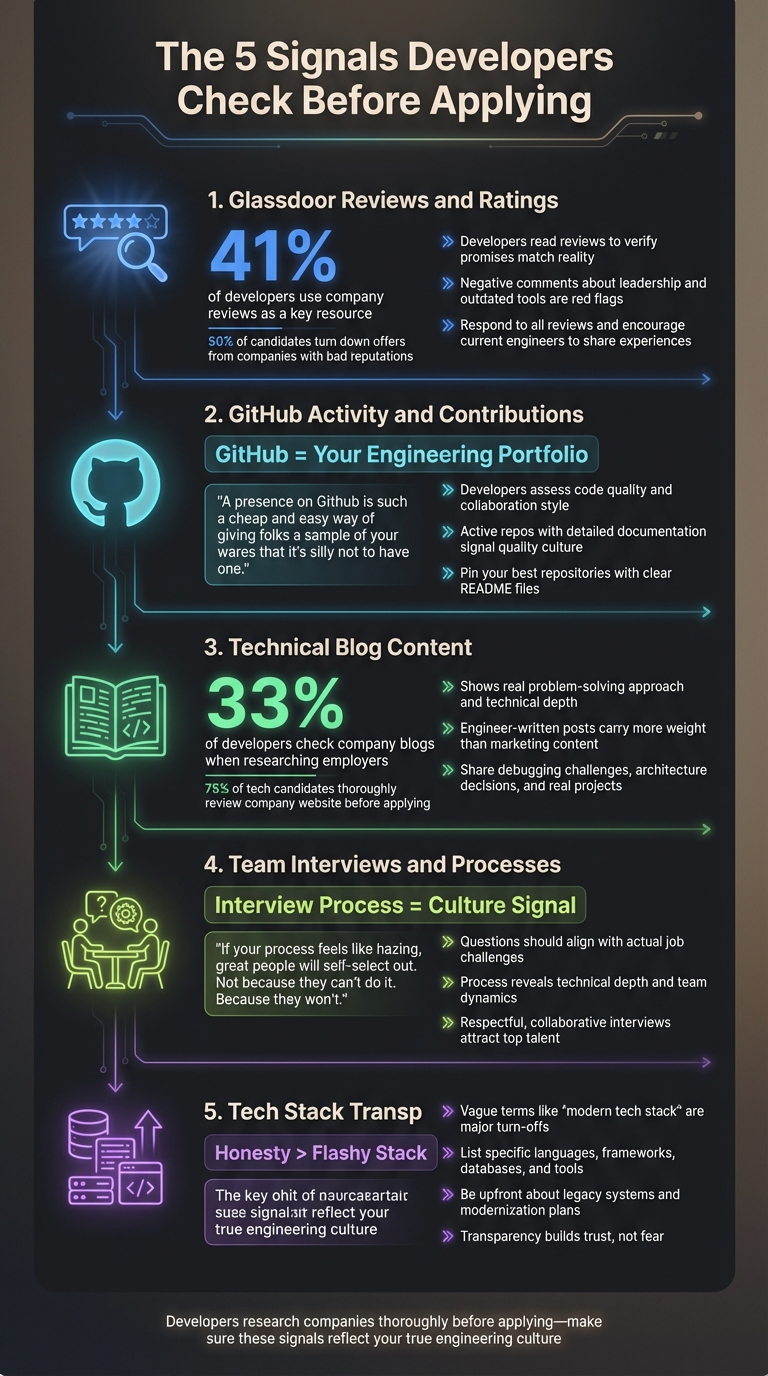 {What Developers Check Before Applying: 5 Key Employer Brand Signals}
Before developers hit "apply", they dig deep. They're not just looking for a company that sounds good - they want proof that you're technically solid and honest about the work environment. These five signals help them decide if your company is worth their time.
Glassdoor Reviews and Ratings
Glassdoor is where developers go to see if your reputation holds up. They’re not just skimming the star rating - they’re reading reviews to see if your promises match reality. In fact, 41% of developers use company reviews as a key resource when researching potential employers. Negative comments about leadership, planning, or outdated tools can quickly send top talent running.
Here’s a striking stat: 50% of candidates turn down offers from companies with bad reputations, even if the pay is good. That means even a few unaddressed negative reviews can cost you your best prospects.
The smart move? Claim your Glassdoor profile and respond to every review - good or bad. Thank people for their feedback, and when you notice recurring complaints, treat them as opportunities to improve. You can also encourage your current engineers to share their honest experiences to balance the narrative.
GitHub Activity and Contributions
Your GitHub profile is like a portfolio for your engineering team. Developers use it to assess your code quality, how you collaborate, and your overall approach to building software. They’ll look at how you manage pull requests, handle issues, and interact with the open-source community. Active repositories with detailed documentation and meaningful commit messages show that you care about quality and teamwork.
A strong GitHub presence gives candidates a glimpse into your work culture.
"A presence on Github is such a cheap and easy way of giving folks a sample of your wares that it's silly not to have one."
- HireThisMarine, Senior Software Engineer
To stand out, pin your best repositories and make sure they’re well-documented. Highlight your most impressive projects and ensure your documentation is clear and professional.
Technical Blog Content
An engineering blog does more than promote your brand - it shows that your team tackles real challenges and knows how to explain them. Developers read these blogs to understand your problem-solving approach and the complexity of the work you do. Posts that dig into debugging tricky issues or detailing system migrations can reveal what it’s like to work on your team.
The key is to keep it real. Posts written by engineers about actual projects carry far more weight than generic content. For example, a deep dive into a production outage or a detailed breakdown of a major architectural choice can build trust and credibility with potential candidates.
Team Interviews and Processes
Interviews are more than just hiring tools - they’re a window into your team’s culture. Developers scrutinize your interview process to gauge your technical depth, team dynamics, and respect for their time. If the process feels like a hazing ritual or relies too heavily on irrelevant algorithm challenges, even highly qualified candidates might walk away.
What matters is how interviewers interact, whether the questions align with the actual job, and if the process feels collaborative rather than combative. Developers often check review sites to see if others’ experiences match their own impressions. A transparent and respectful process sends a strong signal about your engineering culture.
Tech Stack Transparency
Once developers understand your interview process, they zero in on the tools they’ll use. Vague terms like "modern tech stack" without specifics - or hiding that they’ll be maintaining legacy systems - are major turn-offs. Developers want upfront details about your stack so they can decide if the role fits their skills and interests.
Being honest about your tools, even if they’re outdated, can go a long way. If you explain your plans to modernize, candidates will respect the transparency. On the flip side, withholding details until later in the process can leave them feeling misled. Using a transparent developer job post checklist to list languages, frameworks, and tools shows you’re upfront about what the job entails. It’s not about having the flashiest stack - it’s about being honest about what you’re working with.
Building an Engineering Blog That Attracts Candidates
Creating an engineering blog isn't just about sharing updates - it's about proving that your team tackles real, technical challenges. Here's why it matters: 33% of developers turn to company blogs when researching potential employers , and 75% of tech candidates thoroughly review a company's website before applying . For many, your blog is their first impression of your technical credibility.
What sets apart a blog that draws in talent from one that gets overlooked? Authenticity. Developers can quickly spot corporate fluff, so your content needs to reflect the actual work and culture of your team. By sharing genuine insights and showcasing real projects, you can demonstrate what it's like to be part of your organization.
Share Real Projects and Technical Challenges
The most compelling engineering blog posts dig into real technical hurdles. Instead of focusing on feature announcements or product launches, highlight the challenges your team overcame and the solutions you devised. These stories not only showcase your team’s expertise but also provide a glimpse into the kind of work potential candidates could expect .
For example, in May 2024, Ido Shamun from daily.dev shared a detailed post on how his team slashed their React monorepo CI time by 70%. He broke down their approach, which included restructuring pipelines and fine-tuning eslint rules to streamline developer workflows . Similarly, in December 2023, Ante Barić wrote an "Under the Hood" post about the "Weekly Digest" feature, explaining how his team tackled the challenge of sending over 1 million personalized emails using GraphQL and Sendgrid . These posts didn’t just describe the end result - they walked readers through the tough decisions and tradeoffs that led to success.
Focus on the difficult parts of your projects: debugging nightmares, architectural dilemmas, or performance optimization struggles. By being transparent about these experiences, you give candidates a clear picture of the problems they’d be solving if they joined your team. And when these stories come directly from your engineers, they carry even more weight.
Encourage Engineers to Contribute Posts
When engineers write blog posts, it not only highlights their expertise but also boosts your team's credibility . Candidates value hearing directly from the people doing the work - not from the marketing department.
"Engineer-driven company blogs allow your current developers to speak to your potential future tech talent – and do it in a language that they understand and can connect with."
Make sure to credit individual engineers for their contributions. For instance, in November 2023, Ante Barić published a post titled "Moving back to React", which detailed his team’s transition from Preact to React. The article offered a transparent look at the migration process, emphasizing performance improvements and better developer experiences . By attaching his name to the post, it not only built his personal reputation but also strengthened the company’s image as a hub of technical talent.
If your team is hesitant about writing, provide a simple framework: outline the problem, walk through the technical journey, highlight the challenges, and explain the solution. Encourage engineers to write about more than just code - team rituals, onboarding experiences, or even fun moments like technical pranks can offer a glimpse into your culture. Etsy’s "Code as Craft" blog is a prime example of how an engineer-driven blog can resonate deeply with the developer community .
Open Source Contributions as Employer Branding
Contributing to open-source projects can do wonders for your company's image, showcasing your technical expertise in ways that no careers page ever could. Here's why it matters: 60% of hiring managers actively seek open-source talent, but 89% struggle to find candidates with the right skills and experience . By engaging in open-source work, your company positions itself as a hub where developers can take on meaningful projects that extend beyond your core product.
Open-source contributions also provide a glimpse into your engineering culture. Ian Varley, Software Architect at Salesforce, explains it well:
"It's kind of a window for them to see the great engineering that's going on inside of the company that they otherwise wouldn't be able to see" .
By sharing internal code or contributing to prominent projects, you allow potential hires to evaluate the quality of your work. This transparency fosters trust and opens the door to stronger collaboration.
Build Trust Through Open Collaboration
Open-source involvement signals transparency, technical expertise, and dedication to the developer community. These qualities resonate with developers who value authentic collaboration.
One way to encourage this is by offering paid time for open-source contributions. For instance, Guy Martin, Director of Open at Autodesk, and Ibrahim Haddad implemented a "50% rule" at Samsung, ensuring developers spent half their work hours contributing to upstream projects. This strategy not only strengthened Samsung's influence in critical projects but also enhanced the reputation of its engineers . CloudBees supports this idea:
"Being able to contribute to open source during office hours is a perk that a lot of engineers are waiting for. It's a major bonus in a crowded market and can help a lot when hiring" .
Another effective approach is to focus on projects tied to your company's future needs. Yahoo (later Oath) played a key role in creating and maintaining large-scale projects like Hadoop, building a reputation that drew developers interested in big data and high-scale computing . Similarly, Microsoft's contributions to the WinObjC project, based on David Chisnall's Objective-C runtime, highlighted how supporting individual open-source efforts can establish long-term credibility .
Internally adopting open-source tools and infrastructure also reinforces a forward-thinking engineering culture. This alignment with community practices makes it easier for your team to contribute externally, further enhancing your reputation.
Highlight Individual Engineer Contributions
Acknowledging your engineers' open-source efforts can boost your credibility with potential hires. Developers want to feel that their contributions are valued and that they have opportunities to grow their public profiles.
Make open-source work an official part of the job, not just an optional perk. When engineers see their contributions recognized as a core responsibility, they’re more motivated to invest in these projects. This also ensures the broader community associates your company with these contributions, strengthening your employer brand.
Encourage public speaking by supporting engineers in presenting their open-source work at conferences. Developers are more likely to adopt a project - or consider joining your company - when they hear directly from the creators . Including open-source responsibilities when you write developer job descriptions can also attract candidates who want to build their public profiles .
As one developer, Hecate, put it:
"Open-Source is my CV. Since I don't have any diploma past high school, this is how I show employers that I can walk the walk and not just talk the talk" .
Developer Community Engagement
Connecting with developers where they already gather shows that your company values the same technical spaces they care about. Hosting meetups or sponsoring conferences sends a clear message: you're genuinely invested in the developer ecosystem. This approach naturally expands your talent pool as developers begin associating your brand with both personal and professional growth opportunities .
The stats back this up: 34% of developers turn to community engagement and events when researching potential employers , and companies with a strong employer brand attract 50% more qualified candidates . These connections happen in environments where developers collaborate and learn . Let’s dive into two strategies that can spotlight your technical culture.
Host Meetups and Local Events
Technical meetups offer developers a chance to experience your company culture in action. When your engineers lead discussions on real-world challenges or cutting-edge technologies, it gives potential candidates an authentic glimpse into your team’s expertise and the kinds of problems they’d work on. This kind of peer-to-peer interaction carries more weight than any careers page ever could.
Your current engineers are your best advocates - they can share firsthand insights about the work, the tools, and the team dynamics. But here's the key: the culture showcased at these events must align with what candidates will actually experience if they join your company. Any disconnect could hurt credibility and lead to higher turnover . These meetups not only highlight your technical authenticity but also demonstrate how your employer brand translates into real-world experiences.
Sponsor Conferences and Hackathons
While meetups foster close-knit connections, sponsoring larger events like conferences and hackathons amplifies your presence across the broader developer community. These events show you're committed to supporting the ecosystem, not just filling open positions. When your engineers participate as speakers or mentors, it further solidifies your credibility.
A strong employer brand doesn’t just attract better candidates - it can reduce hiring costs by up to 43% . Beyond the numbers, meeting developers in their spaces leads to much higher engagement than traditional cold outreach. Just like technical blog posts build trust by tackling real challenges, sponsoring events demonstrates your long-term investment in the community. When developers see your company backing events that help them grow, they’re far more likely to keep you in mind when considering their next career move.
Social Proof That Works: Real Engineer Stories
When it comes to building trust with developers, nothing beats hearing directly from their peers. Developers tend to trust insights from fellow engineers far more than polished corporate messaging. With so many job seekers and developers relying on peer reviews to evaluate potential employers, stories from your current engineers are exactly what candidates want to see.
The secret lies in how the message is delivered. Corporate marketing often feels overly polished or detached, while engineer-driven content speaks directly to developers in a way that feels relatable. As Stack Overflow explains:
"Engineer-driven company blogs allow your current developers to speak to your potential future tech talent – and do it in a language that they understand and can connect with" .
This kind of peer-to-peer communication gives developers a real sense of your company’s technical challenges, work environment, and day-to-day operations .
The impact of this approach is tangible. For example, in 2017, Clover Network’s recruiting team used an employee advocacy strategy to hire 135 engineers in just one year, with a cost of only $7,000 per hire - a remarkable feat given the competition from much larger companies . Similarly, Accelleron saw job applications double after launching an employer brand strategy centered on employee stories, following its spinoff from ABB .
Use First-Person Stories Instead of Corporate Videos
First-person accounts from engineers resonate deeply because of their honest and relatable tone. Developers are often skeptical of content that feels like it’s all talk but no substance. In fact, 75% of tech professionals check a company’s website before making a decision . What they’re looking for are real stories - accounts of both the challenges and successes engineers experience on the job.
Cisco has embraced this approach by encouraging employees to share unfiltered stories across its career page, blog, and social media. As FutureCode IT Consulting observed:
"Cisco's employee-generated content provides a genuine and unfiltered view of the company's culture" .
The key is to let engineers tell their stories in their own words. Whether it’s about solving a tough technical problem, describing a project they’re proud of, or simply sharing what a typical workday looks like, these raw insights often outperform polished, scripted content .
Share Stories Through Video, Blogs, and Social Media
To amplify the authenticity of these stories, use a variety of content formats. Video, blogs, and social media all offer unique ways to connect with developers on the platforms they prefer. Video, in particular, is powerful for testimonials because it conveys emotion and builds trust in ways that text alone can’t . Short videos showing behind-the-scenes glimpses, virtual office tours, or even an employee’s first week can provide candidates with a vivid sense of what it’s like to work at your company .
Twilio exemplifies this with its "Builders" theme, where every new employee builds an app using the Twilio API during onboarding. These stories are then shared on the "Twilio Magic" culture page and social media, reinforcing a culture of innovation and creativity . Etsy takes a different route with its "Code as Craft" blog, where developers write directly about their technical challenges and projects . Both approaches succeed because they allow engineers to share their experiences authentically. Another effective strategy is social media takeovers, where engineers temporarily manage company accounts on platforms like LinkedIn or Instagram, giving followers an unfiltered look at your engineering culture .
Measuring Employer Brand Impact on Hiring Pipeline
Building a strong employer brand takes effort, so it’s important to measure what’s actually working. Here’s an encouraging stat: 75% of job seekers research a company’s brand before applying . The tricky part is identifying which of your efforts are driving developers to take action.
Carmen Collins, Social Media & Talent Brand Lead at Cisco, emphasizes:
"Start with your goals. Without clear goals, you'll never be able to measure success" .
Hannah Fleishman, Inbound Recruiting Manager at HubSpot, echoes this:
"Pick metrics that you know you can have an impact on, but that also move the needle on your overall recruitment goals" .
The focus should be on metrics tied to developer behavior - not just surface-level stats. These numbers help you refine your strategy while staying true to your brand and making data-driven improvements. Below are some key metrics to track if you want to measure how well your employer brand is converting interest into quality candidates.
Track Application Conversion Rates
The Candidate Conversion Ratio is a valuable tool for understanding how many developers move through each stage of your hiring funnel . This metric highlights where candidates drop off. For example, if developers view your job postings but don’t apply, it could mean your messaging isn’t hitting the mark. On the other hand, if candidates apply but exit during interviews, it might suggest a disconnect between the expectations set by your brand and what they experience during the process.
An applicant tracking system (ATS) can help you zero in on these drop-off points . Beyond tracking applications, you should also measure direct engagement and use proven sourcing strategies to evaluate how your brand resonates with technical audiences.
Monitor Developer Engagement Metrics
Developer engagement gives you a deeper look at how your technical content and community presence are performing. For example, track views on your engineering blog, stars and forks on your GitHub projects, or interactions with social media posts from your engineers. These metrics show whether developers find your content valuable.
Source of hire data is another key metric. It reveals which channels - like technical blogs, GitHub activity, developer forums, or conference sponsorships - are bringing in the most high-quality applicants . Interestingly, while employee referrals only account for about 7% of total applicants, they contribute to over 40% of all hires . This makes referral rates a strong indicator of your brand’s appeal within the developer community.
You can also measure your Net Promoter Score (NPS) by asking candidates how likely they are to recommend applying to your company to a peer . Lastly, use social listening tools to track mentions and sentiment on platforms where developers gather. This helps you spot both positive feedback and potential concerns .
How daily.dev Recruiter Amplifies Employer Brand
Once you've polished your engineering employer brand, the next challenge is ensuring it reaches the right audience. Distribution matters just as much as crafting quality content. You might have an outstanding engineering blog, compelling open-source projects, and engaging engineer stories, but if developers don’t see them, those efforts won’t translate into opportunities.
daily.dev Recruiter changes the game by connecting with developers where they’re already active - within a trusted, professional network they use daily. Instead of relying on cold outreach or outdated profiles, it brings your opportunities directly into the feed of developers who are actively growing their skills. This seamless integration turns your visibility efforts into real connections, ensuring your brand and roles reach the right talent.
Target Developers with Role Visibility
With daily.dev Recruiter, job opportunities are embedded directly into the daily.dev platform, where developers consume technical content. This means your roles appear naturally, aligned with what developers are already engaging with - not as intrusive ads, but as relevant, timely opportunities.
The platform is particularly effective at reaching active vs passive developer recruitment strategies often highlight the value of reaching passively employed engineers - those skilled professionals who aren’t actively searching job boards but are open to the right opportunity. These are often the top candidates: senior contributors and engineering leaders who won’t stumble across your Glassdoor reviews or blog posts unless something actively catches their attention. By integrating into their daily routine, daily.dev Recruiter ensures your brand connects with this high-value audience, creating opportunities for meaningful engagement.
Build Trust Through Double Opt-In Connections
Respect for developers’ time is at the core of the verified, double opt-in model that daily.dev Recruiter employs. A connection only happens when both the developer and the employer agree, maintaining your brand’s integrity and avoiding the reputation risks of spammy outreach.
This approach enables warm introductions based on mutual interest. Developers see clear role details upfront, allowing them to assess if the opportunity fits before opting in. This ensures that when conversations begin, both sides are genuinely interested and invested. The payoff? Higher response rates and productive discussions that lead to real results - all while reinforcing the developer-first identity your brand represents.
Conclusion: Building a Developer-Focused Employer Brand
Creating a meaningful employer brand for developers goes beyond fancy recruitment videos or a polished careers page. It’s about honest communication, technical credibility, and engaging authentically with the developer community. Developers value transparency, respect for their expertise, and a clear understanding of the challenges they’ll face.
To build this kind of brand, focus on three key areas: being open about your tech stack and challenges, showcasing your team's work authentically, and respecting developers’ time and skills. When these align with what developers care about - like clear tech details and real stories from engineers - you establish trust and credibility.
The numbers back this up. Companies with strong employer branding can cut hiring costs by up to 50% and reduce turnover by 28% . For example, Clover Network managed to hire 135 engineers in 2017 at just $7,000 per hire, while Accelleron saw their global job applications double after crafting a data-driven Employee Value Proposition (EVP) .
What’s the takeaway? Empower your engineers to share their stories, contribute to open-source projects, and engage with developer communities. Follow a transparent developer hiring checklist and respond to feedback - even when it’s tough. Developers notice signals like Glassdoor reviews, GitHub activity, technical blogs, and the clarity of your tech stack. Addressing these areas shows you’re committed to growth and improvement.
FAQs
How can I improve our engineering employer brand on a small budget?
Sharing real stories and showcasing your team’s culture can make a lasting impact. Instead of relying on overly polished corporate messaging, focus on what makes your company stand out. Highlight real developer experiences, contributions to open source projects, and active participation in community events like meetups or conferences.
An engineering blog is another great way to connect. Use it to share valuable insights, lessons learned, and behind-the-scenes experiences from your team. This not only showcases expertise but also builds credibility.
The key is consistency. Regularly communicate your company’s purpose and values in a way that feels genuine. By doing so, you’ll build trust and create a deeper connection with developers - all while keeping costs manageable.
What should we publish on an engineering blog if we can’t share proprietary details?
Sharing technical insights and lessons learned can be a powerful way to demonstrate expertise while maintaining confidentiality. By focusing on general concepts and best practices, you can provide value without exposing sensitive details.
For example, you might discuss architectural patterns and the reasoning behind choosing one approach over another. Highlighting trade-offs - like balancing scalability with simplicity or performance with cost - can resonate with peers facing similar challenges. Sharing how your team navigated these decisions can spark meaningful conversations.
Another great topic is team workflows. For instance, you could dive into how your team uses agile methodologies, integrates CI/CD pipelines, or manages technical debt. These stories not only showcase your team’s efficiency but also offer actionable takeaways for others.
Contributions to open-source projects are another way to build trust. Sharing your experience working on or maintaining open-source tools provides a glimpse into your technical expertise and collaborative spirit. It also underscores your commitment to the broader engineering community.
Lastly, consider sharing authentic stories from an engineer’s perspective. Maybe it’s a challenge you overcame, like debugging a tricky issue or optimizing a system under tight constraints. These narratives are relatable and help humanize technical topics, making your insights more engaging.
By focusing on these areas, you can highlight your skills and knowledge while respecting confidentiality. It’s all about striking the right balance between transparency and discretion.
Which metrics best show whether employer branding is increasing qualified developer applicants?
Metrics that show how well your employer branding is drawing in qualified developers include application rate, quality of hire, and source of hire. These metrics provide a clear picture of how effectively you're engaging and converting the right candidates.
.png)