Recruitment in tech often frustrates developers: vague job postings, irrelevant outreach, and lack of follow-up are common complaints. Companies can improve by focusing on respect, transparency, and clear communication. Here are 10 actionable practices to make your hiring process stand out:
- Include salary ranges: Saves time and builds trust.
- Specify the role and tech stack: Avoids confusion and wasted effort.
- Make opting out simple: Reduces spammy outreach.
- Limit follow-ups: Respect boundaries to avoid irritation.
- Clarify process and timelines: Keeps candidates informed and engaged.
- Provide feedback: Helps candidates learn and leaves a positive impression.
- Use structured evaluations: Ensures fairness and consistency.
- Avoid lengthy take-home tasks: Respect candidates' time.
- Communicate outcomes quickly: Avoid ghosting and maintain professionalism.
- Respect privacy: Handle candidate data responsibly.
These steps improve not just hiring outcomes but also your reputation among developers. Start by auditing your tech hiring stack and addressing gaps like missing salary details, unclear timelines, or lack of feedback. Developers value respect and transparency - make sure your actions reflect that.
::: @figure 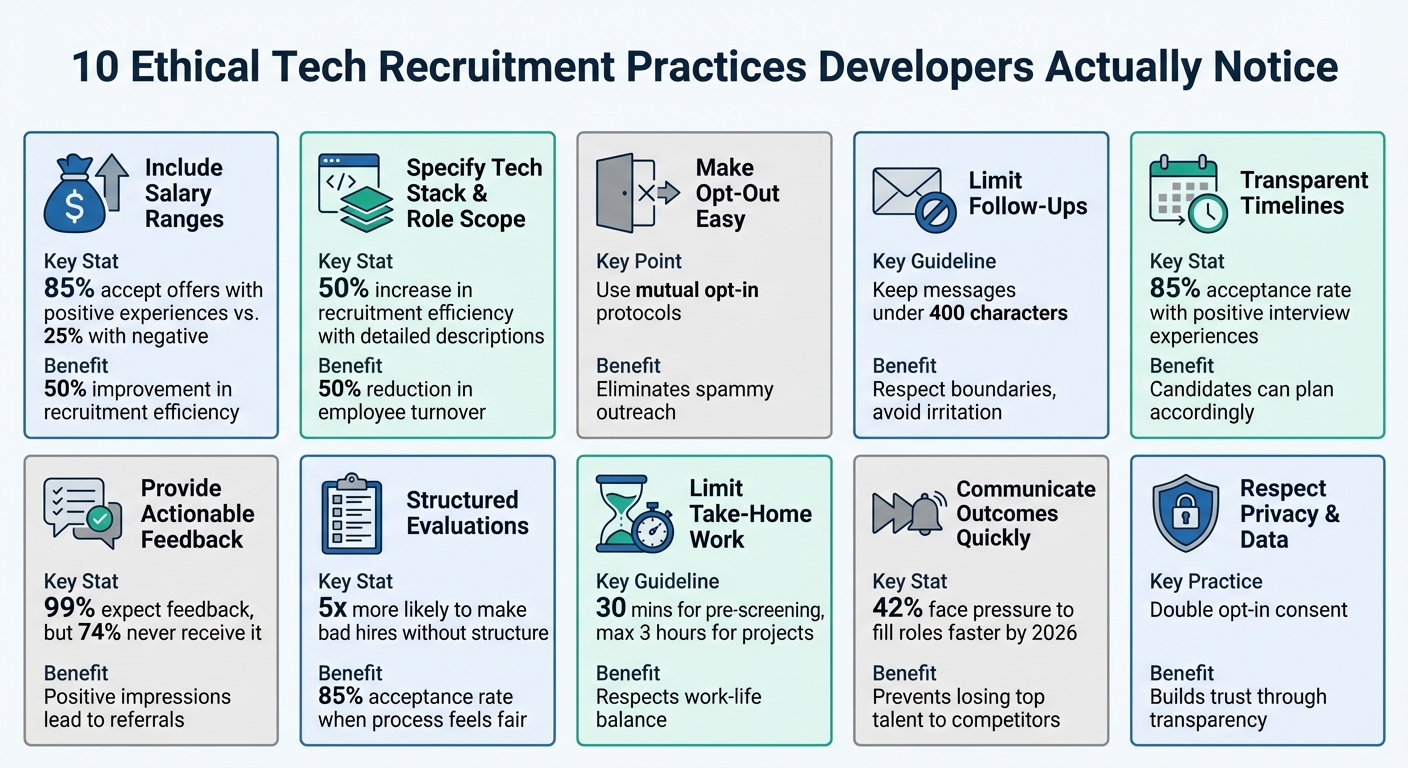 {10 Ethical Tech Recruitment Practices Developers Value}
1. Always include a clear salary range
Developers value their time, and omitting salary details in job postings can send the wrong message. It may suggest a lack of respect for their efforts. As Rudi Bauer from WeAreDevelopers explains:
"If they [developers] aren't respected, you can expect to build a bad reputation inside the dev community."
When salary information is missing, candidates may invest time applying only to find out the compensation doesn’t align with their expectations. This mismatch can erode trust right from the start. Research shows that candidates who report a recruitment processes that prioritize clarity are 85% more likely to accept a job offer, while those with negative experiences are far less likely - dropping to just 25% .
Companies that include salary ranges in their job postings reap tangible benefits. They often improve recruitment efficiency by 50%, reduce the stress of salary negotiations, and avoid misaligned expectations - factors that can increase employee turnover by up to 50% . Transparency in salary isn't just about numbers; it’s an ethical practice that builds trust from the very first interaction. This approach is a key component of a structured developer hiring checklist designed to improve candidate experience. A clear salary range lays the groundwork for respectful and open recruitment, which developers highly value.
2. State the tech stack and role scope precisely
Before developers even consider applying for a position, they need a clear understanding of the technologies they’ll use and the responsibilities they’ll take on. Vague descriptions leave candidates guessing, which not only wastes their time but also damages trust and can scare off highly skilled professionals. And let’s be honest - this kind of ambiguity comes with real costs.
Here’s the reality: unclear job postings can lead to candidates spending an average of 38 days in interviews , only to discover that the technical requirements don’t match their expertise. Dice highlights this issue perfectly:
"Vague job postings that lack specifics on required programming languages, frameworks or project responsibilities can deter skilled candidates and lead to misaligned expectations" .
The numbers back this up. Companies that write detailed job descriptions enjoy a 50% increase in recruitment efficiency and cut employee turnover in half . That’s a game-changer.
Precision matters. Instead of saying “backend experience,” specify “Python 3.10 with Django, PostgreSQL, and AWS.” Instead of offering vague promises, be upfront: “Build scalable APIs serving over 1M users daily.” These kinds of specific details allow developers to quickly determine if they’re a good fit for the role, saving time for everyone involved. Plus, it sends a message of transparency and respect for their expertise - qualities that make the hiring process smoother and more effective.
3. Make consent and opt-out unmistakably easy
Developers dislike relentless outreach - they want full control over who contacts them and how often. If opting out is a hassle, or worse, if their lack of response is taken as consent, it does more than annoy them - it can seriously harm your reputation.
What creates a bad experience? Things like endless "just checking in" emails or burying unsubscribe links where they're hard to find. A better approach is to use mutual opt-in protocols, which let developers decide when and how they engage. For instance, platforms like daily.dev Recruiter implement this by design. Recruiters can only view a developer's complete profile after the developer expresses genuine interest. This method eliminates spammy messages and awkward follow-ups, ensuring all interactions are consensual. Clear consent not only shows respect for developers but also aligns with the transparent practices discussed earlier.
Every outreach should make opting out simple and obvious. Legal standards require you to honor opt-out requests promptly . A message as straightforward as, "If you’d rather not hear from me again, just reply to opt out," can go a long way . Respecting this boundary doesn’t just comply with the law - it helps maintain a positive relationship for future opportunities. Just like being upfront about salary and job details, offering a clear opt-out option demonstrates ethical, developer-focused recruitment.
When developers can easily opt out, they’re more likely to remember you in a positive light - even if the role isn’t a match right now. On the flip side, if you make it hard for them to leave, don’t be surprised if they vent about the experience on Reddit or TikTok. The choice is yours.
4. Limit follow-ups and respect boundaries
When it comes to follow-ups, less is often more. Developers typically make decisions within seconds, and if your follow-up feels like generic spam, they’ll tune out - and remember you for all the wrong reasons. Phrases like "just bumping this to the top of your inbox" are anything but clever. As Georgie Partington from SourceWhale aptly puts it:
"'Just bumping…' = just annoying. You're trying to build trust, not poke them into irritation."
So, how do you follow up without turning them off? Start by keeping each message short - under 400 characters . If your first outreach didn’t grab their interest, don’t just repeat the same pitch. Instead, offer something new. For example, if you initially highlighted the tech stack, focus next on growth opportunities or a unique project challenge .
And here’s an important truth: silence is an answer. If a developer doesn’t respond after a couple of well-timed follow-ups, it’s time to stop. Over-persistence can make you seem pushy or out of touch, signaling that you didn’t do your homework. Worse, developers often share stories of overly aggressive recruiters on platforms like Reddit and TikTok, which can harm your reputation . Respect for boundaries ties back to the importance of clear and transparent communication at every stage.
When you’ve hit your follow-up limit, send a polite closing message to wrap things up. For example: "I haven’t heard back, so I’ll assume the timing isn’t right. I’ll stop reaching out, but feel free to connect when you’re ready." This approach not only maintains professionalism but also leaves the door open for future opportunities . Tools like daily.dev Recruiter make this even easier by ensuring developers only see your messages after they’ve shown interest, eliminating the need for cold, unsolicited follow-ups.
Ultimately, respecting boundaries isn’t just polite - it’s strategic. A well-handled "no" can still lead to referrals or future engagement. Push too hard, though, and you risk damaging relationships permanently. Treat every interaction as an opportunity to build trust, not burn bridges.
5. Be transparent about process, timelines, and expectations
For developers, the hiring process offers a glimpse into your company’s culture. If timelines and next steps feel unclear or disorganized, candidates may assume your workplace operates the same way. And that assumption can have real consequences: candidates with positive interview experiences accept offers at a rate of 85%, compared to just 25% for those with negative experiences .
When communication is vague - like saying, "we'll get back to you soon" without defining what "soon" means - it leaves candidates in limbo. Meanwhile, competitors who move faster and communicate better are likely to win them over. A lack of clarity not only frustrates candidates but also erodes trust .
Being transparent in your hiring process means spelling out exactly what candidates can expect. Share details about the number of interview rounds, the topics covered, and when they’ll receive updates. For instance, instead of a vague promise, say something like, “You’ll hear back from us by Friday, May 15th, at 5:00 PM EST” . If your hiring timeline typically spans six weeks, be upfront about it from the beginning so candidates can plan accordingly. Providing specifics - like who they’ll meet at each stage and what will be discussed - helps candidates prepare and perform their best . Just as clear salary and role details build trust, optimizing candidate experience with well-defined timelines shows respect for their time and set the tone for a professional, organized process.
Osman (Ozzie) Osman, author of The Holloway Guide to Technical Recruiting and Hiring, emphasizes this point:
"Set expectations up front and meet them. Let candidates know early on what your process entails, in terms of speed, steps, and expectations" .
This isn’t just about being polite - it’s a smart strategy. Top developers often juggle multiple offers, and companies that communicate clearly are far less likely to lose out to competitors who act faster.
Transparency doesn’t stop at the interview process. Closing the loop is just as important. Notify every candidate you’ve interviewed with a brief update as soon as possible . Leaving candidates in the dark can harm your company’s reputation, especially since negative experiences often end up on platforms like Reddit’s r/recruitinghell . Tools like daily.dev Recruiter can help by automating timeline updates and providing structured role pages, ensuring candidates always know where they stand.
6. Share honest, actionable feedback
When developers dedicate time to interviews and technical challenges, they expect more than a generic rejection email like, "We've decided to move forward with other candidates." Receiving no meaningful response can be frustrating and damages your company's reputation. The stats back this up: 99% of job seekers believe they should receive feedback on their interview performance, yet 74% say they never do . In the developer community - where word travels fast - poor recruitment experiences can quickly tarnish your image. Developers see their interview time as an investment, so failing to provide feedback suggests a lack of respect for their effort . On the flip side, clear and concise feedback can turn rejection into a valuable learning moment.
Candidates who receive thoughtful, specific feedback often walk away with a positive impression of your company - even if they don’t get the job. These candidates may refer other talented developers your way or even reapply themselves in the future . Feedback doesn’t have to be lengthy or complicated. A few honest lines explaining the decision - like "another candidate had direct Kubernetes production experience" - is far more helpful than silence. For technical assessment tools, providing a performance breakdown can be incredibly useful. Highlighting strengths and areas for improvement, such as code efficiency, problem-solving strategies, or handling edge cases, can transform a rejection into constructive guidance.
This type of feedback not only helps candidates grow but also leaves them with a positive experience. Osman (Ozzie) Osman, author of The Holloway Guide to Technical Recruiting and Hiring, sums it up perfectly:
"A positive, professional experience for candidates is much more likely to lead to an accepted offer. It will reap benefits in the future through referrals and good word-of-mouth" .
To make your feedback actionable, leverage your internal scoring rubrics or evaluation notes. Structured interviews provide a wealth of data - translate that into plain-language feedback that highlights what stood out and where the candidate can improve. Doing so isn’t just ethical; it’s smart. Companies without structured interview processes are over five times more likely to make a bad hire . Just like clear communication about salary and role expectations, actionable feedback builds trust and shows respect for developers’ time and effort.
7. Use structured, bias-aware evaluation
Inconsistent hiring processes - like changing technical questions or shifting "must-have" requirements - can frustrate candidates and create unnecessary confusion. A structured evaluation process eliminates these pitfalls by using consistent questions, rubrics, and criteria for every candidate. This approach not only ensures transparency but also demonstrates fairness that candidates can recognize throughout their journey.
Unstructured interviews, on the other hand, often lean heavily on gut feelings. This reliance can open the door to unconscious bias, especially when decisions are influenced by vague notions like "culture fit." Such methods risk overshadowing actual skills and qualifications. A structured approach, which includes standardized questions and requires interviewers to provide independent feedback within 24 hours, shifts the focus to measurable competencies and reduces bias. It’s a system that balances fairness with effective hiring practices.
The benefits are clear. Candidates who perceive the hiring process as fair and professional are 85% more likely to accept a job offer, compared to just 25% for those who have a negative experience . Additionally, companies without structured hiring practices are five times more likely to make poor hiring decisions .
To implement this effectively, companies can take several steps:
- Remove names and demographic information from code submissions during initial screenings.
- Limit pre-screening assessments to 30 minutes to respect candidates’ time.
- Train interviewers to recognize and mitigate unconscious bias .
- Replace abstract brainteasers with practical work samples that better reflect real-world tasks.
As HiBob points out:
"Unstructured interviews rely too much on gut instinct, which can make it difficult to evaluate candidates consistently" .
8. Reduce unnecessary take-home work
Take-home assessments, like structured interviews, should be fair and considerate of developers' time and effort. Requiring candidates to spend hours on unpaid assignments is a quick way to alienate top talent. Long projects - especially those exceeding 8 hours - can intrude on personal time, strain work-life balance, and create unnecessary tension right from the start . When every stage of the hiring process, from communication to assignments, is handled with fairness, it builds trust with candidates.
Excessive take-home tasks not only disrupt personal schedules but can also lead to ethical concerns. For instance, asking candidates to solve real-world problems or create production-ready features without compensation risks exploiting their work . Providing clear, concise feedback on these assignments is essential and aligns with the broader principle of respectful communication.
To strike the right balance, pre-screening tasks should take no more than 30 minutes, while more detailed projects in later stages should be limited to a maximum of 3 hours . Assign tasks only after an initial interview, and let candidates use tools they are comfortable with .
"Don't ask job candidates to spend eight hours writing software as part of a job interview - that's really messed up and shows no respect for the applicant's time." - Qualified
Set clear expectations upfront by outlining the time commitment, evaluation criteria, and what success looks like . Design these assignments to reflect real tasks the developer might encounter in the role - like debugging a feature or improving performance - rather than relying on abstract puzzles . Most importantly, always provide constructive feedback on completed tasks. While nearly all candidates expect feedback, many report never receiving it . Ignoring this step can harm your reputation within developer communities. By respecting candidates' time and effort, and incorporating ethical practices, you can create a hiring process that developers genuinely appreciate.
9. Communicate outcomes quickly and close the loop
Developers dedicate a lot of time to assessments and multiple interview rounds, so when companies fail to provide feedback - or worse, disappear entirely - it sends a clear message: their time isn’t valued. This kind of treatment frustrates candidates, leading them to voice their dissatisfaction publicly, which can harm an employer's reputation .
Timely feedback isn’t just courteous - it’s crucial. Ignored candidates often decide never to apply again and may even discourage others from considering the company. In a competitive hiring landscape, where top developers often juggle multiple offers, slow communication can cost you the best talent. In fact, 42% of recruiters are expected to face increased pressure to fill roles more quickly by 2026 . Delays in providing updates give competitors the chance to swoop in and secure the hire. On the other hand, quick, clear responses - even if the news isn’t favorable - demonstrate respect and efficiency.
"If you've asked an engineer to invest significant time applying for a role at your company, they deserve timely feedback on where they stand in your hiring process. Nothing is worse than preventing developer ghosting!" – Qualified Manifesto
To maintain trust and transparency, set clear expectations from the start. Replace vague statements like "we’ll be in touch soon" with specific timelines, such as "You’ll hear from us by Friday at 5:00 PM." If there are changes in the process - like a hiring freeze, a delay, or the position being closed - inform candidates immediately to avoid leaving them in the dark . Even automated updates are better than silence, and with 93% of recruiters planning to increase their use of AI by 2026, speeding up response times is becoming a priority . Personal, constructive feedback, when possible, reinforces respect and ensures candidates feel valued. Closing the loop promptly is a simple yet effective way to uphold an ethical and professional hiring process.
10. Respect privacy and data usage
Developers pay close attention to how companies handle personal data during the hiring process. When recruiters misuse this data - like sharing interview evaluations with other companies without clear consent - it doesn’t go unnoticed. These practices quickly become topics of discussion in online communities, often damaging trust.
To regain and maintain this trust, companies need to commit to transparent and ethical data practices. Just as clear job descriptions and salary details foster developer trust, responsible data handling plays a key role in building developer confidence. Developers appreciate practices like double opt-in consent, where they explicitly agree to be contacted before a recruiter gains access to their profile. They also value blind reviews that strip away personal identifiers, ensuring evaluations are based purely on their technical abilities. If AI or automated tools are used for screening, candidates expect a clear explanation of how these systems work and the criteria being applied.
"We will not transform [the platform] into something akin to a credit agency, wielding a disproportionate and unjustified level of power over a candidate's future job prospects." – Greenhouse Ethical Principles
In addition, having clear policies about third-party data sharing and offering simple opt-out options strengthens trust. Developers want transparency about which third-party services have access to their data and who is responsible for safeguarding it. Features like candidate portals, where applicants can track their progress and see exactly how their data is being used, show respect for their privacy. Platforms designed with developers in mind prioritize these principles, using double opt-in introductions to ensure active consent and a respectful approach to data usage.
Conclusion
These 10 practices turn abstract ideas about ethics into tangible actions that developers notice in every message, job posting, and interview. The gap between what companies say about ethics and what candidates actually experience often shows up in reply rates, offer acceptance, and discussions on platforms like Reddit or Glassdoor. And it’s not about flashy perks or brand prestige - it’s about respect, transparency, and keeping promises.
To put these ideas into action, take a step-by-step look at your hiring process. Ask yourself: Are these practices in place, or are they just goals? For instance, does every job post include a clear salary range in USD? Are technical assessments limited to 30 minutes for pre-screens and no more than 3 hours for projects? Do you notify candidates about rejections or next steps within 3–5 business days? And are you using double opt-in consent instead of mass, impersonal outreach? This kind of audit can uncover areas where trust can be built - or where improvements are needed.
When candidates feel respected throughout the hiring process, it leads to more accepted offers, referrals, and positive word-of-mouth. Even those who don’t take the job are more likely to recommend your company to others if they’ve had a professional and respectful experience.
Keep an eye on metrics like reply rates, offer acceptance, and candidate feedback to optimize recruitment funnel conversion rates and quickly evaluate your process. Companies that provide detailed, upfront job postings often see better recruitment results and lower employee turnover. These aren’t just feel-good numbers - they’re clear signs of how well your process values developers’ time and expertise.
FAQs
Why is it important to include salary ranges in job postings?
Including salary ranges in job postings plays a key role in creating clarity and trust between employers and potential candidates. By providing upfront compensation details, companies respect applicants' time and enable them to make well-informed decisions. This approach also streamlines the hiring process by cutting down on unnecessary negotiations and misunderstandings.
Beyond practicality, sharing salary information can help tackle pay disparities by establishing clear and consistent expectations. It signals a commitment to fairness and openness - qualities that job seekers increasingly prioritize in today's competitive job market.
How can companies create a transparent and fair recruitment process for developers?
To build trust and maintain transparency in recruitment, companies should focus on actions that developers can easily understand and value. Start by crafting detailed job postings that clearly outline the tech stack, team structure, and an exact salary range. Avoid using vague buzzwords like "rockstar" or ambiguous job descriptions, as these can undermine credibility.
Implement a consistent, bias-aware evaluation process by using standardized scorecards and interview questions. This ensures every candidate is assessed on an equal footing. Keep communication open and respectful - share clear timelines, provide prompt feedback at every stage, and use consent-based messaging to respect candidates' time and effort.
By integrating these practices into your recruitment platform - such as including structured role descriptions and minimizing unnecessary follow-ups - you create a fairer hiring process. These efforts not only build trust but also boost response rates and enhance your reputation as an employer.
Why is it important to provide candidates with feedback after interviews?
Providing feedback after an interview turns a rejection into a learning opportunity for candidates while reflecting positively on your organization. It allows candidates to identify their strengths and pinpoint areas they can improve, helping them prepare for future opportunities. Plus, it acknowledges the time and effort they invested, leaving them with a favorable impression of your company.
From the company’s perspective, giving feedback enhances your reputation as an employer, boosts the chances of receiving referrals, and encourages candidates to consider reapplying down the line. In the tech world, where ghosting is all too common, offering clear and timely feedback fosters trust and keeps developers engaged. This not only elevates the recruiting experience but also leads to stronger hiring results.
.png)