

Finding top-tier developers in specialized fields like AI, blockchain, and embedded systems is challenging due to a global shortage of talent and their preference for niche communities over traditional job boards. Here's a quick breakdown of where to focus your efforts:
- AI Engineers: Look on platforms like Kaggle, Hugging Face, and arXiv. Competitions, open-source contributions, and conferences like NeurIPS or NVIDIA GTC are key scouting grounds.
- Blockchain Developers: Engage in Ethereum forums, DAOs, and hackathons like ETHGlobal. Track contributors to open-source blockchain projects and protocol communities.
- Embedded Systems Engineers: Explore RTOS forums (Zephyr, FreeRTOS), hardware meetups, and GitHub repositories focused on firmware development.
Key Insight: Over 70% of these developers are passive candidates, thriving in online communities and technical challenges rather than actively seeking jobs. Effective recruitment requires meeting them in these spaces, understanding their work, and building relationships through tailored outreach.
Hiring for these roles demands collaboration with technical experts, leveraging open-source contributions, and using targeted assessments to evaluate skills. By focusing on long-term engagement and proactive talent pipelines, you can connect with the right candidates efficiently.
Why Standard Recruiting Channels Don't Work for Specialized Roles
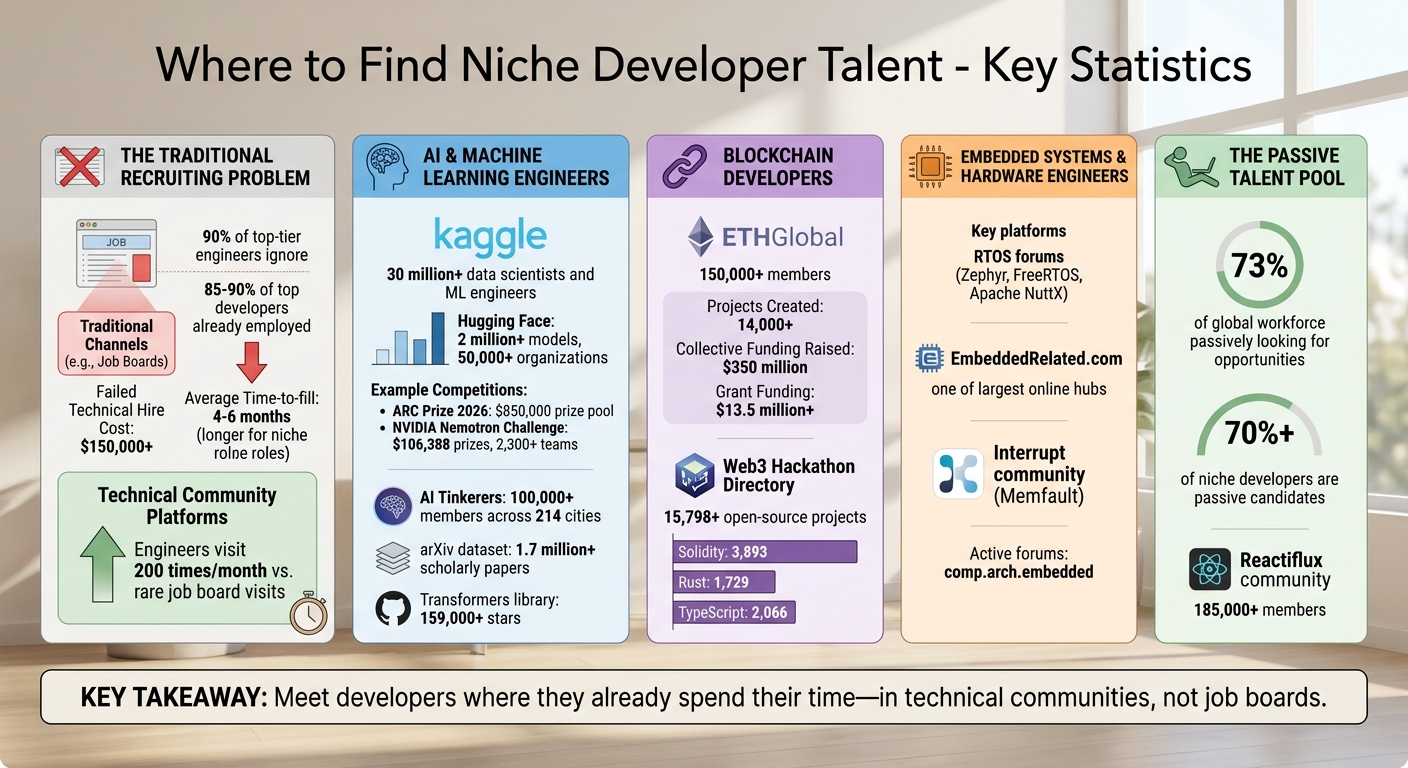
Here’s a startling reality: 90% of top-tier engineers ignore LinkedIn and job boards . This highlights a major issue with traditional recruiting methods. If you're trying to hire AI engineers, blockchain developers, or embedded systems experts, the usual strategies just don’t cut it.
Most top developers (85-90%) are already employed and don’t visit job boards . They’re not browsing career sites or scrolling through job postings. Instead, they’re contributing to open-source projects, diving into technical papers, or engaging in niche online communities. Meanwhile, recruiters are posting jobs in places these specialists rarely frequent, and cold outreach messages often go unnoticed.
Consider this: a typical engaged engineer might visit a technical community platform as many as 200 times a month . Compare that to the rare occasions they check a job board - only when actively looking for work. This disconnect is glaring. Recruiters are targeting the wrong spaces, while the talent they need is thriving in specialized developer networks. Bridging this gap requires smarter tools and strategies.
Keyword Screening Misses Real Expertise
Automated resume screening tools might seem efficient, but they’re far from perfect. These systems rely on keywords like "machine learning" or "Solidity", but they can’t distinguish between someone who completed a weekend tutorial and someone with years of real-world experience. This often results in false positives - candidates who look good on paper but lack the depth needed for production-level work .
The consequences of these errors can be expensive. For instance, a failed technical hire can cost over $150,000 when you account for recruitment fees, onboarding costs, and lost productivity .
These tools aren’t just missing the mark - they’re also failing to address a critical aspect: speaking the language of specialized engineers.
Why Domain Knowledge Matters
Specialized engineers can quickly tell whether a recruiter understands their field. A blockchain job posting that skips over protocol specifics or a vague outreach message screams generic effort. Generic outreach is often dismissed as spam by specialized engineers .
"A customized outreach by a hiring manager can appear much more interesting to candidates than the one done by a recruiter, thus enhancing the responsiveness." - Workfully
The solution isn’t to turn recruiters into technical experts overnight. Instead, it’s about collaborating with hiring managers who understand the nuances or using platforms where developers already spend their time learning and collaborating. When outreach comes from someone with domain knowledge or appears in a trusted environment, response rates improve significantly.
Without this expertise, recruiters risk missing out on the best candidates while wasting time on unqualified ones. And with an average time-to-fill for a Senior Engineer through traditional channels ranging from 4-6 months - and even longer for niche roles - this inefficiency can severely hurt your hiring efforts. Solving these challenges is essential before diving into specialized developer communities, which we’ll explore in the next sections.
Where AI and Machine Learning Engineers Spend Their Time
AI and machine learning engineers aren't hanging out on traditional job boards. Instead, they're immersed in specialized communities where they can build, compete, and collaborate. For instance, Kaggle boasts a massive community of over 30 million data scientists and machine learning engineers . Meanwhile, Hugging Face has become home to more than 2 million models, actively used by over 50,000 organizations, including giants like Google, Meta, and Microsoft . These platforms are where the real action happens - far removed from places like LinkedIn. If you want to connect with top-tier talent, understanding these developer sourcing channels is crucial.
Competitions That Define Expertise
The best AI engineers thrive in environments that challenge their technical skills. Take the ARC Prize 2026, for example. Launched on Kaggle with a prize pool of $850,000, this competition pushed participants to design models capable of fluid intelligence. Within weeks, hundreds of teams were competing . Similarly, the NVIDIA Nemotron Model Reasoning Challenge offered $106,388 in prizes and drew over 2,300 teams as of April 22, 2026 . These contests don't just highlight winners - they showcase engineers who are actively shaping the future of AI.
On the community front, AI Tinkerers is another standout. This group has grown to over 100,000 members across 214 cities worldwide . Their meetups are strictly "no-pitch zones", where engineers focus on live demos and technical problem-solving. In April 2026, simultaneous events in Hong Kong, Poznan, and Nürnberg featured demos of agentic systems and real-time voice translation tools . It's a grassroots network where hands-on expertise takes center stage.
Kaggle, Hugging Face, and arXiv: Where Talent Lives
Kaggle is a proving ground for engineers who excel under pressure. But don't just look at titles like "Grandmaster" or "Master." Instead, dive into solution write-ups. These detailed explanations reveal how engineers approach problems, weigh trade-offs, and think critically .
Hugging Face acts as a live portfolio for AI professionals. Browse profiles for model contributions, engagement on Spaces (interactive AI apps), and open-source contributions like maintaining libraries such as Transformers, which has earned over 159,000 GitHub stars . Engineers with multiple well-documented models or datasets that others actively use stand out as both skilled and production-ready.
For research-heavy roles, arXiv is a goldmine. Leveraging the arXiv dataset on Kaggle, which includes over 1.7 million scholarly papers, can help you identify prolific authors in areas like LLM factual accuracy or reinforcement learning . In early 2026, Google and IBM Research published key benchmarks on Kaggle, such as the FACTS Benchmark Suite and the Enterprise Operations Bench, which are excellent tools for spotting researchers at the forefront of these fields .
GitHub and ML Conferences: More Ways to Spot Talent
GitHub provides a window into how engineers actually code. Instead of focusing on stars for personal projects, look for contributors to widely-used libraries like Diffusers, which has over 33,000 stars. Engineers who maintain active forks or contribute to foundational ML libraries often have the skills to handle production-grade challenges .
ML conferences also offer a chance to connect with different types of talent. Research-heavy events like AAAI, ICML, and NeurIPS are ideal for finding theoretical and academic experts . On the other hand, conferences like NVIDIA GTC (March 16–19, 2026) and the Data + AI Summit (June 15–18, 2026) cater more to applied engineers and infrastructure specialists . Another major event, Ai4 2026 in Las Vegas (August 4–6), is expected to draw over 12,000 attendees and 1,000 speakers, making it North America's largest AI gathering .
Instead of setting up a recruiting booth, consider attending technical bootcamps at these conferences. For example, MLcon offers hands-on MLOps and GenAI bootcamps where engineers focus on sharpening their skills . Reviewing speaker and attendee lists can also help you identify key scientists and engineers from companies presenting new research or case studies . Many conferences in 2026 even offer free virtual admission, giving you the chance to scout talent and track session engagement without the need to travel .
Where to Find Blockchain Developers: DAOs, Hackathons, and Protocol Communities
Blockchain developers, much like AI engineers, often showcase their skills in specialized spaces rather than on traditional job boards. These developers thrive within decentralized ecosystems, contributing their expertise to Decentralized Autonomous Organizations (DAOs), participating in hackathons, and supporting open-source protocol projects.
Ethereum Forums and DAOs
Developer DAO is a prime example of where blockchain talent gathers, offering a space where developers can grow their skills within a self-governed, collaborative environment. This community, run by developers themselves, focuses on advancing web3 education and creating meaningful impact . Members actively engage in governance and contribute to forums, showcasing their dedication and technical expertise.
In October 2023, developer Blessing Emah joined Developer DAO and quickly made an impact, leading a team to secure second place at the Chainbase Hackathon within just a month .
"Developer DAO has brought together some of the most talented people on the web to build web3" - Blessing Emah
"Joining Developer DAO was one of the best career decisions I made! The DAO pushed me out of my comfort zone... and helped me evolve into a better developer" - Narb, DevNTell Lead at Developer DAO
Beyond Developer DAO, tracking Ethereum grant recipients can also reveal promising talent. Through the ETHGlobal ecosystem, community projects have received more than $13.5 million in grants . Additionally, platforms like the ethereum.org GitHub repository and Ethereum-specific forums are excellent for identifying developers who are tackling complex technical challenges .
These channels provide recruiters with a direct view of blockchain talent, setting the foundation for deeper exploration through hackathons and open-source contributions.
Blockchain Hackathons and Open-Source Projects
ETHGlobal has built a thriving network of over 150,000 members and has facilitated the creation of more than 14,000 projects through its hackathons . These events often result in production-ready code, and many participants have gone on to raise a collective $350 million for their companies .
Recruiters can explore the Web3 Hackathon Directory at hackathonprojects.dev, which lists over 15,798 open-source blockchain projects . The directory includes projects across various programming languages, such as 3,893 in Solidity, 1,729 in Rust, and 2,066 in TypeScript . Noteworthy projects from ETHOnline 2025 include Aegis, an AI-automated yield hunter, and Cushion, a tool offering automated liquidation protection for DeFi loans on AAVE .
Attending technical workshops at upcoming events like ETHPrague (May 8–10), ETHGlobal New York (June 12–14), and Ethereum Mexico (May 5–June 16) is another way to connect with developers presenting their research or case studies. Many of these events also offer free virtual access, making it easier for recruiters to scout talent .
Candidates who have completed SpeedRun Ethereum, a structured mentorship and learning program, often demonstrate a solid grasp of the Ethereum stack . Similarly, contributions to frameworks like Scaffold-ETH 2 and Foundry are strong indicators of advanced technical skills . These events and programs highlight the proactive, hands-on approach that defines the blockchain development community, offering recruiters a unique opportunity to connect with highly skilled candidates.
Finding Embedded Systems and Hardware Engineers
Embedded systems engineers play a crucial role in bridging hardware and software, crafting systems that power everything from medical devices to automotive controls. Their professional circles are often smaller and more specialized, focusing on specific hardware architectures or real-time operating systems (RTOS). These engineers gather in highly technical forums and communities, where their expertise becomes evident.
RTOS Forums and Hardware Meetups
Connecting with embedded systems engineers often requires tapping into both online and offline spaces where hands-on expertise is shared.
Interrupt, a community created by Memfault, has become a go-to resource for firmware developers. It offers technical blogs, GitHub repositories, and an active Slack channel where topics like ARM Cortex-M exception handling and watchdog timer implementation are discussed .
"The Interrupt community comprises engineers, hobbyists, and enthusiasts with a shared passion for hardware and firmware development"
Another key platform is EmbeddedRelated.com, which is among the largest online hubs for embedded systems professionals. It features forums on RTOS, bootloaders, and debugging, along with "Top Contributor" lists that highlight knowledgeable members.
"To use or not to use an RTOS in an embedded system can sometimes be an easy decision but sometimes a tricky one" - Stephane Boucher, forum moderator at EmbeddedRelated
For RTOS-specific expertise, communities focused on Zephyr, FreeRTOS, and Apache NuttX are worth exploring . The Zephyr Project, alongside Matter-over-Thread protocols, has been gaining traction as of early 2026, reflecting the industry's evolving focus . Additionally, long-standing groups like comp.arch.embedded remain active, offering insights into architectural troubleshooting and attracting seasoned professionals .
In-person events also play a key role. Conferences such as the Embedded Systems Conference (ESC) and local hardware meetups provide recruiters with a chance to network directly with engineers. Similarly, webinars on embedded software draw specialists from around the globe, offering another avenue to connect with problem-solvers who excel in real-world scenarios.
Electrical Engineering and Firmware Communities
Understanding the distinction between firmware specialists and hardware engineers is essential when targeting specific talent. Firmware specialists focus on areas such as C/C++ programming, bootloaders, and hardware abstraction layers, while hardware engineers deal with PCB layouts, circuit designs, and physical components .
"I'm a hardware design engineer by trade -- I'm embarrassed to show my software" - MaxMaxfield, hardware design engineer at EmbeddedRelated
For hardware-specific expertise, look to forums dedicated to platforms like ARM, MSP430, AVR (AVRclub), PIC (Piclist), and FPGA-CPU . Engineers with degrees in "Computer Engineering" often lean toward embedded software and IoT, while those with "Electronics and Communication Engineering" backgrounds tend to excel in hardware and circuitry .
GitHub remains a valuable tool for evaluating talent. Engineers who share detailed technical repositories demonstrate their embedded systems skills . For hardware-focused needs, regional electronics hubs and specialized forums like comp.arch.embedded can connect recruiters with technicians skilled in tasks like SMT replacement and soldering . These platforms provide direct access to professionals capable of delivering production-ready solutions.
How to Evaluate Specialized Skills Without Technical Expertise
Recruiters who lack in-depth technical knowledge often face challenges when assessing candidates for specialized roles like AI, blockchain, or embedded systems. Engineers in these fields can quickly detect when a recruiter doesn’t grasp their domain, which can erode trust from the outset. To overcome this, structured assessments and collaboration with technical experts are key.
Use Technical Screening Tools and Assessments
Bridging the technical knowledge gap starts with using targeted screening tools. These tools allow recruiters to objectively evaluate candidates without needing to assess technical skills without coding tests. The focus should be on designing tests that measure true understanding, not just the ability to replicate pre-existing solutions.
Incorporate live coding sessions during video interviews. Ask candidates to explain their thought process as they work through problems. This step helps verify their understanding and logical reasoning.
To prevent reliance on AI for solutions, introduce constraints like requiring O(log N) solutions or optimizing memory usage in embedded systems. Such constraints challenge candidates to demonstrate genuine problem-solving skills.
Another effective method is to provide a demo project with pre-written unit tests. Candidates must add a feature without breaking these tests, showcasing their ability to work within constraints and solve real-world problems. For highly specialized roles where internal expertise is limited, consider a contract-to-hire model. This approach allows you to evaluate a candidate’s performance before making a full-time commitment.
Partner with Hiring Managers or Specialist Recruiters
Collaborating with technical leads or hiring managers ensures a more accurate assessment of a candidate’s skills. Before starting the hiring process, consult these experts to define project goals, technical requirements, and team dynamics. This groundwork helps you understand what to look for in a candidate.
When posting job ads on niche platforms like Stack Overflow, work with technical leads to select precise tags - such as Docker, specific AI frameworks, or blockchain protocols. This ensures your listing reaches the right audience.
Internal referrals can also be a goldmine for niche roles. Existing developers often know skilled professionals and can vouch for their abilities. As Nathalie Figuière from CoderPad points out:
"Your own developers are likely to know someone for the job, and will have a good idea of the skill level and abilities of their friends and online acquaintances."
For roles requiring extremely specialized expertise, explore specialized talent networks. These networks provide pre-vetted candidates and conduct thorough technical screenings, saving you time and allowing you to focus on soft skills and team compatibility. Once technical collaborators narrow down the candidate pool, further verify expertise by reviewing open-source contributions.
Review Open-Source Contributions
A candidate’s open-source activity can provide insights that go beyond what a resume can offer. Platforms like GitHub, Stack Overflow, and Dev.to showcase technical proficiency, problem-solving skills, and community involvement.
On GitHub, look for the programming languages they use, the number of followers they have (a sign of peer recognition), and their history of collaboration on projects. Repositories that have been starred or forked by others indicate that their work is respected within the developer community.
On Stack Overflow, check their activity under specific tags related to the role - such as TensorFlow for AI roles or Solidity for blockchain developers. Their reputation score in these areas reflects how the community values their expertise.
Additionally, articles on Dev.to can reveal a candidate’s depth of knowledge and ability to explain complex topics. This skill often signals mastery and a willingness to share knowledge.
It’s important to remember that no candidate will meet every requirement. Instead of searching for a perfect match, aim for candidates who meet about 80% of the technical requirements and show potential for growth. As Tyler Fisher from Hawx Smart Pest Control explains:
"If they meet 100% of the requirements there's no growth for them, and most ambitious professionals want to grow."
Building a Talent Pipeline for Hard-to-Fill Roles
Competing for a limited pool of niche experts can be both costly and inefficient. Instead of scrambling to fill roles reactively, consider focusing on long-term relationships with specialized developers. By doing so, you can reduce hiring timelines and maintain a steady flow of qualified candidates for critical positions that are essential to your operations. Start by identifying potential successors within your team and keeping tabs on external talent well before any vacancies arise. Partnering with technical universities is another effective strategy - offering internships where senior engineers mentor entry-level hires helps create a pipeline of developers already familiar with your tech stack and work environment. This proactive approach bridges the gap between identifying passive talent and actively engaging with them on platforms they frequent.
Engage Through Community Involvement
Developers often steer clear of generic recruitment messages. Instead, they spend their time in communities that help them grow and stay informed - platforms like daily.dev, GitHub, specialized Discord servers, and niche Slack channels. As previously mentioned, generic outreach doesn’t resonate with these professionals.
To truly connect, you need to meet them where they are. For example, join communities like Reactiflux, which boasts over 185,000 members and caters to frontend developers, or forums tailored to embedded systems engineers. Be an active participant by contributing value - whether that’s answering technical questions, recruiting through open-source projects, or sponsoring niche podcasts like Data Skeptic, which appeals to AI professionals.
You can also use creative, technical tactics to stand out. For instance, embed hiring messages in your website’s browser console or use clever WiFi network names at industry events. These subtle cues show that you understand their world and speak their language.
Another idea is hosting virtual "happy hours" focused on technical discussions rather than formal interviews. These relaxed settings allow you to build relationships with passive candidates who might not be ready to make a move but will remember your company when the time comes. Unlike broad, traditional recruitment channels, these tailored strategies help you build meaningful connections with the right talent.
Stay Connected with Passive Candidates
Once you’ve made authentic connections within these communities, the key is to nurture those relationships over time. Interestingly, 73% of the global workforce is passively looking for new opportunities, but these individuals aren’t actively browsing job boards. Platforms like daily.dev create trusted environments where developers feel comfortable sharing career aspirations, making introductions feel more like genuine recommendations than unsolicited messages.
"Trust is the only hack. Engineers come to daily.dev to learn and stay sharp. They trust the platform enough to share career goals... When your role appears inside that routine, it doesn't feel like spam." - Nimrod Kramer, CEO & Co-Founder, daily.dev
Implementing double opt-in systems can make a big difference. These systems allow candidates to discreetly express interest before formal outreach, reducing the perception of spam and ensuring you’re connecting with developers who genuinely want to engage. Tools like daily.dev Recruiter offer this service for $350 per role, per month, without any placement fees.
To stay on their radar, maintain regular touchpoints. Share technical articles, invite them to webinars, or update them about exciting projects your team is working on. By building trust and credibility over time, you’ll ensure your company is top-of-mind when they’re ready to make a career move. It’s about creating relationships that last, not just filling roles when the need arises.
Conclusion
Hiring niche developers - whether for AI model development, smart contract auditing, or firmware programming - requires a tailored approach. Traditional platforms like job boards and LinkedIn often fail to connect with these specialists. Instead, these professionals thrive in unique ecosystems: AI engineers frequent Kaggle, Hugging Face, and arXiv; blockchain experts engage in Ethereum forums and DAOs; and embedded systems developers gather in RTOS communities and hardware-focused meetups.
To evaluate niche skills effectively, collaboration with technical hiring managers is crucial. Practical assessments, such as code reviews and open-source contributions, offer far more insight than keyword-based resume screenings. What truly matters is what these developers are building, reading, and contributing to, not just the buzzwords on their resumes.
Once expertise is assessed accurately, the focus should shift to proactive engagement. Success in this space relies on moving beyond reactive hiring to building genuine relationships. This means participating in the spaces where these developers already grow and learn. Sponsoring technical podcasts, contributing to open-source initiatives, or hosting meaningful virtual discussions are not just recruitment strategies - they're investments in trust and credibility.
Credibility is the foundation for lasting success in recruiting. When your outreach appears on platforms like daily.dev, where developers engage with technical content hundreds of times a month, it feels like a trusted recommendation rather than a cold pitch. By meeting developers in their own spaces and speaking their language, hiring becomes a relationship-focused process rather than a numbers game. This targeted, community-driven approach is the key to successfully attracting and hiring top-tier niche developer talent.
FAQs
What’s the fastest way to find passive AI, blockchain, and embedded engineers?
If you're looking for passive talent in specialized fields like AI, blockchain, or embedded systems, the key is knowing where these experts spend their time online and offline. Here are some great starting points:
- AI Engineers: You'll often find them on platforms like Kaggle, Hugging Face, and arXiv, where they engage in competitions, share models, and publish research.
- Blockchain Developers: These professionals are active in Ethereum forums, participate in hackathons, and contribute to DAOs (Decentralized Autonomous Organizations).
- Embedded Engineers: They typically gather at hardware-focused meetups and participate in discussions on RTOS (Real-Time Operating Systems) forums.
Additionally, using AI-powered tools to analyze developer behavior can make it even easier to identify and connect with these niche specialists.
How can I verify niche skills without being a technical expert?
To assess niche skills without requiring extensive technical expertise, consider using practical assessments. These could include live problem-solving exercises or asking candidates to provide verbal explanations. This approach helps you observe how they reason and tackle challenges.
You can also leverage specialized tools designed for coding challenges or other role-specific tests to simplify the evaluation process. If you're unsure about technical details, working alongside a technical team member or hiring manager can ensure a more accurate assessment and smoother communication with candidates in their field.
What should I look for in GitHub or community profiles to spot real expertise?
When evaluating repositories, prioritize those that are well-organized, feature meaningful contributions, and include clear, thorough documentation. Look for signs of active maintenance, such as a consistent and substantial commit history and a diverse range of work.
Profiles that highlight contributions to notable open-source projects or specialized areas like blockchain or embedded systems can be particularly impressive. Additionally, a detailed README file, links to relevant projects, and visible engagement with other developers - such as discussions or issue resolutions - serve as strong evidence of real expertise.
.png)


