Web3 hiring breaks if I treat it like normal software hiring. There are about 26,000 active developers for roughly 440,000 open roles, and top candidates can disappear from the market in 10 to 14 days. So if I want to hire well, I need to define the role tightly, source in public, verify shipped work, and keep the process under two weeks.
Here’s the short version:
- I start with a clear role, not a broad title like “blockchain developer”
- I separate protocol, smart contract, and dApp/full-stack Web3 roles
- I screen for public proof, not resume claims
- I check mainnet deployments, merged PRs, audit history, and GitHub activity
- I tailor outreach to the developer’s actual work
- I keep interviews focused on judgment, security, and teamwork
- I move fast, because long hiring loops lose strong candidates
A few proof signals matter more than almost anything else:
- 3 to 5 deployed contract addresses
- Audit contest results from places like Code4rena or Sherlock
- Merged pull requests in known protocol repos
- Mainnet work with audit-cycle or incident-response exposure
Quick comparison
| Role | What I look for first | Main proof signal |
|---|---|---|
| Protocol Engineer | Rust, Go, C++, chain internals | Contributions to L1/L2 repos |
| Smart Contract Developer | Solidity, Vyper, Foundry, security sense | Verified mainnet contracts |
| dApp/Full-Stack Web3 | TypeScript, React, wallet UX | Live dApps and wallet-flow repos |
| Security Auditor | Foundry, Slither, bug finding | Audit reports, contests, bounties |
My takeaway is simple: if I hire from resumes first, I waste time. If I hire from public proof of work first, I get a cleaner shortlist and a better shot at closing the right people before they’re gone.
Define the role before you source candidates
Start with a specific title like Senior Solidity Engineer (DeFi) or Protocol Engineer (Rust/ZK) instead of a broad posting like “Blockchain Developer.” That one change makes sourcing much easier. Once the title is clear, you can look in places where that exact kind of work shows up in public.
Separate blockchain, Web3, and hybrid developer roles
These roles are not the same, and they shouldn’t be hired the same way.
Protocol engineers work on the chain layer itself: consensus, peer-to-peer networking, state, sequencers, and L1/L2 internals. Their stack usually includes Rust, Go, or C++.
Smart contract developers write on-chain logic like tokens, swaps, and governance. Since on-chain code is immutable, the screen needs to be tighter. A small mistake can turn into a very expensive one.
dApp/full-stack Web3 developers handle wallet flows, transaction UX, and data indexing. Their day-to-day stack often includes TypeScript, React, viem, and wagmi.
Use those role differences in your first-pass screen:
| Role | Primary Focus | Core Stack |
|---|---|---|
| Protocol Engineer | Consensus, L1/L2 internals, networking | Rust, Go, C++, ZK-proofs |
| Smart Contract Developer | On-chain logic, security, gas optimization | Solidity, Vyper, Foundry, Slither |
| dApp/Full-Stack Web3 | Wallet integration, UX, data indexing | TypeScript, React, viem, wagmi, The Graph |
Chain ecosystem matters just as much as role type. If you identify the chain at the start, you can narrow the search much faster .
Define the stack, project type, and seniority level
Before you source anyone, lock down the chain, toolchain, product domain, and seniority.
For EVM roles, it helps to standardize on Foundry (Forge, Cast, Anvil). Product domain matters too. DeFi roles need deep security judgment and financial math. NFT roles need metadata knowledge and comfort with token standards. ZK infrastructure roles call for advanced cryptography.
Seniority in Web3 is better judged by production exposure than by years alone. Someone may have four years of Solidity experience, but if that work is mostly testnet and POC projects, they may still sit closer to mid-level than senior .
The stronger signals are mainnet deployments and the amount of Total Value Locked (TVL) handled :
| Level | Key Indicators |
|---|---|
| Junior | Testnet deploys, tutorial projects, syntax fluency |
| Mid-level | Independent mainnet deploys, audit-cycle experience |
| Senior | Architectural ownership, incident response, large TVL exposure, full audit cycles |
Set non-negotiable hiring signals before screening starts
Set your minimum bar before the first resume hits your inbox. That keeps the process steady and saves time later.
For smart contract roles, require:
- Verified mainnet deployments
- Recent GitHub activity with public proof of shipping
- At least one audit review or security contest
Ask candidates for 3–5 contract addresses they shipped or co-shipped. Then verify them on Etherscan, Basescan, or Solscan instead of taking GitHub links at face value. Check for PR comments and code review participation, not just raw commit counts. Also confirm whether they worked on a contract that passed a known audit review or joined a security contest like Code4rena or Sherlock .
One practical note: be careful with candidates who use NDAs to explain every project away. In many cases, even private work still has a public deploy address that can be shared for verification .
With the role defined, move to the communities where these developers already work in public.
Where to find Web3 developers who work in public
The best Web3 sourcing signals are out in the open: GitHub, Discord, hackathons, and on-chain activity. A lot of strong candidates are pseudonymous, so GitHub handles and on-chain identities often tell you more than a resume ever will. Where you look should match the chain, stack, and role. Start with the role’s ecosystem and tech stack, and you can narrow the search fast.
Search GitHub, Discord, hackathons, and ecosystem communities
Look for developers with a real track record in the ecosystems you hire for. That includes merged PRs into open-source protocols like Uniswap, Aave, Compound, or OpenZeppelin.
Protocol Discord servers and governance forums are also strong sourcing channels. In those spaces, developers answer technical questions, argue through design choices, and point out security issues in public. That public record matters.
Event-based sourcing works well too. Track participants and winners from ETHGlobal, ETHDenver, Devconnect, and Chainlink hackathons. For security roles, audit contest leaderboards on Code4rena, Sherlock, and Cantina can be especially useful.
Search by chain, language, and tooling instead of broad labels like “blockchain developer.”
Write outreach based on the developer's actual work
Base your outreach on work the developer actually shipped. Mention a repository, PR, audit finding, or deployed contract. That small bit of effort goes a long way.
Be direct about comp, too. Include salary, token structure, and vesting terms upfront. Job posts with salary ranges draw more qualified applications .
Use daily.dev Recruiter for warm introductions to relevant developers
daily.dev Recruiter helps you get warm, double opt-in introductions to developers who are already active in the right topics. Targeting is based on current activity, not old profile data. You can also apply screening criteria before intros happen.
Once you have a shortlist, verify shipped work and test for technical depth during screening.
How to screen for real blockchain experience
After you source public builders, check the work behind the profile. That paper trail helps you clean up the shortlist before technical interviews start. Screening based on shipped work cuts down on false positives and saves time you’d otherwise spend on weak profiles.
Review portfolios, repositories, and deployed work
Start with GitHub. But don’t stop at the repo name or star count. Look for iterative commits, issue threads, and debugging history. A fork with no original work doesn’t tell you much. Neither does a sudden flood of uploads with vague commit messages. A repo with no real test coverage is a red flag. And PR comments often say more about seniority than raw commit counts.
For on-chain roles, verify deployed contracts on a block explorer. Ask candidates for 3–5 contract addresses they’ve shipped, then confirm the verified source code, deployment date, and actual activity on Etherscan, Basescan, or Solscan. Testnet-only work rarely counts as production proof. For senior roles, put more weight on mainnet deployments and audit exposure than years of experience. Meaningful TVL is a stronger signal than years alone .
Also check the README. A strong one explains the problem the project solves, the architecture choices, and the trade-offs the developer made . That kind of documentation shows how someone thinks, not just what they built.
The main proof to check is simple:
- deployed contracts
- audit participation
- merged PRs in recognized protocols
Assess core skills in Solidity, Rust, Ethereum, and smart contract workflows
Use the repo review to separate shipped work from surface-level language familiarity. Writing Solidity is not the same as understanding EVM execution. Basic syntax shows a candidate can write contracts. Execution-level knowledge shows they understand storage layout, gas costs, and how to stop reentrancy .
Tooling helps here too. Candidates who actively use Foundry (Forge/Cast) for testing and fuzzing usually show stronger EVM practice than those who rely only on Hardhat or Remix. Foundry is a strong signal of current EVM practice . For security roles, check whether the candidate shows up on audit contest leaderboards from Code4rena, Sherlock, or Cantina, or whether they have code-linked mitigation PRs tied to real audit reports.
Use this table as a recruiter’s checklist. The goal is to verify proof, not list what each role does:
| Role | Core Skills to Verify | Proof of Work Signal |
|---|---|---|
| Smart Contract Engineer | Solidity, Vyper, Foundry, Slither | Deployed contracts, audit contest rankings |
| Full-Stack Web3 Developer | TypeScript, React, viem, wagmi | Live dApps, wallet-flow repos |
| Protocol Engineer | Go, C++, Rust | Contributions to L1/L2 core repos |
| Security Auditor | Slither, Mythril, Foundry | Audit reports and bug bounty results |
Use a comparison table to standardize early-stage screening
Standardize early screening around artifacts you can verify. It’s easy for candidates to list “Solidity” or “DeFi experience” as skills. It’s much harder to fake a mainnet deployment with active TVL or a merged PR in a major protocol. Use the same screen for every candidate so early decisions stay consistent.
| Criteria | CV-Based Screening | Portfolio/Proof-Based Screening |
|---|---|---|
| Primary Signal | Titles and years of experience | Verified code and deployed contracts |
| Verification | Reference calls (late stage) | Block explorers and GitHub (early stage) |
| Risk Level | High (easy to fake "Web3 knowledge") | Low (hard to fake production code) |
| Technical Depth | Lists "Solidity" or "Rust" | Explains gas optimization and EVM storage layout |
| Tooling | Mentions "Blockchain" | Shows Foundry, Slither, or Hardhat usage |
Instead of screening for “5 years of Solidity experience,” switch to proof lines you can check: a deployed contract with over $1 million TVL, or a merged PR in a protocol like Uniswap or Aave . Proof-based screening also shortens time to hire.
Once the proof checks out, move only qualified candidates into interviews. Then use structured interviews to test judgment, security awareness, and collaboration.
Run a Structured Interview Process and Win Stronger Candidates
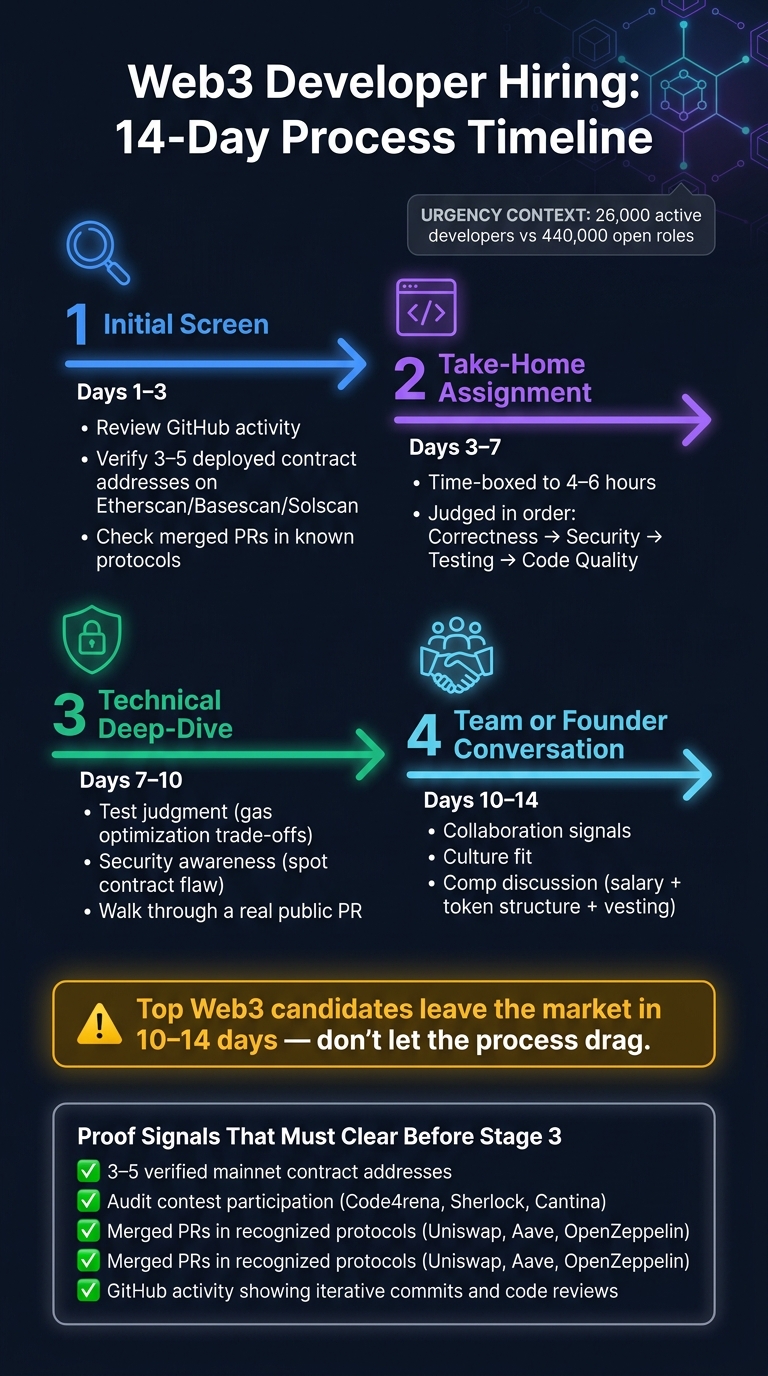
After proof-based screening, interviews should do a different job: test judgment, security habits, and teamwork that a portfolio alone can't show.
Once your shortlist is clean, move fast. Top Web3 candidates are often off the market in 10–14 days . Keep the process to four stages and wrap it up within two weeks. A practical timeline looks like this:
- Days 1–3: initial screen
- Days 3–7: take-home
- Days 7–10: technical deep-dive
- Days 10–14: team or founder conversation
Interview for Technical Judgment, Security Awareness, and Collaboration
Focus on judgment, not memorization. The gap between a strong Web3 hire and a weak one usually comes down to how they think through messy situations, not whether they can recite EVM opcodes from memory.
For technical judgment, ask the candidate to walk through a gas optimization choice they made in production. What did they trade off between efficiency, readability, and upgradeability? That answer tells you a lot.
For security awareness, give them a contract with a built-in flaw and ask them to spot it, explain it, and fix it. Strong candidates tend to find the risk first, then talk through the tradeoff instead of jumping straight to a patch.
For collaboration signals, ask them to explain a public PR or issue thread during the interview. Clear explanations, linked issues, and calm replies to review comments often tell you more than any made-up scenario ever will.
The take-home assignment should be time-boxed to 4–6 hours and judged in this order: correctness first, then security, then testing, then code quality .
Common Mistakes That Weaken Pipelines and Lower Response Rates
That same proof-first approach should carry from sourcing to the final interview. This is where many hiring pipelines start to leak.
The biggest mistake is treating blockchain hiring like standard software recruiting. If you lean on resume keywords like "Solidity" or "DeFi experience" without checking deployed contracts or GitHub history, weak candidates slip through. At the same time, strong candidates get screened out just because they don't have polished CVs.
Vague job descriptions also hurt response rates, as they fail to provide the technical clarity top talent expects. Serious Web3 developers often skip roles that don't name the chain, stack, and contract type. Cold outreach without any reference to the developer's actual work gets ignored fast. People who are active in public communities can tell right away whether you've done your homework.
Then there's speed. If a candidate finishes a take-home and hears nothing for too long, they've probably already moved on.
Conclusion: Build Your Blockchain Hiring Playbook Around Proof of Work and Targeted Outreach
Hire Web3 developers by proof of work, not keywords: define the role, source in public communities, verify shipped code, and move fast.
FAQs
How do I verify a Web3 developer’s real experience?
Go beyond resumes and look for proof-based evidence. GitHub can tell you a lot if you know what to check: production-level contributions, steady activity over time, commits that show clear thinking, and solid testing. That matters a lot more than a pile of forks or old coursework.
It also helps to look at what they’ve done on-chain. Check for deployed contracts, governance participation, audit contest results, and other public traces of hands-on work. In Web3, the work often leaves footprints.
In interviews, ask for specific examples. Have them walk through production decisions they made, gas-saving choices, and how they dealt with risks like reentrancy or oracle manipulation. You’re not looking for textbook answers. You want to hear how they thought through tradeoffs when the stakes were real.
A time-boxed, security-focused take-home is also a good gut check. It can help confirm whether someone has actual smart contract skill or just knows how to talk about it.
What signals separate senior Web3 talent from mid-level candidates?
Senior Web3 talent stands out through production experience and security instincts. It’s not just about knowing Solidity or Rust.
A mid-level candidate might write clean syntax. A senior goes further. They understand EVM execution, gas optimization, and security patterns such as reentrancy prevention and storage layout management. That difference matters a lot once code is live and money is on the line.
The strongest signs are practical ones: mainnet deployments, contributions to audit reports, and the ability to explain the trade-offs or weak spots they’ve dealt with. You want someone who can say what happened, why it mattered, and how they handled it.
GitHub should back that up. Look for documented iteration, meaningful testing, and clear ownership of production-grade code.
How can I attract strong blockchain developers before they go off-market?
Move faster than the usual two-week hiring cycle. Long interview loops drag things out, and that’s often when strong candidates disappear.
Put proactive sourcing first. Find top open-source contributors in your ecosystem and send personalized outreach that speaks to their code. Show up where they already spend time, like Discord servers, governance forums, and hackathon leaderboards.
It also helps to cut friction where you can. Contract-to-hire options can make the first step easier, and competitive pay gives people a clear reason to keep the conversation going.
.png)