Platform engineers are transforming how software teams work in 2026. They build Internal Developer Platforms (IDPs) to simplify infrastructure, enabling developers to deploy in minutes instead of filing tickets and waiting days. With 80% of large organizations projected to have platform teams by the end of 2026, hiring these specialists is now critical for scaling efficiently.
Here’s what you need to know:
- Role Focus: Platform engineers focus on creating tools and workflows to improve developer experience. They treat infrastructure as a product, emphasizing self-service and automation.
- Key Skills: Look for expertise in Kubernetes, Infrastructure as Code (Terraform, Pulumi), GitOps (ArgoCD), and programming languages like Go or Python. Strong communication and product thinking are equally important.
- Demand Surge: Salaries are 27% higher than for DevOps roles, with senior engineers earning $170,000–$275,000+. Specialized skills and certifications (like CKA) can push compensation even higher.
- Interview Approach: Assess candidates with practical interview challenges, such as designing an IDP architecture or building a Kubernetes operator. Prioritize those who demonstrate both technical depth and a collaborative mindset.
- Sourcing Talent: Attend events like PlatformCon and KubeCon, explore GitHub contributor profiles, leverage modern sourcing tactics, or use tools like daily.dev Recruiter to connect with skilled professionals.
Platform engineers are no longer optional - they’re essential for modern engineering teams. Hiring the right talent means focusing on technical expertise, product-oriented thinking, and competitive compensation.
What Platform Engineering Means in 2026
Platform engineering is all about creating and managing the tools and workflows that enable software teams to work more efficiently. At its core, it delivers an Internal Developer Platform (IDP) - a carefully designed set of tools, APIs, and workflows that simplify infrastructure management. For instance, it takes complex tasks, like launching a microservice, and turns them into a streamlined, self-service process that adheres to compliance standards.
What sets platform engineers apart is their product-focused mindset. They treat the internal platform as a product meant to improve the developer experience. Instead of just maintaining servers or writing automation scripts, platform engineers build systems that reduce the mental load on developers. This allows developers to focus on writing application code rather than getting bogged down by Kubernetes configurations or Terraform scripts. For hiring managers, this emphasis on self-service and reducing complexity is a key trait to look for in candidates for modern infrastructure roles.
The rise of platform engineering is backed by data. The percentage of large organizations with platform teams has grown significantly - from 45% in 2022 to a projected 80% by 2026 . By 2026, more than 28% of organizations already have dedicated platform teams . The tools driving this shift are collectively known as the "BACK" Stack: Backstage (developer portal), ArgoCD (GitOps deployment), Crossplane (infrastructure control plane), and Kyverno (policy enforcement) . These tools, all part of the CNCF ecosystem, serve as the foundation of modern IDPs, enabling workflows where infrastructure states are automatically synced from Git repositories.
Success in platform engineering is measured differently than traditional infrastructure roles. Metrics like developer velocity, time-to-deploy, and platform adoption rates take center stage. The industry is moving away from ticket-based infrastructure requests to self-service platforms where developers can provision resources in minutes instead of days . For recruiters, this means prioritizing candidates who combine deep technical expertise with a product-oriented approach to infrastructure.
Platform Engineering vs DevOps vs SRE
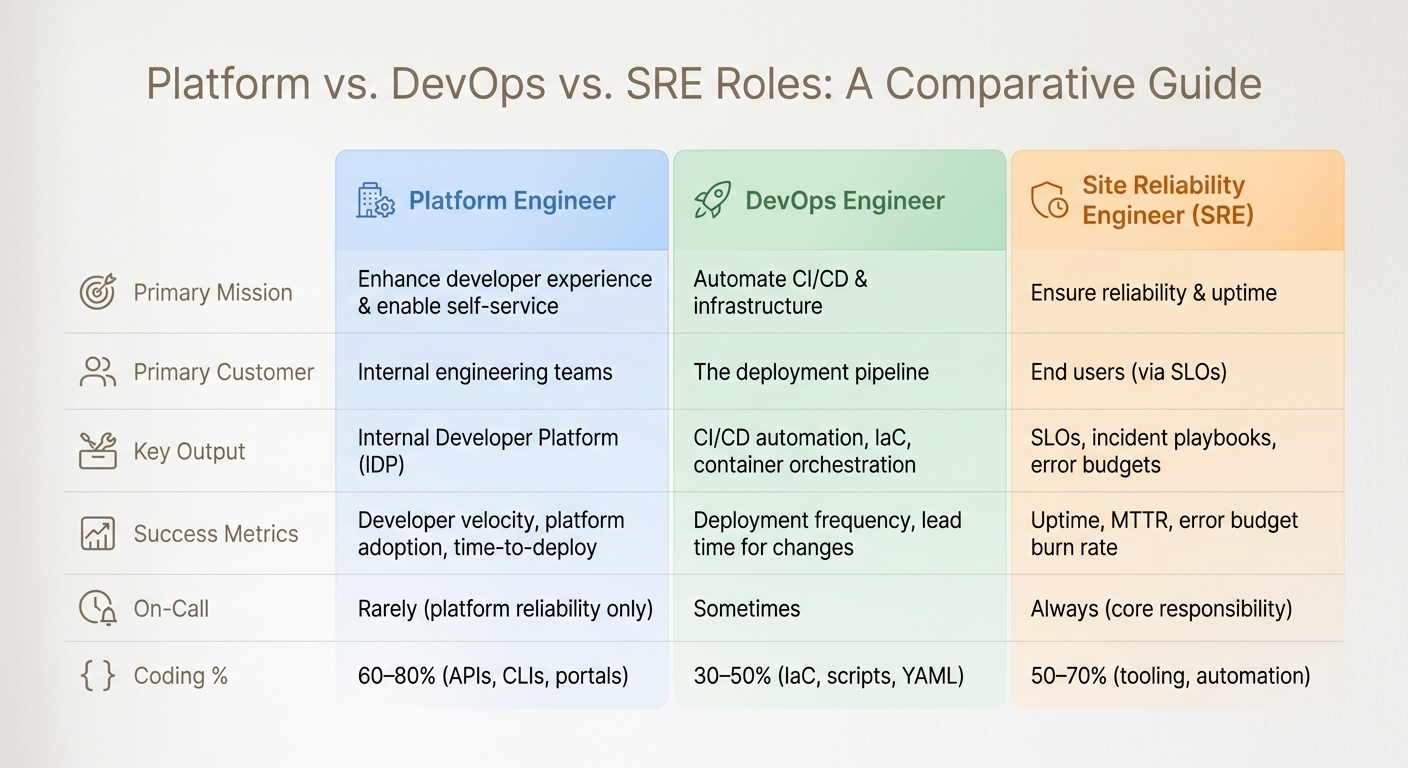
Understanding the differences between platform engineering, DevOps, and Site Reliability Engineering (SRE) is crucial for hiring the right talent. Each role has a distinct mission and responsibilities, and these differences are key when writing job descriptions or evaluating candidates. Here's a breakdown to clarify these roles:
| Dimension | Platform Engineer | DevOps Engineer | Site Reliability Engineer (SRE) |
|---|---|---|---|
| Primary Mission | Enhance developer experience & enable self-service | Automate CI/CD & infrastructure | Ensure reliability & uptime |
| Primary Customer | Internal engineering teams | The deployment pipeline | End users (via SLOs) |
| Key Output | Internal Developer Platform (IDP) | CI/CD automation, IaC, container orchestration | SLOs, incident playbooks, error budgets |
| Success Metrics | Developer velocity, platform adoption, time-to-deploy | Deployment frequency, lead time for changes | Uptime, MTTR, error budget burn rate |
| On-Call | Rarely (platform reliability only) | Sometimes | Always (core responsibility) |
| Coding % | 60–80% (APIs, CLIs, portals) | 30–50% (IaC, scripts, YAML) | 50–70% (tooling, automation) |
Here’s a practical example: A DevOps engineer might set up a Kubernetes cluster and build pipelines for continuous integration and delivery. A platform engineer, on the other hand, would create a self-service portal that allows developers to spin up a new service on Kubernetes without needing to submit a support ticket. Meanwhile, an SRE focuses on keeping production systems running smoothly, handling incident response, and managing error budgets.
To illustrate the growing demand for platform engineers, consider this: In early 2026, a Series C fintech company in Los Angeles successfully hired a "Senior Platform Engineer" in just 22 days. In contrast, a similar "Senior DevOps" role at the same company went unfilled for three months. The difference? The platform engineering role emphasized building an IDP rather than simply managing infrastructure.
When hiring, prioritize candidates who understand these distinctions and can explain how platform engineering transforms internal service delivery into a product-driven approach. This ensures you’re targeting professionals with the right balance of technical expertise and product thinking needed for success in 2026.
Skills to Assess in Platform Engineers
Technical Skills and Tools
Platform engineers need a deeper skill set than traditional infrastructure roles. The job now demands writing production-level code in languages like Go, Python, or TypeScript to create CLIs, APIs, and internal tools - not just basic YAML files or bash scripts.
Kubernetes expertise is a must. Candidates should know how to deploy and extend clusters using controllers, operators, CRDs, and admission webhooks. When it comes to Infrastructure as Code, tools like Terraform, OpenTofu, or Pulumi are key. Look for the ability to design reusable, modular code that can support multiple teams.
GitOps and CI/CD are equally critical. Hands-on experience with tools like ArgoCD for GitOps workflows and familiarity with pipeline tools such as Tekton or Dagger is essential. Knowledge of industry-standard tools like Backstage and ArgoCD signals up-to-date expertise.
Observability is another cornerstone. Engineers should be skilled in integrating tools like OpenTelemetry, Prometheus, and Grafana to deliver pre-configured dashboards and tracing capabilities. Security is just as important - experience with OPA/Gatekeeper, Kyverno, and Vault is highly desirable.
Understanding prominent IDP frameworks is also crucial for creating self-service portals that empower developers. To evaluate coding skills and depth, consider a practical exercise. For instance, ask candidates to build a platform component, like a Kubernetes operator in Go or a Backstage plugin in TypeScript, within 90 minutes.
While technical skills are the foundation, platform engineers must also excel in communication and problem-solving to thrive in this role.
Communication and Problem-Solving Skills
Technical know-how alone isn’t enough for platform engineers. They need strong communication and problem-solving abilities, along with a product-focused mindset. The platform should be treated as a product, with developers as its customers. Look for candidates who measure success by metrics like adoption rates, developer satisfaction, or time-to-first-deploy, rather than just system uptime.
Empathy for the developer experience is key. The best platform engineers understand the challenges developers face and avoid creating overly complex solutions that miss the mark. Charity Majors captures it well:
The bottom line is that platform teams are responsible for developer productivity.
Cross-functional communication is a vital skill. Platform engineers often bridge the gap between developers who want agility and security teams prioritizing controls. They must translate technical challenges in ways that developers can grasp while also presenting risks to leadership in clear business terms.
Systems thinking is another important quality. A strong candidate can evaluate how new tools fit into the organization’s broader ecosystem and anticipate potential ripple effects. Scope discipline is equally critical - knowing when to say no to customizations that don’t align with the platform’s long-term goals. Scenario-based interview questions, like addressing resistance from a product team hesitant to adopt the platform, can reveal these traits.
Lastly, mentoring and knowledge-sharing capabilities set great platform engineers apart. They often lead tech talks and informal learning sessions to encourage platform adoption and spread expertise. This balance of technical excellence and empathetic communication is at the heart of a product-first approach to platform engineering.
Where to Find Platform Engineers in 2026
Communities and Events
Platform engineers have their go-to spaces for networking and professional growth. PlatformCon 2026 is a standout event in the field. Scheduled from June 22–26, 2026, it offers a mix of virtual sessions and in-person "Live Days" in London on June 23 and New York City on June 25. The event extends its reach with a global World Tour, stopping in Paris on September 24, Sydney in October, and São Paulo on November 7. Virtual registration is free, making it accessible to both job seekers and recruiters alike .
Another key event is KubeCon Europe 2026, which has become a prime spot for sourcing talent. It now includes specialized sub-events like Platform Engineering Day, BackstageCon, ArgoCon, OpenTofu Day, and KyvernoCon . These gatherings attract engineers deeply involved in cloud-native technologies and platform tools. The focus on developer experience and the product-oriented approach of platform engineering is heavily reflected in these events. For recruiters, keeping an eye on the speaker lists at PlatformCon and KubeCon is a smart move - these individuals are often top-tier professionals and highly engaged in the field .
Online communities also play a crucial role. Groups like CNCF and PlatformEngineering.org have become thriving hubs for platform engineering talent, with the global community growing to over 280,000 members by 2026 .
For a more targeted approach, consider CNCF project contributors on GitHub. Engineers contributing to projects like Backstage, Crossplane, ArgoCD, or Kubernetes operators often exhibit the problem-solving mindset central to platform engineering . Additionally, newsletters such as "Platform Weekly" and LinkedIn groups dedicated to the field can help connect with passive candidates who might not be actively seeking new opportunities .
These community connections can be further enhanced with advanced sourcing tools.
Using daily.dev Recruiter to Find Platform Engineers
Beyond traditional methods, tools like daily.dev Recruiter are changing how recruiters find platform engineers. This platform connects directly with developers as they engage with technical content, bypassing outdated profile-based systems. By focusing on engineers' interests and activity, it helps identify candidates who are actively learning and staying ahead in the field.
With daily.dev Recruiter, you can use filters to pinpoint engineers skilled in specific tools like Kubernetes, Terraform, Crossplane, and Backstage . The platform tracks engagement with topics like Internal Developer Platforms (IDPs) and Developer Experience (DevEx), making it easier to find candidates aligned with the latest trends .
Look for candidates who display product thinking - those who view infrastructure as a product and internal developers as their customers. This approach, which prioritizes developer experience and self-service capabilities, is a hallmark of modern platform engineering .
daily.dev Recruiter also ensures a smooth and respectful hiring process. All introductions are warm and double opt-in, meaning you only connect with candidates who are genuinely interested in engaging. This eliminates cold emails and unnecessary screening calls, replacing them with meaningful, high-context conversations that respect everyone's time.
How to Interview Platform Engineers
Technical Challenges and Scenarios
Interviewing platform engineers requires a focus on their ability to design infrastructure as a product and create systems that developers can rely on. This means crafting scenarios that test both their technical skills and their problem-solving approach.
Start with an Internal Developer Platform (IDP) architecture design challenge. For example, present a scenario where a company has 150 engineers, 40 microservices, inconsistent CI/CD processes, and 2-hour deployment times. Ask the candidate to draft a 12-month roadmap for building an IDP. The goal is to see if they can identify and prioritize high-impact problems rather than jumping into creating a massive, monolithic solution.
For infrastructure-as-code tasks, present practical challenges. One example: ask candidates to migrate a Terraform state from a local backend to a remote one without disrupting the existing infrastructure . Another option: create a CI/CD pipeline scenario for a fintech app requiring zero-downtime deployments, rollback capabilities under 3 minutes, and SOC 2 audit compliance . These tasks give insight into how well candidates handle real-world constraints.
When assessing Kubernetes knowledge, ask candidates to explain the differences between a Deployment and a StatefulSet. You can also test their ability to implement Role-Based Access Control (RBAC) and network policies. Avoid questions that reward rote memorization - focus on practical understanding . For a migration challenge, consider asking how they would move a monolithic application hosted on EC2 to Kubernetes while minimizing downtime .
For the coding round, keep the tasks platform-specific. Candidates might be asked to build a Kubernetes operator in Go, create a Backstage plugin in TypeScript, or develop a reusable Terraform module with automated tests . This will show whether they can deliver production-level code that aligns with platform engineering needs.
A structured interview process should include four key components:
- A technical screen to evaluate their product mindset.
- A system design session focused on IDP architecture.
- A coding exercise centered on platform-related tools.
- A culture and stakeholder management round .
During the system design stage, ask candidates to describe a "golden path" they've developed and how they balanced standardization with developer flexibility. This reveals their ability to think like a product owner. You can also test their understanding of guardrails by asking how they would implement policies using tools like OPA/Gatekeeper or Kyverno to prevent misconfigurations, such as containers running as root, without relying on manual reviews .
Finally, evaluate their crisis management skills by simulating incident response scenarios. Instead of passive language like "the pipeline broke", focus on ownership-based phrasing such as "I misconfigured the load balancer" . This approach highlights how candidates handle accountability and high-pressure situations.
Assessing Team Fit and Collaboration
Once technical skills have been assessed, shift the focus to collaboration and how candidates handle cross-team dynamics. Platform engineers must navigate resistance and work effectively with diverse teams, so understanding their approach to teamwork is essential.
Behavioral questions are a great way to gauge this. For instance, ask: "A product team bypasses your platform and deploys directly to the cloud using their own custom Terraform. How do you handle this?" . This question reveals whether the candidate defaults to gatekeeping or takes a more product-minded approach, seeking to understand why the platform was bypassed. Follow up with a prioritization scenario: "How do you decide which platform features to prioritize when three different teams have urgent, competing requests?" .
To test empathy and communication skills, ask candidates to explain a complex infrastructure decision to non-technical stakeholders. Including a backend engineer or product manager in the interview can help assess their ability to break down technical trade-offs into plain language. Candidates who struggle to do this might face challenges in driving platform adoption.
Use the STAR method (Situation, Task, Action, Result) to encourage thoughtful, structured responses. For example:
- "Describe a time you anticipated a scalability bottleneck and implemented preventive measures before it impacted developers" .
- "Tell me about a time you realized you had the wrong technical answer. How did you pivot and find the right solution?" .
These types of questions provide insight into how candidates handle uncertainty and problem-solving.
"The platform team treats other engineering teams as customers. They gather requirements, build features, measure adoption, and iterate." – NexaTalent
To assess product thinking, ask candidates how they measured the success of past platforms. Watch for red flags like an inability to cite metrics such as adoption rates, developer satisfaction scores, or deployment time improvements. Strong candidates will mention shadowing developers, gathering feedback, and iterating based on real pain points.
Lastly, evaluate how they manage high-pressure situations. Ask:
- "Tell me about a time you had to prioritize tasks quickly when a critical production bug was reported during a major platform release" .
- "How do you communicate platform reliability and incident status to leadership during a high-stakes outage?" .
These questions help uncover how candidates stay composed under pressure and communicate effectively during crises.
Compensation and Career Growth for Platform Engineers in 2026
Salary Ranges by Experience Level
Platform engineering has become a lucrative field, with base salaries now up to 27% higher than traditional DevOps roles . This pay gap highlights the advanced skill set required for platform engineers, who blend infrastructure expertise with software development to create scalable Internal Developer Platforms (IDPs).
Salaries vary widely based on experience:
- Junior platform engineers (1–3 years): Base salaries range from $100,000 to $130,000 .
- Mid-level engineers (3–6 years): Base pay falls between $120,000 and $175,000, with total compensation (including bonuses and equity) reaching $135,000 to $185,000+ .
- Senior engineers (7+ years): Base salaries climb to $155,000–$220,000, with total packages hitting $170,000 to $275,000+ .
- Staff and Principal engineers (10+ years): Base salaries typically range from $185,000 to $260,000+, and total compensation at major tech firms can exceed $350,000 when RSUs and bonuses are included .
Specialized skills, like Kubernetes expertise validated by a CKA certification, often push salaries to the upper end of these ranges . Robert Ardell, Co-Founder of KORE1, emphasizes the value of advanced skills:
"The gap between deploying a pod and architecting a multi-cluster platform with proper namespace isolation is the gap between a junior hire and a $175K offer."
Certain industries, such as fintech and healthcare, pay even more due to the cost-saving potential of automated compliance guardrails . Additionally, engineers who approach platforms with a "product mindset" - treating the platform as a product and developers as customers - are especially sought after by recruiters who understand what developers want .
Location also matters. Salaries in cities like San Francisco, New York, and Seattle come with a 15–25% premium . Experts recommend prioritizing base salary during negotiations, as equity valuations can be unpredictable .
Beyond the financial rewards, platform engineering offers clear career progression, making it an appealing long-term career choice.
Career Paths for Platform Engineers
A well-defined career path is another draw for platform engineers. Many start their journey with 2–3 years in roles such as DevOps, cloud engineering, or backend development . From there, the progression typically moves from Junior Platform Engineer to Platform Engineer, then to Senior Platform Engineer, and eventually to Staff or Principal Platform Engineer .
At the senior level, engineers can choose between two main tracks:
- Technical track: Focuses on advanced architecture, cross-team strategy, and mentoring, leading to roles like Staff or Principal Engineer.
- Leadership track: Includes positions like Platform Engineering Team Lead, Manager, Head of Cloud Platform, or Director of Cloud & Platform . Both tracks can ultimately lead to CTO roles .
As companies grow, specialization becomes more common. Engineers often focus on areas such as:
- Developer Experience (DX): Streamlining onboarding and improving self-service tools.
- Platform Security: Implementing policy-as-code and automated guardrails.
- Data Platform Engineering: Supporting data processing and machine learning workloads.
- FinOps: Optimizing cloud costs .
For example, improving Developer Experience by tracking onboarding metrics or running satisfaction surveys can help engineers secure higher-paying roles like Staff or Principal Engineer .
"Platform engineering is a multiplier: each improvement (automation, templates, guardrails) scales across many teams and services." – DevOpsSchool
To advance, engineers should focus on the impact of their work - such as reducing developer wait times or simplifying onboarding - and pursue certifications like CKA or AWS Solutions Architect Professional .
Conclusion
Hiring platform engineers in 2026 means recognizing how this role differs from traditional DevOps or SRE positions. Platform engineers focus on building Internal Developer Platforms (IDPs) that empower developers with self-service tools and boost productivity, rather than managing pipelines or handling incidents directly. Using the right job title is key here: for example, a Series C fintech company in Los Angeles successfully filled a "Senior Platform Engineer" role in just 22 days, while a "Senior DevOps" posting had gone unfilled for three months . This clarity in job definition is critical when attracting candidates with the right mix of technical expertise and product-oriented thinking.
When assessing candidates, look for strong product thinking and proficiency in languages like Go, Python, or TypeScript. Candidates should demonstrate an ability to design "golden paths" that address common developer needs, collect feedback from internal users, and track adoption metrics. Interviews should include system design challenges centered on IDP architecture and scenarios that test stakeholder management skills - both are crucial for collaboration and delivering value.
Competitive compensation is another must. Platform engineers typically earn up to 27% more than DevOps engineers , with senior-level packages in the U.S. ranging from $170,000 to over $275,000. To attract top talent, avoid under-budgeting or assigning on-call SRE rotations as part of the role. These higher salaries reflect the strategic importance of platform engineers in modern organizations.
For sourcing, tools like daily.dev Recruiter can help you connect with engineers specializing in platform development. By leveraging their tech stack preferences and engagement with relevant content, you can identify passive candidates who may be open to the right opportunity.
With Gartner projecting that 80% of large software engineering organizations will have dedicated platform teams by 2026 , competition for these roles is only going to increase. By defining the role clearly, prioritizing both technical and product-oriented skills, and using targeted sourcing methods, your organization will be well-prepared to scale effectively.
FAQs
When should a company hire its first platform engineer?
When a company begins scaling its development team - usually around 10 to 20 engineers - it’s time to consider hiring a platform engineer. This role plays a key part in creating and managing an internal developer platform (IDP). An IDP enhances the developer experience, simplifies self-service deployments, and smooths out workflows. As the team expands, platform engineering becomes critical for tackling challenges like deployment delays and infrastructure management, ensuring the organization can scale efficiently.
What’s the fastest way to tell platform engineering from DevOps or SRE?
Platform engineering is all about creating and managing internal developer platforms (IDPs). These platforms are designed to streamline infrastructure and empower developers with self-service tools, all while keeping scalability and the developer experience front and center. On the other hand, DevOps focuses on automating pipelines and infrastructure, acting as a bridge between development and operations teams. Then there's SRE, which is dedicated to ensuring reliability and uptime by using tools like monitoring, managing SLAs, and handling incidents.
To tell them apart, consider the core responsibilities: Is the role about building IDPs (platform engineering)? Or does it center on automation and maintaining reliability (DevOps or SRE)?
What should an IDP MVP include in the first 90 days?
In the first 90 days, an IDP MVP should aim to create a self-service, developer-friendly environment that simplifies workflows and speeds up deployment. The main focus should be on providing:
- A service catalog and templates for essential infrastructure like databases, CI pipelines, and monitoring.
- Golden paths that guide developers through common workflows with ease.
- Self-service deployment capabilities that include built-in guardrails for safety.
The ultimate goal? Get the time-to-first-deploy for new services down to under an hour, making the process as smooth and efficient as possible.
.png)