Choosing the right platform for technical assessments can shape your hiring success. Codility, HackerRank, and CodeSignal each offer unique features tailored to different hiring needs. Here's a quick breakdown:
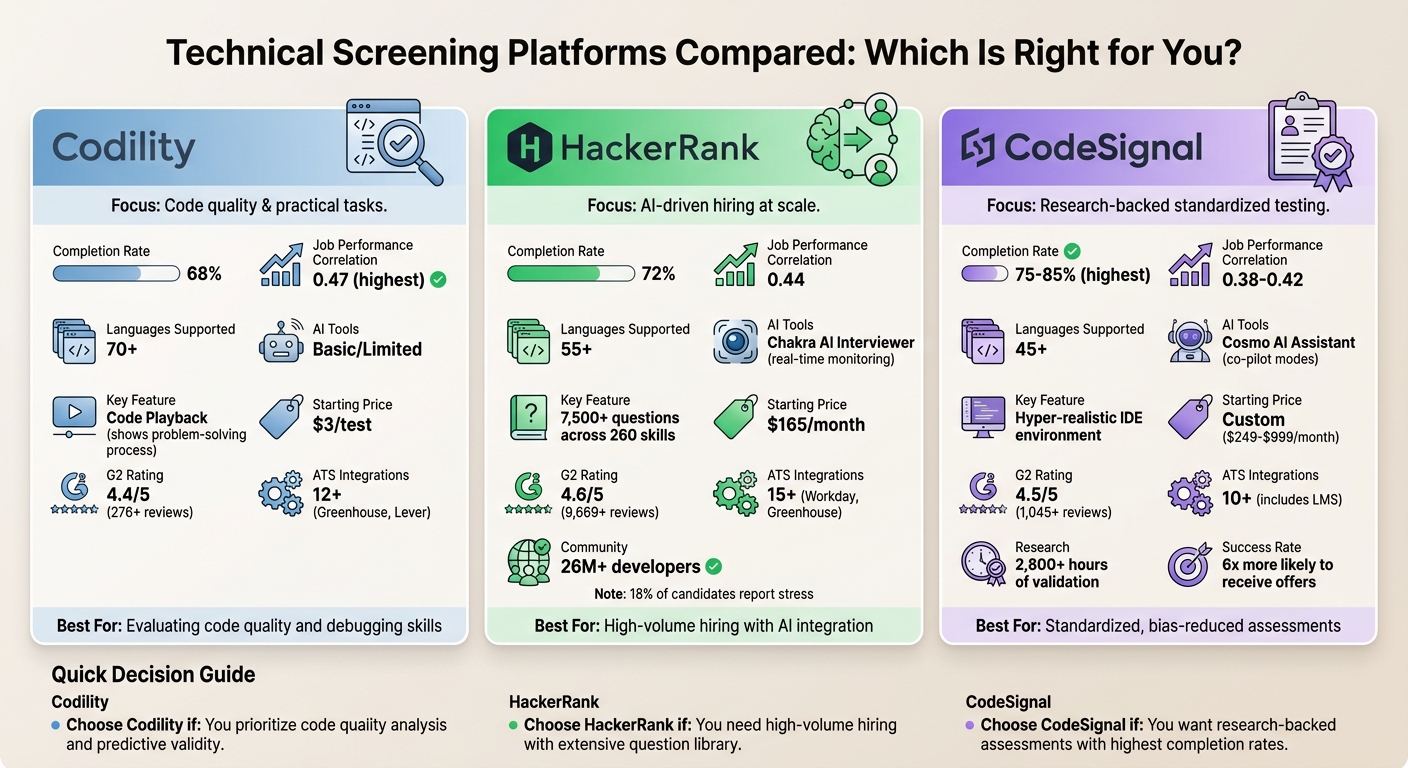
- Codility: Focuses on vetting technical skills with tools like Code Playback and a predictive validity score of 0.47. It supports 70+ languages but has a 68% test completion rate.
- HackerRank: Known for its AI-driven tools like Chakra AI Interviewer and real-time monitoring. It serves 26M+ developers and offers over 7,500 questions across 260 skills. Completion rate: 72%.
- CodeSignal: Emphasizes research-backed, standardized assessments with a realistic IDE and AI assistant Cosmo. It boasts the highest completion rate (75–85%) but uses custom pricing.
Quick Comparison:
| Feature | Codility | HackerRank | CodeSignal |
|---|---|---|---|
| Focus | Code quality, debugging | AI-driven hiring | Standardized testing |
| Completion Rate | 68% | 72% | 75–85% |
| Languages | 70+ | 55+ | 45+ |
| AI Tools | Basic | Chakra AI Interviewer | Cosmo AI Assistant |
| Starting Price | $3/test | $165/month | Custom ($249+) |
Each platform has strengths depending on your priorities, like scale, AI integration, or predictive accuracy. Testing them and gathering feedback can help you pick the best fit for your hiring goals. Using these tools can help you identify qualified technical candidates more efficiently.
Codility: Features and How It Works
Codility has established itself as a robust technical screening platform, catering to companies of all sizes, from startups to massive enterprises with over 5,000 employees. Since its founding in 2009, the platform has evaluated more than 16 million engineers across 68 countries - a testament to its reach and reliability . Its primary focus lies in assessing code quality and algorithmic problem-solving, making it a go-to solution for high-volume tech hiring.
Codility provides two main tools: Codility Screen for asynchronous pre-screening and Codility Interview for live, structured technical interviews conducted through a browser-based IDE . Supporting over 70 programming languages and technologies , it offers flexibility for testing a wide range of technical skills. Standout features like Code Playback and automated grading streamline the evaluation process by analyzing code quality, correctness, and methodology, significantly reducing the time spent on manual reviews .
Key Features of Codility
Codility's Engineering Skills Model 2.0 introduces a library of skill-mapped content designed to deliver fair and evidence-based assessments . Unlike abstract puzzles, the platform focuses on practical tasks, such as debugging, feature-building, and system design, which better reflect real-world challenges .
One of its standout tools, Code Playback, records the candidate’s coding process, providing insights into their problem-solving and debugging techniques . To ensure integrity, Codility incorporates features like plagiarism detection, proctoring, AI-resistant tasks, ID verification, and suspicious behavior monitoring . Additionally, the platform includes an AI assistant called "Cody" and templates for evaluating AI-assisted engineering skills. Recruiters can even use the TryAI service to test whether custom tasks can be solved by AI, ensuring assessments remain relevant in the age of generative AI .
Beyond hiring, Codility’s Skill Map feature helps organizations identify skill gaps within their teams, guiding training investments or pinpointing experts for specific projects . The platform also integrates seamlessly with popular Applicant Tracking Systems (ATS) like Greenhouse, Workable, and Lever .
"With Codility, our teams ran 750 candidate tests over 90 days, saving 2,200 hours of interview time." - Chris Weber, Global Head of Recruitment, AI & Operate Solutions, Unity
These capabilities aim to improve both candidate evaluation and recruiter efficiency, but the platform does have its limitations.
Pros and Cons of Codility
Codility’s features bring several advantages, but there are also areas where it could improve. The platform excels at delivering detailed technical assessments, boasting a 96% customer satisfaction rate and an average rating of 4.6/5 stars on G2 from 350 reviews . Automated grading and Code Playback save hiring teams significant time, and its 68% candidate test completion rate reflects solid engagement. With a predictive validity score of 0.47 for job performance , Codility’s assessments moderately correlate with actual on-the-job success.
However, creating custom assessments can be time-intensive, often requiring around two months . Some users have criticized the platform’s interface, and the IDE has been reported to delete code if a candidate switches programming languages mid-test . Additionally, its focus on algorithmic challenges may not align with every company’s evaluation priorities. For teams looking for alternatives, there are ways to assess technical skills without coding tests.
| Aspect | Strengths | Limitations |
|---|---|---|
| Assessment Quality | Code Playback reveals problem-solving process; supports 70+ languages | Custom assessments can take up to 2 months; IDE functionality is limited |
| Candidate Experience | 68% completion rate; real-world simulations | Subpar user interface; code may be lost when switching languages |
| Pricing | Pay-as-you-go at $3/test; flexible tiers | Enterprise pricing ranges between $20,000–$50,000/year |
| Integration | Smooth ATS integration with Greenhouse, Workable, Lever | Requires significant engineering effort to manage |
Pricing starts at $3 per test for small businesses on a pay-as-you-go basis, with a starter option priced at approximately $150 per month . Business plans range from $5,000 to $15,000 annually, while enterprise plans typically cost between $20,000 and $50,000 per year .
HackerRank: Features and How It Works
HackerRank is a technical screening platform powered by AI, handling an impressive 172,800 skill assessments daily and serving over 25% of Fortune 100 companies . Unlike Codility's focus on code playback, HackerRank uses AI to evaluate candidates' ability to work with modern tools, aligning with the industry's shift toward workflows that integrate AI. Originally designed for scalable hiring, it now assesses "AI fluency", reflecting how developers use AI tools in real-world scenarios.
The platform offers two main products: standardized skill assessments and Chakra, an AI-driven interviewer that adapts to candidates' responses with contextual follow-up questions . Supporting 55 to 58 programming languages , HackerRank includes a built-in AI assistant that candidates can use during tests. Recruiters can monitor these interactions in real time, focusing on how candidates debug AI-generated code or craft prompts, rather than penalizing AI usage .
HackerRank's Integrity Signals system combines AI plagiarism detection, tab monitoring, multiple monitor detection, and ID verification into a single score . This is critical in today's hiring landscape, where 70% of students use AI tools during job searches, and plagiarism detection flags about 60% of candidates. With 93% accuracy, its AI-driven system is three times more effective than traditional methods .
Companies leveraging HackerRank have reported significant improvements. For instance, Red Hat automated early-stage screenings, disqualifying 63% of candidates in the first round and cutting live technical interviews by over 60% . Atlassian used the platform to screen 35,000 campus applicants, reducing plagiarism flags from 10% to 4% and saving time on manual reviews .
"Before we had HackerRank, our managers and our technical roles were sort of creating their own tests, which obviously took a lot of time… once we got HackerRank in place, we were able to streamline the process."
- Joshua Bellis, Global Head of Talent Attraction & Programs, PTC
Key Features of HackerRank
- AI-Assisted IDE: Records test interactions, enabling recruiters to understand candidates' problem-solving approaches .
- Chakra AI Interviewer: Adapts to responses, evaluating skills like problem-solving, code quality, and knowledge depth .
- Real-Time Monitoring: Tracks candidate interactions with AI, distinguishing genuine problem-solving from repetitive responses .
- Extensive Question Library: Offers over 7,500 questions covering 260 skills and 55+ programming languages, with certified assessments that can be deployed quickly .
- Consistent Coding Environment: Enforces time and memory limits per language and allows recruiters to limit available languages for specific tests .
- Robust Integrations: Includes over 40 integrations with ATS and productivity tools like Greenhouse, Lever, and Workday. Features like automated syncing of results and REST API support streamline workflows .
"HackerRank's proctoring features, in particular, help us monitor candidate behavior during assessments, such as detecting tab changes, tracking live code writing, and flagging suspicious activities like plagiarism."
- Plamen Koychev, Managing Partner, Accedia
Pricing starts at $165 per month (billed annually at $1,990) for the Starter Plan, while the Pro Plan costs $375 per month (billed annually at $4,490). Enterprise pricing is customized, with a median contract value of around $13,942 . These pricing options highlight its scalability compared to Codility and CodeSignal.
Pros and Cons of HackerRank
HackerRank stands out with its extensive question library and advanced AI features. It holds a 4.6/5 rating on G2 and scores 9.4/10 for skill assessments . Its integrity scoring system and ATS integrations have helped companies achieve an 83% reduction in evaluation time .
However, the platform's higher starting cost may deter smaller teams, and its complex features often require additional training . Some users report that disabling AI assistant settings requires contacting support, which can slow down customization .
| Aspect | Strengths | Limitations |
|---|---|---|
| AI Features | Built-in AI IDE with real-time monitoring; Chakra AI Interviewer | AI settings require support contact to disable |
| Question Library | Over 7,500 questions across 260 skills with certified assessments | Complex feature set may require additional training |
| Integrity | 93% accurate plagiarism detection with a consolidated integrity score | High flag rate (60%) in AI-heavy environments necessitates manual review |
| Pricing | Flexible plans from $165/month to custom enterprise solutions | Higher starting cost can be a barrier for smaller teams |
| Integration | 40+ ATS integrations with automated result syncing | Custom workflows can be challenging to set up |
"HackerRank's built-in Integrity Signals let us trust every score, and the question library is miles ahead of Codility and CodeSignal. We reduced bad technical hires by 40% in the first quarter."
- Director of Engineering, Fortune 100 FinTech
Despite its learning curve, HackerRank's 9.2/10 rating for customer support on G2 reflects its commitment to helping users navigate its advanced tools .
CodeSignal: Features and How It Works
CodeSignal uses a research-based method to streamline technical screening. Its assessments are designed to mimic real-world developer tasks, offering a realistic environment that mirrors daily workflows. These certified assessments are backed by over 2,800 hours of research and validation conducted by industrial-organizational psychologists. To date, the platform has facilitated over 30 million skill evaluations, making it a trusted tool for companies looking to predict job performance accurately [24, 25].
The platform also includes the Cosmo AI assistant, which operates in two modes: Full AI Co-Pilot Mode for solving complex challenges and Guided Support Mode for syntax assistance. This aligns with the growing trend of engineers relying on AI tools, with 76% using AI copilots daily . Recruiters benefit from full transcripts of candidate interactions with Cosmo, offering insights into their decision-making and problem-solving approaches. As CodeSignal's CEO, Tigran Sloyan, puts it:
"AI is redefining what it means to be an engineer. With AI-Assisted Coding Assessments and Interviews, we're capturing how candidates approach real-world challenges, make decisions with AI support, and deliver solutions that reflect the way software is built today."
Candidates work within a hyper-realistic IDE that includes features like a terminal, filesystem, and multi-file support for over 45 programming languages. This environment allows them to code, debug, and test their solutions as they would in a professional setting . Combined with CodeSignal's patented Coding Score, which predicts on-the-job performance, the platform provides a reliable measure of technical ability. Companies using CodeSignal report that candidates who pass its evaluations are six times more likely to receive job offers. Additionally, organizations experience a 40–60% reduction in the time spent on engineering interviews [23, 24].
To maintain the integrity of assessments, CodeSignal employs several security measures, such as a Suspicion Score for flagging irregularities, a proactive Leak Sweep to protect content, and full proctoring with identity verification. The platform also integrates seamlessly with major applicant tracking systems (ATS) like Greenhouse, Workday, Lever, and Oracle. Its custom pricing model is tailored to meet enterprise-scale requirements .
"By incorporating CodeSignal into our process... we're able to free up roughly 40 to 60% of our engineers' time."
- Michael Leggett, Tech Recruiter, Outreach
Key Features of CodeSignal
CodeSignal stands out with its combination of research-driven assessments and advanced AI tools. Here's what sets it apart:
- Research-Validated Assessments: Built on data from over 13 million evaluations, CodeSignal's tests are designed to predict job success reliably .
- Cosmo AI Assistant: Beyond assisting with syntax and problem-solving, Cosmo acts as an AI interviewer, asking follow-up questions and scoring candidates based on role-specific criteria.
- Hyper-Realistic IDE: The development environment supports over 45 programming languages and includes tools like a terminal and multi-file functionality, simulating real-world coding tasks.
- Predictive Coding Score: This score correlates strongly with job performance, helping recruiters make informed decisions.
- Seamless Integration: Works smoothly with major ATS platforms, simplifying the hiring process.
CodeSignal also delivers measurable results for businesses, with companies reporting over $3 million in cost savings per 100 hires and a 60% faster hiring process. These efficiencies free up senior engineering teams to focus on other priorities.
Pros and Cons of CodeSignal
CodeSignal's strengths lie in its research-backed approach, realistic coding environment, and robust security features. However, smaller teams may find some of its enterprise-focused features less adaptable to their needs, and its custom pricing model lacks the clarity of tiered plans offered by competitors.
| Aspect | Strengths | Limitations |
|---|---|---|
| Assessments | Validated by 2,800+ hours of research and includes a predictive Coding Score | May feel overly enterprise-focused, limiting flexibility for smaller teams |
| IDE Environment | Realistic IDE with terminal, filesystem, and multi-file support | Candidates may need time to adapt to the comprehensive environment |
| AI Features | Cosmo AI assistant offers co-pilot modes and detailed transcripts | Less emphasis on real-time AI monitoring compared to other platforms |
| Integrity | Proactive measures like Leak Sweep and Suspicion Score | Custom pricing model may not be as straightforward as tiered pricing plans |
| Integration | Connects seamlessly with major ATS platforms | Enterprise-scale features might be excessive for smaller organizations |
"Partnering with CodeSignal has helped us to manage a very high volume of interest from candidates in our process and quickly assess their technical acumen, without using a ton of engineering hours."
- Nadia Abouzaid, Head of Diversity Talent Programs, Asana
Codility vs HackerRank vs CodeSignal: Direct Comparison
After diving into the detailed features of Codility, HackerRank, and CodeSignal, here's a head-to-head comparison to help you decide which hiring tools for technical roles suit your needs. Each platform shines in areas like candidate experience, assessment quality, and system integrations, but their strengths vary.
HackerRank stands out with its massive community of over 26 million developers and 2,500+ customers. It emphasizes AI-assisted hiring, offering a built-in AI IDE that tracks candidate-AI interactions in real-time . CodeSignal, on the other hand, boasts a higher completion rate of 75–85%, compared to Codility's 68% and HackerRank's 72%. Codility takes the lead in predictive validity with a score of 0.47, slightly ahead of HackerRank's 0.44 . However, it's worth noting that 18% of candidates report feeling stressed during HackerRank's assessments, according to feedback on Glassdoor .
When it comes to integrations, HackerRank offers over 15 ATS connections, including Workday and Greenhouse, while Codility supports 12+ integrations with platforms like Greenhouse and Lever . CodeSignal differentiates itself by integrating with both Applicant Tracking Systems (ATS) and Learning Management Systems (LMS) . Pricing also varies: HackerRank's Starter plan is priced at $165/month ($1,990/year), while its Pro plan costs $375/month ($4,490/year). CodeSignal uses a custom pricing model, with tiers ranging from $249 to $999/month based on features .
Here's a quick breakdown of their key differences:
| Feature | HackerRank | CodeSignal | Codility |
|---|---|---|---|
| Ideal For | AI-assisted hiring & scale | Standardized, research-backed testing | Code quality & practical tasks |
| AI Assistant | Built-in AI IDE (Real time) | Cosmo AI Assistant | Limited/Basic |
| Completion Rate | 72% | 75–85% | 68% |
| Job Performance Correlation | 0.44 | 0.38–0.42 | 0.47 |
| ATS Integrations | 15+ (Workday, Greenhouse) | 10+ (Airtable, LMS) | 12+ (Greenhouse, Lever) |
| Supported Languages | 40+ languages | 70+ languages/frameworks | 70+ languages |
| G2 Rating | 4.6/5 (9,669+ reviews) | 4.5/5 (1,045+ reviews) | 4.4/5 (276+ reviews) |
| Starting Price | $165/month | Custom/from $249/month | Custom pricing |
Security measures also play a critical role in distinguishing these platforms. HackerRank uses AI proctoring and watermarking to ensure test integrity. CodeSignal offers leak prevention with its Suspicion Score, while Codility employs plagiarism detection alongside session playback . These differences highlight how each platform caters to specific hiring needs, making it easier to align your choice with your recruitment goals.
How to Choose the Right Technical Screening Tool
Matching Platform Features to Your Hiring Needs
Start by pinpointing the specific challenges in your hiring process. For instance, if you're overwhelmed with unqualified applicants, look for tools with pre-ATS filtering to screen candidates before they even enter your pipeline. If your focus is on evaluating senior engineers, select platforms that provide in-depth technical assessments tailored to advanced skill levels.
Your team size and hiring volume also factor into the decision. For example, HackerRank's Starter plan, priced at $165 per month, is designed for high-volume hiring needs. On the other hand, CodeSignal's pricing, which ranges from $249 to $999 per month, is better suited for teams that need standardized, research-backed assessments. These elements help you align platform capabilities with your hiring goals.
The length of assessments is another key consideration. Studies show that tests longer than 45 minutes can lead to over 60% of candidates dropping out. Codility, for instance, maintains a 68% completion rate, emphasizing how test duration affects engagement. If you're hiring for roles requiring proficiency with modern AI tools - which 97% of developers now use daily - platforms like HackerRank, offering real-time AI monitoring, can provide valuable insights into how candidates adapt to current technologies.
Integration capabilities are especially important for larger teams. HackerRank integrates with over 50 ATS platforms, including major systems like Workday, SAP, and Oracle. Meanwhile, Codility offers connections with more than 20 ATS platforms. Be sure to confirm whether your ATS has a native connector and supports essential enterprise features like SSO, SCIM, and SOC 2 compliance.
Testing Platforms and Gathering Feedback
Matching features to your needs is just the first step - testing the platform and gathering feedback ensures it truly delivers. Most tools offer free trials or demos, so take advantage of these to assess the candidate experience. If you're considering a platform for high-volume roles, conduct a pilot test to evaluate metrics like reducing time-to-hire and completion rates before committing to an annual contract.
Feedback is critical. Candidates with a positive assessment experience are 2.1 times more likely to accept a job offer, so their input on usability and stress levels can be invaluable. At the same time, gather feedback from hiring managers to see if the platform's technical insights accurately predict job performance. Keep in mind that 18% of candidates reported feeling stressed during HackerRank assessments, which could influence your employer branding.
To objectively compare platforms, create a weighted scoring system. For example:
- Library breadth: 15%
- Technical depth: 15%
- Anti-cheating measures: 10%
- Candidate experience: 10%
During your trials, track measurable outcomes like reductions in manual screening time or the impact of mobile-friendly platforms on completion rates. Look for platforms with strong predictive validity scores - a score above 0.35 indicates a solid connection between assessment results and job performance. Codility, for instance, boasts a predictive validity score of 0.47, making it a strong contender.
Conclusion
Each hiring platform brings distinct strengths tailored to different recruitment needs. HackerRank is a solid choice for large-scale hiring, especially with its AI tools, as 97% of developers now use AI daily. With a community of over 26 million developers and pricing starting at $165 per month, it’s built for high-volume recruitment. However, it’s worth noting that 18% of candidates report finding its assessments stressful.
Codility, on the other hand, shines when code quality and problem-solving are top priorities. Its code playback feature provides insight into a candidate’s thought process, offering a unique way to evaluate how they approach and debug tasks. With a 0.47 correlation to job performance, it’s particularly effective for assessing practical, hands-on development skills.
CodeSignal focuses on research-backed testing with tools like the Cosmo AI assistant and mobile emulation, creating a realistic and fair assessment environment. Candidates who pass its assessments are six times more likely to land job offers. Pricing ranges from $249 to $999 per month, making it a go-to for teams prioritizing certified assessments and reducing bias in hiring.
Ultimately, the best platform depends on your hiring philosophy and the experience you want to offer candidates. Skills-based assessments are increasingly valued, and a positive testing experience can influence whether top talent accepts your offer. As HackerRank emphasizes:
"Integrity in hiring is about whether candidates follow the rules, not whether they use AI"
This perspective highlights the evolving nature of technical screening. To make the right choice, consider piloting each platform, gathering candidate feedback, and monitoring completion rates. The ideal tool will align with your technical requirements, improve your hiring efficiency, and leave candidates with a great impression of your process.
FAQs
Which tool is best for high-volume hiring?
HackerRank is a go-to solution for high-volume hiring, thanks to its extensive question library and scalable assessment tools. These features make it easier to efficiently screen large numbers of candidates. With a strong emphasis on automation and a wide range of assessments, it simplifies the evaluation process for big applicant pools. While Codility provides solid analytics and realistic coding challenges, HackerRank’s ability to handle large-scale hiring demands gives it a clear edge in these scenarios.
How do these platforms handle AI use and cheating?
Platforms like HackerRank and CodeSignal rely on AI-driven tools to uphold the integrity of their assessments. HackerRank, for instance, uses AI to detect plagiarism, ensuring that all candidates are evaluated fairly. Similarly, CodeSignal incorporates anti-cheating measures to maintain a level playing field during assessments. These tools actively monitor for any suspicious behavior, helping recruiters identify skilled candidates while ensuring the process remains fair for everyone involved.
What’s the easiest option to integrate with my ATS?
Codility stands out as the easiest choice for integrating with applicant tracking systems (ATS). Its built-in integration features simplify recruitment processes and reduce the need for manual data handling. While HackerRank and CodeSignal offer extensive assessment libraries and automation tools, they place less emphasis on ATS integration. Codility’s priority on smooth connectivity makes it an ideal solution for recruiters looking to link assessment tools with their ATS effortlessly.
.png)