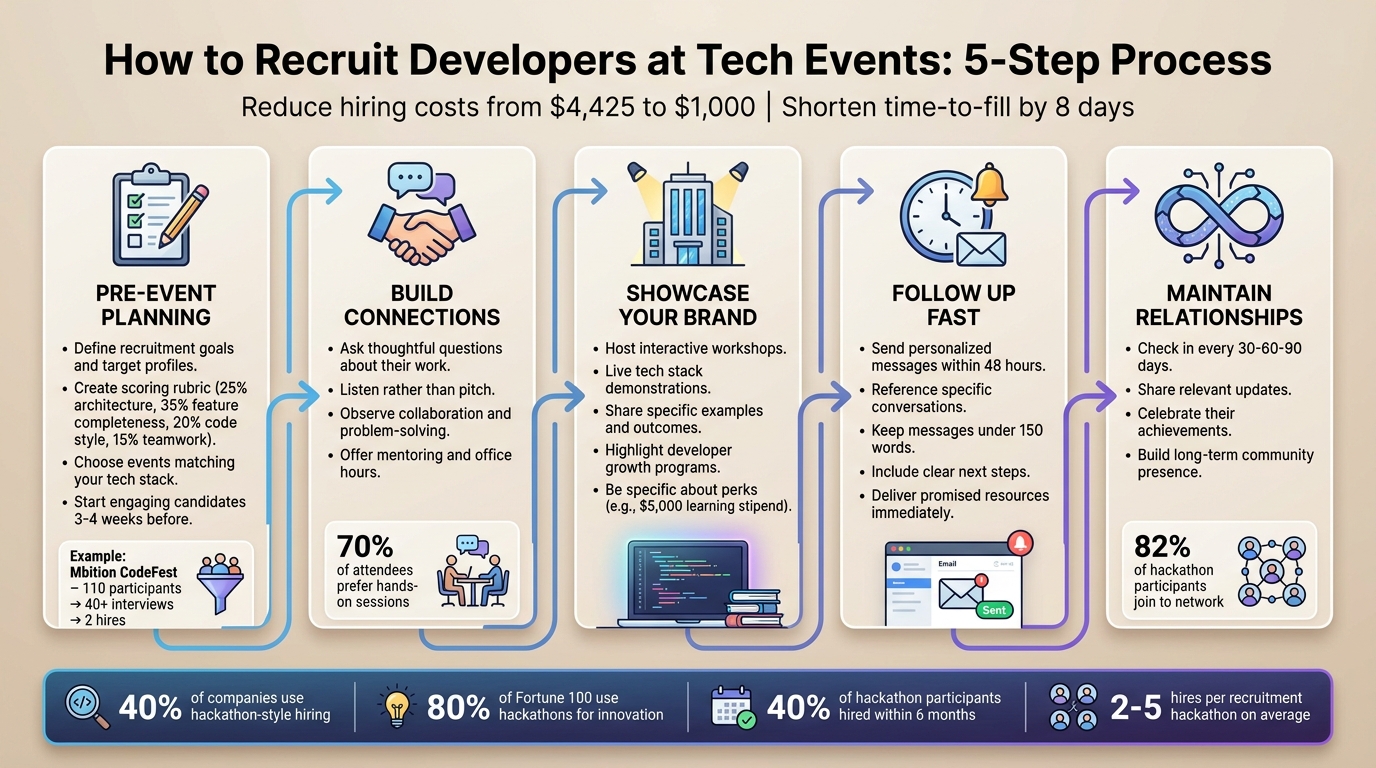
Want to hire developers who can solve problems on the spot? Tech conferences and hackathons let you see their skills in action. Instead of relying on resumes, you can watch developers build, collaborate, and innovate under real-time conditions. This approach not only reduces hiring costs (from $4,425 to $1,000 on average) but also shortens time-to-fill roles by 8 days. Plus, these events help you connect with passionate developers and create a pipeline for future hiring.
Key Takeaways:
- Set clear goals: Define the roles and skills you’re targeting.
- Pick the right events: Match the event’s focus to your hiring needs.
- Engage effectively: Start conversations, observe projects, and highlight your company’s strengths.
- Follow up fast: Personalized messages within 48 hours boost response rates.
- Leverage hackathons: Assess technical and soft skills while building relationships.
Recruiting at these events isn’t just about finding talent now - it’s about creating lasting connections with developers who could be your future hires.
Pre-Event Planning: Preparing for Success
Laying the groundwork before attending a tech event is crucial for meaningful engagement and effective recruitment. Walking into a tech conference or hackathon without a clear plan can lead to missed opportunities. Before reserving a booth or sponsoring an event, outline what success looks like. Are you aiming to fill specific backend engineering roles, or is your goal to grow your developer community? Each objective requires a tailored strategy for engaging with attendees .
Define Your Recruitment Goals and Target Profiles
The first step is to pinpoint the roles you need to fill and the technical skills required for each. Remember, different roles call for different evaluation criteria. Create a scoring rubric with weighted categories, such as 25% for architecture, 35% for feature completeness, 20% for code style, and 15% for teamwork. This ensures an objective way to assess candidates .
Run a calibration exercise with your team to align everyone on how to apply the rubric consistently . Keep in mind that different developer profiles value different things. For instance, junior developers often prioritize career development and mentorship, while senior engineers are more drawn to recognition and technical challenges .
Choose the Right Events
Not every tech event will align with your hiring needs. Match the event’s focus to the skills you’re looking for - attending an AI-focused hackathon won’t help much if your priority is hiring Java backend engineers. A great example is Mbition, Mercedes-Benz’s innovation lab, which hosted a 3-day "CodeFest" in Berlin. The event attracted 110 participants, resulting in over 40 job interviews and 2 immediate hires .
Consider the type of attendees and their experience levels. Some events skew toward students, while others attract seasoned professionals. For example, Booking.com collaborated with Hackathon.com to host a travel solutions challenge that successfully identified strong candidates . Location also plays a role - tech hubs like San Francisco and Austin offer access to dense talent pools for in-person events, while virtual events provide broader reach at a lower cost .
Prepare Your Team and Materials
Your team needs more than just branded swag and a booth. Equip them to ask thoughtful questions, listen to candidate concerns, and share meaningful technical insights instead of giving generic software demos. Every interaction should provide value . Focusing solely on giveaways and foot traffic won’t yield the results you’re aiming for .
Start engaging potential candidates 3-4 weeks before the event. Use the event hashtag on LinkedIn, identify promising profiles from the attendee list, and send direct invites for one-on-one meetings . Prepare personalized follow-up email templates and plan a seven-day communication schedule before the event. Set up digital tools like hackathon platforms (e.g., Devpost or HackerEarth), real-time digital scorecards for evaluations, and "office hours" where your engineers can mentor participants . With these preparations, you can turn a chaotic event into an organized and productive talent discovery process. A well-prepared team and clear objectives set the stage for meaningful connections during the event.
Building Connections During Events
When you're at an event, focus on listening rather than pitching. Developers can quickly pick up on conversations that feel purely transactional, and that can shut down any chance of real engagement. Instead, aim to create meaningful relationships. Treat every interaction as the start of a long-term professional connection, not just a fleeting sales pitch. This mindset naturally sets the stage for genuine conversations.
Start Genuine Conversations
Ask thoughtful questions that show interest in what developers are working on, their challenges, or what brought them to the event. For example, asking something like, "What’s the most interesting problem you’ve solved this month?" can lead to a rich and engaging discussion. Avoid jumping straight into talking about your company’s tech stack or open roles - it’s better to let the conversation flow naturally.
Instead, share tailored insights, discuss industry trends, or give constructive feedback on their projects. Developers value sincerity and technical expertise far more than a rehearsed pitch. Events like hackathons are especially great for observing how developers collaborate and solve technical challenges, often revealing more than a resume ever could .
### Build Trust Within Developer Communities
After those initial conversations, take steps to deepen trust by showing you're an active and supportive member of the community - not just someone with an agenda. Offer value by organizing Q&A sessions with your engineering team, providing one-on-one mentoring opportunities, or hosting "office hours" where developers can get advice or troubleshoot project issues.
Leverage digital tools to stay connected. Use event hashtags and share relevant content to increase visibility while reinforcing your authenticity. And if someone is immersed in their work, be patient - wait for a natural break before starting a conversation. Developers will respect you more when they see you value their time and genuinely understand their world.
Showcase Your Employer Brand
Once you've established those initial connections, it's time to let developers know what sets your company apart. This isn't about giving a hard sell - it’s about showing, not telling. Developers want a glimpse into your engineering culture: how your team works, the tools you use, and the ways you support their professional growth. Use this opportunity to highlight what makes your workplace special.
Present Your Engineering Culture
Bring your engineering culture to life with interactive experiences. Instead of relying on traditional booths with brochures, try hosting workshops or live demonstrations with your engineers. For example, "tech breakouts" where your team showcases your tech stack in action can be incredibly effective. Why? Because 70% of event attendees prefer practical, hands-on sessions over standard presentations .
Take Mbition, Mercedes-Benz’s innovation lab, as an example. They hosted a 3-day CodeFest in Berlin, which included 1-hour individual coding challenges and 4-hour team sprints. The results? Out of 110 participants, they conducted over 40 on-site job interviews and hired two developers .
Use Concrete Examples to Stand Out
Specific examples help your message stick. For instance, Mastercard collaborated with AngelHack to speed up product delivery. Sebastien Taveau, Mastercard's Chief Developer Evangelist & VP of Open API, shared:
"AngelHack helped us put together the Masters of Code... With their expertise, we were able to deliver in 10 months what would usually take 3 years to build" .
Stories like this show real outcomes, which resonate far more than vague claims. Highlight projects that moved from prototype to production and emphasize how your company invests in developer growth - whether through training programs, mentorship, or other initiatives. If you offer standout perks, be specific. Instead of saying "great benefits", mention details like a $5,000 annual learning stipend, support for attending conferences, or flexible work options. Numbers and specifics make all the difference.
Post-Event Follow-Up: Converting Connections Into Hires
After the event ends, the real challenge begins: transforming the conversations you had into meaningful relationships - and, ideally, hires. Post-event follow-ups are your opportunity to build on the connections you made. As Mark Rachapoom, Founder of Dench, wisely points out:
"Follow-ups within 48 hours get meaningfully better response rates than follow-ups sent later. The person still remembers you, the conversation is still relevant... and you don't have to re-establish context" .
Taking action quickly and thoughtfully is what lays the groundwork for turning those initial chats into successful hires.
Write Personalized Follow-Up Messages
Timing is everything, and the first 48 hours after the event are key. Send your follow-up message within this window while your conversation is still fresh in their mind. Personalize the message by referencing something specific you discussed - whether it’s a project they mentioned, a technical issue they’re tackling, or even a shared interest. Keep it short (aim for fewer than 150 words), and make sure to include a clear next step. For instance, if you promised to share a resource, like API documentation or a link to your company’s engineering blog, deliver it right away. Missed the 48-hour mark? No problem - acknowledge the delay and reach out anyway. It’s better to reconnect late than not at all.
Maintain Relationships Through Continued Communication
The follow-up doesn’t end after one message. Building a genuine relationship takes time and consistent effort. As Rachapoom highlights:
"Conference contacts become real relationships when you maintain them consistently over time, not just in the first 48 hours. The first follow-up opens the door. Everything after is what actually builds the relationship" .
So, while the initial follow-up gets the ball rolling, it’s the ongoing communication that solidifies the connection. Check in periodically - every 30, 60, or 90 days - by sharing something relevant, celebrating their achievements, or providing updates that could interest them. This keeps you on their radar in a natural way, without coming across as overbearing.
Using Hackathons as Recruitment Opportunities
Hackathons go beyond the innovation buzz - they're a hands-on way to assess developer talent in real-world scenarios. These events, often stretching up to 48 hours, provide a deeper look into a candidate's skills, offering insights that resumes simply can't capture . While tech conferences help build connections, hackathons take it a step further by giving you uninterrupted access to observe how developers think, work, and collaborate under pressure.
Interestingly, about 40% of companies use hackathon-style hiring as part of their recruitment process, and a whopping 80% of Fortune 100 companies rely on hackathons to drive innovation . They’re not just about creativity - they’re also efficient and cost-effective recruitment tools .
Sponsor and Host Hackathon Events
Sponsoring or hosting a hackathon places your company front and center with highly skilled, motivated developers . Many participants are passive job seekers - not actively looking but open to the right opportunity. These events are a great way to engage with them in a low-pressure, collaborative setting.
If you host your own hackathon, you gain even more control over the experience. You can tailor challenges to match your tech stack, involve your team as mentors, and create an atmosphere that reflects your company’s engineering culture. As one hiring expert from ScaleTwice put it:
"Hackathons allow organizations to find, test, and onboard talent in a format that feels more like collaboration than assessment." – Hiring Expert, ScaleTwice
Even participants who don’t walk away with a prize can leave as advocates for your brand if they have a positive experience.
The cost to organize a hackathon is relatively low - around $4,000 on average. Virtual or hybrid formats can reduce expenses further and broaden your reach to include global talent. Just make sure to provide essentials like strong Wi-Fi, reliable power sources, and good food. Neglecting these basics can quickly tarnish your employer brand. With the right setup, you’ll be ready to spot standout talent based on their project work.
Identify Top Talent Through Project Work
The real value of hackathons lies in the ability to assess candidates beyond their technical expertise. While you’ll see their skills in areas like algorithm design, architectural decisions, and code quality, hackathons also reveal soft skills such as teamwork, leadership, creativity, and the ability to handle stress.
To make evaluations consistent, use a scoring rubric. For example:
- 35%: Feature completeness
- 25%: Architecture
- 20%: Code style
- 15%: Teamwork
- 5%: Innovation
Encourage participants to work on GitHub with timestamped commits. This allows you to track how their code evolves and ensures transparency in contributions.
Don’t wait until the end of the event to engage with top performers. Conduct quick, 15-minute lightning interviews during the hackathon to gauge culture fit and motivation. You can also hold office hours or midpoint check-ins to provide feedback and build rapport. After the event, follow up with standout candidates within 48 hours to keep the momentum going. Research shows that 40% of hackathon participants are hired within six months .
Build Long-Term Presence in Developer Communities
Building meaningful connections within developer communities is key to a successful recruitment strategy. While single events can spark interest, they often fall short of creating the trust needed to consistently attract top talent. The real advantage lies in cultivating an ongoing, recognizable presence. By engaging regularly, you establish credibility and maintain a steady stream of potential candidates who already trust your brand.
Host and Sponsor Events Regularly
Consistent involvement in events positions your company as a reliable and collaborative partner. Hosting or sponsoring hackathons and conferences regularly allows developers to associate your brand with more than just job postings - it becomes a symbol of meaningful interaction. Even participants who aren't hired right away can become advocates for your company within their own networks. By keeping track of standout participants, you can build a reserve of talent to reconnect with when new opportunities arise.
Additionally, organizing events tailored to underrepresented groups can strengthen your reputation for promoting diversity and inclusion . Beyond physical gatherings, maintaining an active online presence helps reinforce these relationships and broadens your reach.
Participate in Online Communities and Networks
Staying visible in the online spaces where developers naturally gather is just as important. Platforms like Discord, Slack, and niche forums provide opportunities to engage with developers in their element. As Get on Board's editorial team highlights:
"Expanding your sourcing horizons beyond LinkedIn creates an edge, letting you reach hidden talent early and ahead of competitors" .
Active participation - whether it’s contributing to discussions, answering technical questions, or offering insights - helps you connect with developers in a meaningful way. Engaging with groups that focus on specific technologies, such as React or Node.js, builds rapport with developer networks. Supporting webinars, meetups, or coding challenges further enhances your visibility, while being open about your tech stack and remote work policies ensures your opportunities align with developers' expectations.
Tools like daily.dev Recruiter take this a step further by offering a double opt-in system, where developers only see opportunities they’ve shown genuine interest in. This approach avoids the impersonal feel of traditional outreach, making it particularly effective for connecting with passive candidates - like senior engineers - who might not be actively job hunting but are open to the right opportunity. Together, consistent online engagement and event participation solidify your standing as a trusted name in the industry.
Conclusion: Getting the Most from Tech Events
Recruiting developers at tech conferences and hackathons depends on thoughtful preparation, meaningful interactions, and building authentic relationships. The key is to present your engineering culture in a way that resonates and create spaces where developers feel comfortable connecting with your team.
This approach often leads to tangible outcomes. For instance, recruitment hackathons typically result in 2 to 5 hires per project . Additionally, using specialized platforms can boost candidate flow and speed up the hiring process . Anna Szmajda-geck, Recruitment Manager at EY GDS Poland, highlights this advantage:
"Challenges are a great way to connect to hidden talent and candidates who may not participate in active vs passive recruitment processes" .
Timely follow-up is crucial - reach out within 48 hours with personalized messages referencing specific projects or contributions. Share event outcomes, send newsletters, and maintain ongoing engagement. It’s worth noting that 82% of hackathon participants join primarily to network and expand their professional connections . They value relationships over rewards, so consistent, tailored communication helps solidify these new connections.
Platforms like daily.dev Recruiter simplify this process by connecting you with developers in the spaces they already frequent. Through warm, double opt-in introductions, you can engage passive candidates who are open to opportunities without the noise of unsolicited outreach. This method is particularly effective for turning event connections into lasting relationships, as developers encounter opportunities only when they’ve shown genuine interest.
FAQs
How do I pick the right conference or hackathon to recruit at?
When selecting events, aim for those that align with your hiring objectives and the specific talent pool you're targeting. Look for conferences or hackathons that center on technologies, teamwork, or areas of innovation relevant to your needs. Assess the event's focus, promotional efforts, and level of community involvement to ensure it draws skilled and motivated developers who fit your company’s culture and technical requirements. Prioritize events where participants have opportunities to showcase practical skills and collaborate effectively.
What should I look for in a hackathon project besides code quality?
When evaluating a project, don't just zero in on code quality. Broaden your lens to include technical complexity, how creatively the project tackles challenges, and its relevance in solving real problems. Judges often appreciate solutions that demonstrate advanced technical skills, present inventive approaches, and showcase potential to make a meaningful difference.
Equally important? The final pitch. A clear and compelling presentation can highlight the team's ability to effectively communicate their solution, which is often as crucial as the solution itself.
What’s the best follow-up process after meeting developers at an event?
The most effective follow-up process starts with prompt, personalized communication - ideally within 24 to 48 hours. This quick response helps keep the connection fresh and demonstrates genuine interest. When reaching out, craft a tailored message that references your previous conversation. Mention something specific you discussed, share any relevant resources, and express your excitement about continuing the relationship.
Using digital tools, like conference apps, can make scheduling future interactions easier and more organized. But remember, the goal isn’t just to collect contact details - it’s about forming meaningful connections that go beyond surface-level exchanges. Focus on fostering relationships that add value to both sides.
.png)