Recruiting developers is different from hiring for other roles. Traditional methods like job boards and cold outreach often fail because top developers - especially senior engineers - aren’t actively job hunting. Instead, they value technical credibility, challenging projects, and peer respect. To attract them, you need to focus on:
- Building trust through technical content (e.g., engineering blogs, open-source contributions, and webinars).
- Engaging in developer communities (e.g., GitHub, Reddit, or Stack Overflow).
- Using targeted advertising on platforms developers frequent (e.g., Reddit, LinkedIn, or Twitter/X).
- Leveraging employee advocacy by encouraging engineers to share their work and experiences.
This approach shifts recruitment from mass outreach to meaningful engagement, earning attention by showing your team’s technical expertise and aligning with what developers care about most.
Recruitment Marketing for Developers vs General Recruiting
Recruiting developers is a whole different ball game compared to filling roles in marketing, sales, or operations. The strategies that might attract a marketing manager or a sales executive often fall flat when it comes to engineers. Why? Because developers are quick to filter out generic outreach that doesn’t respect their expertise. Recognizing these differences is the first step toward effectively using content marketing, social platforms, and community engagement to connect with this audience.
The main distinction lies in what developers trust. While other professionals might be swayed by polished branding or flashy company culture videos, developers prioritize peer recommendations, technical documentation, and actual code. Traditional marketing materials, on the other hand, often don’t even make it onto their radar. In fact, buzzwords like "industry-leading" or "robust" can actively turn them off. This sets the stage for understanding why conventional recruiting tactics often miss the mark with developers.
Why Developers Ignore Traditional Marketing Tactics
Developers are naturally skeptical of anything that feels like sales fluff. Many have dealt with overhyped tools that ended up being poorly documented or riddled with bugs. This experience makes them wary of generic LinkedIn messages or outreach that feels automated and impersonal.
For developers, documentation quality often says more about a company than its brand reputation. They evaluate potential employers the same way they evaluate tools - by diving into the technical details. A "Getting Started" guide that’s clunky or takes too long to follow? That’s a red flag. Neglected engineering blogs or outdated GitHub repositories? Another strike. On the other hand, transparency - like publishing post-mortems, incident reports, or honest “We Were Wrong” posts - earns their respect. Developers value real, tangible examples of technical challenges and solutions far more than vague claims about having a "great culture."
This skepticism means developers are drawn to authentic, expert-driven interactions rather than flashy marketing campaigns.
The Role of Trust and Community in Developer Recruitment
In developer recruitment, trust isn’t handed out - it’s earned. And it’s earned by showing up consistently in the spaces where developers already hang out. Traditional recruitment methods like mass outreach or job board postings often get dismissed as "AI noise" by developers. Instead, community-driven recruitment relies on building relationships through shared interests and meaningful interactions.
Interestingly, senior developers - who make up about 40% of the talent pool - rarely even look at job boards . They’re usually deeply involved in projects they care about, and new opportunities come their way through trusted peer referrals. To connect with this group, you need to engage in technical communities and offer value long before mentioning open roles. As Averi pointed out:
Developers will ban you from communities the moment they sense you're only there to promote your product .
A practical strategy? Spend 4–8 weeks actively participating in developer communities. Answer questions, share technical insights, and contribute to discussions. By demonstrating expertise and being genuinely helpful, you build credibility. Then, when you finally bring up your company or open positions, you’ll already have their trust.
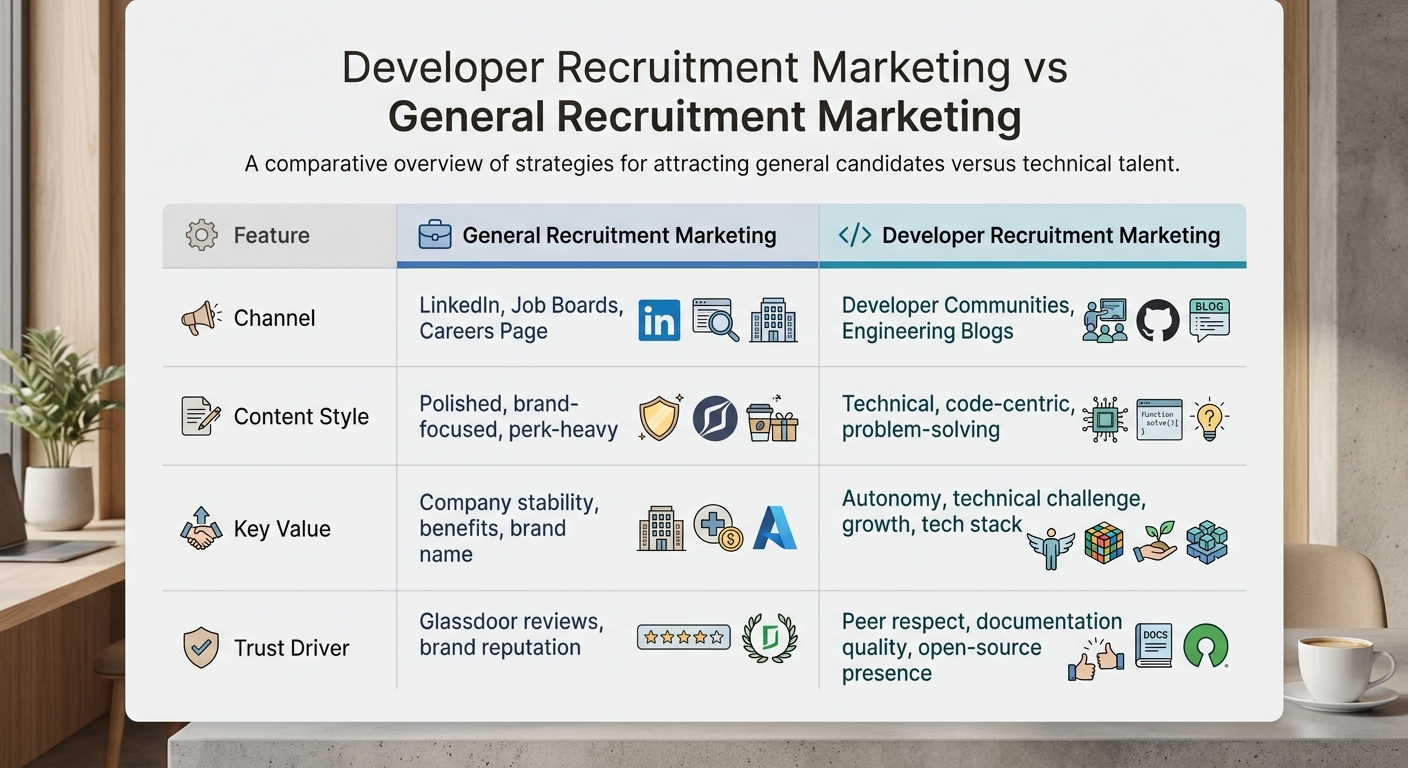
Here’s a quick comparison of how general recruitment marketing differs from developer recruitment marketing:
| Feature | General Recruitment Marketing | Developer Recruitment Marketing |
|---|---|---|
| Channel | LinkedIn, Job Boards, Careers Page | Developer Communities, GitHub, Engineering Blogs |
| Content Style | Polished, brand-focused, perk-heavy | Technical, code-centric, problem-solving |
| Key Value | Company stability, benefits, brand name | Autonomy, technical challenge, growth, tech stack |
| Trust Driver | Glassdoor reviews, brand reputation | Peer respect, documentation quality, open-source presence |
These trust dynamics lay the groundwork for the next steps - crafting tailored content, leveraging social media effectively, and hosting events that resonate with developers.
Content Marketing as a Talent Magnet
Content marketing can be a powerful way to build the technical credibility that attracts top developer talent. By publishing technical content, you showcase your team's ability to tackle complex challenges, navigate modern architectures, and make informed tradeoffs. This matters because while 78% of candidates are open to new opportunities, only 27% are actively job hunting . The developers you want are likely already engaged in meaningful work, so they'll only consider a move if they see clear evidence of your team's expertise.
The numbers speak for themselves. Thought leadership content delivers an average return of $14 for every dollar invested, compared to $5 for standard content marketing . Additionally, 55% of decision-makers - including technical leaders - use thought leadership to evaluate potential employers . When senior engineers publish content, it performs 9 times better than generic company messaging , making it an excellent tool for attracting peer-level talent. Let’s break down how engineering blogs, tech talks, and open source contributions can help you stand out.
Engineering Blogs
An engineering blog is a great way to show that your team tackles real-world technical challenges. Instead of generic "best practices", focus on detailed project retrospectives. For example, explain how switching from microservices to a monolith reduced infrastructure costs or solved scaling issues. Developers trust these kinds of stories because they reflect actual experience, not theory.
Interestingly, failure stories can be even more impactful than success stories. As Peter Korpak from 100signals puts it:
Technical buyers trust failure stories more than success stories because they demonstrate real experience and self-awareness. Nobody fakes a failure story .
Sharing post-mortems or documenting technical migrations that didn’t go as planned adds a layer of transparency that resonates with developers who’ve faced similar struggles.
Publishing under the names of your senior engineers also boosts visibility. Expert-attributed content is 3.2 times more likely to be cited by language models than anonymous or corporate content . By identifying a few senior team members to regularly share insights, you can make a stronger impression on potential recruits than with traditional corporate messaging.
Tech Talks and Webinars
Tech talks and webinars are another way to establish your brand as a technical leader. These events give developers an informal space to explore your technical culture and ask questions about your projects, tools, and engineering practices - without the pressure of a job interview . Since most developers aren’t actively looking for jobs, webinars help build trust over time rather than pushing for immediate results .
Consider hosting live Q&A sessions, technical workshops, or deep-dive tutorials on topics like DevOps or system design. Mariusz Michalowski from Spacelift explains:
Hosting online recruitment events... enable businesses to interact with potential applicants in real time and provide an opportunity for candidates to ask questions and get a better understanding of the job requirements .
A strong employer brand can attract 50% more qualified candidates to your open roles . Sharing real stories from your engineers about overcoming specific challenges adds authenticity that polished marketing materials can’t replicate. Sponsoring events on developer-focused platforms can also increase your visibility and help you connect with top talent. These interactive sessions pair perfectly with written content to strengthen your technical reputation.
Open Source Contributions
Contributing to open source projects is one of the clearest ways to demonstrate a developer-friendly culture. Open source work allows developers to see who wrote the code, how it was reviewed, and how decisions were made. In this "gift economy", status is earned through the quality of contributions and peer recognition, making it a strong signal of technical credibility .
The numbers highlight the impact: 96% of software used by major industries includes open source components , and 83% of organizations trust open source for their most sensitive projects . In 2022 alone, developers launched 52 million new open source projects on GitHub . By contributing to these projects, your team engages directly with the ecosystem where developers spend much of their time.
To make your projects more inviting, curate "good first issues" that don’t require extensive knowledge of legacy systems. Provide clear README and CONTRIBUTING files, and publicly acknowledge contributors . A well-enforced Code of Conduct can also create a welcoming environment that attracts diverse talent. As Eric Raymond observed:
Status is delicately dependent on the critical judgment of peers .
When developers respect your open source work, they’re far more likely to consider joining your team. Together, engineering blogs, tech talks, and open source contributions create a compelling strategy to showcase your expertise and attract top-tier talent.
Social Media Strategy: Where to Promote Developer Roles
Social media is a powerful tool for building long-term brand awareness and engaging passive candidates. The trick? Move away from generic, automated outreach - developers tend to tune that out - and instead, engage authentically in the spaces where they already spend time. This approach ties into a broader focus on technical credibility and genuine community involvement.
The best results come from combining developer sourcing channels with spaces that encourage technical discussions. While general social media can work, platforms centered around coding and collaboration often yield better outcomes because they attract developers who are passionate about their craft.
Using Twitter/X
Twitter/X is a great platform for sharing real-time technical insights and joining conversations about the latest tools, frameworks, and trends in the industry. It’s a space where you can post snippets from your engineering blog, highlight interesting challenges your team is tackling, or weigh in on technical debates. Developers gravitate toward accounts that consistently deliver value, so focus on building trust and familiarity before posting job openings.
To reach specific developer groups, use niche hashtags like #webdev or #javascript. You can also participate in fun traditions like "Meme Mondays" to show the human side of your brand and connect with the community. When promoting roles, emphasize what truly matters to developers - like meaningful projects, growth opportunities, and strong technical leadership - rather than just listing perks or salary.
While Twitter/X is great for quick, dynamic interactions, LinkedIn offers a space for deeper, more detailed conversations about roles.
Using LinkedIn for Professional Networking
LinkedIn is particularly effective for targeting senior developers by providing detailed information about roles, team structures, and the tech stack they’ll work with. It’s a platform where you can share in-depth content from your engineering team, such as project retrospectives, technical case studies, or key lessons from production challenges.
Posts authored by your senior engineers tend to perform better than generic corporate updates. Encourage your team to share their expertise under their own names - it builds trust and gives potential candidates a glimpse of the people they’d be working with.
While LinkedIn thrives on detailed role content, platforms like Reddit are all about reputation and authentic engagement.
Engaging on Reddit and Developer Communities
When it comes to developer communities like Reddit, Hacker News, or Stack Overflow, reputation is everything. These platforms are highly resistant to overt marketing, and users can spot inauthentic behavior instantly. Following the 9:1 rule is key: contribute nine helpful, non-promotional posts for every promotional link you share. As Mariya Delano from the Developer Marketing Alliance puts it:
You don't promote yourself. You use it as a research channel for figuring out what people are talking about and [distribute content] as a good faith community participant .
On Hacker News, which draws over 6 million developers each month , focus on sharing unique, high-quality updates - like a new tool your team implemented or a major infrastructure change. As Alexey Klochai, Founder of Wizard on Demand, explains:
The standards of quality are super high. You have to put a lot of work into what you publish there. It's easier to rank on Hacker News if you have something interesting to share .
For Reddit, optimize your profile by using a clear username (e.g., "name_company"), adding your company’s logo as an avatar, and including a transparent bio with a link to your site. Prioritize zero-click content, meaning you post full articles or detailed answers directly on the platform rather than dropping external links. On Stack Overflow, focus on answering technical questions to showcase your expertise without immediately promoting job openings. Monitoring relevant keywords can help you join discussions naturally. A helpful and trustworthy presence increases the chances that developers will take an interest in your roles.
Paid Advertising for Developer Roles: Platform Analysis
Paid advertising can be a powerful tool for recruiting developers - when done right. Unlike organic strategies that take time to build momentum, paid ads offer instant visibility. But here's the catch: developers are quick to dismiss traditional marketing tactics. Ads filled with corporate jargon or generic perks often fall flat, wasting your budget. Instead, your messaging needs to feel authentic, resonate technically, and clearly communicate value. Think of it as extending the same principles from your organic strategies into your paid efforts.
While organic content builds trust over time, paid ads can provide a quicker route to visibility - if you approach them with a developer-focused mindset.
Platform Comparison for Paid Ads
Each advertising platform has its strengths, and knowing how to use them effectively can make or break your campaign. Here's a snapshot of key metrics to guide your decisions:
| Platform | Avg CPC (USD) | Avg CTR (%) | Avg Conversion Rate (%) | Best For |
|---|---|---|---|---|
| Twitter/X | $1.50–$4.00 | 0.5–1.2 | 2–4 | Quick buzz, trends |
| $5–$9 | 0.3–0.6 | 3–6 | Professional targeting | |
| $0.50–$2.50 | 0.8–1.5 | 1–3 | Community engagement | |
| Google Ads | $3–$7 | 2–5 | 4–8 | High-intent searches |
LinkedIn stands out for targeting senior developers, offering conversion rates of 3–6% and costs per qualified lead ranging from $50–$150. Its precision targeting - by job title, skills, or experience - makes it an excellent choice. Sponsored content that highlights your tech stack or engineering culture tends to perform especially well.
Google Ads works best for developers actively searching for roles. By focusing on high-intent keywords like "Python developer jobs", you can capture traffic ready to convert. Combining search ads with display ads on technical websites and using exact-match keywords can yield conversion rates as high as 8%.
Twitter/X offers lower costs but requires engaging, technical creatives. Ads featuring code snippets, engineering challenges, or technical tips often outperform polished corporate messaging. The platform's fast-paced nature is perfect for generating buzz, but your message needs to grab attention immediately.
Reddit provides the most budget-friendly option, particularly in niche subreddits like r/cscareerquestions or r/MachineLearning. However, success here hinges on blending your ads seamlessly into the community. Ads that feel like genuine posts can achieve click-through rates of up to 1.5%, while overtly promotional material risks being ignored or downvoted.
Avoiding Budget Waste
The key to effective paid advertising lies in testing, segmentation, and a developer-centric approach. For example, a SaaS company spent $10,000 on LinkedIn and Google Ads targeting "full-stack engineers" and achieved 45 qualified applications at $222 per application, with a 5.2% conversion rate. Their secret? Video ads showcasing their codebase and real technical challenges.
To refine your campaigns, conduct A/B tests with 2–4 ad variations over 1–2 weeks, allocating $500–$1,000 per test. Experiment with elements like tech stack icons versus salary highlights, problem-solving headlines versus perks-focused ones, and calls-to-action like "Join our open-source team" versus "Apply now." This iterative testing approach can improve click-through rates by 20–50%.
Audience segmentation is another game-changer. Instead of targeting all "IT professionals", narrow your focus by skills (e.g., JavaScript or AWS), experience levels (e.g., 2–5 years), and location (e.g., U.S. tech hubs). One campaign targeting "mid-level React developers in San Francisco" tripled conversion rates and reduced CPC by 30%.
To avoid wasting your budget, steer clear of generic ads, poor targeting, and unoptimized landing pages. Use developer-specific language, exclude junior candidates when hiring for senior roles, and ensure landing pages load quickly while showcasing code demos or technical documentation. These steps alone can save 40–60% of your budget.
Developer Events and Sponsorships as Recruitment Channels
Developer events provide a chance to engage directly with tech talent in environments where they're already active and invested. Whether it's hackathons, conferences, or meetups, these gatherings put you face-to-face with developers who are passionate about technology - not just passively browsing job boards. The tricky part? Ensuring your investment actually delivers results. Too often, companies treat event sponsorships as a simple brand awareness exercise rather than a focused recruitment tool, which can lead to wasted budgets and minimal hiring success.
To make the most of these events, you need to fully understand your investment. This includes calculating all costs - travel, booth setup, staff time, and promotional materials - to measure ROI in tech hiring and get a clear picture of the channel’s value . By analyzing these costs, you’ll be better equipped to decide if the investment is worth continuing.
Getting ROI From Sponsorships
Before sponsoring an event, set clear and measurable goals, like generating qualified leads or fostering meaningful on-site interactions . Opt for formats that actively engage attendees, such as live coding challenges, hands-on workshops, or demonstrations of your projects. These activities not only showcase your team’s work but also encourage developers to interact with you in a meaningful way.
Post-event follow-ups are just as critical as the event itself. Create a structured follow-up plan - at 4, 8, and 12 weeks after the event - to track how many leads turn into interviews or hires . If an event doesn’t result in hires within a reasonable timeframe, use that data to shift your budget toward more effective recruitment strategies. Companies that prioritize training and development often see returns on their investment ranging from 300% to 600% . This commitment to growth resonates with developers who value opportunities to learn, strengthening your reputation as an employer of choice. With measurable outcomes like these, you can build trust and foster deeper connections, particularly at smaller, more focused events.
Building Connections at Events
Metrics are important, but real connections happen in smaller, more intimate settings. Informal meetups with 8 to 10 participants create space for genuine conversations about technical challenges and team culture . These smaller gatherings are far better at building trust than large, impersonal booth presentations.
When your team attends events, make sure to include senior engineers who can share real-world insights into your technical processes. Developers are far more likely to trust and connect with peers who can discuss actual architectural decisions rather than delivering rehearsed pitches about "cutting-edge technology." By sharing their experiences and answering technical questions honestly, your engineering team becomes a key recruitment asset. And with the average time to hire sitting at around 24 days , the relationships built at these events can speed up the hiring process. When candidates already trust your team, they’re more likely to move forward quickly. This peer-led, authentic approach reinforces the kind of employer brand that developers genuinely value.
Employee Advocacy: Turning Engineers Into Brand Ambassadors
Your engineering team can be one of your strongest recruiting tools. When developers share their personal experiences, they connect with audiences in ways that traditional company posts simply can't. Here's why: content shared by employees gets double the click-through rate of corporate posts and generates eight times more engagement . Why? Because it feels real. Developers trust other developers talking about real projects and challenges - not polished corporate messaging .
As Alex Her, Co-founder of EB Space, explains:
People trust other people more than they trust brands. It's about giving employees the freedom to share their authentic stories and experiences, turning them into natural advocates for the company .
This approach only works when it's genuine. Forget ghost-written posts or scripted messages. Engineers should be encouraged to share stories about their career paths, the technical obstacles they've tackled, and what excites them about their work. Posts that feel rehearsed or overly corporate - like dozens of employees posting the same "we're hiring" announcement - stand out for all the wrong reasons:
put out the same messages as 200 other teammates, it's pretty obvious we're ghost-writing… and it's not authentic .
Amplifying Employee Voices
The best way to support your engineers is to give them guidance, not scripts. Offer general topics, tracking links, and maybe a few hashtag suggestions - but let them write in their own voice. Authenticity matters. Engineers can share architecture diagrams, specific tech stacks, or measurable results from their projects. For instance, a post detailing how they reduced transaction latency from 340ms to 18ms will resonate far more than vague claims about "cutting-edge technology" .
Want to extend their reach? Consider using LinkedIn Thought Leader Ads to amplify the best organic posts from your team. These ads deliver a 0.95% click-through rate, nearly double the 0.56% CTR of standard sponsored content . With a monthly budget of $500–$2,000, you can target key accounts while preserving the authenticity of the original posts . Focus on promoting content where engineers share technical insights, open-source contributions, or specific project wins. This strategy is particularly effective when you recruit developers through open source and communities where they are already active. This type of content consistently outperforms traditional corporate posts by 2-3x in engagement .
Boosting Referrals Through Advocacy
When engineers share authentic posts, they naturally attract like-minded talent from their professional networks. This kind of employee advocacy has a measurable impact: it boosts talent attraction by 58%, improves retention by 20%, and cuts cost-per-hire by 50% .
To keep your team engaged in advocacy, introduce leaderboards, rankings, or small rewards like gift cards for consistent contributions or standout posts, such as detailed technical videos . Make advocacy part of your onboarding process so it becomes second nature, but always keep participation voluntary. Forcing it would only undermine the trust and authenticity that make these programs so effective. When engineers genuinely want to share their work, the results speak for themselves: 75% of job seekers are more likely to apply for a position if the employer actively manages its brand .
Measuring Recruitment Marketing ROI for Developer Roles
When it comes to hiring developers, success isn’t just about the number of applications you receive. It’s about understanding how well your strategies resonate with candidates and how they influence the overall hiring process. Measuring recruitment marketing ROI for developer roles means looking at how your technical content builds trust, speeds up hiring, and attracts candidates who already align with your engineering culture by understanding developer needs.
Key Metrics for Measuring Success
To gauge quality, pay attention to whether candidates reference your technical content during interviews. Pre-educated candidates - those who’ve engaged with your content - can reduce hiring cycles by as much as 36% . That’s a big deal when time-to-hire impacts your bottom line.
Employee advocacy is another strong indicator of success. Content shared by engineers outperforms corporate posts by a factor of 9 , and LinkedIn personal profiles generate 561% more reach than company pages . Additionally, technical content attributed to experts is 3.2 times more likely to be cited by AI tools than unattributed material , making it a powerful asset in today’s job search landscape.
For paid campaigns, click-through rates (CTR) offer valuable insight. Ads that boost an engineer’s organic post achieve a 0.95% CTR - almost double the 0.56% seen with standard sponsored posts . If you’re spending $500 to $2,000 monthly on platforms like LinkedIn, this difference can significantly lower your cost-per-qualified applicant.
These metrics provide a solid foundation for applying multi-touch attribution to better understand your recruitment marketing efforts.
Attribution Models for Recruitment Marketing
Developers rarely apply after a single interaction with your company. They may first encounter your brand through GitHub projects, blog posts, or conference talks. Multi-touch attribution helps you map this journey and identify which touchpoints drive results.
For example, track how a single technical idea evolves - from a LinkedIn post to a byline article, and later to a podcast or conference talk . This cascade of content is powerful, especially when you consider that 55% of decision-makers, including technical leads, rely on thought leadership content to evaluate companies .
It’s also worth looking at referral quality. Consistent technical publishing creates a “recognition effect,” where engineers’ shared insights attract referrals from candidates who already understand your technical standards .
Finally, calculate the financial return of your efforts. Thought leadership in technical fields delivers an average return of $14 for every dollar invested, compared to $5 for standard content marketing . To identify your most effective channels, compare your cost-per-hire - including both direct costs like ad spend and indirect costs like content creation - against hire quality and retention rates. This approach ensures your recruitment marketing dollars are spent where they matter most.
How daily.dev Recruiter Offers Targeted Visibility to Developer Audiences
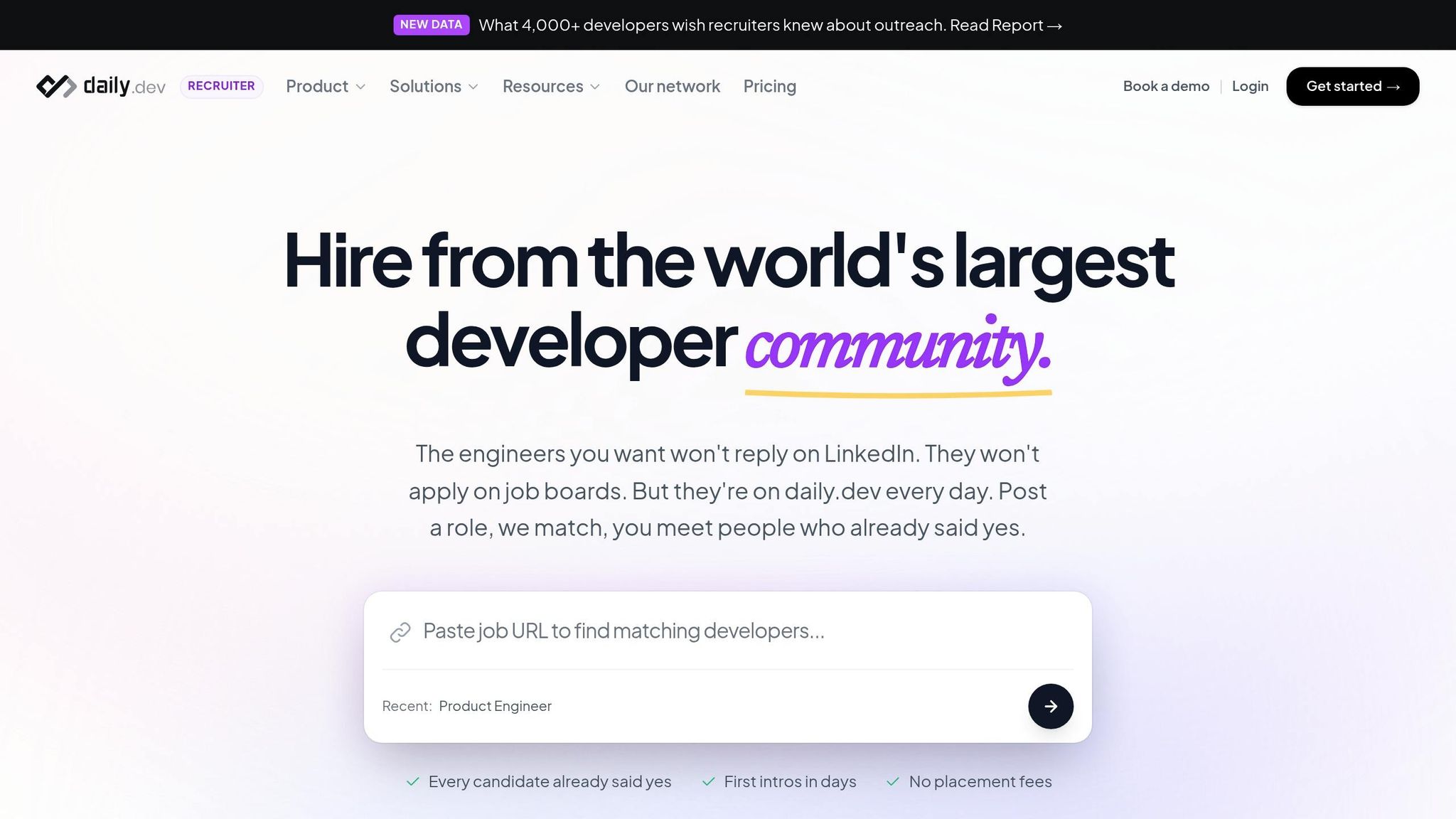
Traditional recruitment methods often rely on cold outreach or random encounters. daily.dev Recruiter flips the script by connecting you with developers in the spaces they already frequent - while they’re reading technical content, honing their skills, and interacting with their professional community.
This strategy fits seamlessly with the broader goal: reaching developers where they naturally seek out technical knowledge.
Connecting With Passive Developers Through Content
daily.dev Recruiter integrates your job opportunities into an active developer network, where engineers engage daily. Unlike interruption-heavy tactics like unsolicited outreach, this platform relies on a double opt-in process. Developers who see your opportunities have already expressed interest, creating a warm introduction. Your roles appear alongside trusted technical content, allowing developers to engage on their own terms. This means you only connect with candidates who genuinely want to hear from you, avoiding the pitfalls of cold emails.
The platform’s focus ensures every interaction is relevant and meaningful. By using daily.dev Recruiter, you’re targeting engineers who are deeply engaged in their work - not casual browsers on a generic social site.
Targeting and Developer-Friendly Experience
Expanding on the idea of content-driven engagement, this platform places your roles directly in developers’ daily routines. With candidates now researching employers through search engines, AI tools, and content platforms before visiting career pages , daily.dev Recruiter ensures your roles are visible where developers are already active - in their trusted feed of technical content and discussions.
The platform also provides advanced targeting tools to reach specific developer groups based on interests, skills, and engagement behaviors. You can pre-screen candidates using custom criteria, ensuring better matches and cutting down on time spent sorting through unqualified applicants.
For developers, the discovery process feels natural and unobtrusive. Instead of encountering aggressive ads, they come across opportunities through the content they already enjoy. This developer-first approach leads to higher response rates from passive talent while building genuine interest in your company before any conversations begin.
Conclusion
Hiring developers isn’t about shouting louder - it’s about building trust through real technical credibility. The numbers tell a clear story: 69% of candidates turn down offers from companies with bad reputations , while 92% would make a move for a company with an excellent reputation - even without a pay bump . What shapes that reputation? Not flashy marketing campaigns, but honest stories, employee advocacy, and showing up in the technical spaces developers care about.
As Louis Blake, People and Performance Coordinator at Fonda, puts it:
"It's less about convincing candidates and more about showing them."
The days of relying solely on traditional job boards are long gone. Today’s recruitment landscape demands a multi-channel approach. In fact, 86% of organizations now prioritize talent marketing to stay competitive for top talent . And it works - companies that focus on recruitment marketing see three times better candidate quality . Tools like engineering blogs, tech talks, employee advocacy, and targeted social media campaigns are crucial for connecting with the 70% of the talent pool that consists of passive job seekers . These are developers who aren’t actively applying but are open to the right opportunity.
This shift underscores the importance of trust and authenticity. When companies misrepresent roles or culture, they risk high turnover rates and damaging public reviews - both of which can seriously harm their employer brand. On the flip side, being transparent and genuine attracts candidates who genuinely fit your company’s values and mission .
With this in mind, daily.dev Recruiter offers a developer-first solution. By leveraging trusted technical content and community interactions, it connects you with engaged developers. This approach turns recruitment into a trust-driven process, where conversations start on the right foot, and candidates are genuinely excited to engage.
FAQs
How do I start recruiting passive developers without spamming them?
To connect with passive developers without resorting to spam, focus on building genuine relationships and establishing technical trust. Show up where developers already spend their time, like respected tech blogs, open-source projects, or developer forums. When reaching out, make it personal - reference their specific work or interests. Instead of pushy tactics, let your employer brand shine through meaningful content and active participation in the developer community. This approach feels natural and resonates more with developers.
What technical content attracts senior engineers fastest?
Senior engineers gravitate toward in-depth technical content that proves expertise and offers real value. This can take several forms, including:
- Detailed technical blogs: Articles that dive deep into complex topics, offering solutions or unique perspectives.
- Open source contributions: Sharing code or tools that solve specific problems, often accompanied by thorough documentation.
- Best practices discussions: Engaging in conversations that highlight effective methods or innovative approaches within their field.
These formats appeal because they reflect a deep understanding of technical challenges and provide insights that align with their advanced skill set.
What metrics show recruitment marketing works for developer roles?
When it comes to recruiting developers, tracking the right metrics can make all the difference. Here are some key ones to focus on:
- Click Volume: This shows how many people are interacting with your job postings or ads. A higher number indicates strong initial interest.
- Click-Through Rate (CTR): CTR measures how often people click on your links compared to how many see them. It's a great way to gauge how engaging your messaging is.
- Quality of Hire: This metric focuses on the performance and impact of new hires, helping you understand if you're attracting top talent.
- Source of Hire: Knowing where your successful candidates are coming from (like job boards, referrals, or social media) helps you refine your sourcing strategy.
- Application Conversion Rates: This tracks how many people who view your job postings actually apply, revealing how compelling your application process is.
Together, these metrics provide insights into candidate interest, engagement, and overall recruitment success, giving you a clear picture of how well your strategy is working.
.png)