

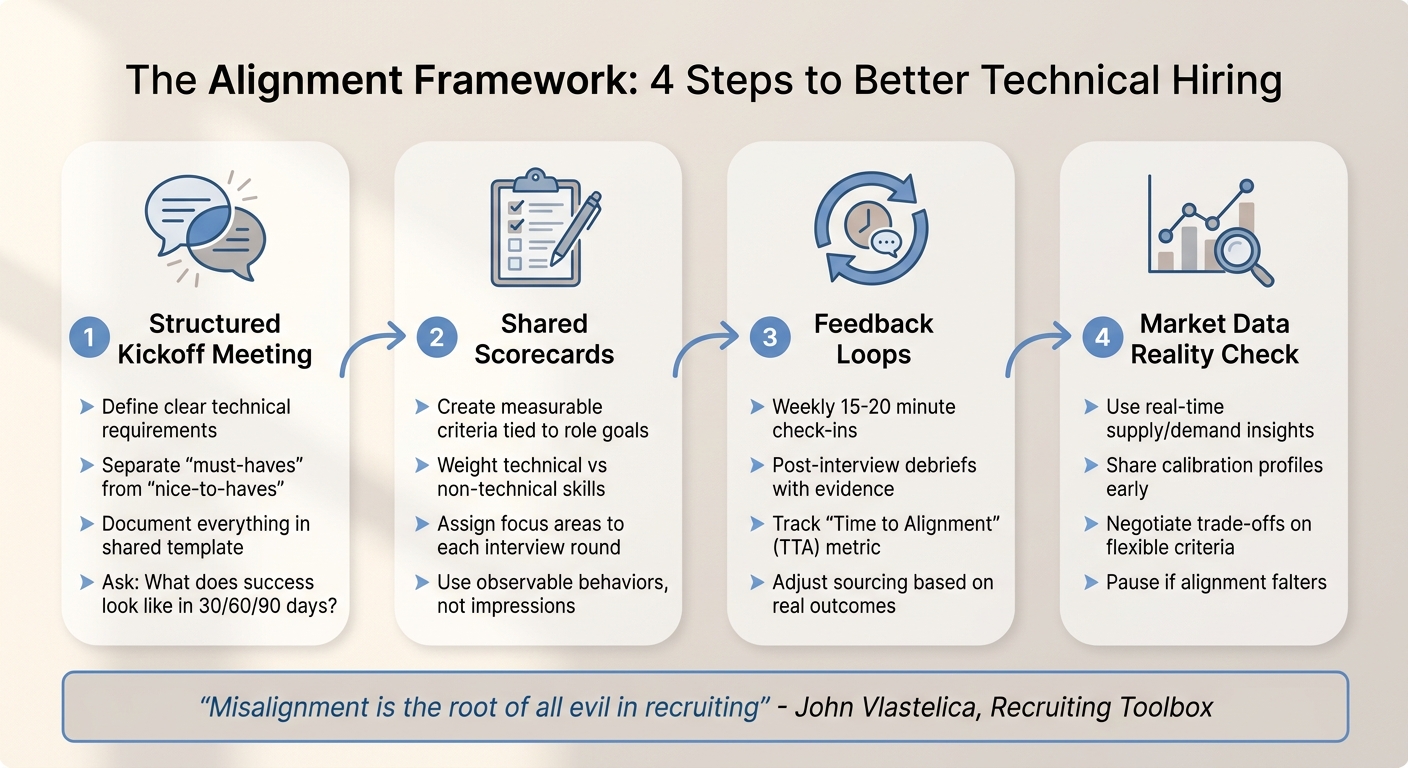
Hiring misalignment wastes time and resources. Recruiters and hiring managers often have different interpretations of technical roles, leading to misunderstood job descriptions, delayed processes, and poor hiring decisions. To fix this:
- Start with a structured kickoff meeting: Define clear technical requirements, separate "must-haves" from "nice-to-haves", and document everything in a shared template.
- Use shared scorecards: Evaluate candidates consistently with measurable criteria tied to the role's goals.
- Build feedback loops: Regular check-ins and post-interview debriefs help refine expectations and adjust sourcing efforts.
- Rely on market data: Use real-time insights to set realistic hiring goals and avoid chasing unattainable profiles.
Why Hiring Managers and Recruiters Talk Past Each Other
The gap between hiring managers and recruiters often goes beyond simple miscommunication. Recruiters tend to focus on job titles and work history, while hiring managers prioritize tangible proof of problem-solving skills and technical expertise. Without a clear framework to bridge these priorities, decisions can default to gut instincts. This issue is further complicated by recruiters often lacking deep technical knowledge, making it harder for them to act as effective mediators between technical and non-technical teams.
Common Misalignment Scenarios
Imagine a hiring manager initially requesting a React developer with three years of experience, only to later decide that the role also requires expertise in GraphQL and system design. This change forces recruiters to start over, wasting time and delaying the process.
Budget misunderstandings are another frequent hurdle. If financial constraints or budget approvals aren’t communicated clearly, recruiters might present salary offers that are about 15% lower than initially discussed . This kind of discrepancy often leads to candidates rejecting offers at the final stage.
Even terminology can cause confusion. For example, when a hiring manager says they’re “considering an offer,” a recruiter might interpret this as a signal to start setting acceptance deadlines. Meanwhile, the manager may see it as an early-stage conversation. Additionally, incomplete compensation details - like focusing only on base salary while ignoring the full benefits package - can make it hard for candidates to evaluate the total value of an offer. This is especially problematic in technical roles, where the overall package often plays a significant role in decision-making.
These disconnects don’t just slow things down - they come with real costs.
What Misalignment Costs Your Team
Misalignment is more than just an inconvenience; it’s expensive and damaging. When hiring processes fall apart after months of interviews, teams lose valuable time and risk harming their employer brand . High-quality candidates who drop out after lengthy interview loops represent not only wasted effort but also the missed opportunity to fill critical roles.
Inconsistent evaluations add to the problem, increasing hiring risks and opening the door to bias. Unclear requirements lead to unreliable interview outcomes, and in some cases, external recruiters may focus more on closing deals than ensuring the right technical match. This can result in overlooking essential details.
Ultimately, the cost of a misaligned hire - both in terms of time and resources - is far greater than the effort required to establish alignment from the start.
The Intake Meeting Framework: Essential Questions for Developer Roles
The kickoff meeting sets the stage for a smooth and effective hiring process. By rebranding it from "intake" to "kickoff", the focus shifts from a one-sided information dump to a collaborative effort where both recruiters and hiring managers share the responsibility for success. This meeting goes beyond just gathering a list of requirements - it's about creating a shared understanding of the role before diving into candidate resumes.
"Misalignment is the root of all evil in recruiting" - John Vlastelica, Founder and CEO of Recruiting Toolbox
This meeting is your chance to stop misalignment before it starts. Recruiters need to think like talent advisors, challenging unrealistic expectations instead of passively taking notes. That means asking tough questions upfront and using real market data to adjust expectations before sourcing begins. A structured framework helps recruiters zero in on the right questions to uncover the role's precise technical requirements.
Questions Every Recruiter Should Ask
The first step is to define what success looks like in concrete terms. If a hiring manager says they need a "senior developer", dig deeper. What specific technical skills does this person need? How many years of hands-on experience with the core technologies are essential? And what are the key challenges this person will tackle in their first 90 days?
It's also critical to separate the "must-haves" from the "nice-to-haves." What technical skills are absolutely non-negotiable, and where can the team be flexible? For instance, does the candidate need five years of React experience, or would three years suffice if they have strong JavaScript fundamentals? Clarify these trade-offs early to avoid confusion later. Additionally, decide which team members will vet technical skills to ensure a thorough yet efficient interview process.
Another effective tactic is using sample resumes to align expectations. Bring resumes that reflect the described requirements and ask, "Would you interview this person?" This exercise helps uncover hidden preferences or deal-breakers, saving time before high-volume sourcing begins. Track your "time to alignment" (TTA) to measure how quickly you can get everyone on the same page.
Of course, asking the right questions is only half the battle. Documenting the answers ensures that everyone stays aligned throughout the search.
Using a Template to Document Requirements
Once the key details are clarified, standardizing them in a template locks in alignment. A well-designed template ensures accountability and prevents shifting expectations mid-search. This document should outline the role's primary responsibilities, required technical skills, preferred qualifications, team structure, compensation range, and evaluation criteria. It’s also helpful to include sections for culture add (not just culture fit) and the technical standards the team expects candidates to meet.
The template should specify who is responsible for evaluating each aspect of the role and define what success looks like at 30, 60, and 90 days. Most importantly, recruiters should have the authority to pause sourcing if misalignment arises.
"The last thing you want to do is keep on sourcing, sending candidates to hiring managers to review, and bring candidates in to interview if you know the hiring team isn't aligned" - John Vlastelica
Companies that prioritize quality hiring empower recruiters to hit pause and recalibrate, rather than waste time on a misaligned process that leads to dead ends.
Translating Technical Requirements: What 'Senior React Developer' Actually Means
The title "Senior React Developer" might sound straightforward, but it can mean very different things depending on the company or team. Two people with the same title could have completely different skill sets, which makes it crucial to dig deeper into what the role truly requires. Recruiters play a key role in bridging this gap by turning vague titles into actionable criteria.
"Job titles, experience years, and employer history do not reliably predict performance in technical roles." - Metaview
Instead of taking the title at face value, recruiters need to ask: What does "senior" mean here? Is it about building scalable component libraries from scratch? Or is it mentoring junior developers while delivering features quickly? These are very different skills, and lumping them together can lead to mismatched expectations and wasted time during the hiring process.
Breaking Down Vague Job Titles
Start by translating the job title into specific technical skills and challenges. For example, does the role require expertise in Next.js, server-side rendering, and performance optimization? Or is the focus more on state management with Redux and creating complex UI components? Knowing the answers will guide your sourcing efforts.
It’s also important to define success in measurable terms. What should this person achieve in their first 30, 60, or 90 days? If the hiring manager says, "Build scalable front-end architecture", dig deeper. Does that mean reducing page load times by a certain percentage? Migrating legacy code to a modern framework? Leading a team through a major refactor? These details help turn a broad title into a clear hiring target.
Rather than relying solely on job titles, focus on skills-based sourcing. Look for candidates who have worked on similar challenges. For instance, a developer who built a high-traffic e-commerce checkout system might be a better fit than someone with a prestigious title but less relevant experience.
Once the technical skills are mapped out, the next step is identifying which ones are critical and which are flexible.
Separating Must-Haves From Nice-to-Haves
It’s common for hiring managers to list every technology they’ve encountered as a "requirement." This is where recruiters need to step in and prioritize. What skills are absolutely necessary, and where can the team be flexible?
Ask hiring managers to rank technical skills in order of importance. For example, could deep expertise in one framework be traded for strong problem-solving and architectural thinking? This approach can widen the talent pool without sacrificing quality.
Structured interviews are another way to ensure clarity. Instead of relying on gut instincts or resume keywords, assign specific focus areas to interviewers - like technical and soft skills like system design, communication, or technical decision-making. This ensures you’re gathering complementary insights and truly understanding what "senior" means for this role.
And if you’re struggling to find candidates who meet every requirement, use real market data to adjust expectations. Tools like daily.dev Recruiter can show you what’s realistic based on the current talent pool. If the ideal combination of skills doesn’t exist in the market, it’s better to recalibrate early rather than waste weeks searching for a unicorn candidate.
Building a Shared Scorecard: Evaluation Criteria Both Sides Agree On
Once you've established a clear intake process and translated technical requirements effectively, the next step is creating a shared scorecard. This ensures that both recruiters and hiring managers are aligned when evaluating candidates. Without such a framework, assessments can easily become inconsistent - one person might emphasize technical skills like system design, while another focuses on soft skills like communication. This lack of alignment wastes time and can lead to decisions being swayed by the loudest voice in the room.
A shared scorecard helps bridge this gap. Start by defining the role’s requirements in measurable terms. Instead of vague criteria like "strong problem-solving skills", outline specific behaviors, such as the ability to break down complex problems or weigh trade-offs between performance and maintainability. These measurable actions give interviewers a clear framework for evaluation.
"Recruiters help hiring managers articulate what success looks like in the role, translating technical requirements into observable behaviors." – Metaview
You should also assign clear objectives to each interview round. For instance, one round might focus on system design, another on collaboration, and another on technical decision-making. By assigning unique responsibilities to each round, you gather a wide range of insights without redundancy.
How to Weight Technical and Non-Technical Criteria
Not every skill carries the same importance, and this should be decided upfront. Together, recruiters and hiring managers can determine which criteria are critical and which are secondary. For example, you might prioritize technical expertise but still ensure that collaboration and mentoring skills are assessed. Once these priorities are set, reflect them in the scorecard to guide interviewers.
This weighting isn’t just theoretical - it’s a practical tool to keep evaluations consistent. For example, if technical decision-making is weighted heavily, interviewers know to focus their attention there. This ensures that all candidates are evaluated against the same standards.
Keeping Candidate Scoring Objective
To maintain objectivity, feedback should always be anchored in specific, observable examples rather than impressions. Subjective comments like "lacked confidence" or "seemed sharp" don’t provide a clear basis for comparison. Instead, feedback should detail specific actions or responses. For instance, instead of saying, "They struggled with the coding challenge", note that "They couldn’t explain the time complexity of their solution or address edge cases when prompted."
"When interview feedback is grounded in observable behavior and clear examples, technical hiring becomes more objective, fair, and repeatable." – Metaview
Recruiters play a key role here, acting as process owners to ensure feedback meets this standard. If an interviewer provides vague or unsupported opinions, recruiters should request clarification. This isn’t about being difficult - it’s about ensuring every candidate is evaluated fairly and decisions are evidence-based.
Post-interview debriefs also help calibrate scoring across interviewers. Use these discussions to resolve disagreements by referring to documented, shared evidence. Over time, this process not only improves consistency but also helps refine evaluation criteria for future hiring. By anchoring decisions in clear, observable data, your team is better prepared to make fair and effective hiring choices.
Feedback Loops: Calibrating Expectations After Initial Candidate Reviews
Building on the shared scorecard approach, feedback loops help align real-world candidate performance with initial expectations. Even with a solid intake process and a shared scorecard in place, real candidates often defy early assumptions. Feedback loops bridge the gap between expectations and reality. They allow recruiters and hiring managers to adjust technical requirements based on actual interview outcomes, rather than relying solely on what seemed promising on paper.
This adjustment is essential because traditional signals, like job titles, can be misleading. For example, two individuals labeled "Senior React Developer" might have vastly different skill sets - one could excel in system architecture while the other struggles to articulate trade-offs in performance versus maintainability. Regular feedback sessions help refine the understanding of what "qualified" really means for a specific role.
"Insights from successful past interviews [help] refine future sourcing criteria and improve candidate quality over time. This closes the loop between sourcing and hiring outcomes." – Metaview
To ensure meaningful refinements, focus on specifics. For instance, ask which technical decisions challenged a candidate during the interview. This evidence-based approach ensures that adjustments target real skill gaps rather than subjective preferences. The following sections outline actionable ways to integrate feedback into your sourcing and interviewing strategies.
Weekly Check-Ins to Review Pipeline Progress
Schedule quick, 15–20 minute weekly check-ins to evaluate candidate flow and adjust expectations. These aren't comprehensive debriefs but are meant to catch trends early. For example, if multiple candidates are falling short on a specific technical skill, it might be time to tweak your sourcing criteria or reconsider whether the skill is genuinely critical.
These sessions also help address interviewer drift, where hiring managers unconsciously shift their priorities mid-process. For instance, one week they might emphasize system design, and the next, mentoring experience. Document these changes and adjust the pipeline accordingly to avoid wasting time sourcing candidates based on outdated criteria.
Keep discussions centered on specific sourcing adjustments. If candidates with "5+ years of React experience" aren’t meeting expectations, consider targeting developers with experience in particular problem areas, like building real-time collaboration tools or optimizing large-scale state management. This skills-focused approach is far more predictive than rigid filters based on job titles or years of experience. These quick reviews naturally inform post-interview debriefs.
Post-Interview Debriefs to Identify Gaps
After each interview round, hold concise debriefs grounded in documented evidence rather than subjective impressions. Compare candidate performance against the shared scorecard to pinpoint where initial requirements may not align with reality.
"Technical recruiting succeeds when interviews are structured around evidence, not gut feel." – Metaview
Use these debriefs to fine-tune your sourcing strategy. For instance, if candidates are consistently strong in technical skills but weak in collaboration, consider adding behavioral screening questions earlier in the process. Conversely, if candidates excel in soft skills but lack technical depth, you might be overemphasizing interpersonal traits during sourcing. These insights should feed directly back into your sourcing and screening processes, creating a continuous improvement cycle that sharpens your hiring criteria with each interview.
What to Do When the Talent Market Doesn't Match the Wishlist
Sometimes, the talent pool just doesn’t align with what’s on paper. When feedback loops highlight a disconnect between your ideal candidate profile and the actual market, it’s time to rethink your approach. Sticking to unrealistic expectations not only wastes time but also leads to poor candidate experiences and high rejection rates - outcomes that can hurt your reputation as an employer. Instead of chasing an impossible hire, pause, review the data, and negotiate on what’s truly essential. The key? Let data drive the conversation.
Using Developer Supply and Demand Data
Start by grounding the discussion in facts. Sharing calibration profiles - such as sample LinkedIn profiles - early in the process can help set realistic expectations. This proactive step ensures everyone is aligned before you dive into sourcing.
John Vlastelica from Recruiting Toolbox explains it well:
"Sometimes this looks like education on market realities, pushing back on unrealistic candidate profiles to come up with something realistic given the pay and attractiveness of the work." – John Vlastelica, Recruiting Toolbox
Keep an eye on your internal metric, Time to Alignment (TTA), which measures how long it takes for you and the hiring manager to agree on a viable candidate profile. Tools like daily.dev Recruiter’s developer network data can provide real-time insights into the availability of specific skills, making it easier to assess what’s realistic.
Negotiating Trade-Offs Between Non-Negotiable Skills and Flexible Criteria
Once you’ve laid out the market realities, it’s time to have a candid discussion about priorities. Break down the must-have skills from the nice-to-haves. Focus on the critical technical requirements while identifying areas where you can be flexible.
If the hiring manager remains rigid despite clear evidence from the market, it’s better to pause the process than to continue chasing an unattainable goal. As Vlastelica puts it:
"The last thing you want to do is keep on sourcing, sending candidates to hiring managers to review, and bring candidates in to interview if you know the hiring team isn't aligned."
Taking a step back to recalibrate not only saves time but also spares candidates from a frustrating and misaligned hiring process.
Conclusion
Getting recruitment right starts with alignment, and that means incorporating structured intake meetings, shared scorecards, and consistent feedback loops into your hiring process. Misalignment between recruiters and hiring managers isn’t just a minor hiccup - it’s a costly mistake. As John Vlastelica from Recruiting Toolbox aptly states, "Misalignment is the root of all evil in recruiting." When there’s no clear agreement on what a "senior React developer" entails or which skills are truly essential, the result is wasted time, bloated candidate funnels, and poor hiring decisions.
The fix? Start with structured intake meetings. Use these to ask targeted questions and document every detail. Create a shared scorecard to define what "good" looks like before a single resume lands on the table. Then, build in feedback loops - weekly check-ins and post-interview debriefs - to refine expectations as you gain insights into the talent market.
When expectations clash with market realities, leverage tools like daily.dev Recruiter to provide data-driven insights about developer supply and demand. This helps ground conversations in facts rather than wishful thinking. Track metrics like Time to Alignment (TTA) to measure how quickly you and your team sync up on viable candidate profiles. And don’t be afraid to hit pause when alignment falters - companies with strong hiring standards empower recruiters to stop sourcing until everyone’s on the same page.
Focus on quality over speed. Taking the time to align on technical requirements upfront avoids drawn-out searches and mis-hires. It safeguards your employer brand, respects candidates’ time, and ensures the right developers - those who genuinely fit your team’s needs - walk through the door. By consistently applying these principles, you create a recruitment framework that transforms technical requirements into actionable strategies, setting the stage for hiring success.
FAQs
What should a developer role kickoff meeting include?
A kickoff meeting for a developer role is your chance to set the tone for the project and ensure everyone is on the same page. It’s where you define project goals, outline roles and responsibilities, and clarify technical requirements. This meeting isn’t just about logistics - it’s about building a shared understanding.
Here’s what needs to be covered:
- Role Scope and Expectations: What exactly does the role involve? For example, if you're hiring a "senior React developer", what does that mean in terms of skills, tasks, and responsibilities?
- Deliverables and Deadlines: What’s expected, and by when? Clear timelines keep everyone aligned.
- Collaboration Practices: How will the team communicate? What tools and workflows will be used?
It’s also essential to review the project background, objectives, and timeline. This context ensures everyone understands the big picture and how their contributions fit into it. By the end of the meeting, technical needs should be translated into actionable steps, laying the groundwork for smooth and effective teamwork.
How do we turn vague titles into testable technical requirements?
To transform titles like "senior React developer" into something measurable, collaborate with hiring managers to establish clear, actionable criteria for success. Pinpoint the essential technical skills, problem-solving capabilities, and decision-making traits required for the role. Then, convert these into structured tools like interview questions, coding challenges, or scenario-based assessments. This approach ensures candidates are evaluated based on specific requirements, steering clear of vague job titles or subjective assumptions.
When should we pause sourcing and realign the hiring team?
When you notice a mismatch between the talent pool and the role's requirements - or after evaluating the first batch of candidates - it’s wise to hit pause on sourcing. Taking this time to regroup with the hiring team allows everyone to adjust expectations and ensure the process stays grounded in what the market can realistically offer.
.png)


