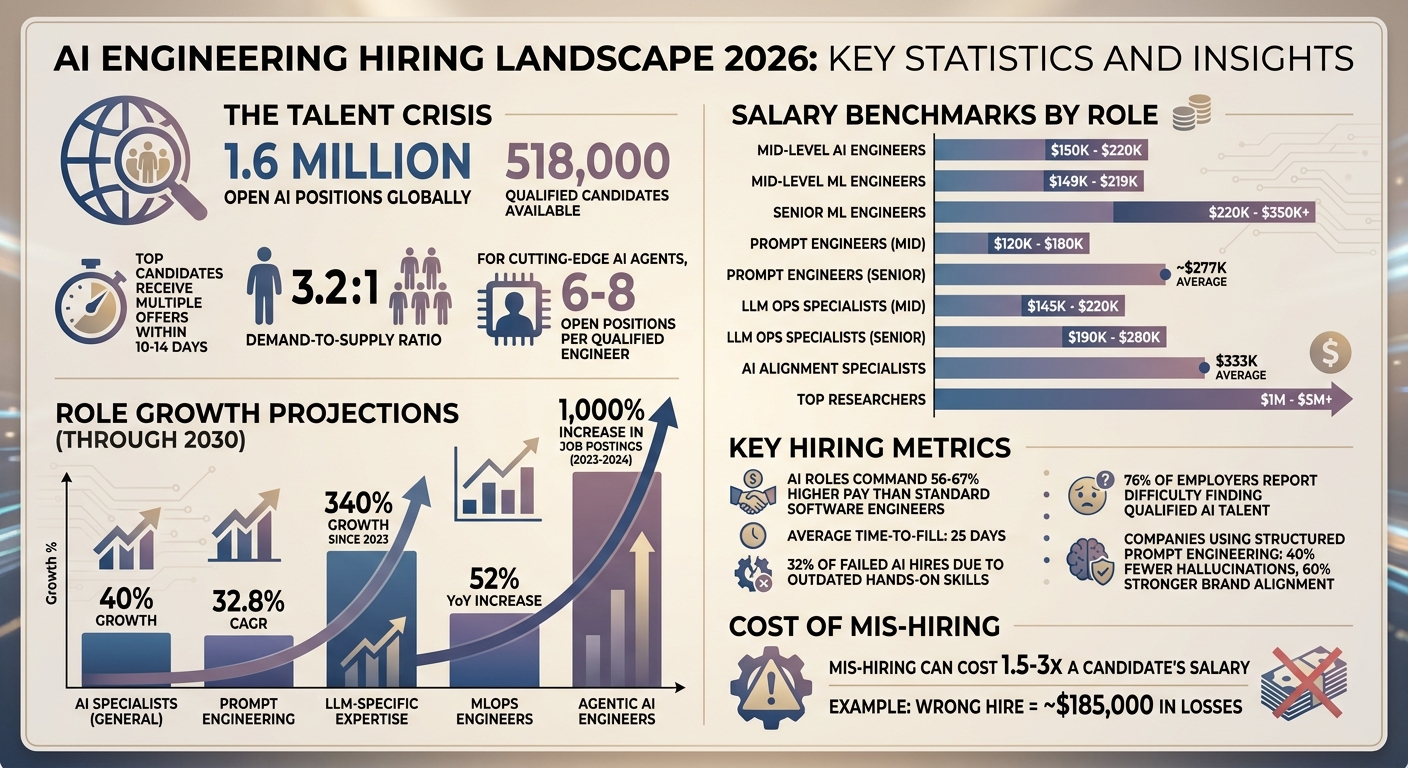
Hiring AI and prompt engineers in 2026 is challenging due to a massive talent shortage. With 1.6 million open AI positions but only 518,000 qualified candidates, competition is fierce. Key takeaways:
Demand-Supply Gap: There are 3.2 open positions for every candidate. Top professionals often juggle multiple offers within 10–14 days.
Role Clarity: Understand the difference between AI Engineers (integration-focused), ML Engineers (model builders), Prompt Engineers (LLM specialists), and LLM Ops Specialists (system maintainers). Mis-hiring can cost 1.5–3x a candidate’s salary.
Salaries: AI-related roles command 56–67% higher pay than standard software engineers. Mid-level AI Engineers earn $150K–$220K, while senior ML Engineers can exceed $350K.
Where to Find Talent**: Top platforms include GitHub, Hugging Face, Kaggle, and Discord communities like LangChain and MLOps. Use tools like daily.dev Recruiter for targeted outreach.
Interview Process: Focus on practical tasks like debugging, RAG pipeline design, and prompt optimization. Avoid outdated whiteboard puzzles.
To compete with Big Tech, offer ownership, impactful projects, and fast hiring processes (10–14 days). Tailor compensation packages with equity and bonuses to attract top talent.
The AI Talent Market in 2026
Demand and Supply Gaps
In cutting-edge fields like production-grade AI agents, the talent shortage is intense - estimates suggest there are 6 to 8 open positions for every qualified engineer . This imbalance is driving an overwhelming demand that far exceeds the supply of skilled professionals.
The days of creating flashy prototypes are over. Companies now need engineers capable of building production-grade systems that can handle real-world business challenges, not just experimental models. The competition for this talent is fierce, with Big Tech, AI startups, and traditional enterprises all vying for the same limited pool. Top candidates often receive multiple offers within 10–14 days , making slow hiring processes a significant disadvantage. To stay competitive, companies must find experienced tech talent quickly using developer-first networks.
This stark talent gap is setting the stage for rapid growth in specialized AI roles.
Growth Projections for AI Roles
The shortage of skilled professionals is driving a surge in demand for niche AI roles, with a clear focus on specialists over generalists. For instance, engineers working on autonomous, multi-step systems (Agentic AI) experienced a massive 1,000% increase in job postings between 2023 and 2024 .
Prompt engineering roles have also seen impressive growth, rising 135% year-over-year . This surge is fueled by the need to cut API costs, manage model behavior, and build evaluation frameworks that achieve over 90% accuracy. The global prompt engineering market is expected to grow at a 32.8% compound annual growth rate (CAGR) through 2030 . Similarly, MLOps engineers, who focus on transitioning models from prototype to production, saw a 52% year-over-year increase in demand .
| Role / Specialization | Expected Growth Rate (through 2030) | Primary Demand Driver |
|---|---|---|
| AI Specialists (General) | 40% | Enterprise adoption and digital transformation |
| Prompt Engineering | 32.8% CAGR | Cost optimization and production reliability |
| LLM-specific Expertise | 340% (since 2023) | Custom model fine-tuning and RAG architectures |
| MLOps Engineers | 52% YoY increase | Infrastructure maintenance and production needs |
The trends are unmistakable: the demand for "AI-curious" generalists is giving way to a need for highly specialized experts. Areas like RAG architecture, AI governance (especially with the EU AI Act compliance starting August 2026), and LLMOps are emerging as critical domains. These shifts highlight the importance of sourcing strategies that focus on specific skill sets rather than casting a wide net for general AI talent.
AI Role Taxonomy: What Each Position Does
AI Engineer vs Prompt Engineer vs ML Engineer
Different AI roles come with distinct responsibilities, and understanding these differences is crucial to avoid costly hiring mistakes . Let’s break it down:
AI Engineers focus on integrating existing foundation models like GPT-4, Claude, or Gemini into applications. They operate at the API level, designing RAG pipelines, implementing function calls, and connecting large language models (LLMs) to products .
On the other hand, ML Engineers work behind the scenes, building models from the ground up. Their expertise lies in creating model architectures, developing training pipelines, fine-tuning models using techniques like LoRA and QLoRA, and managing GPU infrastructure . If your project involves proprietary data and requires custom training, you’ll need an ML Engineer. But if the goal is to integrate an existing LLM into your product, an AI Engineer is the better fit.
"The AI Engineer is fundamentally a systems integrator... The ML Engineer is fundamentally a model builder." – HeroHunt.ai
Prompt Engineers specialize in crafting and refining the natural language instructions that guide LLMs. They create structured prompts, manage chain-of-thought reasoning, and set up evaluation frameworks to reduce hallucinations. For example, in 2025, a health-tech company in Orange County cut its hallucination rate from 23% to under 2% in just one week by hiring a prompt engineer. This engineer replaced a simple four-line instruction set with a more structured prompt library, incorporating chain-of-thought scaffolding and output validation . Companies using structured prompt engineering have reported 40% fewer hallucinations and 60% stronger brand alignment .
When it comes to salaries, these roles reflect their varying complexities. Mid-level AI Engineers typically earn $150,000–$220,000, while ML Engineers are in the $160,000–$220,000 range. Senior ML Engineers can command $220,000–$350,000+ due to their technical expertise. Prompt Engineers earn slightly less, with mid-level salaries around $102,000–$165,000 and senior roles reaching $200,000–$250,000+ . Clearly defining these roles is essential for effective AI hiring strategies as of 2026.
While these roles focus on building and optimizing AI systems, another key position ensures their smooth operation.
LLM Ops Specialists
LLM Ops specialists (also known as MLOps engineers) are the backbone of AI system reliability. While AI Engineers design features and ML Engineers build models, LLM Ops specialists handle the deployment and maintenance of these systems. Their responsibilities include managing model versioning, monitoring costs, and implementing guardrails. They also configure CI/CD pipelines, set up automated retraining workflows, track prompt versions, log requests, and establish fallback mechanisms .
Key skills for this role include expertise in tools like Docker, Kubernetes, and MLflow, along with the ability to monitor model drift and address performance issues in real time.
"The model is 20% of the work. The infrastructure to deploy, monitor, retrain, and maintain it is the other 80%." – Devin Hornick, KORE1
Salaries for LLM Ops specialists reflect their critical role. Mid-level professionals typically earn between $150,000 and $200,000, while senior specialists can earn $200,000–$280,000 annually. Their work ensures AI systems remain efficient and reliable over time.
How to Assess Skills for AI Roles
Practical Skills vs Theoretical Knowledge
By 2026, the hiring process for AI roles has moved away from outdated whiteboard puzzles toward assessments that focus on real-world applications. Traditional algorithm questions often miss the unpredictable and nuanced nature of AI work . A more effective evaluation combines hands-on technical skills with a strong grasp of underlying concepts.
Practical skills take center stage for roles involving deployment and integration. Candidates should be tested on their ability to debug model bottlenecks, optimize inference for unstructured data, or design a retrieval-augmented generation (RAG) pipeline capable of handling 10 million documents . The best engineers demonstrate what’s often called AI judgment - the ability to make trade-offs between models like Claude and GPT-4o based on factors such as cost, latency, and performance .
Theoretical knowledge, on the other hand, highlights whether candidates understand the "why" behind system behaviors. Ask them to explain concepts like overfitting, the role of regularization in model convergence, or the appropriate use of metrics like Precision, Recall, or F1 for specific scenarios . Strong candidates should be able to articulate the trade-offs in their design decisions, such as why they selected a particular optimizer or loss function .
"The fix isn't better resumes - it's better assessment. Test real-world scenarios: messy data, monitoring failures, scaling challenges." – Dan Cumberland
Be wary of red flags, such as candidates who focus solely on model names without considering system architecture, or those boasting "State of the Art" results without providing validation sets or precision-recall curves . Data from 2026 shows that 32% of failed AI hires resulted from candidates with impressive resumes but outdated hands-on skills, a shift driven by AI trends in engineering hiring . This approach ensures alignment with a broader strategy for hiring AI engineers without agency fees.
These real-world evaluations naturally lead into deeper assessments, such as portfolio reviews and take-home projects.
Portfolio Reviews and Take-Home Projects
Candidate portfolios offer a direct way to assess their ability to deliver in real-world settings. Portfolio reviews provide quick insights into practical expertise. A strong portfolio often follows the "3-Project Formula": a RAG application, an AI agent capable of tool use, and a full-stack AI product . Look for structured GitHub repositories that showcase production-level discipline - modular code and thorough test coverage are more telling than research notebooks . Contributions to major open-source libraries like Hugging Face or Transformers are another strong indicator of experience in complex, production-grade environments .
Take-home projects (spanning 2–5 days) are excellent for evaluating how candidates approach end-to-end system design . For example, you might provide an unstructured dataset and ask them to build a RAG pipeline or optimize a model under specific constraints. Pay attention to how they handle edge cases, document trade-offs, and structure their code for maintainability.
For prompt engineers, a 45-minute live exercise can be particularly revealing. Provide them with 50 customer support tickets and an API key, and ask them to create a prompt that categorizes tickets by urgency and sentiment with at least 90% accuracy . This test highlights their ability to iterate, refine, and apply domain knowledge - not just their technical prompting skills.
"The prompts that fail in production almost never fail because of bad prompt engineering technique. They fail because the person writing them didn't understand the domain." – Tom Kenaley, Senior Partner and President, KORE1
Always ask candidates how they define success. Strong candidates will specify evaluation datasets and scoring rubrics instead of relying on vague judgments like "it looks right" . This approach helps identify engineers who can build reliable, scalable systems - not just prototypes.
Where to Find AI Engineers
Top Communities and Platforms for AI Talent
If you're looking for skilled AI engineers, start where they showcase their work. GitHub is a prime spot - target contributors to major frameworks like PyTorch, TensorFlow, LangChain, LlamaIndex, and vLLM to assess their hands-on expertise. Meanwhile, Hugging Face has become a go-to platform for professionals in large language models (LLMs). Here, engineers share models, create demos, and publish model cards that highlight their generative AI capabilities.
For those interested in research-driven talent, platforms like arXiv and Papers With Code provide access to preprints and implementations from cutting-edge researchers. Kaggle offers another avenue, where rankings like Grandmaster and Master indicate an engineer's ability to build high-performing models under real-world constraints. Additionally, universities such as Stanford, MIT (CSAIL), CMU, UC Berkeley (BAIR), and the University of Washington are known for producing top-tier AI talent. Engaging with students from these institutions 3–6 months before they graduate can give you a head start.
Communities on Discord and Slack are also hotspots for AI discussions and project sharing. Popular examples include the LangChain Discord, the MLOps Community (boasting over 20,000 members), and the Weights & Biases Discord. Beyond these, platforms like the LocalLLaMA subreddit and Twitter (formerly X) are buzzing with AI-related conversations. Don’t overlook annual conferences like NeurIPS, ICML, ICLR, CVPR, and ACL, which are excellent for networking with top talent.
"The best AI engineers are not actively job searching. They are publishing on arXiv, contributing to open-source LLM projects, speaking at NeurIPS and ICML, and building side projects." – HeroHunt.ai
To stand out during outreach, technical credibility is a must. Instead of sending generic messages, find passive developers without spamming them by referencing specific GitHub contributions, Kaggle results, or published research. With around 1.6 million open AI positions globally but only 518,000 qualified candidates - a demand-to-supply ratio of 3.2:1 - personalized engagement is critical. In such a competitive market, direct sourcing tools can make all the difference.
Using daily.dev Recruiter to Source AI Developers
While community platforms are essential, specialized tools can simplify the hunt for top AI talent. daily.dev Recruiter is one such tool, connecting you with developers who actively engage with AI and machine learning content. By analyzing natural engagement signals, the platform identifies passive talent based on their technical interests. Its double opt-in model ensures you're only speaking with developers genuinely open to new opportunities.
With AI-related job postings projected to grow by 163% between 2024 and 2025 and the average time-to-fill for AI roles hovering around 25 days , speed is crucial. daily.dev Recruiter integrates seamlessly with your existing ATS and offers advanced targeting options, helping you streamline the hiring process without compromising on candidate quality. By focusing on developers already engaged with AI content, the platform complements your efforts on technical communities and boosts your chances of finding the right talent quickly.
AI Salary Benchmarks for 2026
Salary Ranges by Role
With the growing demand for AI talent and a noticeable skills gap, companies must budget carefully to attract top professionals. By 2026, AI-related roles command a hefty wage premium. Employees with AI expertise now earn 56% more than their peers in similar roles without AI skills - a sharp increase from 25% just a year ago . This reflects the intense competition for talent in a market where demand far exceeds supply.
Here’s a breakdown of salary ranges:
- Mid-level ML Engineers: $149K–$219K base salary, with senior engineers earning $220K–$300K. Total compensation, including equity and bonuses, can climb to $250K–$500K for experienced professionals .
- AI Engineers: Slightly lower base salaries of $140K–$210K for mid-level roles and $180K–$280K for senior positions. Total compensation packages can range from $220K to $350K when equity is added .
- Prompt Engineers: Mid-level salaries range from $120K to $180K, while senior roles average around $277K . However, standalone prompt engineering roles are becoming less common, as companies increasingly expect this skill as part of a broader AI engineering toolkit.
- LLM Ops and MLOps Specialists: These professionals, responsible for maintaining production AI systems, earn $145K–$220K at mid-level and $190K–$280K at senior levels. Total compensation can reach $240K–$380K .
Geographic location plays a big role in salary differences. In major tech hubs, base salaries are 20–35% higher than remote averages. However, in lower-cost cities like Austin, a smaller nominal salary may provide comparable purchasing power due to lower living expenses and taxes .
Specialized skills can drive salaries even higher:
- Engineers with expertise in AI alignment average $333K, while pre-training specialists earn around $332K .
- Professionals with niche skills like Reinforcement Learning from Human Feedback (RLHF) can command an additional $50K–$100K on their base salary.
- At the highest level, top researchers at organizations like OpenAI, Anthropic, and Google DeepMind earn packages ranging from $1M to over $5M .
"The companies paying $200K+ for AI engineers aren't being reckless. They're doing the math on ROI and the math is working." – Tom Kenaley, President, KORE1
How to Budget for AI Talent
To attract top-tier AI professionals, companies need to structure compensation packages thoughtfully. AI roles often require a 30–50% premium over general software engineering positions . Candidates typically evaluate total compensation (TC) rather than just base salary, which means offers should include:
- Base salary: The foundation of the package.
- Annual bonuses: Typically 15–20% of base salary.
- Equity (RSUs or options): A significant component for senior roles, with 42% of senior specialists receiving more than half of their compensation through equity .
Don’t forget to account for additional costs like benefits, taxes, and bonuses, which can add 15–25% to the base salary . For example, a base salary of $180K could result in a loaded cost of $225K, with equity vesting over four years pushing total compensation to as much as $300K .
Speed is another critical factor in hiring. The average time-to-fill for AI roles is now just 25 days, and top candidates often receive multiple offers within 10–14 days . Delays in the interview process - such as taking 4–6 weeks to make a decision - can lead to losing top talent .
For companies with tighter budgets, alternative strategies can help:
- Geographic arbitrage: Hiring in lower-cost areas like Austin or Houston can reduce base salaries by 10–20% while maintaining competitive purchasing power .
- Contract-to-hire models: A three-month contract-to-hire arrangement allows you to assess a candidate’s technical fit before committing to a permanent salary, often reducing the hiring timeline to just 2–3 weeks.
In this fiercely competitive market, moving quickly and offering compelling packages is critical. A delay in decision-making could end up costing far more than a generous offer.
Interview Design for AI Positions
Traditional whiteboard puzzles have fallen out of favor for testing AI skills - they just don’t reflect the challenges of real-world AI work. The current approach to AI interviews, designed for 2026 needs, focuses on production-ready skills. Candidates are tested on tasks like debugging models, preprocessing data, and improving inference speed while managing costs .
A strong interview process typically unfolds in three stages: a 30–45 minute technical screen that dives into past projects, a 2–4 hour live machine learning challenge, and a system design discussion. The emphasis is on evaluating how candidates solve problems in real time, rather than just their final results. For example, do they carefully inspect the data before coding? Do they iterate logically instead of chasing a "perfect" solution right away?
"If your interview process can be passed by someone who's only ever used the ChatGPT web interface, your interview process is broken." – Tom Kenaley, President, KORE1
Technical Challenges and System Design
AI engineers are often presented with challenges that mimic messy, real-life scenarios. For instance, candidates might be asked to optimize a bottlenecked model or fix issues like vanishing gradients. They could be tasked with achieving 95% accuracy within a $5,000 compute budget, instead of overspending for a marginal gain .
Prompt engineers might face a 45-minute challenge to categorize 50 support tickets by urgency, sentiment, and routing. One standout candidate achieved 93% accuracy by developing a classification rubric before diving into the task . This kind of structured problem-solving reveals much more than generic prompting ever could.
System design interviews focus on building end-to-end AI infrastructures. For example, candidates might be asked to design a Retrieval-Augmented Generation (RAG) pipeline that handles data drift or edge cases. They’ll need to explain their choices - like chunking strategies or vector database selection - and how they’d manage a 20% accuracy drop caused by a schema change. These discussions also test their grasp of trade-offs, such as when to use cutting-edge models like Claude Opus versus more budget-friendly alternatives .
For senior roles, expect a deeper dive into critical thinking. Candidates might discuss a recent AI research paper, showcasing how they stay up-to-date in this rapidly evolving field . If someone claims they delivered "state-of-the-art" results in a past project, ask for specifics - validation sets, precision-recall curves, or confidence intervals. This ensures their claims hold up under scrutiny .
| Interview Stage | Duration | Focus Areas |
|---|---|---|
| Technical Screen | 30–45 min | Project walkthrough and ML fundamentals |
| Live Challenge | 2–4 hrs | Data preprocessing, debugging, and prompt optimization |
| System Design | 45–60 min | RAG pipeline design, scalability, and cost management |
While technical expertise is crucial, the ability to communicate and collaborate effectively is just as important.
Communication and Collaboration Skills
Beyond technical skills, a great AI engineer must explain complex ideas clearly and work well with others. For example, ask candidates to describe a model's limitations to a non-technical stakeholder or discuss the impact of a 3% hallucination rate in a customer support agent. These scenarios test their ability to bridge the gap between technical and non-technical audiences .
Resilience is another key trait. A good question might be: "Tell me about a time when a model worked perfectly in testing but failed in production." This reveals how they debug under pressure and collaborate with cross-functional teams. The best candidates will walk you through their thought process - how they identified the problem, resolved it, and what they learned .
Candidates who struggle to explain trade-offs or fail to consider production constraints should be avoided, no matter how technically skilled they are . Despite the fact that 76% of employers worldwide report difficulty finding qualified AI talent , it’s critical to maintain high standards for communication and teamwork. After all, even the most brilliant engineer can cause more problems than they solve if they can’t work effectively with others.
How to Compete with Big Tech for AI Talent
Big Tech may have deep pockets, but smaller companies can attract top AI engineers by offering what the giants often can't: ownership, impact, and speed. In a competitive market where talent is scarce, the way you frame your opportunity can make all the difference.
Emphasize Culture and Growth Opportunities
Experienced AI engineers often evaluate roles based on the significance of the projects they'll work on. They want to build innovative solutions, not just execute tasks in a rigid, ticket-based system . While Big Tech can offer compensation packages of $300,000–$500,000+ for LLM engineers , smaller companies can stand out by promoting technical ownership and mission-driven work that delivers visible results .
Anthropic, for example, boasts an 80% retention rate over two years, thanks to clear growth pathways and internal mobility . To compete, outline a compelling 12-month role evolution plan during the offer stage. Show how the role progresses from Senior Engineer to higher-level positions like Staff, Principal, or Lead Architect. Sweeten the deal with personalized perks, such as dedicated research budgets ($3,000–$5,000), travel to major conferences like NeurIPS or ICML, and access to high-performance GPUs .
"Year one, people stay for impact. By year three, they stay for growth. If they can't see a path, they start taking calls." – Tom Kenaley, Senior Partner and President, KORE1
Flexibility is another major draw. Remote-first companies attract 2.3× more applicants on average , so offering flexible work policies is no longer optional - it's essential. Speed also matters: aim to complete your hiring process within 10–14 days. Companies that take longer than three weeks often lose candidates to faster-moving competitors .
Pairing a strong cultural pitch with focused, efficient outreach will help you connect with the right talent quickly.
Leverage Warm Introductions Through daily.dev Recruiter
Generic outreach just doesn’t work anymore. By 2026, 70% of job seekers will use generative AI to filter recruiter messages, so only highly targeted communication will break through . The best hires often come from warm introductions, trusted referrals, and meaningful conversations with engaged candidates .
This is where daily.dev Recruiter comes in. It connects you with passive AI developers who are already engaging with top-tier AI/ML content. Every introduction is double opt-in, meaning candidates only see opportunities they're genuinely interested in. No cold emails. No spam filters. Just high-quality conversations with engineers who are already tuned into the latest AI trends and tools. By using daily.dev Recruiter, you’re not just another recruiter in their inbox - you’re offering a relevant and trusted opportunity.
| Feature | Big Tech Offering | Your Value Proposition |
|---|---|---|
| Compensation | High base + stable RSUs | Competitive base + 0.1%–0.3% equity with high upside |
| Role Scope | Specialized/Siloed | Broad ownership & technical depth |
| Hiring Speed | 4–8 weeks | 1–2 weeks |
| Impact | Incremental | Mission-critical/Product-defining |
| Autonomy | Process-heavy | High technical authority |
Conclusion
Hiring AI engineers in 2026 demands clear role definitions, quick decision-making, and practical evaluation methods. With a 3.2:1 demand-to-supply ratio, top candidates often juggle multiple offers within days, making delays a costly mistake . Companies that streamline their hiring process to just 25 days and provide same-day feedback often outpace slower competitors .
Start by defining the role with precision. Missteps, like hiring a machine learning engineer when you actually need someone skilled in LLM integration, can waste around $185,000 and delay critical product launches . Once the role is clear, focus your sourcing efforts where AI engineers are most active - platforms like GitHub trending repositories, Hugging Face model cards, arXiv author lists, or specialized Discord servers like LangChain and LlamaIndex . Targeted sourcing like this ensures you’re reaching the right talent pool while preparing to align your budget with market expectations.
Speaking of budgets, it’s crucial to stay realistic about compensation. AI roles come with a hefty 56% wage premium compared to traditional software positions. Mid-level AI engineers typically earn between $150,000 and $220,000, while senior LLM specialists at well-funded companies can command $300,000 to over $500,000 . Clearly outline the total compensation package - base salary, equity, and bonuses - because candidates weigh the full offer, not just salary .
When it comes to interviews, prioritize practical, hands-on assessments. Exercises like debugging bottlenecks or building a RAG pipeline are excellent for evaluating real-world problem-solving skills . Avoid trivia-based questions or processes that could be passed by someone with only basic AI tool experience. Instead, focus on production-ready skills and system design capabilities . This approach ensures you’re identifying candidates who can deliver in real-world scenarios.
Lastly, tap into warm introductions through tools like daily.dev Recruiter to find passive developer candidates already engaged with cutting-edge AI/ML content. These double opt-in conversations ensure you’re speaking with engineers who are genuinely interested. In 2026, success in hiring AI talent boils down to speed, precision, and relevance. Nail these, and you’ll stay ahead in the race for top-tier talent.
FAQs
How do I choose between an AI engineer, ML engineer, and prompt engineer?
Choosing the right professional depends on what your project requires:
- AI engineers focus on creating complete AI systems and ensuring they can scale effectively. They take care of the bigger picture in AI development.
- ML engineers are all about building, optimizing, and refining machine learning models to perform at their best.
- Prompt engineers specialize in crafting and improving prompts for large language models (LLMs) to enhance their responses.
If your goal is to scale AI solutions, an AI engineer is the way to go. For boosting model performance, bring in an ML engineer. And if you need better interactions with LLMs, a prompt engineer is your best choice.
What interview tasks best predict production-ready LLM skills?
The most effective interview tasks for evaluating production-ready LLM skills emphasize hands-on prompt engineering and ensuring system reliability. These tasks might involve rewriting prompts to minimize hallucinations, creating strategies for validating outputs, and crafting prompts that adapt to data drift. Additionally, system design exercises that mimic real-world scenarios - like addressing hallucinations or managing API costs - are excellent for assessing a candidate's ability to build scalable and dependable LLM solutions suitable for production use.
How can I make an offer competitive without Big Tech budgets?
To remain competitive in 2026 without the deep pockets of Big Tech, it’s crucial to align your compensation packages with AI market benchmarks - where salaries often top $200,000 annually. But money isn’t everything. Highlight non-monetary perks like flexible work arrangements, opportunities to work on meaningful projects, and a mission that resonates with talent.
Additionally, focus on building your employer brand by actively participating in AI communities. Whether it’s sponsoring events, contributing to open-source projects, or sharing thought leadership, these efforts can make your company more appealing. Lastly, streamline your hiring process to minimize delays and reduce the time it takes to extend an offer. Together, these strategies can help you attract top AI talent, even with budget limitations.
.png)