Finding top-tier Rust and Go engineers in 2026 is challenging due to high demand and limited talent pools. Rust excels in performance-critical tasks, memory safety, and reducing infrastructure costs, while Go dominates cloud-native tools like Kubernetes and Docker. Both languages are essential for modern systems but require distinct active vs passive developer recruitment strategies.
Key Takeaways:
- Rust: Smaller talent pool (~709,000 primary users), steep learning curve (3–6 months to proficiency), and high demand in performance-critical industries like fintech and gaming. Salaries range from $156,000 to $235,000 for senior roles.
- Go: Larger pool (~1.8 million primary users), quicker ramp-up (2–4 weeks), and widespread use in cloud infrastructure. Senior salaries range from $190,000 to $260,000.
- Challenges: Rust has a scarcity of experienced developers, while senior Go engineers are often already in high-level roles.
- Sourcing Tips: Focus on GitHub, specialized communities (e.g., RustConf, GopherCon), and contributors to CNCF projects. Use niche job boards and highlight opportunities for direct impact and open-source contributions.
Quick Comparison:
| Metric | Rust | Go |
|---|---|---|
| Primary Users | ~709,000 | ~1.8 million |
| Learning Curve | 3–6 months | 2–4 weeks |
| Salary (Senior) | $156,000–$235,000 | $190,000–$260,000 |
| Key Use Cases | Performance-critical systems | Cloud-native infrastructure |
| Hiring Time | 60–90+ days | 45–75 days |
To attract talent, focus on offering meaningful work, competitive compensation, and opportunities to work with cutting-edge technologies. Smaller companies can compete with tech giants by emphasizing flexibility, team impact, and alignment with what developers want.
Rust vs Go: Understanding the Developer Talent Pool
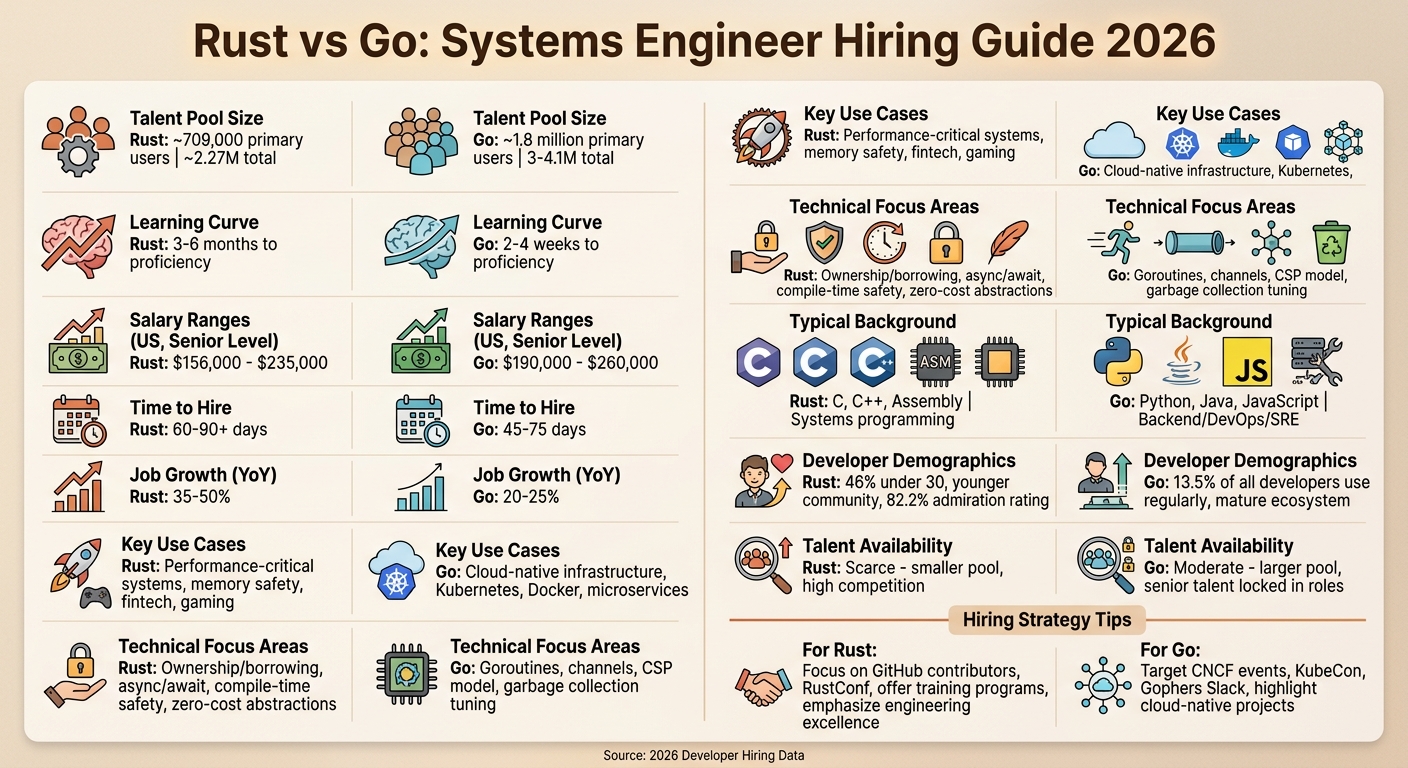
In 2026, the talent pools for Rust and Go reveal stark contrasts, which play a crucial role in shaping recruitment strategies. Go boasts around 1.8 million developers using it as their primary language, while Rust trails behind with about 709,000 . This disparity means hiring Rust engineers involves navigating a significantly smaller pool of candidates.
The demographics of these developers also paint a revealing picture. Rust tends to attract younger programmers - 46% are under 30, and two-thirds have less than a decade of coding experience . Many Rust developers come from systems programming or security-focused backgrounds, often with experience in C or C++ . On the other hand, Go developers typically transition from backend roles, DevOps, or Site Reliability Engineering, where Go is often just one tool among many . These distinctions are key to understanding how and where to find the right talent for each language.
Rust Developer Demographics and Market Availability
Rust's steep learning curve limits its talent pool. Becoming proficient in Rust generally takes an experienced engineer 3–6 months, compared to just 2–4 weeks for Go . Max Wells from the Rustify Team highlights this challenge:
Go takes 2–4 weeks to reach productivity; Rust takes 3–5 months - that gap is the entire explanation for Rust's salary premium, because it directly controls how many engineers ever reach employability .
This learning curve impacts both hiring strategies and salary expectations. Despite its challenges, Rust enjoys an impressive 82.2% admiration rating over nine consecutive years . However, its limited talent pool has led companies like AWS, Google, and Microsoft to focus on hiring engineers with general expertise and then training them in Rust . Meanwhile, demand for Rust developers has surged, with job postings increasing by 35% to 50% annually , driven by the rise of AI infrastructure and government mandates for memory-safe programming languages.
Go Developer Demographics and Market Availability
Go’s simplicity has resulted in a larger, more accessible pool of developers . Around 13.5% of all developers use Go regularly or as their primary language . The language has become a cornerstone for cloud-native infrastructure, powering tools like Kubernetes, Docker, and Terraform . This broader pool, however, comes with its own challenges when targeting top-tier talent.
Senior Go developers are often locked into high-level roles and are less likely to respond to outreach . Job demand for Go developers has grown steadily, at approximately 20–25% year-over-year. Hiring timelines for mid-to-senior roles are relatively manageable, typically taking 45–75 days according to our developer hiring timeline planner. However, specialized infrastructure roles can push hiring timelines beyond 90 days .
Rust vs Go Talent Pool Comparison
The table below highlights key differences in hiring metrics for Rust and Go, showcasing the distinct challenges and opportunities each language presents.
| Metric | Rust | Go |
|---|---|---|
| Global Population | ~2.27 million | 3–4.1 million |
| Primary Language Users | ~709,000 | ~1.8 million |
| YoY Job Growth | 35–50% | 20–25% |
| Productivity Ramp-Up | 3–6 months | 2–4 weeks |
| Typical Time-to-Hire | 60–90+ days | 45–75 days |
| Talent Availability | Scarce | Moderate |
| Typical Previous Language | C, C++, Assembly | Python, Java, JavaScript |
| US Senior Salary Range | $156,000–$235,000 | $190,000–$260,000 |
Where to Find Rust and Go Engineers
To hire Rust and Go engineers, it’s best to focus on specialized communities rather than generic job boards to find passive talent. These engineers often gather in specific spaces where they discuss projects, share knowledge, and network.
Rust Developer Communities and Sourcing Channels
The Rust community is active across several platforms that cater specifically to its developers:
- The Rust Programming Language Forum is the official space for technical discussions.
- Rust Discord is a vibrant hub for real-time interaction among developers .
- r/rust on Reddit is a hotspot for news, project showcases, and even hiring threads .
GitHub is another essential resource. The rust-lang/rust repository, with its impressive 110,000+ stars and over 5,000 contributors, is a prime location to find experienced developers . Similarly, crates.io, Rust’s package registry, highlights active library maintainers who are often skilled systems engineers . Paul Dix, Founder and CTO of InfluxData, shared how announcing a Rust-based project sparked significant interest:
I announced that we're working on this new core of the database in November of 2020 in a talk I did. And I said we were hiring and basically like we got a bunch of inbound interest because of the fact that it was written in Rust .
For networking, RustConf serves as the largest annual global event for the Rust community, attracting senior talent . Additionally, niche job boards like Filtra.io, RustJobs.dev, and RustJobs.fyi are excellent alternatives to broader platforms . The Stack Overflow Rust community is another great spot to identify engineers who are actively solving production-level issues . These channels place you directly within the Rust ecosystem.
Go Developer Communities and Sourcing Channels
The Go community has its own set of dedicated spaces and events:
- GopherCon, held annually in the US, Europe, and India, is the primary conference for Go developers .
- KubeCon and other Cloud Native Computing Foundation (CNCF) events are especially valuable for finding senior Go engineers, as Go dominates the cloud-native infrastructure space .
For online engagement, Gophers Slack (gophers.slack.com) is a central hub with over 60,000 members . Communities tied to Kubernetes and HashiCorp are also excellent for accessing experienced Go developers .
To pinpoint active contributors, tools like CNCF DevStats (devstats.cncf.io) track involvement in Go-based projects such as Kubernetes, Prometheus, and etcd. Meanwhile, CNCF Slack and Kubernetes Special Interest Groups (SIGs) facilitate in-depth technical discussions where top-tier talent often participates . For broader outreach, Go Weekly (golangweekly.com) serves as a professional newsletter widely read by the Go community .
These platforms are vital when competing with major tech firms and infrastructure companies for the best systems engineers. Adopting technical hiring best practices ensures your process remains competitive in this tight market.
How to Assess Systems Programming Skills Beyond Syntax
Hiring for systems programming roles requires looking past basic syntax knowledge to uncover engineering depth. When evaluating Rust and Go engineers, focus on their systems-level understanding. The strongest candidates grasp key concepts like stack versus heap allocation, threading models, and how to balance performance trade-offs between I/O-bound and CPU-bound tasks.
Another crucial area to assess is production debugging skills, which often separate experienced systems engineers from those who simply excel at coding tests. For Rust engineers, look for candidates who rely on the compiler to enforce correctness. For Go engineers, focus on their ability to use tools like the race detector and runtime profiling. Pay attention to how clearly they explain their debugging approaches.
Architecture challenges are also a great way to gauge real-world problem-solving abilities. Ask candidates to design solutions like high-throughput microservices, event-driven pipelines, or caching strategies. This helps you see how they prioritize avoiding failures - whether it's memory corruption and tail latency in Rust or managing complexity and delivery speed in Go. Once you’ve explored their architectural thinking, delve into language-specific technical skills to confirm their expertise.
Technical Skills to Evaluate in Rust Engineers
When assessing Rust candidates, start with their understanding of the ownership and borrowing system. Present them with code that triggers borrow checker errors and ask them to explain why it’s unsafe and how they’d fix it. Strong candidates should clearly explain the connections between ownership, lifetimes, and memory safety, while avoiding overuse of unsafe blocks.
Concurrency is another key skill to evaluate. Look for familiarity with async/await patterns, the Send and Sync traits for thread safety, and runtimes like Tokio. Experience with the rayon library, which supports parallel processing, is also a plus. A robust understanding of how Rust’s type system prevents data races at compile time is essential.
Rust engineers also need to be skilled at navigating documentation. Test their ability to use resources like docs.rs to solve problems. Candidates with experience in languages like C++, Haskell, or OCaml often bring helpful mental models for Rust’s type system and memory management.
Technical Skills to Evaluate in Go Engineers
For Go engineers, focus on their ability to manage goroutines and work with the CSP (Communicating Sequential Processes) model. Practical exercises like building a worker pool with channels, implementing stream fan-in, or designing a rate-limited API can showcase their concurrency skills. They should also demonstrate how they detect and prevent data races, such as by using the select statement for multiplexing.
A deep understanding of Go’s garbage collector is another key skill. With advancements like Go 1.26’s "Green Tea" GC reducing overhead by 10–40% , candidates should know how to optimize performance by analyzing heap shape, pointer density, and using GOMAXPROCS. Proficiency with tools like pprof flame graphs and trace views to identify CPU or memory bottlenecks is also important.
Be on the lookout for red flags like skipping context cancellation, missing tracing, or unsafe shared-state practices. Candidates should also understand that Go’s goroutines start with a lightweight 2KB stack, allowing millions to run concurrently in a single process . Their ability to leverage this efficiency is a strong indicator of expertise.
Rust vs Go Skills Comparison
| Feature | Rust Assessment Focus | Go Assessment Focus |
|---|---|---|
| Memory Management | Ownership, borrowing, lifetimes (no GC) | GC tuning, heap escape analysis, allocation pooling |
| Concurrency Model | Async/await, Tokio runtime, type safety | Goroutines, channels, CSP, context control |
| Thread Safety | Compile-time enforcement via type system | Runtime race detection, mutex usage |
| Error Handling | Result<T, E> and Option<T> types |
Explicit if err != nil checks |
| Primary Debugging | Borrow checker and type error resolution | pprof and runtime profiling tools |
| Binary Size | 5–10 MB (no runtime included) | 15–25 MB (includes GC runtime) |
Salary Ranges for Rust and Go Engineers in 2026
By 2026, systems engineers specializing in Rust and Go command higher salaries compared to developers working with mid-tier languages - often earning an additional $15,000 to $30,000 annually . This reflects both the demand for and the complexity of performance-critical programming skills.
Rust developers lead the pack when it comes to per-capita salaries. Entry-level roles start at $130,000, with senior positions ranging from $170,000 to $225,000. At the staff level, salaries often exceed $300,000. In tech hubs like New York City, the average salary for Rust developers reaches $212,000 . Go developers, meanwhile, earn an average of $146,879. Senior roles in Go see salaries between $160,000 and $210,000, while staff-level engineers can make $200,000 to over $280,000 .
| Experience Level | Rust Base Salary (US) | Go Base Salary (US) |
|---|---|---|
| Junior (0–2 years) | $90,000 – $125,000 | $85,000 – $115,000 |
| Mid-Level (2–5 years) | $125,000 – $170,000 | $120,000 – $160,000 |
| Senior (5–10 years) | $170,000 – $225,000 | $160,000 – $210,000 |
| Staff / Principal (10+ years) | $210,000 – $300,000+ | $200,000 – $280,000+ |
These numbers highlight the competitive compensation required to attract and retain top-tier systems engineering talent.
Specialized expertise can further boost salaries. For instance, Rust engineers working in blockchain or cryptocurrency see a 30–50% pay increase, with an additional 10% for WebAssembly-related skills. For Go developers, experience with Kubernetes, distributed systems, or CNCF projects adds 10–15% to their base pay .
In April 2026, a remote Senior Software Engineer (Rust) role with Defense Unicorns offered a salary range of $148,750 to $201,250. This position focused on military projects combining hardware integration with human-machine-AI collaboration .
Beyond base salaries, compensation packages often include additional perks. These might include signing bonuses of $10,000 to $30,000, equity options, remote work stipends ranging from $1,000 to $5,000, and budgets for learning AI tools . Developers proficient with tools like Cursor or Claude Code can earn a 10–20% premium. To stay competitive and reduce hiring delays, companies should aim to offer at or above the 50th percentile - $170,000 or more for Rust and Go engineers .
How to Compete with FAANG and Infrastructure Companies for Systems Engineers
You don’t need to match FAANG-level salaries to compete for Rust and Go talent. The appeal of the languages themselves can work in your favor. Many engineers are eager to move into Rust or Go professionally but find opportunities limited to tech giants or crypto firms. This creates a unique opening for smaller companies to stand out.
What can you offer that FAANG often can’t? Direct impact, flexibility, and open-source opportunities. Engineers at FAANG can sometimes feel like a small cog in a massive machine, but at your company, team members can directly shape the technical direction without layers of bureaucracy. Eric Kinariwala, CEO of Capsule, puts it this way:
It's often easy to get lost in a big organization. Whereas our teammates have a direct and significant impact on our products... which is orders of magnitude larger than the impact one may have at a bigger technology company or FAANG.
This sense of ownership and influence is a powerful draw for engineers who want their work to matter.
Crafting a Narrative That Attracts Talent
To compete effectively, you need more than competitive compensation. A compelling story and clear vision can make all the difference. Nathan Davis from UMATR explains:
For founders, that means attracting talent will require narrative and clarity, not just comp packages.
Highlight the unique challenges your company tackles - whether it’s revolutionizing healthcare infrastructure, advancing climate tech, or building developer tools. Show how Rust or Go plays a key role in achieving those goals. This connection between mission and technology can resonate deeply with candidates.
Hiring for Potential
Instead of focusing solely on senior candidates, consider mid-level developers who are eager to transition into Rust or Go. This is a largely untapped talent pool. In fact, 65% of Rust developers currently use the language only for side projects - a clear sign that many are looking for their first professional opportunity with Rust. Micah Wylde, Founder of Arroyo, emphasizes:
Because as a small company, you can attract people because they want to work in Rust. And that's a big incentive to work for you.
By hiring for potential rather than just seniority, you can build a motivated team while offering these developers the chance to grow their careers.
### Leveraging Open Source and Communities
Rust and Go engineers often value opportunities to contribute to their ecosystems. Offering time for open-source contributions, sponsoring events like RustConf or GopherCon, or supporting CNCF projects can be a huge incentive. Additionally, the Rust community, in particular, prioritizes a culture of engineering excellence - focusing on correctness over quick fixes. By emphasizing these values, you can further differentiate your team.
Incorporating these strategies can help you attract top-tier systems engineers without directly competing with FAANG’s resources. It’s about creating a workplace where engineers feel their skills and passions align with meaningful work.
How daily.dev Recruiter Connects You with Rust and Go Engineers
Finding passive Rust and Go talent requires a fresh approach. Instead of relying on outdated profiles, daily.dev Recruiter identifies qualified systems engineers by tracking their real-time engagement with technical content. For example, when developers actively consume material on topics like memory safety, CNCF projects, or concurrency models, it highlights their genuine interest and ongoing learning in these areas.
With approximately 3–4 million Go developers and 2.27 million Rust developers worldwide - many of whom are in senior positions - these engineers often prioritize staying updated with technical content over browsing job boards . By monitoring engagement within specific ecosystems, such as CNCF for Go or memory-safety discussions for Rust, the platform surfaces engineers who are deeply invested in these technologies.
The platform uses a double opt-in introduction model to ensure a respectful and efficient process. Recruiters identify candidates based on engagement data and share a concise, developer-friendly job brief that outlines technical challenges and stack details. Developers then decide whether to opt in, resulting in warm, interest-driven connections. This method aligns seamlessly with broader systems recruiting strategies.
Unlike keyword searches on LinkedIn, which often fail to differentiate between outdated contributions and active work, daily.dev leverages engagement data to pinpoint specific interests like distributed systems, eBPF, and WebAssembly. This pre-qualification process not only reduces screening time but also boosts response rates from passive talent.
This strategy empowers companies without FAANG-level budgets to connect with engineers who are already interested in their tech stack, creating a more level playing field in the race for top talent.
Conclusion
Finding and hiring skilled Rust and Go engineers in 2026 calls for a focused sourcing strategy that moves beyond the usual job boards and LinkedIn searches. Look for talent in places like GitHub, CNCF projects, and Rust-specific communities . Tools like devstats.cncf.io can help you identify standout contributors - make your outreach more effective by referencing their specific pull requests .
Once you've identified potential candidates, it’s crucial to assess their real-world systems knowledge. For Go developers, prioritize skills like explicit error handling, managing goroutine leaks with context.Context, and writing code that maintains simplicity rather than adding unnecessary complexity . For Rust developers, focus on their understanding of ownership, borrowing, and lifetimes, as these are essential for avoiding bugs at compile time . Keep in mind that a deep understanding of systems concepts - like threading, memory allocation, and stack vs. heap usage - matters more than the number of years they've been coding, especially since Rust is still relatively young .
To attract top talent, you'll need to offer more than just competitive salaries. Senior Go developers in the U.S. typically earn between $190,000 and $260,000, while senior Rust developers fall in the $156,000 to $235,000 range . If matching FAANG-level salaries isn’t feasible, consider offering perks like remote work, flexible schedules, and opportunities to contribute to open-source projects.
Platforms like daily.dev Recruiter can simplify the hiring process by connecting you with developers already engaged in topics like memory safety, CNCF projects, or concurrency models. The platform’s double opt-in model ensures you're only reaching out to developers who have shown interest in your specific tech stack. Share a concise job brief that highlights real challenges and stack details, and you'll have access to top-tier systems talent without needing a FAANG-sized budget.
FAQs
Should I hire Rust engineers or Go developers for my team?
Choosing between Rust engineers and Go developers comes down to the specific requirements of your project.
- Rust engineers are ideal for tasks that demand memory safety, consistent performance, and low-level systems development. This makes them a strong choice for embedded systems or applications where latency is a critical factor.
- Go developers, on the other hand, excel in building scalable, cloud-native services, microservices, and APIs. Go's simplicity and native support for concurrency make it particularly well-suited for these use cases.
When it comes to cost, Rust engineers often command higher salaries due to their specialized skill set, while Go developers tend to be more readily available and offer competitive compensation.
What’s the best way to assess real systems skills in Rust or Go interviews?
When assessing system skills in Rust or Go interviews, it's essential to focus on the areas that highlight a candidate's ability to handle real-world challenges.
For Rust, pay close attention to their understanding of ownership, borrowing, and how they ensure memory safety. These are core principles of the language and critical for writing efficient, bug-free code.
For Go, evaluate their grasp of idiomatic patterns, effective use of goroutines, and how they handle race conditions. These skills demonstrate their ability to write clean and concurrent code in Go.
In both cases, use scenario-based questions and coding exercises to test their ability to solve problems and apply their knowledge to production-level situations. This approach can help uncover their expertise in areas like concurrency, memory management, error handling, and debugging under real-world conditions.
How can a smaller company attract senior Rust/Go engineers without FAANG pay?
Smaller companies have a real chance to catch the attention of senior Rust and Go engineers by showcasing what makes them stand out. Highlight opportunities to work on cutting-edge projects, contribute to open-source initiatives, and make a real impact within the organization. These are the kinds of perks that often outweigh the appeal of larger, more corporate environments.
For Rust developers, emphasize your focus on areas like WebAssembly and security technologies - fields where Rust is making waves. For Go engineers, point to your work with cloud-native infrastructure and microservices, as these are areas where Go truly shines.
Additionally, promoting growth opportunities, flexible work setups, and a strong, collaborative company culture can go a long way. While smaller companies may not always match the salaries of tech giants, offering competitive benefits and the promise of meaningful, fulfilling work can more than make up for it.
.png)