Hiring a staff or principal engineer is not just senior hiring with more steps. I’d treat it as a different search with a different scorecard: scope, decision rights, cross-team influence, time horizon, and org impact.
Here’s the short version:
- Senior engineers usually work at the team level and think in weeks to a quarter.
- Staff engineers work across teams, shape architecture, and often think about the next 12 months.
- Principal engineers work at the org level, guide long-range technical direction, and may think 3–5 years out.
- At this level, coding matters less than judgment and influence. A fast coding round won’t tell you much about whether someone can move hard decisions across teams.
- Cold outreach often fails for these roles. The article points to 1%–3% reply rates for cold outreach vs. 30%–50% for warm intros.
- These searches also take time: 90 to 180 days is normal, in part because principal engineers are rare, often about 1 for every 50–100 engineers.
- Pay is usually about the full package, not just salary. In major U.S. markets, Staff can land around $400,000–$600,000 total comp, while Principal can reach $600,000–$900,000+.
If I were hiring at this level, I’d do three things first:
- Define the role before sourcing starts
- Test for cross-team impact, not just coding
- Make the offer about scope, autonomy, and executive access
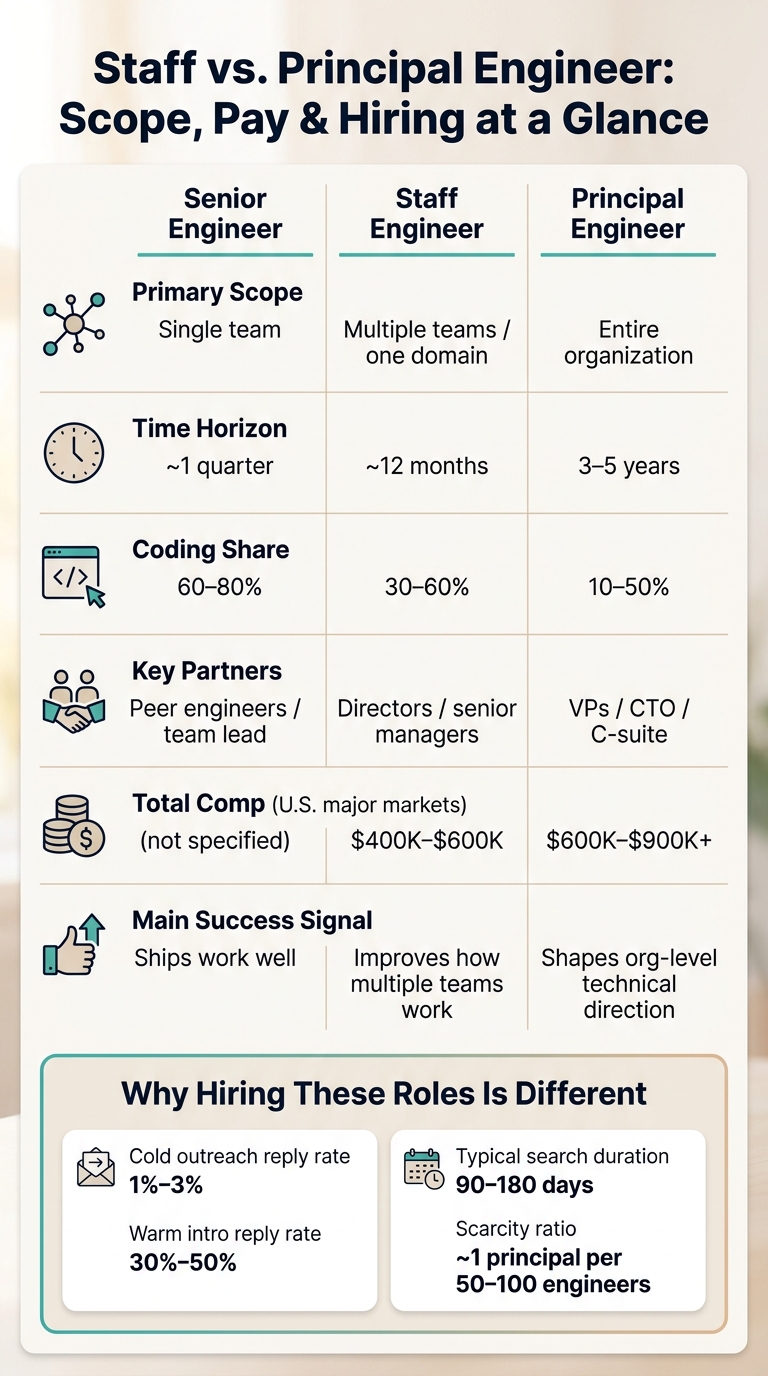
Quick comparison
| Level | Main scope | Main decisions | Time horizon | Coding share | Main signal |
|---|---|---|---|---|---|
| Senior Engineer | One team | Features and implementation | About 1 quarter | 60%–80% | Ships work well |
| Staff Engineer | Multiple teams or one domain | Cross-team architecture | About 12 months | 30%–60% | Improves how many teams work |
| Principal Engineer | Whole org | Long-range technical direction | 3–5 years | 10%–50% | Shapes org-level direction |
A big point runs through the whole piece: titles can mislead. A “Staff Engineer” title does not always mean staff-level scope. So I’d look for proof: specific decisions, trade-offs, hard cross-team work, and signs the person made other engineers more effective.
The rest of the article explains how to define the role, find the right people, test for true staff-plus scope, spot title inflation, and close offers that strong candidates will take.
Define the role before you start recruiting
Before you source anyone, the role needs to be clear enough to hire against. At staff-plus levels, fuzzy scope leads to fuzzy hiring. And when the scope is fuzzy, you attract the wrong people and burn time on the wrong conversations .
Senior vs. staff vs. principal: scope, decisions, and impact
Use scope, decision rights, and impact to tell senior, staff, and principal roles apart.
| Dimension | Senior Engineer | Staff Engineer | Principal Engineer |
|---|---|---|---|
| Primary Scope | Single team | Multiple teams / domain | Entire organization |
| Key Partners | Peer engineers / team lead | Directors / senior managers | VPs / CTO / C-suite |
| Decision Focus | Features & implementation | Cross-team architecture | Org-wide technical strategy |
| Coding Time | 60–80% | 30–60% | 10–50% (variable) |
| Time Horizon | About 1 quarter | About 12 months | 3–5 years |
| Impact Metric | Shipped features / projects | Org multiplier / efficiency | Technical health / strategy |
The jump from staff to principal isn't just “more staff.” It's a different kind of job with a broader field of influence.
Once you know the scope, the next step is simpler: figure out whether your company needs this level of leverage right now.
Signs your company actually needs staff-plus talent
A few patterns tend to show up when a company needs staff-plus talent:
- Cross-team technical calls keep piling up behind one person
- Teams keep solving the same problem in slightly different ways
- Migrations stall out or drag on
- Architecture varies too much from team to team
Those are signs that cross-team impact is missing.
There's another issue that gets missed all the time. If senior engineers can only move up by becoming managers, staff-plus hiring usually falls apart. Why? Because one hire can't fix a ladder that doesn't exist. If there's no staff-plus path, retention problems won't disappear just because you add one person.
That role definition becomes the basis for sourcing and evaluation.
Why sourcing and evaluation break down for staff-plus roles
Why standard sourcing misses staff and principal engineers
Staff and principal candidates usually aren't out there sending resumes every week. That's why generic outreach tends to flop, while trusted introductions do far better.
The reply data makes that pretty clear. Cold outreach to staff engineers gets 1%–3% replies. Warm intros get 30%–50%. So if you're trying to fill these roles with pure volume sourcing, you're probably spinning your wheels .
Job boards add another problem: they lean too hard on title. A candidate called "Staff" at a smaller company may line up more closely with senior-level scope inside a larger org . And principal engineers are scarce to begin with, showing up at about 1 per 50–100 engineers in most companies . That scarcity is part of why a 90-to-180-day search is normal for these roles .
How to evaluate staff-level capability with real evidence
Once you reach the right people, the interview loop needs to test staff-plus leverage, not coding speed.
Standard LeetCode rounds and whiteboard interviews often miss what matters at this level. You're not just looking for someone who can code fast under pressure. You need to see architecture judgment, technical judgment, and cross-team influence. A better setup is a 90-minute cross-team architecture case for staff candidates or a paid async design exercise for principal candidates, with focus on trade-offs, non-goals, and rollback plans .
Another smart move: share a one-page brief describing a real company problem 24 hours before the interview. That gives candidates time to think, which is usually a much better test than forcing a performance on the whiteboard .
One of the best questions in the whole loop is about influence without authority. Ask for a specific time the candidate moved a decision across teams that did not report to them . Then listen closely. You want to hear friction, trade-offs, design reviews, and how they built agreement. If the story sounds too smooth, dig in. Staff-plus work is messy. Also, bring your CTO or VP of Engineering into the loop early. Candidates at this level often see those leaders as peers, and they expect that talk to happen early .
Red flags that point to title inflation
Title inflation is common. Companies often use "Staff" as a retention tool for senior engineers who don't want to move into management . The result is a big pool of people with the title, but not the cross-team scope the job calls for.
That same evidence-based interview loop should help separate real staff-plus scope from inflated titles. A few signals tend to make the gap pretty obvious:
| Signal | True Staff+ | Title Inflation |
|---|---|---|
| Ownership language | Names specific decisions and trade-offs | Uses "we" for every critical call |
| Problem framing | Identifies which problems are worth solving | Solves problems assigned by others |
| Mentorship | Can name a specific engineer they helped grow | Can't name a specific engineer they mentored |
| Time horizon | Thinks in quarters and years | Thinks in weeks and sprints |
| Reversals | Can name a decision they'd make differently | Has no answer |
Another pattern to watch: candidates who stay focused on personal output, like features shipped or code written, instead of organizational impact. A good checkpoint is the reverse question: ask for a technical decision they'd make differently today. If they can't name one, keep probing .
"Staff is measured in blast radius, the number of engineers whose week got better because of a decision this person drove." - Mike Carter, KORE1
For principal roles, a missing point of view on AI-assisted development and governance is also a red flag .
Build offers that staff-plus candidates will accept
Once you’ve confirmed the candidate’s scope and influence, the offer has to show the role is REAL.
What compensation looks like at the staff-plus level
Base salary matters, but it usually doesn’t decide the deal. Staff-plus candidates look at total comp, equity structure, and refreshers. Base salary often levels off around $300K–$400K. What tends to close the gap is the full package: total comp, how equity is set up, and what happens after the first grant starts to run out. In major U.S. tech hubs, Staff roles often land around $400K–$600K total comp, Principal around $600K–$900K+, and top AI labs can go past $1.2M .
The vesting setup matters just as much as the grant size. Standard packages use a four-year vesting schedule with a one-year cliff . Candidates also expect annual refreshers at 25%–50% of the original grant so they don’t take a pay hit once the first vest finishes . If someone is leaving a big tech company, a sign-on bonus in the $150K to $300K range is common to make up for unvested equity they’re walking away from .
Here’s how staff-plus candidates usually weigh an offer:
| Factor | Priority | What They're Actually Asking |
|---|---|---|
| Scope & Autonomy | Critical | Will I have real decision rights, or just a title? |
| Equity Upside | High | Is this grant structured for long-term upside? |
| Team Quality | High | Are there strong engineers here I can actually multiply? |
| Executive Access | Medium-High | Will I work with leadership directly? |
| Mission Fit | Medium-High | Is this a problem worthy of my level? |
| Base Pay | Moderate | Is it fair? It needs to be, but it won't close the deal. |
Why referrals outperform cold outreach at this level
At this level, comp gets the candidate to reply. Trust gets them to say yes.
Referrals work because they do more than introduce a person. They validate the role, the team, and the hiring manager before the first call even happens. And that matters a lot. A warm intro from someone the candidate trusts will beat even the slickest job post.
How to close with autonomy, influence, and mission
Once the numbers are in range, candidates start asking a tougher question: Will I actually get to make calls here?
That’s why the best closing conversations get concrete, fast. Don’t sell “big opportunity” in vague terms. Talk about the actual problem, like the Kafka pipeline dropping events under load. Details like that show the role has real scope. They also show that someone at the executive level cares enough to fix it .
A common sticking point is who owns the call. Staff-plus candidates want to know, early, whether they’ll have final say on architecture and technical standards or whether every decision gets bounced through a committee. Say it plainly. Then back it up with early executive access. A conversation with the CTO or VP of Engineering in the first or second interview round sends a strong signal that the title comes with the influence it should .
"Staff engineers leave when the technical problems stop being interesting or when they get quietly pulled into management they never wanted." - Mike Carter, KORE1
One step that often helps move things along: send a 90-day mandate before the offer goes out. Lay out the exact organizational problem or technical decision the candidate will own in their first three months. It cuts ambiguity and gives them something concrete to step into.
Conclusion: A better approach to staff-plus engineering hiring
Staff-plus hiring only works when the role, the hiring process, and sourcing are built around cross-team influence rather than team-level output.
Start by getting clear on the kind of leverage you need. Is it technical direction, cross-team alignment, or organizational problem-solving? From there, assess candidates based on real proof of impact, not interview theater. And the title should line up with the actual scope of the job.
Once the role is defined, sourcing stops being a volume game and becomes a targeting problem. In practice, staff-plus sourcing still runs on warm introductions, not mass outreach.
That’s why signal quality matters just as much as reach. daily.dev Recruiter helps surface staff-plus engineers through behavioral and engagement signals, then begins each introduction as a warm, double opt-in conversation.
If your team needs a repeatable way to find these candidates, use a channel built for high-signal discovery. For role frameworks, visit /roles/staff-engineer.
FAQs
When should I hire a staff engineer instead of a senior engineer?
Hire a Staff Engineer when your organization starts to feel bigger than its current engineering setup can handle. In many cases, that happens once you’re past 15 to 25 engineers and cracks start to show between teams.
At that point, a Senior Engineer may still be strong inside one team, but not set up to solve problems that stretch across several teams. You might see your CTO turning into a bottleneck for technical calls. Or different teams may drift into inconsistent architecture. You may also need someone who can set technical direction across multiple teams without stepping into people management.
If the need is more limited than that, a strong Lead or Senior Engineer is probably enough.
How can I tell if a candidate has real staff-plus scope?
Look for cross-team or organization-wide influence, not just strong feature delivery. Strong staff-plus candidates remove system-level bottlenecks, help other teams adopt better ways of working, and make an impact that goes well beyond their own code.
Ask for examples of architecture decisions, technical leadership, systems thinking, and how they handled trade-offs without direct authority. That’s usually where the difference shows up. Someone can be a great builder and still not be operating at staff-plus scope.
Be careful if they talk only about individual tasks, tickets, or personal output. The same goes for candidates who struggle to explain their effect on the broader organization.
What actually closes strong staff and principal candidates?
Strong staff and principal candidates don’t choose a role on salary alone. They look at the full package: total compensation, often including meaningful equity, and a mission they can believe in.
That’s only part of it, though. Many also want autonomy, hard technical problems with clear business impact, and the chance to shape decisions across the company without having to manage people.
What tends to close them? Clear goals for the first 90 days and visible executive trust in their technical judgment.
.png)