Hiring developers at a fast-growing startup is challenging. You're competing with tech giants, facing a talent shortage, and operating on limited resources. Here's what you need to know:
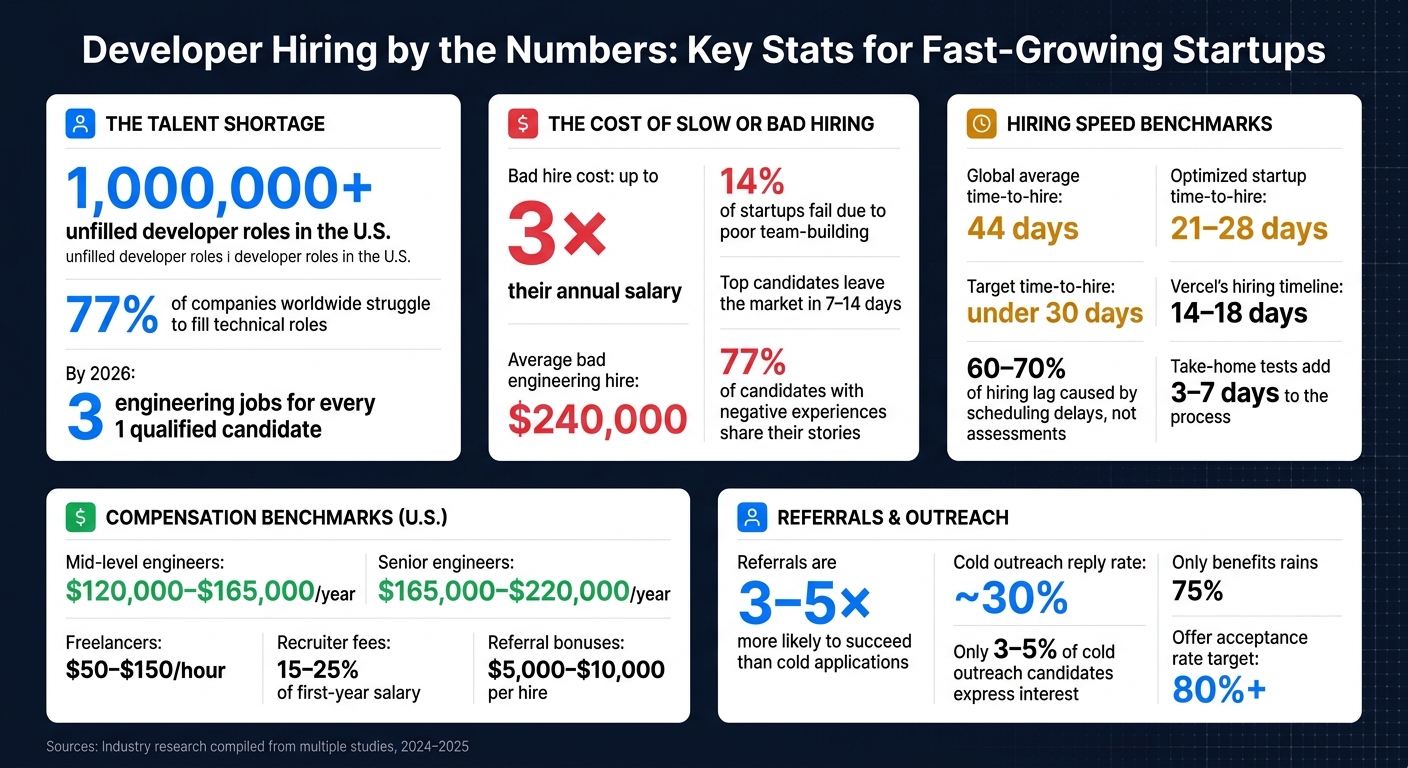
- The Problem: There's a massive developer shortfall in the U.S. - over 1 million unfilled roles. Top engineers are hired within 7–10 days, while startups often take 6 weeks or more.
- The Cost of Mistakes: A bad hire can cost up to 3x their annual salary. Plus, 14% of startups fail due to poor team-building.
- The Solution: A structured hiring playbook. Define clear roles, set measurable goals, streamline processes, and prioritize speed without sacrificing quality.
This guide breaks down how to recruit developers effectively, from aligning hiring goals with growth stages to creating efficient pipelines and sourcing top talent. Startups that systematize hiring early on can build strong teams while avoiding costly mistakes.
Defining Your Startup's Developer Hiring Goals
Nailing down your hiring goals is the first step in building a solid developer recruitment strategy. Before posting any job listing, you need to be crystal clear about what you're hiring for and why. Skipping this step often leads to mismatched hires and delays.
Mapping Roles to Your Growth Stage and Product Roadmap
Your hiring strategy should align with your startup's growth stage. In the Seed/MVP phase, you’ll want full-stack generalists who can handle the entire user journey independently. As you progress to Series A, it’s time to bring in specialists - backend, frontend, and mobile engineers - to refine and scale your systems. By Series B, roles like DevOps, security, and QA automation become crucial for ensuring reliability and infrastructure stability.
To streamline hiring, create a "success profile" for each role. This should outline the specific problem the hire will solve within their first 6–12 months. For instance, you might need someone to cut API response times from 200ms to 50ms. Such clarity helps candidates assess their fit and makes your hiring process more efficient. With over half of engineering roles in 2025 expected to be senior-level or higher , being specific about your needs ensures you attract the right talent.
Once you’ve defined the roles, set benchmarks to track your progress and measure success.
Setting Measurable Hiring Targets
Your hiring plan should align with your funding runway and product goals. For example, if you have 18 months of runway, outline how many engineers you’ll need by months 6, 12, and 18 - and determine what each hire will contribute to your product roadmap.
Track two key metrics from the start: time-to-hire and offer acceptance rate. An efficient process should aim for a time-to-hire of under 30 days. While the global average is 44 days , optimized hiring workflows can reduce this to 21–28 days . If your offer acceptance rate falls below 80%, you may need to revisit your compensation package, equity offer, or candidate experience. Another important metric is the pass-through rate at each interview stage. For example, if only 1 in 5 candidates passes your technical assessments, it may indicate that your test is either too difficult or not aligned with the role you’re hiring for.
Building a Lean Hiring Budget
Once your roles and targets are set, it’s time to manage your budget wisely. With limited resources, every dollar counts. One of the most cost-effective strategies is leveraging employee referrals. Referrals are 3–5 times more likely to succeed than cold applications . Offering referral bonuses between $5,000 and $10,000 per successful hire is often cheaper than paying recruiter fees, which can range from 15–25% of a candidate’s first-year salary .
Be realistic about salary expectations. In the U.S., mid-level engineers typically earn $120,000–$165,000, while senior engineers command $165,000–$220,000 . If your cash flow is tight, equity can help close the gap. Use simple tools, like a spreadsheet, to show the potential value of a 0.25% stake in both $100M and $500M exit scenarios. This makes equity feel like a tangible benefit rather than a vague promise. For non-core functions, hiring freelancers at $50–$150 per hour can be a smart short-term solution, helping you conserve resources for critical full-time hires.
Defining clear goals upfront lays the foundation for a scalable and efficient recruitment process.
Building a Scalable Developer Recruitment Process
Once your hiring goals and budget are set, the next hurdle is creating a recruitment process that can handle multiple roles at once without breaking down. While early-stage startups often hire on an as-needed basis, this approach quickly becomes unsustainable as you grow.
Designing a Repeatable Recruitment Pipeline
A well-structured recruitment pipeline is key to scaling your hiring efforts. It should have clearly defined stages, assigned responsibilities, and consistent outcomes. This ensures candidates move smoothly through sourcing, screening, technical assessments, and final interviews.
One effective strategy is to shift from generic job titles to outcome-focused roles. For example, instead of advertising for a "Senior Backend Engineer", specify the goals for the role, like "reduce database query latency by 40% in the first quarter" . This clarity helps attract candidates who are genuinely suited to your needs, filtering out mismatches early.
Your recruitment pipeline should also adapt as your team grows. Here's a useful framework:
| Growth Phase | Team Size | Primary Focus | Key Structural Move |
|---|---|---|---|
| Foundation | 10–30 | Documenting culture & standards | Define engineering levels (Junior to Staff) |
| Scaling | 30–60 | Reducing communication overhead | Shift to squad-based, cross-functional teams |
| Maturity | 60–100+ | Operational & architectural stability | Invest in DevEx and staff-level leadership |
When your team grows beyond 30 developers, recruiting can no longer be a side task for your CTO. At this stage, hiring a dedicated technical recruiter or Head of Talent becomes essential . Tools like role scorecards, which assign numerical ratings to each competency, can help make hiring decisions more objective and consistent.
This structured approach allows you to scale your recruitment process efficiently without compromising on quality.
Hiring Fast Without Cutting Corners on Quality
Speed is critical in today's job market. By 2026, there will be three engineering jobs for every qualified candidate , and the top 10% of candidates are usually off the market within 10 to 14 days . A lengthy 41-day hiring process simply won't cut it.
The biggest bottleneck in hiring isn't candidate assessments - it's the downtime caused by scheduling delays and slow decision-making, which account for 60–70% of the lag . Here are two ways to speed things up:
- Pre-schedule 2–3 interview slots per week on every interviewer's calendar.
- Ensure every qualified applicant gets a recruiter screen within two business days of applying .
Another time-saver is replacing multi-day take-home assignments with shorter alternatives, like a single-day task or a 45–60 minute live pair-programming session. Take-home tests often add 3–7 days to the process and can deter senior engineers from completing them . Live sessions not only save time but also give both sides a chance to evaluate compatibility in real-time. Companies like Vercel keep their hiring timeline to 14–18 days by prioritizing live pair-programming, while PostHog uses a "SuperDay" format to conduct all interviews in one day and extend offers within 48 hours .
After the final interview, hold a team debrief within 24 hours while impressions are still fresh. Use a blind scoring system (1: Strong No, 4: Strong Hire) where each interviewer submits feedback independently before group discussions. This reduces groupthink and speeds up decision-making .
Tools That Help You Hire More Efficiently
The right tools can streamline your recruitment process, cutting down on manual tasks and keeping things moving. For most startups, an Applicant Tracking System (ATS) is a must. Options like Manatal (starting at $15/user/month) , Workable ($299/month) , and Ashby - popular among venture-backed startups - offer varying levels of functionality, from basic tracking to advanced data reporting .
For technical assessments, platforms like HackerRank, Codility, and CoderPad provide standardized challenges, creating a level playing field for all candidates . If you're dealing with a high volume of applicants, AI-powered tools like AltHire AI can reduce screening interview time by up to 60% and speed up hiring by 70% . However, these tools should complement human judgment, not replace it.
"Hiring is the #1 priority for every startup once they've raised money, and to do it well you need the right platform." – Jared Friedman, Partner, Y Combinator
Keep your tool stack lean. Focus on solutions that eliminate friction and free up your team to concentrate on what matters most - evaluating candidates. Too many tools can create unnecessary complexity, slowing down the process instead of speeding it up.
Sourcing Developers in a Competitive Market
Once you’ve got a scalable recruitment process, the next hurdle is finding top-tier developers in a market where demand far outpaces supply. With 77% of companies worldwide struggling to fill technical roles , a passive approach just won’t cut it. To stay ahead, you need a proactive, multi-channel sourcing strategy.
Using Your Network to Generate Referrals
Referrals are one of the fastest ways to secure strong hires. When a candidate hears about your company from someone they trust, it immediately builds credibility. Start by creating a "Dream Team Roster" of 10 to 25 developers who either already know your company or align perfectly with your needs. Cultivate these relationships over time so you’re ready when the right opportunity arises.
"You're likely gonna engage with 50 people at the top of the funnel just to make one hire." - Steve Bartel, CEO and Co-founder, Gem
Go beyond your immediate network by tapping into connector nodes - influential individuals whose recommendations can open doors to high-quality candidates. A single introduction from a trusted source can outperform months of cold outreach. Don’t forget to incentivize employee referrals with bonuses; these hires often integrate more smoothly and stay longer . Building a robust referral network ensures a solid foundation for your sourcing strategy.
Using daily.dev Recruiter to Reach Pre-Qualified Developers
One of the biggest challenges in hiring developers is that the best talent isn’t actively browsing job boards - they’re busy honing their skills and building projects. That’s where daily.dev Recruiter comes in.
daily.dev, a platform used by millions of developers, allows you to source candidates based on their real-world engagement - like the technologies they follow and the content they consume . This method focuses on identifying developers who are actively learning and staying ahead.
"You're finding people who are actively curious and learning, which tells you more than a list of past jobs." - Nimrod Kramer, Co-founder and CEO, daily.dev
This approach is especially valuable for startups, where adaptability is crucial. With daily.dev Recruiter, every introduction is warm and double opt-in, ensuring you’re connecting with candidates who are genuinely interested in exploring new opportunities.
Combining Outbound and Inbound Sourcing
While platforms like daily.dev help target engaged talent, a well-rounded strategy requires blending outbound and inbound efforts. No single channel is enough to consistently attract top developers. Think of sourcing as a sales funnel: outbound efforts help you reach passive talent, while inbound channels capture those already interested in your company.
Outbound sourcing works best when it’s personalized. Generic messages rarely land - cold outreach reply rates hover around 30%, and only 3–5% of candidates typically express interest due to factors like fit or compensation . Honest, tailored messaging, such as "We're early. It's messy. We need someone like you", tends to resonate with developers who thrive in dynamic startup environments .
"The strongest candidates are often passive and won't be found unless you're running a deliberate, outbound hiring motion." - Avetis Antaplyan, Founder and CEO, HIRECLOUT
For inbound sourcing, timing is everything. Reaching out within 1 to 3 days of a funding announcement or major product launch significantly boosts response rates . These moments of momentum are ideal for activating both outbound and inbound efforts. Pair this with niche job boards and curated marketplaces to maintain a steady pipeline, even during quieter periods.
| Channel | Why It Works | Risk If Used Poorly |
|---|---|---|
| Warm Introductions | Builds trust before the first interaction | Weak asks can damage relationships |
| Targeted Cold Outreach | Quickly connects with passive talent | Generic messages are often ignored |
| daily.dev Recruiter | Highlights engaged, pre-qualified candidates | Missed opportunities without quick follow-up |
| Niche Job Boards | Attracts candidates with specific intent | Can be overwhelmed by noise and volume |
Building a Candidate Experience Developers Actually Respect
Once you've fine-tuned your recruitment process, the next step is ensuring that every interaction with candidates reflects your startup's culture and professionalism. In today's competitive tech landscape, the way you treat candidates isn't just about being polite - it's a key factor in attracting top talent quickly and effectively. Finding great developers is only the beginning. How you engage with them during the hiring process will determine whether they accept your offer or vanish without a word. And remember, developers talk. A slow or disorganized hiring process can tarnish your reputation in no time.
"If the candidate experience doesn't match the pitch, trust erodes quickly." - Avetis Antaplyan, Founder and CEO, HIRECLOUT
Writing Job Pitches That Are Clear and Honest
Skip the buzzwords and avoid generic job descriptions. Instead, focus on creating a Success Profile - a detailed outline of the specific business challenges the developer will tackle in their first 6–12 months . This gives candidates a clear understanding of what the role actually entails.
Pair your job description with a one-page "Why Us?" document that highlights your mission, showcases the technical challenges of the position, and explains the impact the new hire will have . Transparency is critical, especially when it comes to compensation. Break down salary, equity mechanics, and other details like ISOs versus NSOs, the strike price, vesting schedules, and potential outcomes at key valuation milestones (e.g., $100M vs. $500M) .
"A startup offer is partly a job offer and partly a risk-sharing agreement." - The Underdog.io Team
A well-crafted pitch lays the groundwork for respectful and efficient communication throughout the hiring process.
Responding Quickly and Communicating Clearly
In hiring, speed speaks volumes. When a startup moves quickly, it shows decisiveness and respect for the candidate's time. Developers expect prompt responses, and delays longer than 48 hours can cause them to lose interest. To prevent this, adopt a 48-hour update rule for every stage of the process . Additionally, at the end of every interview, offer specific time slots for the next step right away - this simple action can save 3–5 days of back-and-forth scheduling .
"The company that moves fastest almost always wins. Not because speed itself is attractive, but because it signals that the organization can actually make decisions." - JobsByCulture
Running Structured and Fair Interviews
Structured interviews are essential for creating a fair and consistent experience that aligns with the promises made in your job pitch. Unstructured interviews can lead to bias and inconsistent evaluations. A well-designed, four-part interview loop often works best for engineering roles. This might include:
- A practical technical screen
- A collaborative pair-programming session
- A behavioral interview focused on ownership
- A team conversation to assess cultural alignment
Each stage should focus on a specific skill to avoid redundancy. To ensure fairness, require written feedback from each interviewer before any group discussion. This prevents anchoring bias and keeps evaluations objective .
When it comes to technical assessments, skip abstract puzzles. Instead, use live pair-programming exercises that reflect real-world tasks. If you choose to assign take-home work, set a strict time limit of 2 hours, provide a starter codebase, and share the evaluation criteria upfront . For instance, Vercel emphasizes live pair-programming over take-home assignments because it accelerates the process and provides immediate feedback on collaboration skills .
Conclusion: Scaling Developer Hiring Without Losing Quality
Growing a developer team quickly doesn’t have to mean lowering your standards. The most successful startups approach hiring like they would a product - tracking metrics, fixing what's not working, and ensuring every candidate interaction reflects their brand.
Here’s why it matters: A single bad engineering hire can cost a company an average of $240,000 . On top of that, 77% of candidates with negative experiences will share their stories . These numbers highlight just how crucial it is to have a disciplined and thoughtful recruiting process.
To succeed, you need to focus on the basics: clearly defining roles, running a structured interview process, sourcing proactively, and respecting candidates’ time by communicating promptly. As your team grows - whether it’s from 10 to 30, or 30 to 60+ engineers - the core principles remain the same. What changes is the level of complexity.
"Scaling engineering teams from 10 to 100 developers isn't just about hiring fast, it's about hiring smart." - Mayank Pratap Singh, Co-founder & CEO, Supersourcing
One key metric to keep an eye on is your offer acceptance rate. If it dips below 80%, it’s a red flag that something might be off with your compensation package or the candidate experience . Addressing these issues quickly is crucial. Startups that build strong recruiting practices early on gain a long-term edge in engineering talent. By nailing these fundamentals, fast-growing companies can expand their teams without sacrificing quality.
FAQs
What should my first 1–3 engineering hires be at my stage?
When you're just starting out, your first 1–3 engineering hires should concentrate on creating a solid product foundation. Begin with a full-stack engineer or someone deeply experienced in your core tech stack who also has a strong product-focused mindset. As you grow, bring in team members with complementary skills, such as frontend or backend specialists, and tackle other essential areas like QA or DevOps. Look for candidates who are adaptable, align well with your team culture, and can excel in the fast-paced world of startups.
How can we cut time-to-hire under 30 days without lowering quality?
Reducing your time-to-hire to under 30 days without sacrificing quality is achievable with a focused approach. Start by tapping into pre-vetted talent pools - this eliminates the need for lengthy sourcing and ensures you're starting with qualified candidates.
Next, simplify your interview process by incorporating quick, targeted assessments that evaluate the most relevant skills. Delays often occur during scheduling and decision-making, so having a clear, streamlined process in place is crucial.
Finally, engaging candidates early can help shorten notice periods and speed up onboarding. By combining these strategies, fast-growing startups can hire efficiently while maintaining high standards.
How can we make equity offers easier for candidates to understand?
Equity offers can feel confusing, but breaking them down into simple terms helps make them clearer. Start by explaining the type of equity being offered. Is it stock options or restricted stock units (RSUs)? These are common forms of equity, but they work differently. For example:
- Stock options give you the right to buy company shares at a fixed price, typically lower than the market value.
- RSUs are shares granted to you, but you only own them after meeting certain conditions, like staying with the company for a set period.
Next, talk about vesting schedules - this is how and when equity becomes yours. A standard schedule might be "4 years with a 1-year cliff." This means no shares are yours until you’ve worked a full year, at which point 25% vests. After that, the rest vests gradually over the next three years.
Be clear about the potential value of the equity. This involves explaining the company’s valuation, the number of shares outstanding, and what percentage of the company the equity represents. For example, if the company is valued at $50 million and has 10 million shares, each share is worth $5. If you’re offered 10,000 shares, that’s $50,000 in potential value.
It also helps to discuss growth scenarios. Show how the equity could grow if the company succeeds. For instance, if the valuation doubles to $100 million, your equity could also double in value. But be honest about risks - startup equity isn’t guaranteed to grow.
By using straightforward language and real-world examples, you can help candidates understand the full picture of their equity offer, including both its potential rewards and uncertainties.
.png)