Low response rates in technical recruiting are a major challenge. Developers often ignore generic outreach, with cold email response rates as low as 2-5%. Recruiters face trust issues, with only 15% of developers believing they understand technical roles. Meanwhile, hiring is harder than ever, with tech jobs averaging 369 applications but only 0.5% ending in offers.
Key strategies to improve response rates:
- Personalize outreach: Reference specific projects or achievements to show genuine interest.
- Time it right: Emails sent on Sundays or early mornings often perform better.
- Use the right platforms: Developers favor personal email over LinkedIn and respond well on GitHub or Slack.
- Build trust: Focus on ongoing relationships instead of transactional interactions.
Recruiters who prioritize respect, transparency, and thoughtful communication stand out in a crowded field. Start by crafting concise, tailored messages and following up with care to improve trust and engagement with tech talent.
::: @figure 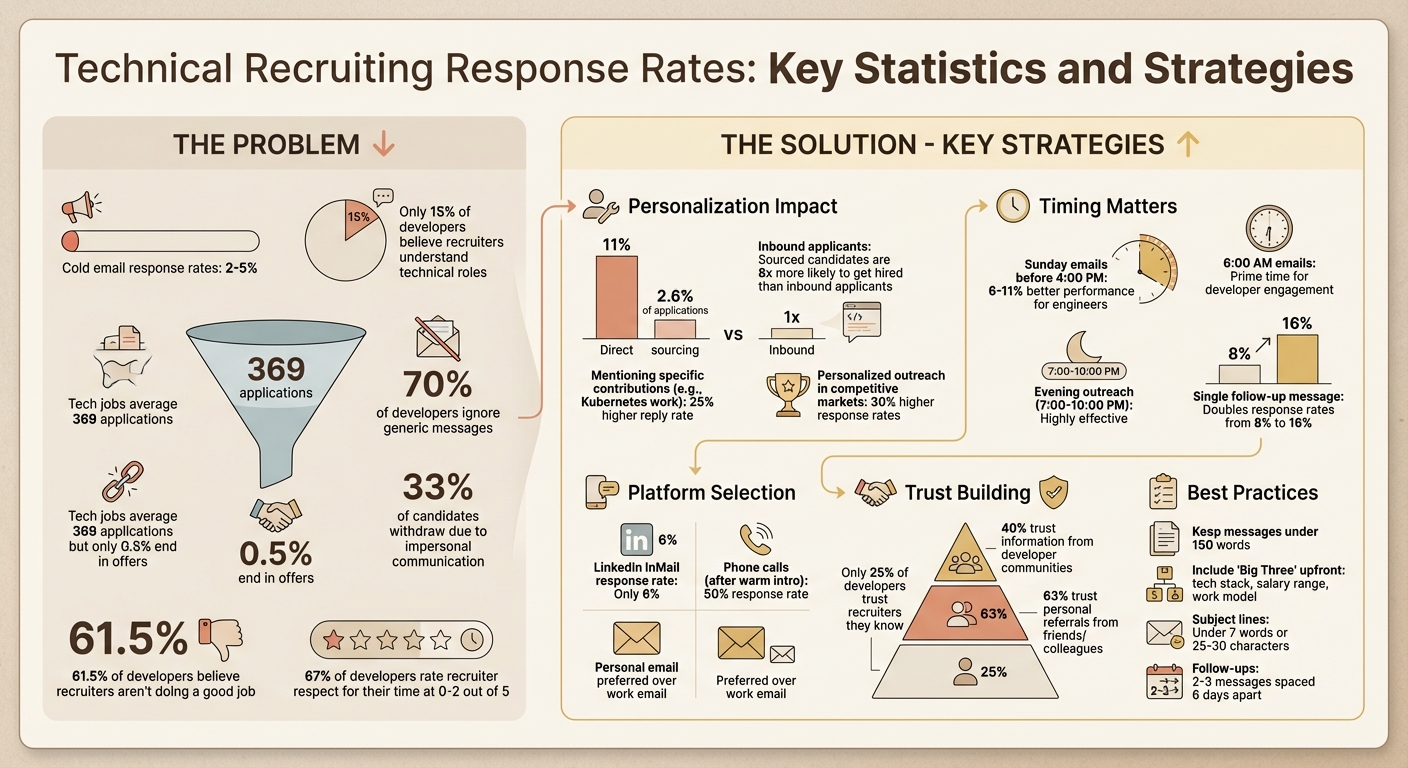 {Technical Recruiting Response Rates: Key Statistics and Strategies}
Personalize Your Outreach Messages
Personalization isn’t just a courtesy - it’s often the key to getting a response. Here’s why it matters: direct sourcing with personalized outreach leads to 11% of hires from only 2.6% of applications. That makes sourced candidates almost eight times more likely to get hired than inbound applicants. When developers see that you’ve taken the time to understand their work, they’re much more likely to engage.
Consider this: 70% of developers ignore generic messages, and 33% of candidates withdraw when they feel disrespected by impersonal communication. With software roles attracting an average of 369 applicants per job, standing out means going the extra mile. Personalized outreach isn’t just about grabbing attention - it’s about building trust and showing respect for the candidate’s time and expertise. The process starts with thoughtful research.
Research Candidates Before Reaching Out
Spend 5–10 minutes researching each candidate to gather meaningful insights. Start with GitHub - check out their repositories, recent commits, and contributions to open source projects to see what they’re working on. Dive into Stack Overflow to explore their activity in specific tags and their answers that showcase expertise. Look for technical blogs on platforms like Dev.to or Medium to spot any thought leadership, such as posts on React or cloud architecture. Jot down 2–3 specific achievements you can reference in your message.
For example, one recruiter shared that mentioning a developer’s open-source Kubernetes contribution led to a 25% higher reply rate than sending a generic message. Including details like specific pull requests or lines of code can transform a cold email into a meaningful conversation starter.
Write Messages That Developers Want to Read
Keep your outreach concise - under 150 words - and use a tone that’s respectful and conversational. For instance, start with something like, “I came across your work on…” and highlight 1–2 specific projects or skills (e.g., “Your work optimizing that ML model really stood out”). Avoid buzzwords like “ninja,” “rockstar,” or “guru,” as they often come across as tone-deaf to developer culture. Instead, focus on authentic and relevant details.
Structure your message with a clear hook, some role-specific details, a unique aspect of your company, and a low-pressure call to action. For example, you could end with, “I’d love to hear your thoughts on how we’re tackling similar challenges.” This approach not only respects their time but also opens the door to a genuine conversation. When you show that you value their expertise, they’re much more likely to respond.
Choose the Right Time and Platform
Timing and platform choice are key when reaching out to developers. A poorly timed message on the wrong channel can easily get lost in the shuffle. Did you know that a single follow-up message can double response rates from 8% to 16%? But this only works if your initial approach is well thought out.
Find the Best Times to Contact Developers
Developers often spend their workdays deep in code, so reaching them during their focus hours can backfire. Surprisingly, emails sent on Sundays before 4:00 PM perform 6% to 11% better than average for engineers. Engineering managers tend to respond best on Sunday afternoons (9% above average), while data professionals are most engaged Monday through Friday at 9:00 AM (5% to 8% better). Product managers? They’re most active on weekend mornings before noon (5% to 10% better).
For email outreach, 6:00 AM is a prime time - many developers check their phones first thing in the morning. Evenings between 7:00 PM and 10:00 PM are also effective as developers wind down their day. Steer clear of 10:00 AM and 3:00 PM, which tend to be the least engaging times. Always adjust to the candidate’s local time zone, and for mid-week outreach, aim for Tuesday through Thursday afternoons (1:30–3:30 PM) when developers are transitioning out of deep work.
Once you’ve nailed the timing, the next step is picking the right platform.
Use Platforms Where Developers Are Active
LinkedIn isn’t the go-to for many developers. In fact, only 6% of recruiters report high response rates from LinkedIn InMails alone. Instead, developers prefer personal email over work email, and recruiters who use the phone - after a warm introduction - see response rates as high as 50%.
Specialized platforms like daily.dev Recruiter offer a more direct route, connecting you with developers who have already expressed interest in opportunities. GitHub and Stack Overflow are excellent for evaluating skills through code contributions, but they require thorough research before reaching out. For niche spaces like Discord, Slack, or Reddit, you’ll need to spend time building trust by participating genuinely before making any recruitment pitch.
"While LinkedIn is awesome, not everybody is on it. So ask yourself where else is your talent hanging out? It can be a forum, it can be a meta group, it can be Slack or something else." - Per Tjernberg, Founder, PipeLabs
When writing recruiter emails, start strong by highlighting the "Big Three" in the first few lines: tech stack, salary range, and work model (remote, hybrid, or on-site). Keep subject lines short - ideally under 7 words or 25–30 characters - to ensure they display fully on mobile. For follow-ups, stick to two or three concise messages spaced 6 days apart, and add value each time. For example, you could share a relevant blog post or an interesting project detail.
Build Trust Through Ongoing Relationships
When it comes to recruiting developers, building trust isn't just a nice-to-have - it's essential. Most developers aren't actively seeking new jobs, which means they’re not likely to respond to a one-time pitch. In fact, 61.5% of developers believe recruiters aren’t doing a good job when it comes to outreach. To stand out, focus on creating meaningful, ongoing relationships instead of treating interactions as quick transactions.
Focus on Relationships, Not Just Transactions
Developers are quick to spot a transactional approach, and it’s a major turnoff. Instead of framing your outreach as a one-time offer, treat it as the start of a real conversation. Genuine, personalized engagement builds trust over time and can lead to better results. Recruiters who take the time to personalize their outreach see 30% higher response rates in competitive markets.
One way to build this trust is by offering value without expecting anything in return. For instance, you could:
- Share an industry report on new tech trends.
- Invite them to a webinar on topics like AI agents or Rust.
- Send a case study about career growth at companies similar to theirs.
This approach shows you’re invested in their interests and professional growth, not just filling a role. A thoughtful message like this can make a big difference:
"Hi [Name], I noticed your work on [specific repo] - great job on [feature]! We’re tackling similar challenges at [Company], and I thought you might find this report on [relevant trend] interesting."
Messages like this feel personal and authentic, setting the stage for a relationship rather than a sales pitch.
Follow Up Without Being Pushy
Building trust also means following up in a way that respects their time. Follow-ups are crucial, but there’s a fine line between persistence and being overbearing. A structured approach can help:
- 1st follow-up (2–3 days later): Share a relevant technical article.
- 2nd follow-up (5–7 days later): Highlight recent industry news.
- 3rd follow-up (10–14 days later): Invite them to a low-pressure event.
If you still don’t hear back, consider sending a polite email acknowledging that the timing might not be right, and leave the door open for future conversations. This kind of considerate follow-up shows respect - something that’s often lacking, as 67% of developers rate recruiter respect for their time at 0–2 out of 5.
Tools like daily.dev Recruiter can simplify this process by connecting you with developers who have already expressed interest in opportunities. These platforms use a double opt-in system, meaning every introduction starts with a foundation of mutual interest. Whether you’re using a platform like daily.dev Recruiter or more traditional methods, the key remains the same: treat developers as people worth building long-term connections with, not just as short-term goals.
Coordinate Outreach Across Multiple Channels
Developers engage with various online platforms, so it’s important to align your recruitment efforts with the right channels at each stage. Email is the go-to choice for initial outreach, job alerts, and follow-ups, while phone calls are more effective for scheduling interviews or providing feedback after interviews. Choosing the wrong channel can significantly hurt response rates, so a thoughtful multi-channel strategy is essential to complement the trust-building techniques discussed earlier.
Match Channels to Recruitment Stages
Start with email for your initial contact. It’s non-intrusive and allows developers to review your message at their own pace. For follow-ups or more technical conversations, consider developer networks where they are already active, like GitHub, Stack Overflow, Discord, or Slack.
Phone calls can be highly effective, boasting a 50% response rate compared to just 6% for LinkedIn InMail. However, timing matters. Only schedule calls after you’ve established trust through email exchanges. Calling too early can come across as pushy and may harm the relationship.
Avoid using personal social media platforms like Facebook, Twitter, Skype, or Google Hangouts, as developers often view these as overly invasive. Instead, stick to professional channels and email them directly at their personal addresses to respect their current employment situation.
Tools like daily.dev Recruiter take the guesswork out of channel selection by connecting you with developers in professional settings. These platforms focus on where developers already engage - reading technical content and staying up-to-date with industry trends. By starting with mutual interest, you avoid the trial-and-error of guessing the best channel. Whether you’re coordinating outreach across various platforms or leveraging developer-centric tools like daily.dev Recruiter, the key is meeting developers where they feel comfortable. This approach reinforces the personalized experience, helping to build trust from the very first interaction.
Create a Better Experience for Candidates
Once you've nailed your outreach message and chosen the right channels, the next step is creating an optimized candidate experience that reinforces the trust you've worked so hard to establish. Developers often share their experiences on platforms like daily.dev, Discord, and Reddit, meaning a single negative interaction can tarnish your reputation across entire communities.
Communicate Clearly and Respond Quickly
Developers typically want three key details upfront: the tech stack, the salary range, and the work model. Share this information in your very first message. For example, instead of saying "competitive compensation", specify a range like "$140,000–$180,000." Instead of vague terms, list specific tools and technologies such as "React, TypeScript, PostgreSQL, AWS." This level of transparency shows you respect their time and builds immediate trust.
Accuracy is just as critical. Mistaking Java for JavaScript or pitching a backend role to a frontend specialist can instantly undermine your credibility. To make your messages easier to digest, use bullet points - developers often skim emails during meetings or while juggling tasks. Aim to keep your initial outreach concise, ideally between 80–125 words (around three to five sentences). For tips on the best timing, check the "Choose the Right Time and Platform" section.
Never Ghost Candidates
Clear communication also means treating candidates with respect - this includes avoiding the all-too-common mistake of ghosting. Failing to follow up damages trust not just with individual candidates but across the entire recruiting industry. If someone isn’t the right fit, take a moment to send a brief, respectful message explaining the decision. Better yet, provide something of value, like a relevant article, a referral to another company, or constructive feedback on their portfolio.
"The difference between a great sourcer and a sub-par sourcer is in how much discipline someone has in following up, in not wasting productivity cycles." - Angela Miller, Head of Recruiting, Instabase
When following up, limit yourself to two or three messages spaced 2–4 business days apart. If there’s no response after your final attempt, send a polite email to let them know the door is open for future opportunities. This approach not only preserves your professional reputation but also keeps candidates warm for roles down the line. Tools like daily.dev Recruiter can simplify this process by connecting you with developers who have already expressed interest, making communication more efficient and effective.
Use Social Proof to Build Credibility
Personalized communication and transparency are great starting points, but adding social proof can take your credibility as a recruiter to the next level. Developers often approach recruiter outreach with skepticism - and it’s easy to see why. Only 25% of developers trust recruiters they already know, and that number drops even lower for cold emails or warm introductions. On the flip side, 63% trust personal referrals from friends and colleagues, and 40% trust information from developer communities . This highlights a key takeaway: credibility grows fastest when you showcase positive experiences other developers have had with your company.
Share Stories from Real Developers
Let your current developers tell their stories. Their experiences can paint a clear picture of your company’s culture and technical environment. For example, mention specific challenges your team has tackled, like “scaling infrastructure for 2 million daily users.” These details show you understand what developers care about.
Take the case of recruiter Alina in early 2025. She reached out to a developer named Alexey, referencing his "passenger transport simulator" project on GitHub, which used a Spring/Hibernate/PostgreSQL stack. Alexey agreed to an immediate meeting because, as he put it, she was the first recruiter to actually review and reference his code . This kind of personalized, technical engagement makes it clear that you’re not just sending out generic messages - it shows genuine interest and effort.
Show What Makes Your Company Different
Developers want more than buzzwords like "innovation" or "growth." They’re looking for opportunities to tackle real technical challenges, grow their skills, and make a meaningful impact. Be specific. Instead of saying, “we value innovation,” highlight something tangible, like your team’s adoption of micro-frontends or your policy of dedicating time to open-source contributions.
A great example of this is Zevi Reinitz at Livecycle. In September 2023, he used a "give before you ask" strategy to promote the open-source tool Preevy. By following developers on GitHub and engaging with their work through plain-text emails - before pitching anything - his campaign saw a ~60% unique open rate and a ~30% unique click rate. This led to hundreds of GitHub stars and several collaborative responses . Why did this approach work? Because it showed genuine interest in developers’ work, treating them as creators rather than just leads. When you respect their craft, developers are far more likely to engage with your opportunities.
Conclusion
Improving low response rates isn’t about sending more messages - it’s about crafting smarter, more targeted ones. Strategies like personalized outreach, well-timed communication, and genuine engagement are key to connecting with developers. These approaches focus on what developers value most: respect for their time, consideration for their platforms, and a sincere effort to build meaningful, long-term relationships - not just transactional interactions.
The data paints a clear picture. Technical roles now require more interviews due to surging application volumes, yet only 50% of tech teams achieved their hiring goals. Competition for skilled developers is tougher than ever, and generic outreach no longer works. To stand out, you need to personalize your messages, pick the right channels and timing, ensure a positive candidate experience, and use social proof effectively.
If you’re ready to take action, start by evaluating your current outreach efforts. Are your messages tailored to individual candidates, or are they just cookie-cutter templates? This week, try experimenting with multi-channel follow-ups - reach out via email, LinkedIn, and active developer communities. Monitor your response rates and refine your approach based on what resonates. Remember, 33% of candidates withdraw when their time isn’t respected, and 34% report no feedback after 60 days. Clear and prompt communication can go a long way in building trust.
The market for technical talent rewards quality over quantity. By aligning your process with what developers prioritize, you’ll not only build trust but also stand out in a crowded field. Teams that streamline their workflows and treat scheduling as a core priority achieve better results - even in the face of a 43% drop in hires-per-recruiter. When you consistently integrate personalization, thoughtful timing, and respectful follow-ups, you transform your recruitment strategy and establish a reputation that attracts top developer talent.
FAQs
What should I test first to quickly boost replies?
Start by testing personalized outreach messages that immediately address key details like salary, tech stack, and work model. These are the factors developers care about most, so putting them front and center can grab their attention and improve response rates. Keep your messages clear, concise, and tailored to their interests to make a strong, lasting impression.
How can I personalize outreach in 5–10 minutes?
When reaching out to developers, a little preparation goes a long way. In just a few minutes, you can craft a message that stands out by focusing on key details about their work and interests.
Start by scanning their GitHub, LinkedIn, or personal blog. Look for recent projects, contributions, or skills that align with the role you're offering. Mention something specific - like a unique project they’ve worked on or a tool they’ve mastered. This shows you’ve taken the time to understand their expertise.
Make sure to include essential role details, such as salary range or remote work options, so they can quickly see if the opportunity fits their needs. Keep your tone friendly and professional, and tailor the message to their technical background. A concise, thoughtful approach builds trust and makes it more likely they’ll engage with you.
What follow-up schedule feels persistent, not pushy?
A well-planned follow-up schedule is all about timing and tone. Start with your first follow-up 3–5 days after the initial contact. If there’s no response, wait about a week before sending a second message. Keep your communication short, personalized, and focused on offering value. Use a gentle, low-pressure approach - like proposing a quick conversation - and aim to send your messages midweek, preferably in the early afternoon. This way, you can stay on their radar while respecting their time and maintaining trust.
.png)