You do not need FAANG-level pay to hire strong developers. I’d focus on four things instead: clear ownership, a fast hiring process, transparent communication about pay, and outreach aimed at developers who already want a different kind of role.
Here’s the short version:
- Big tech usually wins on pay, brand, and résumé value
- Smaller companies can still win on scope, learning pace, and direct product impact
- A strong process should move from first contact to offer in about 10 business days to 2 weeks
- Most developers are passive candidates - about 80% - so generic outreach often fails
- If I can’t match a $190,417 median U.S. software engineer comp package, I need to explain the tradeoff in plain English
That means I should be direct about:
- Base salary
- Equity terms
- Bonus
- Runway and funding stage
- On-call load
- Work hours
- Tech debt and codebase problems
- What the engineer will own from day one
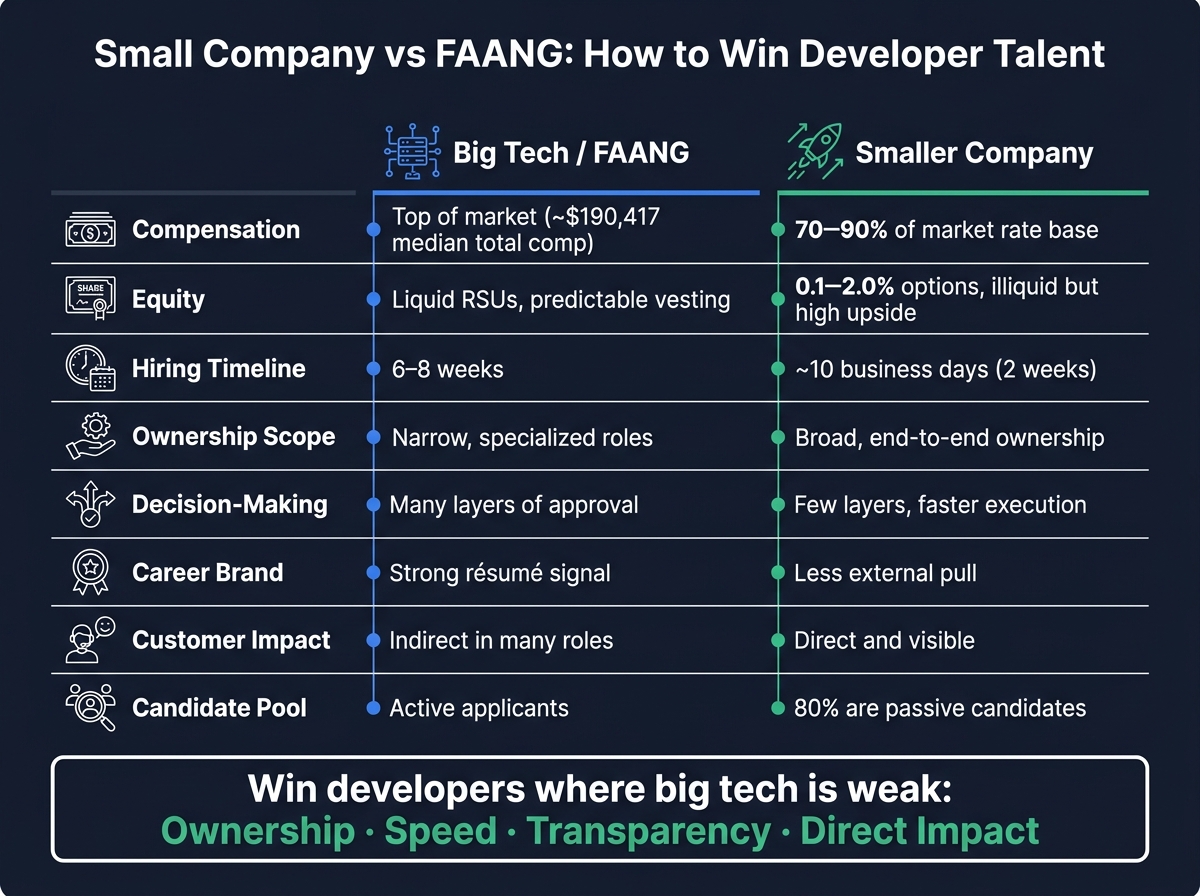
Quick Comparison
| Area | Big Tech | Smaller Company |
|---|---|---|
| Pay | Top of market | Often lower cash comp |
| Brand on résumé | Strong | Usually less pull |
| Ownership | Often narrower | Often broader |
| Decision-making | More layers | Fewer layers |
| Hiring timeline | Often 6–8 weeks | Can be about 2 weeks |
| Customer impact | Less direct in many roles | More direct in many roles |
| Equity | RSUs, more predictable | Options, more risk |
If I were hiring against FAANG, I would not sell “startup culture” or vague upside. Instead, you should align job offers with developer goals to stand out. I’d show the job as it is, explain the money as it is, and tell the truth in the JD to make it easy for the right developer to say yes.
Where big tech wins and where it loses
The FAANG advantage: pay, brand, and career credibility
Big tech pay is tough to beat. For most developers, it feels safer than startup equity. Cash is clear. Equity can feel like a lottery ticket.
And pay isn't the whole story. A name like Google or Amazon still carries weight in the U.S. job market. It signals pedigree, experience, and hiring selectivity. That kind of brand credit tends to follow developers into whatever they do next.
That’s where FAANG starts ahead. If you’re hiring against that, your pitch can’t be generic. You have to get much more specific.
Where big tech loses: bureaucracy, slower promotion cycles, and limited ownership
The same scale that makes big tech appealing also creates drag. More process. Less ownership. Slower promotion cycles. More room for burnout.
Developers who leave big tech usually aren’t chasing salary alone. They’re often looking for more scope, more speed, and a stronger signal that their work matters.
Big tech wins on pay and brand. Smaller companies tend to win on ownership, speed, and direct customer impact.
The developers most likely to leave big tech are usually the ones who feel boxed in, not the ones who are simply tired of working hard. That’s the opening for non-FAANG employers. Your hiring pitch starts there: not with higher pay, but with better ownership, faster learning, and clearer impact to scale your engineering team.
Build a value proposition developers will actually believe
Compete on ownership, learning speed, and customer impact
Make the tradeoff concrete. Spell out what they’ll own, how fast they’ll learn, and how closely their work ties to customers.
At a startup, a senior engineer may own a feature end-to-end, from design through customer feedback. In big tech, that scope is often narrower and more specialized. That’s a plain, meaningful difference. Say it directly.
Use those gaps in both the role description and the recruiter message.
A title at a 40-person startup does not always carry the same outside weight as the same title at a much larger company. Candidates already know that. It’s better to acknowledge it than try to sell around it.
How to present compensation honestly when you cannot match FAANG
Lead with total value, not just base salary. Show the full picture together: base, equity, and career path.
The median total comp for a U.S. software engineer in 2026 is about $190,417, with packages often split 60–70% base, 20–30% equity, and 10–15% bonus . You may not be able to reach the top end of that range. But you can make the equity feel real, and that starts with specifics.
Show the tradeoff in plain English.
| Component | Startup (Seed–Series C) | Big Tech / FAANG |
|---|---|---|
| Base Salary | 70–90% of market rate | Top of market |
| Equity | 0.1–2.0%, illiquid options | Liquid RSUs, predictable schedule |
| Bonus | Milestone-based | 10–20% of base |
| Perks | Autonomy, title upgrades | Comprehensive benefits |
Share the 409A valuation, strike price, vesting schedule, dilution risk, and refresh policy . If you can’t walk through those numbers in simple terms, candidates may assume the equity is not worth much . When they compare offers, push them to look at total comp - base plus expected bonus plus a conservative equity estimate - instead of base salary alone .
Frame equity as long-term upside, not as a stand-in for cash.
Use transparency as a trust signal
Developers leaving big tech have usually heard more than enough grand mission talk. When other companies are selling the dream, candor stands out.
Trust comes from specifics, not hype. Be upfront early about the things candidates will learn anyway:
- current runway
- funding stage
- on-call rotation
- expected work hours
- where the codebase has real technical debt
So instead of saying the stack is modern, say the API layer has technical debt and needs refactoring. Instead of hinting at huge equity upside, share the actual 409A valuation, strike price, vesting schedule, and refresh policy .
Big tech engineers spot fuzzy promises fast. Specific, honest detail - even when it includes risk - shows respect for their judgment. That tends to build more trust than any mission statement.
That matters because candidates will compare your offer with hiring loops that may already take weeks elsewhere. Once the offer feels credible, speed becomes the next edge.
Run a hiring process that beats big tech on speed and relevance
Go from first contact to offer in about two weeks
FAANG interview loops can stretch to 6–8 weeks. Aim to close in about 10 business days. For smaller companies, that pace matters a lot. If you can't match FAANG on pay, reducing time to hire is often the clearest edge.
Keep the process tight:
- a recruiter screen
- one practical technical assessment tied to the actual work
- a final conversation with the hiring team
Add one stage that checks clear technical communication. That matters more than people sometimes think, because it often maps closely to how well someone will work with a startup team. For critical hires, a 1–2 week paid trial can help you see how the person handles ambiguity and gets work done. You can also use trained external interviewers for the technical stage to keep things moving without adding more load to internal engineers .
Speed gets attention. Specificity is what makes that speed work.
Describe the engineering work in concrete terms, not hype
Fast hiring falls flat if the role sounds vague. Be plain about the stack, the system boundary, the ownership scope, and the main constraint.
That kind of detail does two things at once. First, it shows the role is real. Second, it helps the candidate picture the job: what they'll build, what they'll own, and what friction they'll deal with day to day. That's often what they're trying to judge anyway, especially if they care about ownership and impact.
Shape outreach and interviews around what the developer wants next
Once the role is defined clearly, shape the message around the candidate's next move. Generic outreach usually gets ignored. A note that points to a specific GitHub repository or Stack Overflow answer shows real interest . Outreach from a hiring manager or senior engineer also tends to land better, since developers often trust peers more .
Center the conversation on what the developer wants next. That could mean more ownership, faster growth, or better balance. When each touchpoint reflects those priorities, the process feels personal instead of mass-sent.
Find developers who are ready to leave big tech and build a repeatable process
Signs a developer may be ready to leave big tech
Once your pitch is clear, the next step is finding developers whose public behavior hints that a move may be on their mind.
Not every FAANG engineer wants out. But some are closer to leaving than they look. The hard part is that 80% of developers are passive candidates who rarely update LinkedIn or reply to cold outreach . So the signal usually isn’t a job application. It’s something quieter.
Pay attention to developers who engage with ideas beyond their current role. Maybe they’re reading about a different stack, commenting on problems outside their team, or spending time on topics that line up more with where they want to go than where they are now. That gap matters.
When you reach out, be specific. Mention a recent public signal tied to their work . A generic note gets ignored. A message that shows you understand what they do has a much better shot.
How daily.dev Recruiter helps you find developers open to new roles
These candidates are hard to spot from a resume alone.
A resume shows where someone has been. It doesn’t show what they care about right now.
daily.dev Recruiter sits on top of daily.dev, a professional network where developers spend time each day reading, learning, and engaging with technical content. That gives recruiters context on what a candidate is learning now, which a resume can’t provide . The platform surfaces developers based on recent technical activity and signs they may be open to a move, so you can reach people whose interests already line up with what you’re building.
| Feature | daily.dev Recruiter Benefit |
|---|---|
| Sourcing Signal | Recent technical activity and technologies they follow |
| Candidate Type | Passive talent and actively curious learners |
| Introduction Style | Mutual-interest introductions |
| Transparency | Upfront compensation and technical challenge details |
| Efficiency | Developer hiring platform and ATS integration and less admin work |
Every introduction starts with mutual interest. That helps keep the conversation about fit, not pure outreach volume.
Conclusion: win developers by competing where big tech is weak
Winning developers from big tech often comes down to timing and fit.
FAQs
How can a startup compete with FAANG for developers?
Startups need to lean into what big tech often can’t offer: impact, autonomy, ownership, and faster growth.
Be upfront about your stage, runway, and technical challenges. That kind of honesty sets the tone early. Then move fast - ideally in less than two weeks.
If you can’t match base salary, shift the conversation. Focus on meaningful equity, bonuses, and the chance to build and own work that matters from day one.
What should I share upfront with candidates?
Build trust from the very first interaction by being transparent. Share the tech stack, salary range, and work model up front so candidates can tell, fast, whether the role fits.
Then go a step further. Explain the role’s main challenges in the first 6 to 12 months, why the company and the role matter, and how compensation works, including equity mechanics. If there are limits, tradeoffs, or technical debt, say so plainly. That kind of honesty shows respect and helps bring in candidates who are aligned with what the job actually is.
How do I know a big tech engineer is open to leaving?
A big tech engineer may be open to leaving if they respond to clear, role-specific outreach, engage with content tied to your startup’s challenges, or bring up concerns about ownership, slow promotion, bureaucracy, or layoff anxiety.
During the hiring process, have a fast, honest conversation to confirm fit and prevent surprises later. Pay close attention to any hesitation around total value - equity mechanics, refresh, strike, or bonus - or around broader alignment on what matters to them.