

If I had to sum it up in one line: developers reply when recruiters are clear, specific, and respectful of their time.
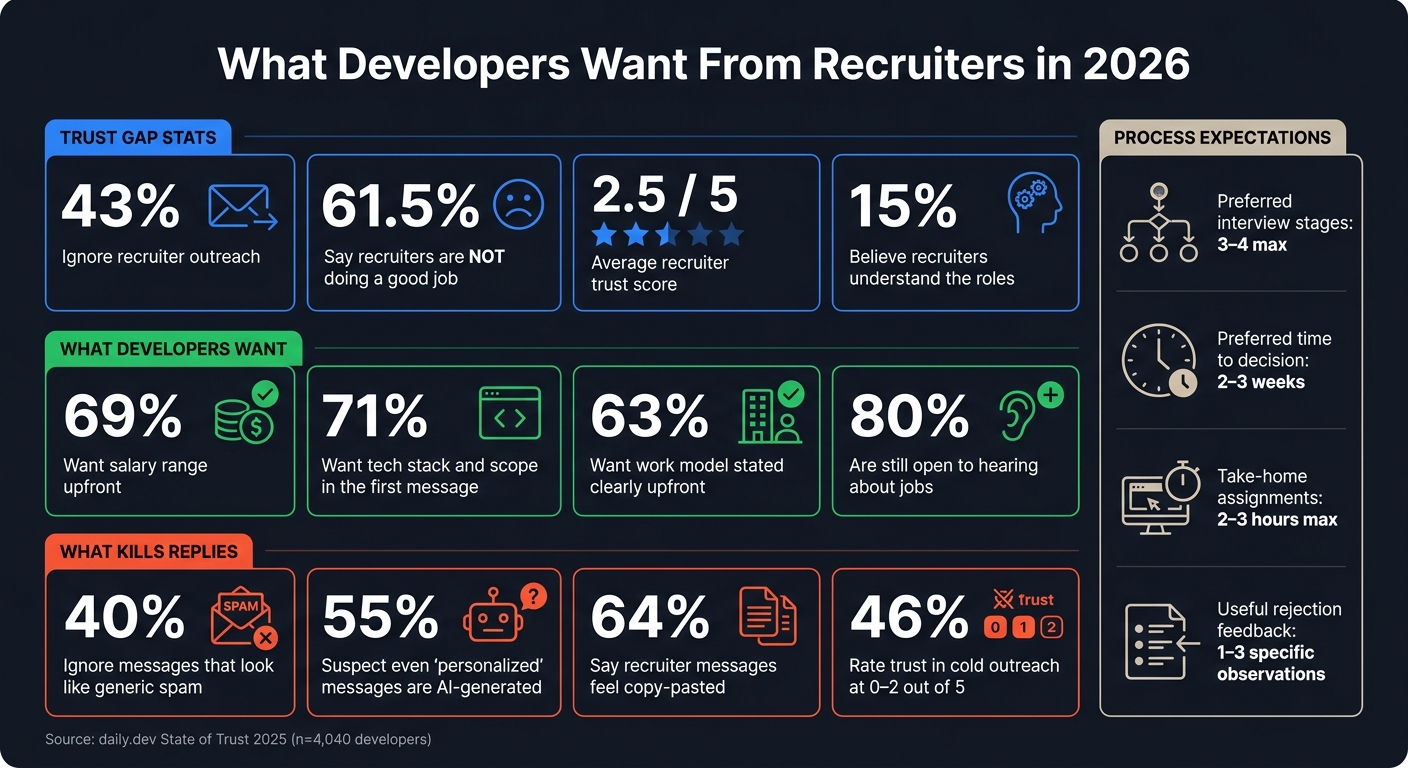
In 2026, the problem is not just inbox volume. It’s that 43% of developers ignore recruiter outreach, 69% want salary upfront, and 55% suspect even “personalized” messages were written by AI. At the same time, 80% are still open to hearing about jobs. So the door is not closed. But the bar is higher.
If I were boiling this article down for a busy reader, I’d say this:
- Lead with facts: salary, level, location, remote rules, and tech stack
- Show role fit: prove you understand the job, not just the title
- Reference actual work: mention a repo, talk, post, or pull request - not just a profile
- Keep hiring tight: most developers want 3–4 interview stages and a decision in 2–3 weeks
- Make the job match the pitch: no surprise scope changes, no hidden onsite rules, no shrinking pay band
- Give feedback: even 1–3 specific notes after rejection shows respect
- Let developers control contact: opt-in outreach works better because it starts with consent
Quick Comparison
| What developers want | What turns them off |
|---|---|
| Salary range upfront | “Competitive compensation” |
| Clear scope and level | Vague titles and fuzzy ownership |
| Exact remote/location rules | “Flexible” with no details |
| Proof you know their work | Copy-paste flattery |
| Short, clear interview process | Long loops and slow updates |
| Honest job details | Role changes mid-process |
| Useful feedback | Silent rejection |
| Contact on their terms | Cold outreach with no context |
This article makes one point from start to finish: developer recruiting works better when the process feels honest, clear, and under the candidate’s control.
1. The trust gap: what frustrates developers most
That gap starts before a recruiter gets the first reply.
What trust means in developer recruiting
For developers, trust comes down to two things: getting the role details right and doing what you said you’d do. It’s not mostly about sounding warm or polished. It’s about whether the first message feels accurate.
If that opening note is vague, many developers stop reading. Simple as that. So the first message has to do more than be polite. It has to show that the recruiter knows what they’re talking about.
In daily.dev's survey of 4,040 developers, 61.5% said recruiters are not doing a good job, and the average recruiter trust score was 2.5 out of 5. On top of that, only 15% of developers believe recruiters fully understand the roles they're hiring for. So most developers read recruiter outreach with skepticism already baked in.
### What’s broken about developer hiring
A lot of messages fail for plain, obvious reasons. 40% of developers ignore messages because they look like generic spam, 26% ignore them because the role is irrelevant to their skills, and 19% skip the message if salary is missing. When a message lacks context, it usually gets passed over.
Developers also put more trust in other channels than in cold outreach. Personal referrals from friends or colleagues rank highest at 63%, followed by developer communities at 40% and recruiters they already know at 25%. Cold outreach from an unknown recruiter comes in last.
Here’s where the disconnect shows up most often:
| Recruiter assumption | Developer reality | Data source |
|---|---|---|
| A friendly message is enough. | Generic outreach feels like spam, and 64% say recruiter messages feel copy-pasted. | daily.dev State of Trust |
| Salary can come later. | 69% want salary upfront, and 19% ignore messages without it. | daily.dev State of Trust |
| LinkedIn shows actual skills. | Only 14% say LinkedIn best reflects their abilities. | daily.dev State of Trust |
| More outreach means more responses. | 43% of developers ignore recruiter messages. | daily.dev State of Trust |
| Name-based personalization is enough. | 55% suspect even personalized messages are AI-generated. | daily.dev State of Trust |
Before developers reply, they’re usually scanning for three things: salary, role fit, and proof that the recruiter understands their work. If those pieces are missing, the message often dies on the spot. If they’re there, the gap starts to shrink.
2. What developers want to see before they reply
The first lines decide whether a developer keeps reading. If the basics aren't there, the message gets ignored. So the opening message has to show the role is real, specific, and worth a click.
Lead with salary, level, location, and remote policy
Start with the details people care about most: salary, level, location, tech stack, and work model. 71% want the tech stack and scope in the first message, and 63% want the work model stated clearly upfront. That means sharing a real salary range, the seniority level, where the role sits, and what "remote" actually means, including time zone expectations.
"Location flexible" and "we support hybrid work" don't say much. "Remote within the U.S.; core hours 10 a.m.–4 p.m. PT" does.
| Element | Low-transparency example | High-transparency example |
|---|---|---|
| Salary | "Competitive compensation package" | "Base: $160,000–$190,000, plus bonus and RSUs." |
| Level | "Software Engineer role" | "Senior Backend Engineer (L5 equivalent)" |
| Location | "Location flexible" | "Primary office: Seattle, WA. Remote in the U.S. allowed; relocation support if you prefer onsite." |
| Remote policy | "We support hybrid and remote work" | "Remote within the U.S.; core hours 10 a.m.–4 p.m. PT" |
| Tech stack | "Modern technologies including cloud" | "Go, PostgreSQL, Kubernetes on AWS, gRPC; services handle 1B requests/day." |
Show you understand the role, not just the keywords
Only 15% of developers believe recruiters actually understand the roles they're hiring for. That doubt didn't come out of nowhere. A lot of outreach gets the title right but misses the scope, level, or scale of the work.
A good fix is simple: spend 30–60 minutes with the engineering manager and a senior engineer before outreach starts. Use that time to confirm the actual stack, the must-have skills, and what the hire will own. Then turn that into a short 3–5 sentence role summary and get manager approval before anyone sends a message. That kind of detail shows you've done your homework.
Reference their actual work, not their profile
Generic praise like "your LinkedIn profile looked impressive" doesn't work. 55% of developers already suspect that "personalized" messages are AI-generated, so surface-level compliments can hurt trust instead of building it.
What does work is simple: mention something real. A GitHub repo. A blog post. An open-source contribution. A conference talk. Then explain why it matters for this role.
"We saw your
fast-cachelibrary - particularly the PR optimizing LRU eviction under high concurrency - matches the performance problems our team faces scaling our caching tier."
That one sentence says more than three paragraphs of empty praise. For a deeper breakdown of why generic outreach gets ignored, see passive developers explain why generic outreach gets ignored.
Once they reply, the process itself has to earn their trust.
3. What developers expect during the hiring process
Once a developer replies, the hiring process has to prove that trust was earned. A reply is only the start. What happens next - interviews, communication, and whether the role matches what was promised - determines if a developer stays in the process.
Keep the process short, clear, and predictable
Developers usually expect no more than 3–4 interview stages and a decision within about 2–3 weeks of the first interview. When a process drags into six or more interviews across multiple months, it tends to signal disorganization or fear of making a call. Senior engineers, in particular, are more likely to opt out.
Length matters, but predictability matters just as much. In the first scheduling email, send a short overview of the process: the stages, the format, and when a decision is likely. That one small step sets the tone. Long gaps with no update do the opposite. Even a brief note saying feedback is still being gathered - plus the date of the next update - goes a long way.
Keep take-home assignments to 2–3 hours max and tie them to the work the person would actually do. Abstract puzzles and long unpaid projects tend to frustrate people. A remote pair-programming session or a short code review is often a better signal than a full-day interview loop.
| Process element | High-friction | Developer-friendly |
|---|---|---|
| Interview stages | Six or more interviews over multiple months | 3–4 structured conversations over 2–3 weeks |
| Post-stage communication | No update for weeks | Reply within 2–3 business days after each stage |
| Take-home assessment | 8–10 hours of unpaid work | Scoped exercise 2–3 hours max, tied to real tasks |
| Evaluation criteria | Shifts mid-process without notice | Shared with interviewers upfront and kept consistent |
Make the job description match the real role
Developers expect the transparent developer job description to line up with the actual role. That means the scope, team setup, tech stack, work model, and compensation should be clear from the start.
Few things damage trust faster than a role that changes once interviews begin. A hands-on engineering job that turns out to be mostly ops or people management. A remote-first role that quietly comes with regular office visits. A salary range that shrinks after several rounds. Any of those can cause a developer to step away.
The fix is simple: set the role scope, compensation band, and work model before sourcing starts, and keep them fixed unless something has honestly changed. If a team reorg or budget change forces an update mid-process, say it early. Then give the developer a clear, pressure-free chance to bow out.
| Element | Marketing-heavy / vague | Honest / context-driven |
|---|---|---|
| Role scope | Wear many hats in a fast-paced environment | Individual-contributor role with clear ownership |
| Team context | Join our growing engineering team | Team size, partners, and reporting lines are stated upfront |
| Tech stack | Modern cloud-based technologies | Primary languages, frameworks, infrastructure, and dependencies are listed |
| Remote policy | We support flexible work arrangements | Remote, hybrid, or on-site expectations are explicit |
| Compensation | Competitive salary based on experience | Salary range is shared upfront |
Give useful feedback after rejection
Most developers who reach the interview stage never get a clear reason for rejection. But feedback is part of respecting their time. It shouldn't be treated like an extra favor.
It also doesn't need to be long. 1–3 specific observations are enough. Keep the focus on fit, not on judging the person's overall skill. For example, say the team moved forward with someone who had production experience leading multi-team migrations at scale. If the developer could fit a later role, say that plainly and explain what would need to be different.
This is not hard to scale. If interviewers log 2–3 specific observations in the ATS right after each conversation, recruiters usually have enough detail to give a useful response. And for developers who reached the final round, a short phone call with direct feedback is often worth the extra effort.
That same respect for control is also why opt-in recruiting tends to work better. The next step is giving developers more say in when they want to engage.
4. Why opt-in recruiting fits how developers want to engage
The big shift here is control. Developers want to decide when they’re open to hearing from recruiters.
Fatigue from uninvited, high-volume outreach is well documented. According to the daily.dev State of Trust 2025 report, 46% of developers rate their trust in cold recruiter outreach at 0–2 out of 5, and 64% say recruiter messages feel copy-pasted. So even a well-written message starts at a low-trust baseline if it shows up without permission.
Developers respond better when they can opt in on their own terms. That changes what a good recruiting channel looks like.
Opt-in recruiting gives developers consent, relevance, and control. They want to choose when they’re open to new roles, not be treated like they’re always on the market.
| Dimension | Traditional outbound sourcing | Opt-in recruiting |
|---|---|---|
| Who initiates contact | Recruiter, without prior permission | Developer chooses when to be visible |
| Message volume | High volume, lower relevance | Lower volume, higher relevance |
| Context about availability | Rarely known | Developer signals openness and preferences |
| Developer experience | Often feels interruptive | Feels expected and respectful |
| Likely outcome | Message fatigue, low response rates | meaningful engagement and higher response rates |
That’s the logic behind opt-in recruiting.
daily.dev Recruiter uses warm, double opt-in introductions, so recruiters reach out to developers only after they signal interest. The platform surfaces developers inside a community where they’re already active - reading, learning, and engaging with technical content every day. That gives recruiters access to current skills and interests, not a profile last updated during a past job search. The result is fewer interruptions and better-fit conversations.
Conclusion: the best way to recruit developers in 2026
The main takeaway is simple: developers reply when they feel respected. Throughout this article, the same pattern shows up again and again. Developers react to clarity, credibility, and control.
The formula itself isn’t complicated: trust, transparency, and respect for their time. Recruiters get more replies when they lead with salary, explain the role clearly, keep the process short, and give useful feedback. The bar is clear. What makes the difference is how well you follow through.
Opt-in recruiting puts those same ideas into practice by reaching developers only when they choose to engage. daily.dev Recruiter is built around that approach, with warm introductions to developers who have already signaled that they’re open. That leads to more relevant conversations with developers who are already willing to hear from recruiters. When developers choose to engage, recruiters tend to get better conversations and better fits.
Build each part of your outreach and hiring process around the developer experience. That’s how you earn more replies and make better hires.
FAQs
Why do developers ignore recruiter messages?
Developers often ignore recruiter messages for a simple reason: the outreach feels generic, off-target, and not worth the time.
daily.dev data makes that pretty clear. 40% dismiss these messages as generic, and 55% suspect “personalized” outreach is AI-generated.
Missing details make things worse. 19% ignore messages that don’t include salary information. On top of that, weak technical credibility and vague job details make the trust gap even bigger.
What should recruiters include in the first message?
Hi [First Name] - I came across your work on [specific project, repo, article, or feature] and liked how you handled [specific detail]. It stood out because it shows strong judgment, not just solid coding.
I’m reaching out about a [Job Title] role at [Company Name].
Here are the key details up front:
- Salary: $[min]–$[max] USD
- Tech stack: [tech stack]
- Scope: [brief role scope]
- Work model: [remote / hybrid / onsite], based in [location if needed]
- Company: [1–2 concrete details about product, stage, team, or mission]
If this looks like it could be a fit, the next step is a short intro call or I can send over the full job brief first - whichever you prefer.
If now isn’t a fit, no problem at all - just reply “pass” and I won’t follow up.
How can recruiters build trust with developers?
Recruiters build trust with developers through clear communication, relevance, and respect for their time.
In the first message, share the salary range, tech stack, and remote work policy. It also helps to personalize your outreach by pointing to the developer’s actual work, not just dropping a generic note into their inbox.
A few habits make a big difference:
- Use opt-in engagement instead of pushing for a call right away
- Set clear interview timelines
- Avoid ghosting
- Provide constructive feedback if they’re rejected
That kind of outreach feels human. And in a market where developers get hit with generic messages all the time, that matters.
.png)


