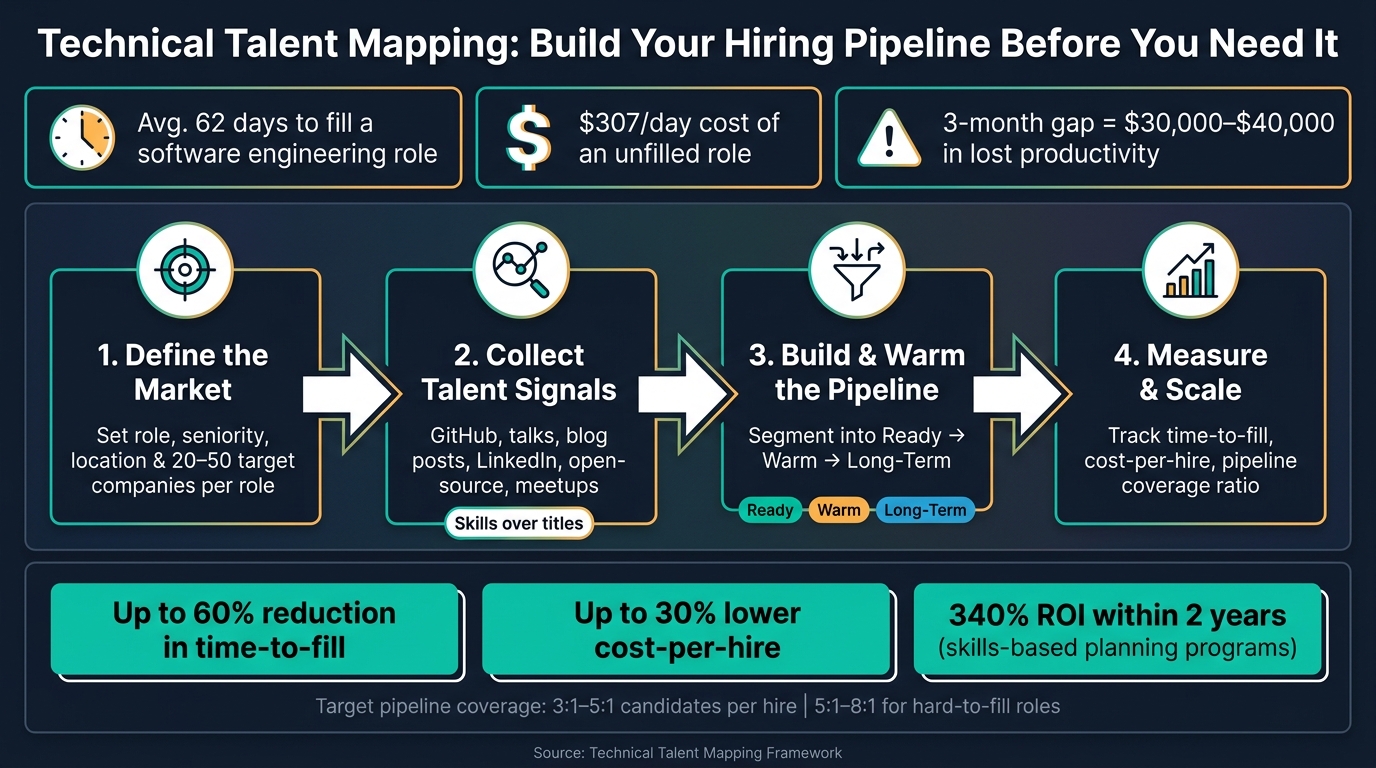
If you wait until a req opens, you're already late. In the U.S., software engineering roles take about 62 days to fill, and many senior or niche roles take 60–90+ days. That delay can cost $307 per day on an $80,000 salary, with a 3-month gap adding up to $30,000–$40,000.
Here’s the short version: I’d build the pipeline before hiring starts. That means I would:
- define the exact talent market first
- map developers by skills, not titles
- use public, job-related signals only
- sort people into Ready, Warm, and Long-Term
- run steady outreach based on timing and signal changes
- track results like time-to-fill, cost-per-hire, and pipeline coverage
This article is about using talent mapping as market research, not tracking people. The goal is simple: know where the right engineers are, what they work on, and who may be open to a move, so hiring is less rushed and less expensive.
A few points stood out to me:
- Warm pipelines can cut time-to-fill by up to 60%
- They can lower cost-per-hire by about 30%
- A healthy pipeline often targets a 3:1 to 5:1 candidate-to-hire ratio, and 5:1 to 8:1 for harder roles
- Strong signals often come from GitHub, talks, blog posts, LinkedIn, meetups, and open-source work
Here’s the flow in plain English:
| Step | What I’d do | End result |
|---|---|---|
| 1 | Set role, level, location, and target companies | A clear market to map |
| 2 | Gather public skill signals and log them in one place | A usable talent list |
| 3 | Segment, contact, and maintain the pipeline | Warmer candidate relationships |
| 4 | Measure hiring speed, cost, and pipeline health | Clear proof the process works |
What I like about this approach is that it moves hiring from a last-minute scramble to a repeatable system. Instead of starting from zero every time, you keep a live map of people who fit the work and the stack.
Step 1: Define the market you want to map
Set the market before you gather profiles. If you skip that step, a talent map turns into a plain name list that won’t help much with a 12–18 month hiring plan. The scope you set becomes the filter for every company, skill, and location choice that comes next.
Choose roles, seniority levels, and hiring locations first
Start with future hiring demand, not just today’s open reqs. Focus on role archetypes instead of titles: backend, platform/SRE, data/ML, and engineering management.
For each archetype, spell out the seniority bands you want to track. Senior and staff-level roles often take 60–90+ days to fill, with AI/ML roles at around 89 days and senior SRE roles at about 75 days. Those are the roles where a warm pipeline can make the biggest difference, so they should usually come first.
Location matters too. Decide early whether the roles are fully remote within the U.S., hub-based, or tied to specific metros. If day-to-day teamwork depends on overlap, define the time-zone window you need. That keeps the map centered on people your company can actually hire, not just people who look good in a spreadsheet.
Build a target company and engineering team list
Look at the places where your future hires already work. Build a list of 20–50 target companies per role. It helps to group them into a few buckets:
- direct competitors
- adjacent product companies
- specialized consultancies or agencies with engineering talent that can shift across problems
Then go past the company name. For each organization, note team-level patterns: how teams are set up, which product areas they own, and how mature their engineering practices and stack are. That detail shows which companies are producing the kind of engineers you need, not just which ones happen to employ developers.
Map by skills, not just by job titles
Once company and location filters are in place, score people by what they can do, not by the label on their profile.
Titles are messy across companies. One company’s Software Engineer II might line up with another company’s Senior Developer. Looking at skills and technologies cuts through that noise and centers the map on actual capability.
Build a simple skills taxonomy around the clusters that matter for each role: programming languages, frameworks, cloud platforms, data tooling, security practices, and reliability disciplines. Define what baseline and advanced proficiency look like inside each cluster. That taxonomy becomes the scoring model for the candidate pool you build next. This approach is particularly effective for identifying passive talent who may not be actively looking but possess the exact technical capabilities required.
Once the market is defined, collect public signals from the people and teams inside it.
Step 2: Collect and organize developer talent signals
Now that your market is defined, start gathering public signals that show what a developer actually builds, ships, and shares. The aim is simple: turn those signals into a developer talent pipeline you can use. As you collect data, sort each signal using the role, seniority, location, and skill filters from Step 1.
Use public sources to assess technical depth
The clearest signals come from public work: GitHub profiles, open-source contributions, conference speaker pages, technical blog posts, meetup agendas, podcast interviews, community profiles, and public portfolio sites. LinkedIn is still useful for role history, skills, and location. But if you want a better read on technical depth, public work samples usually tell you more. Put more weight on signals that are recent and relevant, not just high in volume.
When you review a GitHub profile, focus on recency, consistency, and signs of original or meaningful contribution. Recent commits, original repositories, and work in relevant open-source projects usually say more than a long trail of old activity. Contribution graphs can help, but they shouldn't be your only signal. Repository quality matters too. A clear README and solid documentation can reveal a lot about how someone communicates and explains technical choices.
Conference speaker pages and technical blog posts can also help you spot specialists with a clear point of view. If a developer has spoken about the stack you're hiring for, writes about it, and contributes to a related project, those signals line up in a useful way. Two or three recent signals that point in the same direction are often more helpful than a long list of stale ones. Research on GitHub hiring signals found that profile cues were viewed as more reliable indicators of technical ability and motivation than resume information alone.
Build a skills matrix and candidate segmentation model
Use the skills taxonomy from Step 1 as your scoring frame. Once you've gathered signals, put them into a structure you can work with day to day. A simple spreadsheet or CRM table is enough if you use standard columns and controlled vocabulary. For each developer, capture the following:
- role family
- seniority band
- primary and secondary technologies
- domain experience
- location
- move signal strength
- public signal sources with links
- date of last validation
- priority level
It's also smart to separate claimed skills from verified signals. That way, you can quickly see what's self-reported and what's backed by public evidence.
Priority level is where this starts to turn into action. After the signals are logged, segment people based on how current and complete those signals are:
| Segment | Criteria | Next Action |
|---|---|---|
| Ready | Two or more recent, independent signals; strong fit on the core stack; evidence of active interest | Prioritize for immediate outreach by understanding what developers want |
| Warm | Good fit, but signals are less recent or less complete | Nurture with relevant content and revisit regularly |
| Long-Term | Niche skills or high seniority, but no current move signals | Stay in touch through occasional community engagement |
These segments give you the base for outreach timing, cadence, and trigger-based follow-up in Step 3.
Step 3: Build and maintain a warm hiring pipeline
With your skills matrix and candidate segments in place, the next step is to turn that data into a working pipeline. The aim isn't just to make contact. It's to build a pipeline you can actually use when hiring demand jumps. Using a developer hiring timeline planner helps ensure your pipeline moves at the right pace.
Use the Ready, Warm, and Long-Term segments from Step 2 to shape cadence and ownership.
Set CRM stages, ownership, and outreach cadence
A developer talent pipeline needs clear stages so candidates don't get stuck. Keep it simple:
- Identified → Researched → Contacted → Nurture → Shortlisted → Hired
Move a candidate to Researched after you confirm their current stack, employer, and one recent public signal. Move them from Contacted to Nurture only after a direct reply.
Ownership matters too. One recruiter should handle nurture and early relationship building. Another should step in once a candidate moves into active interview coordination. On every record, log the last touch date, owner, and channel.
Review warm candidates every month so relationships stay active without getting noisy. Cadence should match each segment:
- Ready candidates get outreach right away
- Warm candidates get monthly value-based touchpoints
- Long-Term candidates get quarterly newsletters or event invites
Once the process is set, the next job is feeding it with useful content and well-timed triggers.
Use content-driven outreach to keep the pipeline warm
Mapped candidates tend to respond best when outreach connects to what they already build and share in public. Content-driven outreach works better because it gives them something useful instead of sending yet another “just checking in” message.
That can mean engineering blog posts, architecture deep dives, conference talk recordings, open-source releases, or a look at how your team handles a technical problem they've written about in public. Personalize by craft, not private details. For example, mention a recent Kubernetes talk they gave and explain how your platform team handles a similar scaling challenge.
Different formats fit different moments in the relationship. Use three:
- newsletter updates for broad awareness
- targeted technical content for segmented groups
- 1:1 check-ins for top-priority candidates
Trigger outreach when move signals appear
Routine cadence keeps the relationship alive. But move signals are often what turn a warm conversation into an actual hiring opening.
These signals can include a profile update, a new public talk, renewed open-source activity, or a location change.
When a mapped candidate shows a new public signal, reach out fast and mention it directly. That's what separates a generic check-in from a message that feels timely and tied to something real. If a candidate doesn't reply after two thoughtful touches, pause outreach for 60–90 days unless another signal appears. That line helps keep outreach credible.
The next question is which signals most often lead to replies and interviews. Once outreach is in motion, track which signals and touchpoints turn mapped candidates into conversations.
Step 4: Measure ROI and scale the process with daily.dev Recruiter
Track the hiring outcomes that show talent mapping is working
Now that your pipeline is up and running, the job shifts from doing outreach to checking results. The goal isn't to count activity. It's to see whether talent mapping is leading to faster hires, better hires, and lower hiring costs by balancing active vs passive developer recruitment.
Track six KPIs across speed, hire quality, pipeline health, and spend.
| KPI | Definition | Why it matters |
|---|---|---|
| Time-to-fill | Calendar days from requisition approval to offer acceptance | Decrease 30–50% for mapped technical roles within 6–12 months |
| Time-to-hire | Days from candidate entering your CRM to offer acceptance | Drops as pre-mapped candidates move faster through interviews |
| Pipeline coverage ratio | Qualified candidates in pipeline ÷ planned hires. Target 3:1–5:1 for most technical roles; 5:1–8:1 for hard-to-fill roles | Stays steady across quarters without last-minute scrambles |
| Quality of hire | (New hires meeting or exceeding expectations at 90 days ÷ total new hires) × 100% | Improve 10–20 percentage points as mapped candidates align better on skills and culture |
| Hiring manager satisfaction | Average score (1–5) collected after each hire | Rises as managers see shorter searches and stronger candidate slates |
| Cost-per-hire (USD) | Total recruiting spend ÷ number of hires in the period | Lower through fewer agency fees and less last-minute sourcing |
One skills-based workforce planning program cut time-to-fill for technical roles from 127 days to 47 days. That's a 63% reduction. It also calculated a 340% ROI within two years .
If your coverage ratio and time-to-fill aren't moving, that's a sign your upstream signals need work. In plain English: your map may look fine on paper, but it isn't giving you enough early insight. These metrics show where your talent map is holding up and where you need fresher inputs.
Use daily.dev Recruiter for passive talent mapping
Once you know which signals matter, the next move is simple: use a source that shows those signals earlier.
daily.dev Recruiter helps you connect with developers through warm, double opt-in introductions on a network built for software engineers. That matters because reading behavior and topic interest can help confirm your skills segments and spot move signals before a person updates a resume or replies to outreach.
Here's what that looks like in practice: a developer whose feed is full of Rust performance tuning and WebAssembly content likely fits a Rust systems engineer segment. That's the kind of clue that helps you adjust your skills-based map in real time instead of waiting until a role opens and everyone is suddenly in a rush.
The warm, double opt-in setup also keeps outreach more relevant, which can help lift reply rates.
Conclusion: Build the hiring pipeline before you need it
Technical talent mapping works best when you treat it as a repeatable process, not a one-off task. Teams that work this way are less likely to fall into scramble hiring when demand jumps. That's how you build the hiring pipeline before you need it.
FAQs
How is technical talent mapping different from sourcing?
Sourcing is a hands-on effort to find and engage candidates for an open role or one that’s likely to open soon.
Technical talent mapping is a more forward-looking process. It helps teams understand where engineering talent sits across the market before a role even opens. That way, hiring teams can get ahead of future needs and cut the time and cost that often come with reactive hiring.
What public signals are most useful for mapping developers?
Focus on public behavior that points to hands-on technical skill and a possible willingness to try something new.
- GitHub: steady contribution history, solid pull request write-ups, and pinned repos with clear documentation
- Stack Overflow: reputation and badges linked to specific tools, languages, or platforms
- Move signals: profile updates, new certifications, more forum activity, and visible learning in newer frameworks
How often should I update a proactive hiring pipeline?
Use a steady update rhythm to keep your hiring pipeline working the way it should.
- Update developer personas quarterly with new data and input from your engineering team.
- Review metrics like pipeline velocity and quality of hire monthly.
- Adjust recruiting criteria quarterly.
- Nurture candidates every 2 to 4 weeks.
- Re-evaluate your process and systems every 6 to 9 months.
.png)