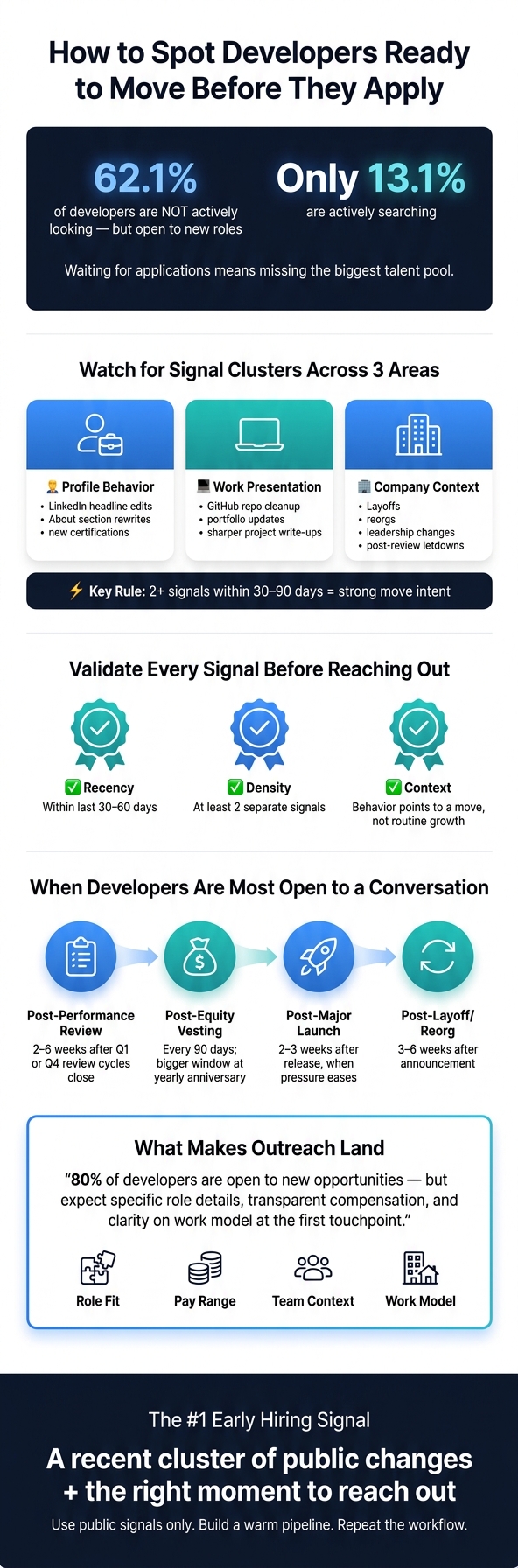
Most developers who switch jobs haven’t applied yet. In fact, 62.1% are not actively looking but are still open to a new role, while only 13.1% are actively looking. That means if I wait for applications alone, I miss the biggest group.
Here’s the short version: I look for small public changes that happen close together, not one-off updates. The pattern usually shows up across three areas:
- Profile behavior: headline edits, About section rewrites, new certifications
- Work presentation: cleaned-up GitHub repos, updated portfolio, clearer project write-ups
- Company context: layoffs, reorgs, leadership changes, post-review letdowns
What matters most is timing and signal clusters. A single change means little. But two or more signals within 30 to 90 days can point to someone getting ready for a move.
I also keep outreach simple and careful:
- Use public signals only
- Check for recency, density, and context
- Reach out at common decision points, like 2 to 6 weeks after performance reviews, after equity vesting dates, or 3 to 6 weeks after a reorg
- Lead with role fit, pay range, team context, and work model using a tech recruiting cheatsheet to ensure all key details are covered.
Quick view
| Area | What I watch for | What it may mean |
|---|---|---|
| Profile updates | LinkedIn headline or About edits, new certs | Person wants to be found |
| Work updates | GitHub cleanup, portfolio edits, project polish | Person is getting work ready for review |
| Company changes | Layoffs, reorgs, leadership shifts | Move risk may be higher |
| Timing | Post-review, post-vesting, post-launch | Person may be more open to talk |
If I had to sum it up in one line, it would be this: the best early hiring signal is a recent cluster of public changes, paired with the right moment to reach out.
The passive developer myth and the real sourcing problem
Why passive does not mean uninterested
Active vs passive developer recruitment is often misunderstood; “passive” is a bad label. Most developers aren’t out there actively job hunting, but plenty are open to the right role.
What tends to get their attention is simple: better pay, a clearer path to grow, or a tech stack they want to learn. If the message sounds generic, it feels like mass mail and usually gets ignored. That same gap shows up in many sourcing systems too. They track applications, but they don’t track intent.
Why standard sourcing misses early career move intent
That’s why standard sourcing often misses early career-move intent. ATS pipelines, job boards, and keyword searches usually surface people after they’ve already decided to make a move.
The core issue is static profiles. Many developers update LinkedIn or GitHub only after they switch jobs, not before. So a static profile can hide a live change in interest.
Intent-based sourcing looks for early behavioral signals, not just job titles and listed skills.
Signals that predict a developer career move
Don’t read too much into one small change. A conference appearance, a new skill, or a profile edit on its own doesn’t say much. What matters is a cluster of changes across different places within 30–90 days. That’s often where the first real clues show up, well before a developer ever submits an application.
Behavioral signals from public professional activity
Start with the signals developers choose to show in public. If a LinkedIn headline changes from "Senior Backend Engineer at Acme" to "Senior Backend Engineer | Go | Distributed Systems", that may look minor. It isn’t. It’s a deliberate shift toward a profile that’s easier for recruiters to find.
Now add a rewritten "About" section, a new AWS or Kubernetes certification, and more networking with people at other companies. At that point, you’re not looking at random activity anymore. You’re looking at a pattern.
A growing interest in content about interviewing, salary, or career ladders can also point to early-stage job market research, even if there’s no public sign of an active search yet.
Digital signals from developer work and community activity
Next, look at how recent work is presented. On GitHub, the key is curation, not raw volume. Move-related activity usually has a different feel than casual learning. You may see fewer projects, but they’re cleaner and easier to review. READMEs get updated with screenshots and deployment links. Project descriptions become sharper and easier for someone else to assess.
A refresh of a personal site can send the same message, especially if it adds a clear projects section with quantified impact. Activity in developer communities focused on jobs, pay, freelance work, or career changes can matter too, mainly when it lines up with the GitHub and profile updates above.
Organizational signals that raise move likelihood
Then look at company context. Layoffs, reorgs, acquisitions, and leadership changes often push engineers into passive job searches, including people who were fine staying put before. A slide in Glassdoor reviews that mentions no growth, constant reorgs, or burnout can be another sign that attrition risk is climbing.
On their own, these company-level signals tell you which employers deserve attention. They do not tell you which person is ready to move. That’s why the best read comes from combining company turbulence with individual action.
If a developer works at a company that just announced a reorg, and that same person has updated LinkedIn, cleaned up their portfolio, and become more active in job-focused developer communities, that mix is much more telling than any one signal by itself.
| Signal category | Example | Solo signal | Clustered signal |
|---|---|---|---|
| Behavioral | LinkedIn headline rewrite + new certification | Low | High |
| Digital | GitHub portfolio polish + personal site update | Low to medium | High |
| Organizational | Company layoff + leadership change | Medium as context | High when paired with individual signals |
The next step is validating which signals are real before outreach.
How to validate signals and time outreach without crossing the line
How to tell a real signal from noise before reaching out
Not every signal is worth acting on. Before you contact a developer who isn't yet an active candidate, put each signal through three simple checks: recency, density, and context.
- Recency: keep it within the last 30–60 days
- Density: look for at least two separate signals
- Context: make sure the behavior points to a likely move, not just normal career growth
| Signal Type | What It Suggests | How to Validate |
|---|---|---|
| LinkedIn profile update | Preparing to be found | Look for concurrent changes across multiple fields within a short window |
| Certification alone | Routine professional development | Cross-check with at least one other recent behavior-based signal |
| GitHub or portfolio updates | Polishing work for external review | Confirm the work aligns with skills commonly requested for the roles you hire |
| Increased activity in developer communities | Early-stage exploration of new roles or technologies | Cross-reference with profile updates or commit activity |
| Company layoff, reorg, or acquisition announcement | Elevated attrition risk at the team level | Verify whether the specific team or function is likely affected |
A static profile can tell you where someone has been. Recent behavior is more useful because it shows current intent instead of old history . That's the difference between guessing and reading the room.
Stick to public signals only in your outreach. Don't mention hidden behavior or anything that would make the person wonder how you found it. Once you see a real cluster of signals, timing is the next thing to get right.
When developers are most open to a conversation
Performance review cycles often wrap up in Q1, with another cycle in Q4 at some companies. Openness to new roles often climbs 2–6 weeks after reviews close, especially if a raise or promotion didn't happen. That's why late Q1 and early Q2 can be a strong window.
Equity vesting creates similar moments. If a developer is on a standard 4-year grant with quarterly vesting, they hit a natural decision point every three months, with a bigger one around the yearly anniversary. After a vesting milestone passes, the financial pull to stay drops, and interest in offers that reset equity can increase.
The same pattern shows up after a major release. In the 2–3 weeks after launch, pressure usually eases. People finally have room to think about what they want to build next.
Layoffs and big reorganizations need more care. In most cases, the better outreach window is 3–6 weeks after the announcement. Reach out too early and it can feel tone-deaf. Wait a bit, and your note is more likely to land as helpful instead of predatory.
How to keep outreach useful rather than off-putting
The simplest rule is also the one that keeps you out of trouble: only mention what the developer chose to make public.
A conference talk, an open source contribution, a blog post, or a portfolio project is fair game. The person put it out there on purpose.
What tends to backfire is calling out detailed behavioral tracking. For example, saying, "I saw you read several posts about interview prep last week" doesn't sound informed. It sounds like surveillance. Even if that data was technically accessible, it can still feel creepy. A good gut check is this: if the developer would be surprised that you know it, leave it out.
daily.dev research reports that around 80% of developers are open to new opportunities but expect specific role details, transparent compensation, and clarity on work model at the first touchpoint .
That number should shape the message. Lead with the why: why this role, why this person, and why now.
A note that connects a public talk or open source contribution to a real engineering problem your team is working on will usually land better than a vague "I came across your profile." Keep the close short and easy. Give them enough context to review on their own time, and make it simple to decline without friction.
Store these signals in your CRM so follow-up stays timely and steady. Then move them into a warm pipeline instead of treating each one like a one-shot lead.
Building a warm pipeline with intent data and daily.dev Recruiter
A simple intent-based workflow for pre-active candidates
Once you've validated the signal, move each developer into a nurture path you can run again and again. The goal isn't one lucky message. It's a workflow you can repeat.
A simple setup has five stages: monitor, score, segment, nurture, and revisit.
Start with something useful. That could be a salary benchmark, a short market update, or a guide to intent-based recruiting for technical roles. Hold off on the job pitch at first. Give the developer a reason to trust your judgment before you ask for their time.
Quarterly touchpoints work well here. Then, every 90 days, review engagement data like opens, clicks, and replies so you can tighten the message and decide who is worth a direct conversation .
Warm introductions beat cold outreach because the candidate already has context.
How daily.dev Recruiter surfaces developers open to new roles
That workflow falls apart if the signals are old. daily.dev Recruiter turns intent signals into a live candidate pool based on current behavior.
daily.dev Recruiter looks at what developers are doing now, not just what sits on a static profile.
The platform runs inside an opt-in developer community where engineers already spend time reading, following topics, and engaging with technical content each day. By analyzing on-platform behavior instead of off-site tracking, it can spot developers whose activity has shifted toward career-related content, like new frameworks, interview prep, or role research. It links work history, current reading, and technologies under active review to surface intent before a resume changes .
That matters for a simple reason: behavior-based matching can surface developers who are already looking into relevant technologies, even before they update a profile.
When a developer's engagement passes a meaningful threshold, daily.dev Recruiter connects them with matching roles through a warm introduction after mutual interest is confirmed. The developer sees a short role brief with the stack, team focus, compensation range in USD, and remote or on-site expectations, then decides whether to express interest. The recruiter then reviews the match before sending a warm introduction to both sides . Candidates matched by behavior are 3x more likely to pass initial screening .
It also syncs with ATS and CRM tools, so intent signals can flow into the systems teams already use .
Conclusion
The result is a pipeline built on intent instead of guesswork.
Most developers can be reached before they apply. The edge comes from spotting intent early, timing outreach well, and using public, opt-in signals. That's how teams build a warmer pipeline with less wasted outreach.
FAQs
Which signals matter most?
The strongest signals come from changes in behavior, not from job-seeking labels.
Look for a sudden jump in learning or reading activity, a sharper focus on certain skills, profile updates, and more activity in niche technical communities. Those are often the signs that someone is shifting gears.
For the best results, pair those signals with explicit intent, like opting into a private job introduction. That two-layer approach often works better than old-school sourcing.
How can I avoid creepy outreach?
Prioritize transparency and mutual consent. Don’t scrape personal data or blast out generic automated messages that make developers feel like entries in a spreadsheet.
Use platforms that support warm, double opt-in introductions, so developers can look over the role details before they choose to connect. If you reach out directly, mention relevant open-source work or projects, respect professional boundaries, and keep any follow-up polite.
How do I build a warm pipeline?
Build a warm pipeline by shifting from cold outreach to a relationship-first approach built on trust and shared interest.
Start by using double opt-in platforms and behavioral signals to spot developers who are open to hearing from you. Then log those interactions in your CRM or ATS so you can track interest over time instead of starting from scratch every time.
From there, keep your outreach relevant and low-pressure. A tailored follow-up feels a lot better than a random check-in, especially when it reflects what the candidate has already shown interest in. The goal isn't to push for an immediate reply. It's to stay on their radar in a way that feels respectful.
Treat candidates like long-term prospects, not one-time leads. That small mindset shift can change the tone of your entire pipeline.
.png)